Ms. Payette and Mr. Scheer: Science and religion can – and should – co-exist: Peter McKnight

The most balanced commentary I have seen on the GG controversy by McKnight, a former Templeton-Cambridge fellow in science and religion at the University of Cambridge:

My horoscope warned me that I’m likely to offend everyone today, so here goes: Governor-General Julie Payette is wrong. And so are her critics.

In a speech attacking anti-scientific sentiments in society, Ms. Payette riffed on astrology and climate change skeptics and, in the interest of complete self-immolation, tackled religious belief by saying: “We are still debating and still questioning whether life was a divine intervention or whether it was coming out of a natural process let alone, oh my goodness, a random process.”

As many critics have charged, Ms. Payette’s language was impolitic to say the least. Her incredulous “oh my goodness” suggests she’s shocked – shocked, I tell you – that anyone might think God had something to do with life. But I’ll leave it to others to discuss the proper decorum for a governor-general.

I’d rather discuss science and religion. And on the former subject, I’m not even sure of what science Ms. Payette was referring to. That “random process” business sounds like evolution by natural selection, which, as any biologist can tell you, is as well confirmed as any scientific theory.

Or perhaps she was referencing the origin of life, which is the province of abiogenesis, not natural selection. And as any biologist can also tell you, abiogenesis is not nearly a settled matter.

But here’s the rub: As scientists work on abiogenesis or any other scientific theory, they won’t appeal to divine intervention – because they can’t. Science, as the study of the natural world, permits consideration only of natural causes – causes involving matter, energy and their interaction. Scientists must therefore resist any appeal to supernatural causes, be they God, karma or voodoo.

This approach, known as methodological naturalism, has proven tremendously successful, allowing us to predict and control much of the natural world. But it doesn’t mean that supernatural causes don’t exist; it only means that science must, by its own choosing, remain silent about the supernatural.

And indeed, many scientists who are faithful to the methodological naturalist approach are also faithful to God, because they recognize that the supernatural lies beyond science, that when science tries to squeeze God out of the equation, it is overstepping its bounds. This, it seems, is Ms. Payette’s faux pas: She may know a lot about science, but she evidently doesn’t know where science ends.

That’s only half the story. Ms. Payette’s critics make the same mistake, from the other side. Conservative Leader Andrew Scheer, for example, spoke of “faith groups who believe there is truth in their religion” and opined that “respect for diversity includes respect for the diversity of religious beliefs.”

Now where to begin with that? How about here: Mr. Scheer is effectively equating respect for people with respect for opinions. That’s more than a little ironic coming from a conservative: Remember when the left was rightly ridiculed for promoting exactly this sentiment – “viewpoint discrimination” – which means we must accept all opinions as equal?

But more to the point, if religion is going to use its theories to explain the natural world – to overstep its bounds and compete with science on its own turf – then it ought to be criticized, for criticism is essential to science. Unfortunately, though, if the United States is any example, the prohibition on viewpoint discrimination has taken hold. So we see “religious freedom” laws that demand equal time for evolution and creationism in science classes. After all, these are two opinions about the nature of life, and all opinions are equal, right?

Religious freedom laws are, of course, disastrous for science. But the attempt to compete with science on its own turf, the failure to recognize where religion ends, is also detrimental to religion: It presents an impoverished view of God, one where the divine becomes part of nature rather than something transcendent, something beyond the natural world. And worse, it draws religion away from the big questions that lie beyond science, the moral and metaphysical questions that have preoccupied the religious for millennia.

Rather than engaging in turf wars, as Ms. Payette and Mr. Scheer seem destined to do, perhaps we should consider how science and religion can co-exist and, indeed, complement each other. Science, after all, teaches us about the nature of life, about what we are and how we came to be, while religion teaches us about the nature of living, about who we are and how we ought to behave. And we need both. In their rightful places.

via Ms. Payette and Mr. Scheer: Science and religion can – and should – co-exist – The Globe and Mail
U.S. Congress split over whether criticizing Israel constitutes antiSemitism – Haaretz.com

Expect we would have similar divisions if there were hearings on an antisemitism definition, and how it applies to criticism of Israel and Israeli policies:

A U.S. House of Representatives committee heard tough exchanges between proponents and opponents of a bill that would codify a definition of anti-Semitism that incorporates a controversial component addressing attacks on Israel.

The nine witnesses appearing Tuesday at a meeting of the House Judiciary Committee were split: Five among those said the proposed addition to federal anti-discrimination statutes is a necessary means of stemming anti-Semitism on campuses, and four who argued it infringes on speech freedoms. The law if enacted would apply to Title VI of the 1964 Civil Rights Act, which addresses institutions — including universities — that receive federal funding.

The witnesses at times directly addressed one another, violating congressional protocol. Barbs were exchanged, with each side questioning the bona fides of the other in defining anti-Semitism. In a bizarre twist, the coauthors of the language that the bill would codify argued opposing viewpoints.

Lawmakers — who also bickered at times — marveled at the Jewish family food fight they were witnessing.

“It’s like throwing a ball and having a scrum and seeing who wins,” Rep. Doug Collins, R-Ga., said.

At issue is the Anti-Semitism Awareness Act — a version also is under consideration in the Senate — which would codify the State Department’s definition of the phenomenon, which is used by diplomats to identify the problem and report on it.

Top officials of the Anti-Defamation League, the American Jewish Committee, the Simon Wiesenthal Center and Christians United for Israel advocated for the proposed statute, as did Paul Clement, a former U.S. Solicitor General. Opposing were two Jewish studies professors, the director of PEN America –  a speech freedom umbrella, and the head of an outfit that combats anti-Semitism.

Representing the American Jewish Committee, which backs the bill, was Rabbi Andy Baker, the AJC’s director of International Jewish Affairs. Ken Stern, who in 2004 when both he and Baker were employed by AJC  drafted the language in question,  now directs the Justus & Karin Rosenberg Foundation, which combats anti-Semitism. Stern opposes codifying the language into law, although he still endorses the language for its intended use, as a means for diplomats to identify anti-Semitism.

The language, in its current State Department formulation, includes a section that defines as anti-Semitism language that “demonizes” Israel. It breaks down the term “demonizes” as: “Using the symbols and images associated with classic anti-Semitism to characterize Israel or Israelis, drawing comparisons of contemporary Israeli policy to that of the Nazis, blaming Israel for all inter-religious or political tensions.”

In his testimony, Stern said that the tough standards he would apply in assessing whether a speech at the United Nations by Iran’s president was anti-Semitic should not devolve onto college freshmen. He said it would be especially cruel to young Jews still testing their boundaries within the community.

“Whether or not you can be an 18-year-old anti-Zionist and within the (Jewish) community is not a debate Congress should decide,” he said.
Proponents said that the bill would not inhibit speech because the definition would only be applied when assessing whether a Title VI-banned act — violence or a bid to shut off speech — was anti-Semitic, and not to anti-Semitic speech in and of itself.

“It wouldn’t raise First Amendment problems, it would only be triggered by harassment,” said Clement.

That, Stern said, was “disingenuous” — a federal statute would naturally inhibit speech. “When you prioritize a certain definition it has the weight of having Congress behind it,” he said.

Barry Trachtenberg, a Jewish studies professor at Wake Forest University in North Carolina, seemed to accuse proponents of the legislation of bad faith. “They are part of a persistent campaign to thwart scholarship, debate, and activism critical of Israel,” he said.

The Simon Wiesenthal Center’s Rabbi Abraham Cooper and the ADL’s Jonathan Greenblatt fired shots at Trachtenberg, and at Pamela Nadell, the president of the Association for Jewish Studies, saying that academics were not in the trenches. Cooper chided the committee for inviting them. “It’s like inviting people from the Flat Earth Society to a hearing about NASA,” he said. Greenblatt mocked them as being ensconced in an ivory tower.

Cooper seemed visibly uncomfortable, crowded next to Trachtenberg at the witness table, who kept staring at him. Cooper kept emphasizing that the Jewish leadership in its entirety backed the bill, seeming to sideline Stern’s organizational affiliation. At one point Cooper’s insistence that the entire Jewish community backed the bill drew a correction from Rep. Jerry Nadler, D-N.Y., who produced a letter from J Street U, the liberal Middle Eastern lobby’s campus affiliate, opposing the bill.

via U.S. Congress split over whether criticizing Israel constitutes anti-Semitism – U.S. News – Haaretz.com

Similarities in Nigerian asylum claims based on sexual orientation have Legal Aid Ontario asking questions

Good comparative analysis to spot anomalies:

Nigerian asylum seekers in Canada are making so many similar claims based on sexual orientation that Legal Aid Ontario is worried some claims may be fabricated.

Jawad Kassab, who leads the refugee and immigration program at Legal Aid Ontario, said the agency has identified an “unusual” pattern in sexual orientation claims filed by Nigerian refugee seekers this year.

He said the agency has written to five lawyers who represent a “high volume” of those cases and asked if they can help explain what’s behind it. He would not name the lawyers.

Kassab said he is concerned that if claims are fabricated, refugees with legitimate claims might have a harder time getting the help they need.

“It galls me because of the potential impact that it could have on the refugee system and the Canadian public’s perception of refugee claimants and refugees in a very vulnerable time globally,” he said.

Former Nigerian president Goodluck Jonathan signed the Same-sex Marriage Prohibition Act into law on Jan. 7, 2014. The law allows for up to 10 years in prison for belonging to a gay rights groups and up to 14 years imprisonment for engaging in homosexual behaviour. (Tiksa Negeri/Reuters)

The Nigerian government outlawed same-sex relationships in 2014. Arbitrary arrests, extortion and mob violence against those believed to be homosexual have become more common since then, according to New York-based Human Rights Watch, a nonprofit, nongovernmental organization.

Lawyers who represent Nigerian refugees say that may explain the recent spike in Nigerian refugee applications based on sexual orientation.

“It’s almost like a war zone for homosexuals,” said immigration lawyer Richard Odeleye. “You cannot expect people to put up with that, and they have to leave.”

Odeleye, who said he received one of the letters from Legal Aid Ontario, says he finds the suggestion that lawyers may be coaching clients to fabricate their stories “insulting” and “discriminatory.”

About 90 per cent of the refugee claims made by Nigerians in Canada are heard in Toronto.

Kassab said Legal Aid Ontario, which covers the legal costs for most refugee claims heard in the province, became suspicious after a routine review of refugee applications showed that 60 to 70 per cent of about 600 Nigerian claims made in Ontario since April were based on persecution because of sexual orientation.

Kassab described that number as “high, relative to other countries.”

Kassab said the stories often involved a married person whose spouse discovered them with a same-sex partner. The married couple then reconciled and they and the same-sex partner all applied for refugee status in Canada over fears of persecution in Nigeria.

via Similarities in Nigerian asylum claims based on sexual orientation have Legal Aid Ontario asking questions – Canada – CBC News

John Ivison: Liberals braced for another ’huge wave’ of illegal asylum seekers from U.S.

Good analysis by Ivison of some of the issues involved but no easy solutions.

Comes out at same time as IRCC annual tracking survey, showing a small but significant increase in those believing immigration levels too high (27 percent vs 23 percent a year earlier) and a small increase, but within the margin of error, of those who believed too many refugees were coming to Canada (32 percent vs 30 percent) – see Federal government immigration poll suggests hardening attitudes:

You have to feel sorry for the 300,000 Central Americans and Haitians in the United States covered by temporary protected status, who look likely to be deported in the next year or so.

The Trump Administration said Tuesday Nicaraguan nationals must leave by January 2019, and that it is seeking additional information on whether to end TPS designation for Hondurans.

The writing would also appear to be on the wall for 50,000 Haitians, who see their protected status end in January, and 200,000 El Salvadoreans, who lose their status next March.

The situation demands compassion – some of the affected people had been allowed to live and work in the U.S. for 20 years.

But it does not mean Canada should step up and offer social assistance, education, health services, emergency housing and legal aid to any asylum seekers who feel like wandering across the border within sight of an official port of entry.

The Liberal government looks set to be swept up by a second wave of illegal asylum seekers along the Quebec border – the direct result of meek acquiescence to U.S. policy.

Both Canada and the U.S. signed the Safe Third Country Agreement that means refugees claim asylum at the first point of entry. If that happens to be in the U.S., then they can’t claim asylum in Canada, unless they have a blood relative here or are an unaccompanied minor.

But the agreement does not apply to claimants who enter Canada at a location that is not a point of entry.

That is why over the summer, 13,000 mainly Haitian refugees crossed illegally near the Saint Bernard-de-Lacolle border station and promptly gave themselves up to the RCMP.

The numbers slowed down from around 200 people a day to 60-70, according to Jean-Pierre Fortin, president of the Customs and Immigration Union. But he says the processing system is already “plugged” – and now the U.S. Administration has signalled its intentions, he expects a “huge wave”.

“We’re talking about a major crisis,” he said.

Jason Kenney, the leader of the United Conservative Party in Alberta and a former federal Immigration minister, said he pushed the Obama Administration to close the loophole that allows asylum seekers to flaunt the Safe Third Country agreement.

The request was refused, in part Kenney believes because the U.S. sees it an avenue for illegal aliens to deport themselves.

Michelle Rempel, the Conservative immigration critic, raised the issue with Ahmed Hussen, the Immigration minister, at committee last month. She asked if Hussen had broached the subject with his U.S. counterpart.

“We haven’t done that,” Hussen conceded.

But if Canada doesn’t challenge a loophole that undermines the spirit of the agreement, we might as well hang out the bunting for the flood of asylum seekers we can expect over the next 12 months.

Canada remains an attractive destination because the system is absurdly generous and completely overwhelmed.

The government has attempted to spread the word that there is no advantage to arriving in the country irregularly. MPs Pablo Rodriguez and Emmanuel Dubourg were dispatched to explain to Latino and Haitian communities in the U.S. that claiming asylum in Canada is not a free ticket into the country – and that half of all claims in 2016 were rejected.

Rodriguez is about to go back on the road, heading to Texas and New York to advise the Latino populations there not to quit their jobs and take their kids out of school until they understand the situation. “I tell them that if they are returned, it may be to their country of origin, not the United States,” he said.

But it remains to be seen whether that message percolates to all potential asylum seekers.

Canada remains an attractive destination because the system is absurdly generous and completely overwhelmed. Only a tiny proportion of asylum seekers have had their claims processed, beyond a cursory health and criminal check.

After a health and security screening, individuals deemed eligible are able to claim a range of social benefits and get a work permit.

Under the Immigration and Refugee Protection Act, asylum seekers have to show they are in need of protection from torture, death or “cruel and unusual treatment or punishment” in their home country.

But if a claim is rejected, they can appeal to the Refugee Appeals division of the Immigration department or ask the Federal Court to review the decision.

Needless to say with a backlog running into the tens of thousands this process takes years.

Taxpayers will be relieved to know that failed refugee claimants under a removal order MAY NOT be eligible for social assistance.

The government says it has a national operations plan that will be used by federal departments in the event of a significant increase in the number of irregular border crossings.

The first evidence of this plan is the delivery of winterized trailers for up to 200 people at the Lacolle border crossing.

But Rempel is concerned the government the integrity of the system is falling apart.

“Our options shouldn’t be limited to putting a winterized trailer at the border. Departmental officials have already warned that this is only going to get worse and worse,” she said. “A long stretch of the Quebec-Vermont border should be designated an official port of entry by law.”

It is not a problem of the Liberal government’s making – the tired, the poor and the huddled masses are being driven from the U.S. by an overtly anti-immigrant president.

But Justin Trudeau’s message that Canada will welcome anyone fleeing persecution, terror and war has made this country sound an attractive proposition to many who just want to increase their standard of living.

The Prime Minister needs to be unequivocal in his messaging – to economic migrants and to the Americans.

via John Ivison: Liberals braced for another ’huge wave’ of illegal asylum seekers from U.S. | National Post

Japanese internment letters convey betrayal at loss of homes, heirlooms

Good research and reminder of this historic injustice:

Judy Hanazawa says the federal government sold her family’s fishing boats and homes while her parents were in internment camps during the Second World War, but what hits hardest is seeing a 70-year-old letter from her father disputing a government cheque for $14.68.

Hanazawa had never seen the letter until recently, but the Vancouver resident said reading it conveys the sense of betrayal her father must have felt losing family possessions and having to start over with almost nothing after he was held in a camp in British Columbia’s Interior.

“My dad, in writing this letter, was really intent on being dignified in how he approached the government,” Hanazawa said. “He pointed out to them the value of these belongings was much more than he received. For him it was a lot to write this, to point out that this was not really right.”

The Feb. 10, 1947, letter to the federal Office of the Custodian in Vancouver includes a list of Hanazawa family items — a Singer sewing machine, record player, dresser and other household items — with an estimated value of $224.95. The letter also lists a Japanese doll, worth $10, and includes a reward for its return.

Geniche Hanazawa’s letter is one of 300 letters discovered in a federal archive written by Japanese Canadians protesting the sale of their homes, businesses and heirlooms while held in internment camps during the Second World War.

Historian Jordan Stanger-Ross of the University of Victoria came across the letters while researching federal archives as part of a project examining the dispossession of Japanese Canadians. The Landscapes of Injustice is one of Canada’s largest humanities research projects.

He said many Japanese Canadians were prepared to accept being sent to internment camps during the war, but losing everything was not expected. The federal government promised to keep the homes and businesses for internees, but the policy changed during the war and the properties were sold.

The letters reflect the sense of loss and betrayal Japanese Canadians felt towards the government for selling off their possessions and life’s work without consent, he said.

“They wrote these really remarkable letters, some of them are long and lay out life stories of migration to Canada, building a home, building a business, raising children,” said Stanger-Ross. “Some of them are very short and just say, ‘I received your cheque, which I tore up.’ ”

Authors of the letters include the Victoria owners of a successful dry cleaning business, an internee whose cousins died in France serving Canada during the First World War, and a man who put two of his Canadian-born children through medical school.

“We have many letters from people just shocked at the price for which both their land and personal belongings and businesses had been sold,” Stanger-Ross said.

About 22,000 Japanese Canadians were sent to internment camps in Canada from 1942 until 1949.

“Readers of these letters tend to pause and contemplate what it would mean for me to lose my home, my business, lose the opportunity to educate my children in my community and really lose the dream of multiple generations that have built lives here in B.C.,” Stanger-Ross said.

The letters are also set to become part of an online historical exhibition called Writing Wrongs at the Nikkei National Museum and Cultural Centre in Burnaby, B.C. The exhibit is scheduled to open in 2019.

Museum curator Sherri Kajiwara said Japanese Canadians were prepared to do their time in internment, but losing everything was not part of the deal.

“The thing I find with the letters is the unbelievable politeness and eloquence,” she said. “The language is so painfully polite; basically saying, ‘kindly, please, stop it. You are not allowed to sell my belongings.’ “

via Japanese internment letters convey betrayal at loss of homes, heirlooms | Vancouver Sun

Wrangling over statement of principles shows lawyers far from challenging racism within: Paradkar, Contrary position of Alford

Shree Paradkar on the Ontario law society controversy over the obligation to promote equality, diversity and inclusion:

Although the motion was debated and passed in December 2016, it has been playing out like the pitched battles that spill out on digital media, when demands for equality are framed as violations of free speech, but this time with legalese — and legal action — thrown in.

“We think that the debate has been framed as freedom of expression and conscientious objection — in a vacuum,” said Shawn Richard, CABL president. “The question has to be asked — well, what are you conscientiously objecting to? You’re conscientiously objecting to reducing discrimination? You’re conscientiously objecting to promoting diversity? Inclusion? Equality?”

One law professor called the statement of principles an Orwellian dictate.

Another called it an unconstitutional compelled speech.

The law society says it is not policing lawyers’ thoughts or beliefs, it is asking that their conduct be in accordance to long-standing codes.

“It’s an obligation to promote equality, diversity and inclusion generally, which is nothing more than the obligation lawyers have already,” Paul Schabas, the law society treasurer, told the Law Times.

Do the society’s rules spell this out? Apparently, it’s not just a matter of clicking Control F to find the right words. The injunction filed Monday says this obligation is not supported in the existing code of conduct.

The words “acknowledging” and “promoting” are causing most grief. On one side, “Why can’t lawyers simply acknowledge their obligation to equality?” On the other, “Why are they being told they have a duty to promote equality?”

Emphasizing an obligation to equality in a plan to fight racism is a step so mild it begs the question, why was it even made?

That came down to a question in a 2013 survey asking lawyers to rate their support of this statement:

“It is important to reduce discrimination, but the professional’s main responsibility is to the client and making sure they’re being served by competent lawyers and paralegals.”

This is an obviously problematic statement that linked competence to race. It suggests either you have a competent (white) lawyer or a racialized (incompetent) one.

Richard had a problem with it right away. “I don’t think reducing discrimination and being served by competent licensees is an either/or proposition, but the statement presumes that to be true.”

When a large majority of white and minority licensees either strongly agreed or somewhat agreed with that statement, it showed Richard, “you have to start with what our obligations are.”

via Wrangling over statement of principles shows lawyers far from challenging racism within: Paradkar | Toronto Star

The contrary position, expressed by Ryan Alford:

A Law Society requirement meant to help combat systemic racism in the legal profession is facing major push-back.

Lakehead University law professor Ryan Alford filed paperwork in court Monday seeking an injunction to stop Ontario’s legal regulator from mandating that all lawyers and paralegals adopt a statement of principles indicating an obligation to promote inclusion and diversity.

In a notice of application filed in Superior Court, Alford said he is seeking a declaration from the court that the requirement is “contrary to the rule of law in that it lacks a proper legal foundation,” and is also not supported by the Law Society of Upper Canada’s own rules of professional conduct.

This move follows the announcement last month that Toronto lawyer Joe Groia, a member of the Law Society’s board of directors, would be bringing a motion at the December board meeting seeking an exemption for “conscientious objectors” to the requirement.

Both Alford and Groia have argued that the requirement is “compelled speech,” although they state that they believe in the values communicated by the statement of principles.

Alford said in court documents that he believes making the statement mandatory is a violation of a lawyer’s freedom of expression, and, therefore, is unconstitutional.

“The core of this case is the limits of governmental power,” Alford told the Star in an interview. “Because once the Law Society enacts regulations backed by sanctions, it is acting as the government.”

He said he hopes the Law Society voluntarily suspends the statement requirement until a court can rule on its constitutionality.

Uber CEO Dara Khosrowshahi’s new rule: ‘We do the right thing. Period.’

Not a bad list. The test will be in implementation (e.g., Google’s earlier commitment to “do no evil”):

For those interested, here’s the whole list of new rules:

Uber’s Cultural Norms

We build globally, we live locally. We harness the power and scale of our global operations to deeply connect with the cities, communities, drivers and riders that we serve, every day.

We are customer obsessed. We work tirelessly to earn our customers’ trust and business by solving their problems, maximizing their earnings or lowering their costs. We surprise and delight them. We make short-term sacrifices for a lifetime of loyalty.

We celebrate differences. We stand apart from the average. We ensure people of diverse backgrounds feel welcome. We encourage different opinions and approaches to be heard, and then we come together and build.

We do the right thing. Period.

We act like owners. We seek out problems and we solve them. We help each other and those who matter to us.

We persevere. We believe in the power of grit. We don’t seek the easy path. We look for the toughest challenges and we push. Our collective resilience is our secret weapon.

We value ideas over hierarchy. We believe that the best ideas can come from anywhere, both inside and outside our company. Our job is to seek out those ideas, to shape and improve them through candid debate, and to take them from concept to action.

We make big bold bets. Sometimes we fail, but failure makes us smarter. We get back up, we make the next bet, and we GO!

via Uber CEO Dara Khosrowshahi’s new rule: ‘We do the right thing. Period.’ – Recode

Canada urged to fund program to send students abroad

Is is availability of funding or willingness to study abroad? The International Experience Canada program for 18-35 year olds also has an imbalance between those coming to Canada to work/study versus Canadians going abroad.

That being said, funding may help:

Canada should launch an ambitious new program to send college and university students abroad in an effort to prepare tomorrow’s work force to drive trade and economic relations with emerging markets, a new report says.

The report released on Wednesday was co-authored by one of Prime Minister Justin Trudeau’s former advisers and the former president of Canada’s primary international development agency. It recommends the federal government spend $75-million a year for the program’s first five years to help tens of thousands of students study and work abroad as part of their undergraduate education.

Rather than focus on typical U.S. and Western European destinations, students should be encouraged to study at institutions in emerging economies, a move that will help diversity Canada’s global trade links, the report says.

“If you look at the trends in Canada’s trade relationships and trends within the global economy, it’s quite likely that we are going to be dealing with a shifting set of trade partners in the coming years; we already are,” said Roland Paris, one of the report’s co-authors and university research chair in international security and governance at the University of Ottawa. “This is a long-term investment in the ability of our country to be engaging with those societies, and not just economically, but in other areas as well,” he said.

Dr. Paris wrote the report with Margaret Biggs, a former president of the Canadian International Development Agency who is now a fellow in public policy at Queen’s University. Dr. Paris was a key adviser in Mr. Trudeau’s election team and throughout the government’s early months in power and drafted the Liberal foreign policy strategy leading up to the 2015 election.

Canada will succeed on the world stage by “building bridges” through engagement with international organizations, Dr. Paris has said.

This is not the first report to argue that Canada must redress its lagging investment in outbound student mobility. Such proposals have come annually for the past several years from a variety of educational groups and federally-appointed task forces.

But the authors of the new 40-page report hope to restart a stalled discussion by trumpeting the benefits of study-abroad programs for an audience outside the postsecondary sector. The report’s recommendations have been crafted with the help of corporate leaders, and it emphasizes the benefits of foreign education to the country’s economy.

It also stresses that studying abroad must be accessible to students of all means and backgrounds, a message likely to resonate with a government that has made it clear that its financial contribution to postsecondary institutions, such as research grants, depends on the schools’ commitment to equity and diversity. “We are hoping that this will ignite interest not just in the usual circles, but in the private sector,” Ms. Biggs said.

To kick start the discussion, the report, titled Global Education For Canadians, recruited representatives from Manulife, Royal Bank of Canada and Power Corporation, among others, along with college and university leaders.

But the report highlights how global education can help even small and medium-sized firms, said Sue Paish, a member of the report study group and chief executive of LifeLabs, a health-care company.

“I think we are at the early stage of Canadian business learning that finding the people who can comfortably and effectively navigate the ambiguity in the business world … can be accelerated by hiring people who have had an international study experience,” Ms. Paish said.

In spite of the national and individual benefits, convincing students to go abroad has been difficult for many countries that are part of the Organization for Economic Co-operation and Development. High-quality education systems in their own countries and concerns about costs abroad keep more than 95 per cent of students in Britain, Australia and the U.S. at home. Less than 3 per cent of Canadian postsecondary students currently study abroad for any length of time, according to statistics from the Canadian Bureau for International Education.

But unlike those other English-speaking countries, Canada lacks a national strategy to raise its number, the report points out.

“Our peer countries have already recognized that international learning provides important strategic advantages to their young people and to their societies. We need to have that conversation in Canada; it has barely even begun,” Dr. Paris said.

There is one advantage of Canada’s lack of attention to outward mobility so far. Any future program will learn from the mistakes other countries have made and ensure that studying abroad does not become another advantage for privileged students.

Both Australia and Britain have increased supports to underrepresented students after studies found far less participation in studying abroad.

“The gap between the rich and the poor is only going to get wider if it’s only the affluent students who can make those connections and develop those skills,” Dr. Biggs said.

The report was released by the Centre for International Policy Studies at the University of Ottawa and the Munk School of Global Affairs at the University of Toronto.

via Canada urged to fund program to send students abroad – The Globe and Mail

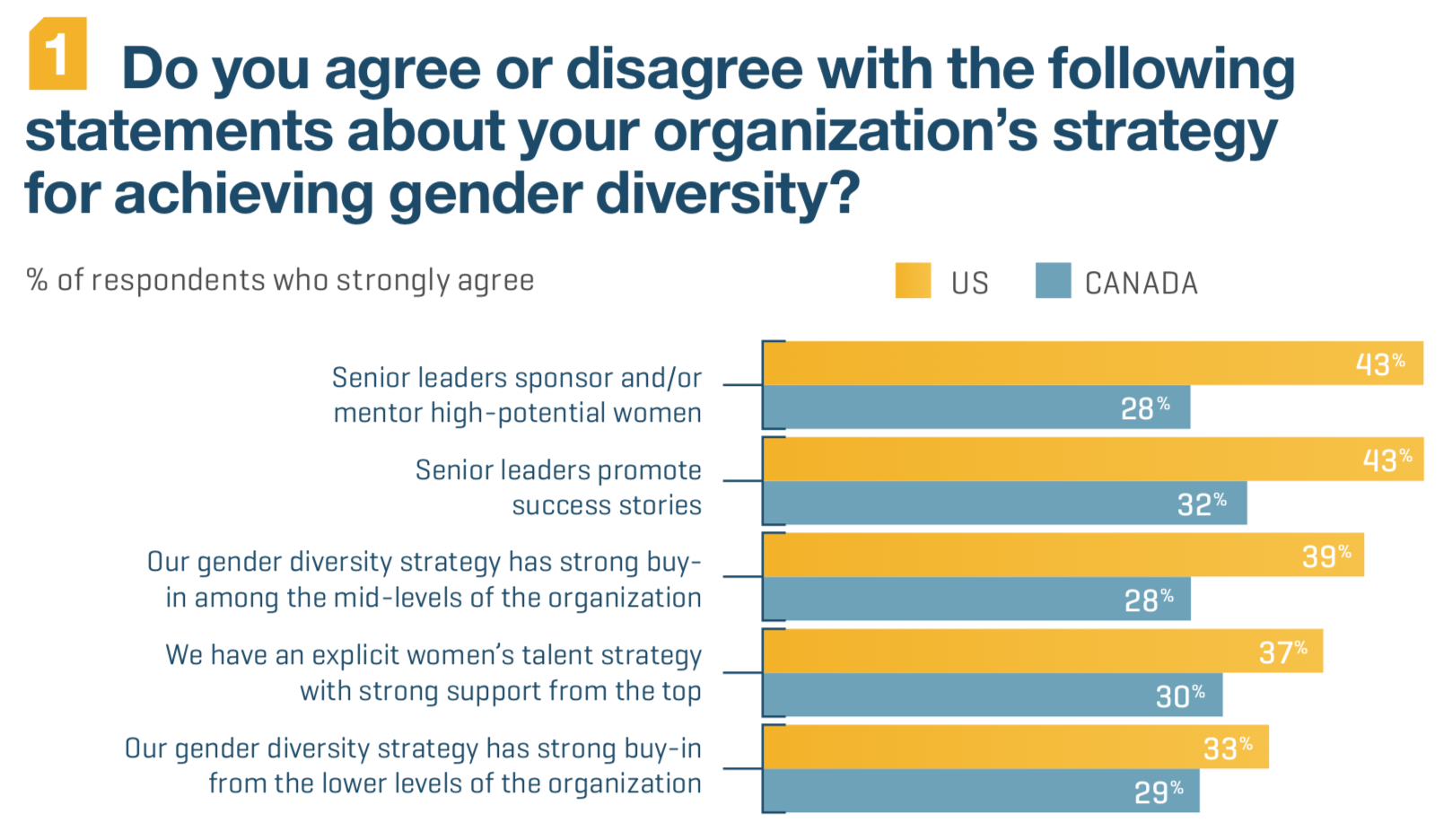
Differences of Opinion: How Canadian and US business leaders think about gender diversity

RBC continues to do interesting research and reports on diversity issues. This Canada-United States comparison being the most recent example (and it challenges Canadian smugness about our diversity policies in the corporate sector). These two charts are particularly revealing, report recommendations follow:

1. Be aware that diversity mandates can backfire.

Surprisingly, mandatory diversity training can often have the opposite effect, increasing bias rather than eliminating it. Research over several decades has shown that corporate leaders and managers are less motivated to increase diversity if they are forced to do so. In one study, Harvard Business Review researchers who analyzed data from hundreds of US firms found that “companies get better results when they ease up on the control tactics.”

Similarly, national policies that promote gender parity, diversity, and gay rights may be viewed as controlling or policing people’s personal opinions and actions. Equal opportunity or pro-diversity legislation may make organizations “check the boxes” to advertise their compliance with the requirements, but may also make them less likely to make practical efforts to reduce gender or other types of discrimination. Rather, engaging leaders and managers to become advocates for change is more effective. Voluntary training to raise awareness, along with mentoring and coaching efforts, participation in task forces or councils, or leadership of affinity groups, works best.

2. Try more innovative solutions.

The most appropriate measures vary across industries and firms, and a decision not to adopt any specific approach cannot be interpreted as a failure. Still, our study shows that companies in both the US and Canada are using only a subset of all the potential strategies. Canadian companies tend to take fewer risks and are less likely to try innovative solutions than their US counterparts. Solutions that have been adopted less frequently in Canada than in the US may provide ideas for further action by Canadian firms. They include:

  • Job auctions or trial hiring (37% vs 43%)
  • On-the-job development activities that provide opportunities to generate business impacts (38% vs 44%)
  • Support for working parents (34% vs 43%)
  • Flex time (48% vs 52%), part-time (31% vs 35%) and childcare subsidies (27% vs 31%)
  • Assessing performance relative to gender diversity targets (37% vs 44%)

3. Build a strong business case for women in senior management.

“Fundamentally, having a workforce and a senior management team that represents the clients and communities an organization serves is both an asset and a competitive advantage,” says Jennifer Tory, Chief Administrative Officer at RBC. “Diversity of gender, thought, and background creates inclusive teams that generate better ideas and solutions. Inclusive teams are strong teams, and strong teams make better business decisions.”

4. Invest in retraining and reintegrating women into the workplace.

One of the biggest challenges in both the US and Canada is the issue of parental leave and how it affects women’s careers. The two countries differ markedly with respect to national policies. In the US, women who take maternity leave do not receive guaranteed payments from the federal government. The Family and Medical Leave Act protects their job for up to 12 weeks; some individual companies and states may offer more generous policies or a short-term disability policy that pays women during their leave of absence. By contrast, Canada is far more generous; its mandated 12-month parental leave is expected to stretch to 18 months in 2018.

In a way, that could “create unintended consequences” for women’s advancement in Canada, says the University of Toronto’s Dart. She notes that although both parents can share the leave, men are often reluctant to take time off. “In many Scandinavian countries paternity and maternity leave are mandatory. Both men and women leave the workplace for a time when they have children, so there is less of an opportunity for gender bias. It has to be mandatory. You have to make it an equal playing field.”

In Canada and other countries where equal parental leave is not mandated, being away from the job for so long could be detrimental to women’s careers, she adds. “Women step out, often because of family pressure, and find it very difficult if they want to come back later on. They have lost their professional networks and they don’t know if their skills are up-to-date. Many companies don’t actively work on bringing women back to work; it is easier to advance the women who have stuck it out.”

5. Make a concerted effort to change societal perceptions.

Here’s where male role models, influencers, pressure groups, and governments play a big part. “With regard to progressing in their career, women are working really hard, but they need networks and sponsorship much earlier in their career,” says Jennifer Reynolds, CEO of the Toronto Financial Services Alliance (TFSA), a public-private partnership that supports the financial services industry. “We need to actively challenge senior management on that, and we have to have men in this dialogue.”

Dart advocates going even further. “There is a very large gap in the middle part of the pipeline,” she says. “There’s always more commitment that we need to see in senior leaders. We need more CEOs and board chairs to advance their support of women. But this battle is not lost at the corporate front. This battle is lost at the home front. The expectations of women, the roles they are supposed to play, are different in different cultures. That’s where we need to start: changing role expectations.”

Source: Download Here

ICYMI: Is Canada’s population too small? My review of Doug Saunders’ Maximum Canada 

For those interested, my take in Policy Options on Doug Saunders’ Maximum Canada.

Source: Is Canada’s population too small?