Differences of Opinion: How Canadian and US business leaders think about gender diversity
2017/11/08 Leave a comment
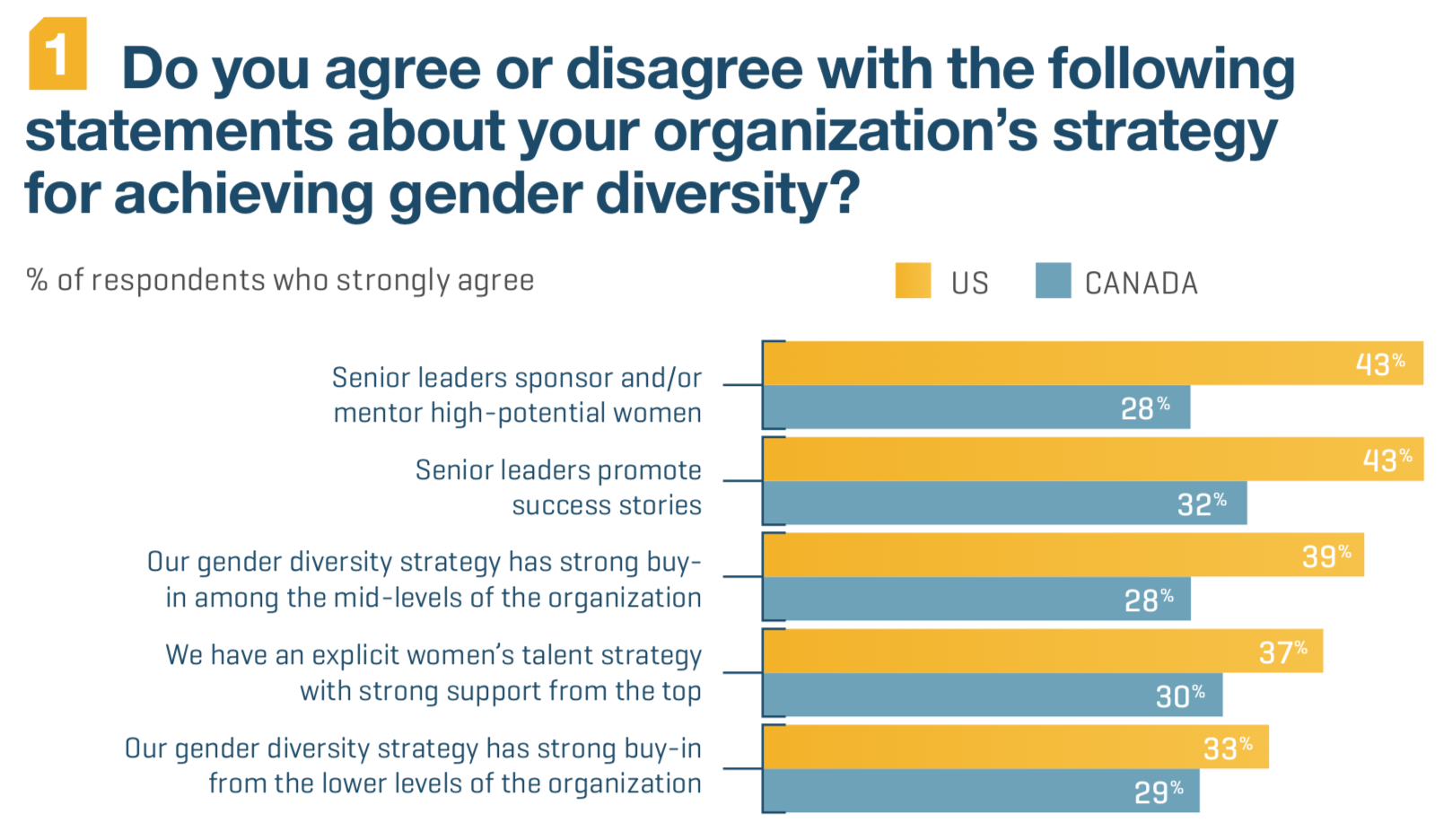 RBC continues to do interesting research and reports on diversity issues. This Canada-United States comparison being the most recent example (and it challenges Canadian smugness about our diversity policies in the corporate sector). These two charts are particularly revealing, report recommendations follow:

1. Be aware that diversity mandates can backfire.
Surprisingly, mandatory diversity training can often have the opposite effect, increasing bias rather than eliminating it. Research over several decades has shown that corporate leaders and managers are less motivated to increase diversity if they are forced to do so. In one study, Harvard Business Review researchers who analyzed data from hundreds of US firms found that “companies get better results when they ease up on the control tactics.”
Similarly, national policies that promote gender parity, diversity, and gay rights may be viewed as controlling or policing people’s personal opinions and actions. Equal opportunity or pro-diversity legislation may make organizations “check the boxes” to advertise their compliance with the requirements, but may also make them less likely to make practical efforts to reduce gender or other types of discrimination. Rather, engaging leaders and managers to become advocates for change is more effective. Voluntary training to raise awareness, along with mentoring and coaching efforts, participation in task forces or councils, or leadership of affinity groups, works best.
2. Try more innovative solutions.
The most appropriate measures vary across industries and firms, and a decision not to adopt any specific approach cannot be interpreted as a failure. Still, our study shows that companies in both the US and Canada are using only a subset of all the potential strategies. Canadian companies tend to take fewer risks and are less likely to try innovative solutions than their US counterparts. Solutions that have been adopted less frequently in Canada than in the US may provide ideas for further action by Canadian firms. They include:
- Job auctions or trial hiring (37% vs 43%)
- On-the-job development activities that provide opportunities to generate business impacts (38% vs 44%)
- Support for working parents (34% vs 43%)
- Flex time (48% vs 52%), part-time (31% vs 35%) and childcare subsidies (27% vs 31%)
- Assessing performance relative to gender diversity targets (37% vs 44%)
3. Build a strong business case for women in senior management.
“Fundamentally, having a workforce and a senior management team that represents the clients and communities an organization serves is both an asset and a competitive advantage,” says Jennifer Tory, Chief Administrative Officer at RBC. “Diversity of gender, thought, and background creates inclusive teams that generate better ideas and solutions. Inclusive teams are strong teams, and strong teams make better business decisions.”
4. Invest in retraining and reintegrating women into the workplace.
One of the biggest challenges in both the US and Canada is the issue of parental leave and how it affects women’s careers. The two countries differ markedly with respect to national policies. In the US, women who take maternity leave do not receive guaranteed payments from the federal government. The Family and Medical Leave Act protects their job for up to 12 weeks; some individual companies and states may offer more generous policies or a short-term disability policy that pays women during their leave of absence. By contrast, Canada is far more generous; its mandated 12-month parental leave is expected to stretch to 18 months in 2018.
In a way, that could “create unintended consequences” for women’s advancement in Canada, says the University of Toronto’s Dart. She notes that although both parents can share the leave, men are often reluctant to take time off. “In many Scandinavian countries paternity and maternity leave are mandatory. Both men and women leave the workplace for a time when they have children, so there is less of an opportunity for gender bias. It has to be mandatory. You have to make it an equal playing field.”
In Canada and other countries where equal parental leave is not mandated, being away from the job for so long could be detrimental to women’s careers, she adds. “Women step out, often because of family pressure, and find it very difficult if they want to come back later on. They have lost their professional networks and they don’t know if their skills are up-to-date. Many companies don’t actively work on bringing women back to work; it is easier to advance the women who have stuck it out.”
5. Make a concerted effort to change societal perceptions.
Here’s where male role models, influencers, pressure groups, and governments play a big part. “With regard to progressing in their career, women are working really hard, but they need networks and sponsorship much earlier in their career,” says Jennifer Reynolds, CEO of the Toronto Financial Services Alliance (TFSA), a public-private partnership that supports the financial services industry. “We need to actively challenge senior management on that, and we have to have men in this dialogue.”
Dart advocates going even further. “There is a very large gap in the middle part of the pipeline,” she says. “There’s always more commitment that we need to see in senior leaders. We need more CEOs and board chairs to advance their support of women. But this battle is not lost at the corporate front. This battle is lost at the home front. The expectations of women, the roles they are supposed to play, are different in different cultures. That’s where we need to start: changing role expectations.”
Source: Download Here
 About Andrew
 Multicultural Meanderings