Caucus, Cabinet and Official Opposition Critic Diversity

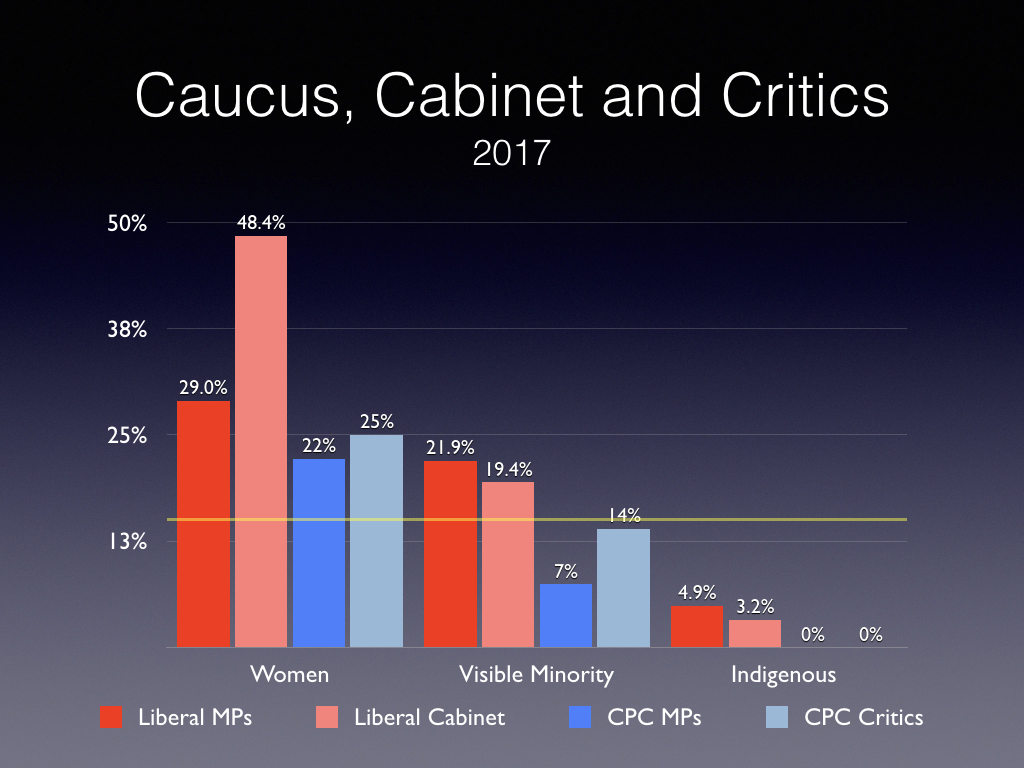
Following the Cabinet shuffle and the appointment of the Conservative shadow cabinet, I did a quick update to my chart showing overall caucus diversity alongside Cabinet and critic diversity.

As many observers have noted in commenting on the new Conservative critics, they may have a “women problem” in terms of the number of MPs  and its translation to the more visible positions (note: the numbers are slightly better when other leadership positions are included – three of the seven are women).

Visible minority Conservative MPs are however well represented.

We don’t need less identity politics—we need more – Ostroff

Good defence of identity politics by Joshua Ostroff, albeit silent on some of the risks to broader social cohesion and that marginalized groups are not unique to minorities that Terry Glavin recently discussed (Are white Canadians becoming conscious of their whiteness? – Terry Glavin):

Before identity politics also became a pejorative, it was used innocuously in academic circles for decades regarding civil rights movements. American anthropologist Vasiliki Neofotistos defined it as a tool to “stimulate and orientate social and political action, usually in a larger context of inequality or injustice.” British political philosopher Sonia Kruks further explained that it does not seek “respect ‘in spite of’ one’s differences. Rather, what is demanded is respect for oneself as different.” In other words, equality—not assimilation.

Inequality and assimilation, however, was Canada’s initial modus operandi, a nation founded by white men who considered minorities and women inferior. During my parents’ lifetime, Indigenous and Asian citizens couldn’t vote and women had only recently gained the franchise. It was legal to ban blacks and Jews from beaches and businesses, but illegal for gays and lesbians to have sex. The last segregated black school in Canada closed in 1983, the same year that raping your wife became illegal. The last residential school closed in 1996. Same-sex marriage wasn’t legal until 2005. Transgender rights became enshrined just this summer.

Democracy has a systemic vulnerability: tyranny of the comfortable majority. People vote in their own self-interest, but many do so without even being aware of what others deal with. Stephen Harper echoed many Canadians’ own thought processes when he admitted in 2015 that an inquiry into missing and murdered Indigenous women “isn’t really high on our radar, to be honest.”

Progress has obviously been made since my parents were born, thanks to the identity politics putting these issues on that majority’s radar. But inequality remains, and that’s why identity politics still matters. It is not about ensuring, as the National Review claimed in their article about Damore’s Google memo, that “the white male must lose.” It’s about ending the funding discrepancy for Indigenous children because there’s a suicide crisis and because way too many kids wind up in foster care. It’s about police reform because more than half of Greater Toronto’s black population has been stopped in public, and both black and Indigenous Canadians are overrepresented in prison. It’s about protecting Muslim and transgender Canadians from hate. It’s about reducing the gender pay gap and increasing diversity across society. It’s about making sure the playing field gets levelled, and that power gets shared.

Trump has shown us what happens when anti-identity politicians take over. They play their own kind of identity politics—but, for them, it’s just called politics. After all, he’s called for a ban on transgender people in the military, a travel ban from some Muslim-majority countries, and a dismantling of affirmative action policies because he claims white people are the ones being marginalized despite the data to the contrary.

That’s why some progressives want to focus on class and stop talking about identity issues, in the hopes that the left can attract more straight white working-class voters who believe they’re threatened by social change. Former White House advisor Steve Bannon’s recent boasts about his advantage over the Democrats captured this dilemma: “The longer they talk about identity politics, I got ’em. I want them to talk about racism every day.”

The Republicans’ grand trick—making white Americans feel like an oppressed minority—isn’t new. The white-race card has been a Republican ploy from their Civil Rights-era southern strategy through the Obama-era Tea Party; Canada, meanwhile, has seen less successful efforts with the Conservatives’ barbaric cultural practices hotline and the Parti Quebecois’ Charter of Values.

As counter-protesters in Vancouver, Boston and most recently London, Ont., stand up together to marginalize white supremacist demonstrations, it seems clearer that identity politics, bringing issues of marginalization to the fore, are as important as ever, semantics be damned. We need to tackle all our different challenges, and not pretend we all have the same ones. Class matters, of course, but if you try to address, say, poverty without dealing with racism, the primary beneficiary is the majority group. That’s how “working class” became synonymous with “white working class.” Trickle-down theory doesn’t work any better on the left than it did on the right.

Despite conservative claims of pandering, every subgroup deserves a government and society that intervenes on its behalf as much as for the dominant group—one that reclaims, rather than rejects, this movement.

And if the point of identity politics is to decrease oppression by increasing equality—a slow but steady process that has been ongoing for a century and must continue, despite the current pushback—it is the way forward to genuinely uniting a nation.
Source: We don’t need less identity politics—we need more – Macleans.ca

The Man Raising an Army of Psychologists in Iraq

Good initiative and investment:

A year after helping more than 1,000 escaped ISIS captives resettle in Germany, Kurdish-German psychologist Jan Ilhan Kizilhan has returned to northern Iraq with a plan to save thousands of other psychologically scarred war victims left behind.

With backing from the German state of Baden-Württemberg, Kizilhan has set out to train a new generation of psychologists and trauma specialists he believes will be among the most qualified in the Middle East

After years of war, Iraq and Syria are struggling with a mental health crisis neither country has the capacity to address. In northern Iraq alone, where more than 1 million people are displaced by violence, just a couple dozen local psychologists are believed to be treating patients.

Various nongovernmental organizations and government initiatives have sought to fill the gaps, including Baden-Württemberg’s asylum program, which physically transported some of the most psychologically scarred women and children in northern Iraq to a part of the world where they could more easily access mental health care.

As a dark measure of the German program’s effectiveness, its directors boast that of its 1,100 beneficiaries—mostly women held as ISIS sex slaves and their children—not one has taken his or her own life in contrast to some other ISIS survivors who didn’t get a spot in the program.

Mindful of the deadly stakes for those left behind, Baden-Württemberg invested 1.3 million euros, a small fraction of its annual budget, into Kizilhan’s new institute, which aims to cultivate the experts where they’re needed.

The Institute for Psychology and Psychotraumatology sits on a neatly manicured hill at the University of Duhok in northern Iraq. On a sunny morning in May, the campus, set against the backdrop of picturesque mountains, hummed with the sounds of lawn mowers.

Just a short drive away, hundreds of thousands of displaced people live in sprawling camps, each one having risen up in the wake of an exodus—from an ISIS advance, bombings, or clashes. Just 40 miles to the south, chunks of Mosul lay in ruin from a months-long battle to oust ISIS from the populous city. Forty miles to the west: the Syrian quagmire. And despite the campus’ unblemished appearance, everyone at the school seems to have been touched by war.

Hewan Avssan Omer, a 26-year-old secretary at the institute, only escaped a 2014 ISIS attack on her village because she happened to be away at school. The militants kidnapped other members of her family, some of whom escaped just months ago. Omer’s 7-year-old cousin spent two and a half years in captivity and returned to society unable to speak his native Kurdish, confused about who his parents are and where he is from.

The staff’s proximity to and familiarity with the local crisis is intentional.

One of the biggest criticisms of the German program was that it exposed trauma victims to the additional stress of culture shock by transporting them to a foreign place.

At his office in Baden-Württemberg in early 2016, Kizilhan said the United Nations refugee agency was one of the critics to raise this concern of detaching victims “from their roots.” The German team responded that it was a price they were willing to pay, at that precarious time, for potentially saving lives. “In Iraq they are living in camps, their parents are killed, they have no roots!” Kizilhan responded. “It’s ridiculous. They need stabilization and security before they can talk about how it felt to be raped and helpless. How do you do this in a tent?”

Source: The Man Raising an Army of Psychologists in Iraq

Australian security agencies may not have approved tighter citizenship laws | The Guardian

Not going well (with good reason):

Immigration officials have been unable to say whether they gained security agency backing for tighter citizenship laws before Peter Dutton announced the controversial overhaul.

The officials told a Senate inquiry in Brisbane they could not confirm whether the Australian Security Intelligence Organisation (Asio) or the Australian federal police raised a need for the proposed changes, or were consulted specifically about them before they were unveiled in April.

The Labor senator Murray Watt seized on the testimony on Thursday as “evidence that shows very clearly there is no national security case for a tightening of the citizenship laws”.

Watt told the Guardian: “Peter Dutton’s own department was unable to produce any evidence that any national security agency had asked for these changes.”

The department also confirmed it knew before the announcement that people who completed the government-funded Adult Migrant English Program (Amep) would still fall short of the university-level English required under the new legislation.

“I think it’s bizarre that we have a government-funded program to help train people in English that will not even be able to provide the level required from the government’s own citizenship test,” Watt said.

David Wilden, a first assistant secretary at the Department of Immigration and Border Protection, told the inquiry he could not “give a definitive answer” to whether Asio gave any advice that tougher citizenship rules were needed to protect national security.

“I’d have to check, I don’t think we went to a specific piece of advice on this bill,” he said, adding the department had ongoing dialogues with the intelligence agency.

Linda Geddes, an acting secretary of the department, said it was the same case with the AFP.

When Watts asked whether the department had consulted either agency specifically on the bill, Wilden said he was unsure and would try to find an answer before the deadline for committee submissions on Friday.

The final day of hearings by the Senate legal and constitutional affairs legislation committee came after the inquiry having received more than 10,000 submissions against Dutton’s proposal.

Only two were in favour: from Dutton’s own department, and the Australian Monarchist League. The committee is due to report next Tuesday.

The immigration officials at the inquiry said the department had considered the fact that most people completing Amep would be at level 4 or 4.5 under the international English-language testing system (Ielts), short of the level 6 required for citizenship.

Wilden said these people would need to show “self-agency” and further their own English study to meet the new mark.

The Labor frontbencher Tony Burke told the Guardian he was “now confident the bill won’t be passed in its current form but I’m not yet confident” it would be rejected in the Senate, as Labor hoped.

When Watt read out a section of the Ielts test relating to Herodotus’ 480BC account of calisthenics at the battle of Thermopylae, “the whole room fell about laughing at just how ridiculous the level of language required was”, Burke said.

“People laughed, and then they reflected on it, and then the frustration started to take over the room when people realised exactly what that would mean in their own instances,” he said. “There was a despondency of people saying, if that’s the new rule, I’ll never become a citizen.”

Source: Australian security agencies may not have approved tighter citizenship laws | Australia news | The Guardian