Diversity and creativity: the link is not as simple as we think

A good summary of a study that is more nuanced than most in the link between diversity and creativity.

Of particular note is how the benefits of diversity are greatest in innovation, less so in implementation. And that personality diversity is likely more important than demographic diversity.

Some good leadership pointers in how to manage diverse work forces:

It has become customary to assume that diversity increases creativity. But Tomas Chamorro-Premuzic, a professor of business psychology at University College London and a faculty member at Columbia University, says the link is not as simple as we think.

Yes, teams with a diverse composition generate a wider range of original and useful ideas. But experimental studies suggest those benefits disappear when the team turns its attention to implementation, deciding which ideas to select and act upon, presumably because diversity hinders consensus.

He writes in Harvard Business Review that an analysis of 108 studies and more than 10,000 teams “indicated that the creativity gains produced by higher team diversity are disrupted by the inherent social conflict and decision-making deficits that less homogeneous teams create. It would therefore make sense for organizations to increase diversity in teams that are focused on exploration or idea generation, and use more-homogeneous teams to curate and implement those ideas.”

He adds that for all the talk about the importance of creativity, the critical activity is innovation – implementing creative ideas. “Most organizations have a surplus of creative ideas that are never implemented, and more diversity is not going to solve this problem,” he says.

Other factors to consider:

  • Good leadership helps. It can assist a team in overcoming the conflicts flowing from diversity. A key is to help members understand other people’s perspectives rather than fixating on their own individual agendas.Too much diversity is problematic. We might assume that the relationship between creativity and diversity is linear. But that appears to not be true and a moderate degree of diversity is more beneficial than a higher dose.


  • Psychology outweighs demography: While we tend to focus on gender, age and racial diversity, the most interesting and influential aspects are the psychological elements of diversity, such as personality, values and abilities. Those are the powerful factors to be alert to.


  • Knowledge sharing is key. For diversity to enhance creativity, a culture of sharing knowledge should be in place. “Studies mapping the social networks of organizations have found higher levels of creativity in groups that are more interconnected, particularly when creative and intrapreneurial individuals are a central node in those networks,” he writes.


  • Cynics are persuadable. He says diversity training is actually most effective with individuals who are skeptical of it. Of course, the challenge is to get them on board for training.


  • Other factors than diversity are more powerful in boosting creativity. He says analysis has found that vision, task orientation, support for innovation and external communication are the strongest determinants of creativity and innovation. Team composition and structure have much less impact.


Certainly diversity is nice for organizations to have. But he insists that if your actual goal is to enhance creativity, there are simpler, more effective solutions than boosting diversity.

Source: Diversity and creativity: the link is not as simple as we think – The Globe and Mail
The anti-racist ad that triggered a backlash

Certainly provoked discussion.

The comments by the Saskatoon city councillor on what they are trying to achieve with the campaign – more mindfulness and awareness of personal advantages (or disadvantages) – are sensible:

In the first phase of the campaign, the committee called on residents to submit videos of themselves answering questions about their thoughts on and experiences with racism, and what personal role they can play in ending it in Saskatoon. Williams was one of a few dozen culturally diverse volunteers to submit a video.

Here’s what he had to say: “I am a white, heterosexual, able-bodied male: the most privileged demographic in human history. If I’m going to be the bridge to ending racism in Saskatoon or anywhere else, I have to acknowledge my own privilege and I have to acknowledge my own racist attitudes, and work through my discomfort.”

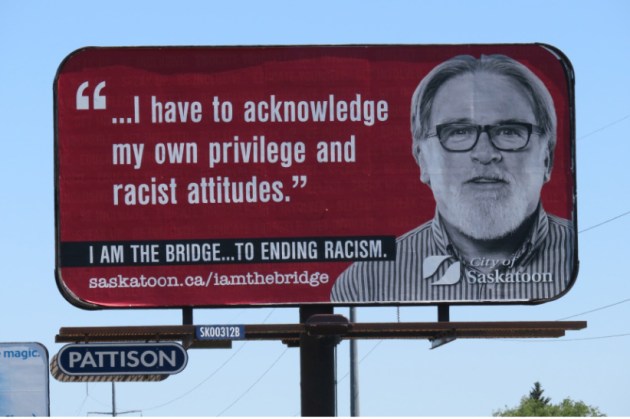
In June, the city rolled out phase two of the campaign, which involves ads spread out across the city in bus shelters, restaurants and bars, along with four billboard installations, featuring quotes from former volunteers. In Williams’ billboard, which shows his face, but not his name, his quote was boiled down to: “…I have to acknowledge my own privilege and racist attitudes.”

With those 10 words, Williams, a professor at Saskatchewan Polytechnic, ignited a firestorm on social media of folks jumping to defend themselves against what they took as an accusation. One Reddit user kicked off a debate on the platform, asking: “Why is the city of Saskatoon purchasing billboards simply to say white men have privilege?” To which someone else replied: “You then invite a series of people who hate men and are racist against whites to criticise your every word and action until they are satisfied by your subservience.” Another wanted to make it clear that: “I have not had one hand out due to being white I’ve worked my ass off to get where I am. All of my friends and family have worked their ass off to get where they are.” Ezra Levant’s the Rebel, went on to call the billboard itself racist, as did an alt-right British group called Western Defence, and a slew of other Twitter users.

In an email to Maclean’s, Williams said that, despite the backlash, “I’m proud to be part of the ‘I am the Bridge’ campaign. I chose my words carefully and I stand by them completely.”

The city is likewise defending the billboard, saying that it wasn’t meant to suggest all people are racist, but rather to encourage residents to consider how they can play a personal role in mitigating racism. “Certainly the level of feedback indicates that the campaign is doing its job,” said Saskatoon city councillor Hilary Gough, “which is to get people talking and thinking about racism and the reality of it in our community.”

Indeed, surveys and polls on racism in the province do suggest that race relations are tense and deteriorating in Saskatchewan. Last year, following the murder of Colten Boushie, a 22 year-old Indigenous man from the Red Pheasant First Nation in Saskatchewan, the NRG Research Group and Peak Communications conducted a survey on racist attitudes across the country. In Saskatchewan, 46 per cent of respondents—more than anywhere else in the country—said racism was a big problem. Meanwhile 30 per cent of respondents in the western Prairies (Saskatchewan and Alberta), said race relations in their communities have gotten worse over the last decade.

Of course, broaching the issue of racism often draws prickly reactions like those towards Williams’ billboard. “Certainly, I think there is some defensiveness in this,” she says. “It takes time to learn about one’s own privilege without feeling like we need to feel guilty.” Part of the backlash, though, comes from a mistinterpretation of the campaign, says Gough. “We aren’t saying that everybody is racist and has racist attitudes, but we are trying to create space for each of us to consider how we can most productively engage with the structures we’re living in and figure out what our role is in eliminating and addressing racism.”

The I Am The Bridge ad campaign, which cost the city $14,000 this year, runs until July 16.

Source: The anti-racist ad that triggered a backlash – Macleans.ca

I applaud British Islam’s refusal to bow to the establishment | Giles Fraser | Opinion | The Guardian

I don’t really understand Fraser’s arguments. Is he against integrating into Britain’s civic life? Does it not make sense for religious institutions themselves find ways to integrate into society? Is refusal good for communities and society? Is respectability necessarily a bad thing?

Back in May, at the Roundhouse Poetry Slam, the brilliant Suhaiymah Manzoor-Khan took to the stage to denounce the importance of being one of those good Muslims, as opposed to one of the bad ones. I refuse to have to prove my humanity to you by cracking a smile, and saying how “I also cry at the end of Toy Story 3”, she said, her voice shaking with intensity and focus. I won’t try to tell you about “the complex inner worlds of Sumeahs and Aishas.” “No,” she insists, “this will not be a ‘Muslims are like us’ poem. I refuse to be respectable … Because if you need me to prove my humanity, I’m not the one that’s not human.”

I wholeheartedly applaud this refusal of respectability. I’m not asked to flaunt my moral or emotional credentials in order to be treated decently. I’m not asked to demonstrate that I am not a radical, or prove that I am an asset to society. Yet this is what immigrant communities, especially those that come with some “foreign” religion, are regularly pressed to do

A report out this week, chaired by the MP and QC Dominic Grieve and titled The Missing Muslims, encourages adherents of Islam to greater participation in civil society and public life. It calls for more British-born imams and greater integration of Muslims into British cultural life.

It’s not a bad report, and its intentions are worthy. It recognises that there are problems with the Prevent agenda – which is an understatement – and it wonders out loud if an official definition of Islamophobia, along the lines of that used for antisemitism, should be explored. But, as with so many of the numerous reports about British Muslims, the focus is always on Islam as a problem to be solved and the need to distinguish between good Muslims and bad Muslims.

This good Muslim/bad Muslim distinction has history, of course. It was precisely this distinction that the British colonial authorities used to separate the secular, wine-drinking, western-integrated, moderate Muslims who were prepared to collaborate with British rule and the suspiciously religious, uppity, bearded Muslims who refused to bend the knee to colonial power. As the Oxford professor Tariq Ramadan has rightly pointed out, the good Muslim/bad Muslim distinction is entirely unhelpful, not least because it associates being good and moderate with some diminution of a Muslim’s religiosity. The distinction effectively says: if you are brown and pray more times a day than the local vicar then you should probably expect to have your phone tapped.

There is another problem with establishment bodies calling for Muslim participation within civil society. The British establishment has a longstanding and highly effective strategy when forced to deal with a “foreign” religion they don’t really understand – they seek to transform it into a mini version of the Church of England. This is how it works: first they encourage an organisational coherence, and crucially a hierarchy, and then they draw the newly established leadership into the establishment, with invitations to the Queen’s garden party and possibly a seat in the House of Lords. They did this with Jews in the 19th century. And they are trying to do it to Muslims in the 21st.

Jews called it the Minhag Anglia. The very idea of the chief rabbi, for instance – not a traditionally Jewish institution – was modelled on the office of archbishop of Canterbury, and its office holders took to behaving likewise. Take Hermann Adler, appointed in 1891. Adler styled himself “Very Reverend” and started wearing gaiters. He liked dining in London clubs and was made a CVO, Commander of the Royal Victorian Order. “He gave the Chief Rabbinate a high, unique dignity, ensuring that the Jews would be accorded official representation in national life,” wrote Rabbi Raymond Apple in a 1998 essay. Others saw it differently: he was the “willing captive of the gilded gentry”, wrote one columnist of the time.

This same strategy of drawing Muslims into the establishment has been at work for some time. But it’s a much harder sell because Islam is so much more theologically resistant to hierarchical thinking. It shuns the idea of popes or archbishops and insists that all human beings have equal access to God. This is what I most admire about British Islam. Its bolshy “Protestantism”. Its refusal to be bought off by official trinkets. Its refusal of respectability. 

Source: I applaud British Islam’s refusal to bow to the establishment | Giles Fraser: Loose canon | Opinion | The Guardian

‘Impossible to close the gap’: Immigration board boss says more resources needed to process legacy refugees – Canada – CBC News

More on IRB problems – Dion is polite in not flagging the number of adjudicator issue (see Globe editorial: The Trudeau government is failing refugee claimants, and Canadians):

Faced with a swelling backlog and a promise to resolve five-year-old asylum claims, the chair of the Immigration and Refugee Board of Canada admits he needs more funding and more people.

Mario Dion insists the IRB has become more efficient in dealing with cases, but it’s not enough.

“I am afraid the way things are at this point we will need additional resources … because there is a limit to how much you can stretch one person’s time,” Dion said in an interview with CBC News.

He said it’s “essentially impossible to close the gap using existing resources.”

Immigration Minister Ahmed Hussen recently announced a review of the asylum system, but he’s offered no guarantee of additional funding.

The bulk of the backlog is made up of Canada’s so-called legacy refugees.

They are a group of about 5,500 people who have yet to have their asylum claims heard. That’s because they arrived in Canada in 2012, just before the federal government passed a law that requires new refugee clams to be heard within 60 days. Since the IRB had to comply with the law, it put thousands of existing files to the side — where they’ve stayed ever since.

Source: ‘Impossible to close the gap’: Immigration board boss says more resources needed to process legacy refugees – Canada – CBC News

Applicants for US Citizenship Surge; Mexicans Least Likely to Apply

Different trend in Canada. Country of origin differences interesting – expect that one reason for lower take-up rates for Mexican immigrants is related to the high cost of US citizenship (about CAD 1,000):

The number of legal immigrants applying for U.S. citizenship has surged by more than 20 percent since 2015, according to a recent Pew Research study – with Mexicans the least likely to apply.

Applications for citizenship were up by 21 percent in the first half of this year at 525,000, compared to the same period in 2016 when 435,000 applied, the report found.

The total number of applications in 2016 was 972,000, 24 percent higher than the approximately 800,000 who applied in 2015.

According to the report, in 2015 there were 45 million immigrants living in the U.S., of whom 11.9 million were “lawful permanent residents holding green cards.”

Among those green card holders, 9.3 million were eligible to apply for citizenship.

Of the 9.3 million, 37 percent or 3.4 million were of Mexican origin, but they were the least likely of all immigrant groups to seek naturalization.

In 2015, 67 percent of all lawful immigrants living in the U.S. and eligible for citizenship had applied – but for Mexicans the rate was considerably lower – 42 percent. That rate hasn’t changed much since then, the report found.

In comparison to the 42 percent of eligible Mexicans applying, 83 percent of those from the Middle East applied and 74 percent of those from Africa.

Middle Eastern immigrants had the highest naturalization rate among all immigrant origin groups, while African immigrants accounted for the largest increase in naturalization rate in the last decade, according to the report.

The report’s research is based on U.S. census data, a year-round survey of 3.5 million households, and a monthly survey of 55,000 households.

Source: Report: Applicants for US Citizenship Surge; Mexicans Least Likely to Apply

Canadian exceptionalism: Joseph Heath | In Due Course

Joseph Heath, of UofT’s department of philosophy, in a recent post paints an overly simplistic picture of “Canadian exceptionalism.”

While many of his points are valid, there is a surprising lack of a historical perspective in his treatment of integration and limitations to his analysis of the numbers and politics.

Historical perspective: Heath seems to anchor his post on the shift towards greater support for immigration in the mid-1990s – the inflection point when more people supported immigration than opposed.

But this ignores the longer term factors that are central to Canada’s relative success. First among them is a “culture of accommodation” that, however imperfect, reflects an early accommodation between settlers and First Nations (e.g., Royal Proclamation of 1763) and between French and English settlers (e.g., Quebec Act of 1774). While more observed in the breach than the observance for most of our early history, it nevertheless provided a way of thinking that underlies Canadian discourse.

The emphasis on integration, as distinct from assimilation, emerged in 1959 as Canadian citizenship articulated that integration was a voluntary process, respect for cultural traditions was compatible with loyalty to Canada, and that the host society was ultimately responsible for newcomer acceptance. The “Other groups” chapter of the Bi and Bi Commission provided further elaboration of the integration process.

The “other groups,” such as Ukrainian Canadians, pressed for multiculturalism in order to recognize their distinct identity and contribution to the building of Canada. The end result was the multiculturalism policy of 1971 and Act of 1988.

It was not merely “inadvertently” that Canada ended up being more successful in newcomer integration, but a series of earlier actions and policy choices – immigration, settlement, citizenship and multiculturalism – that enabled us to do so.

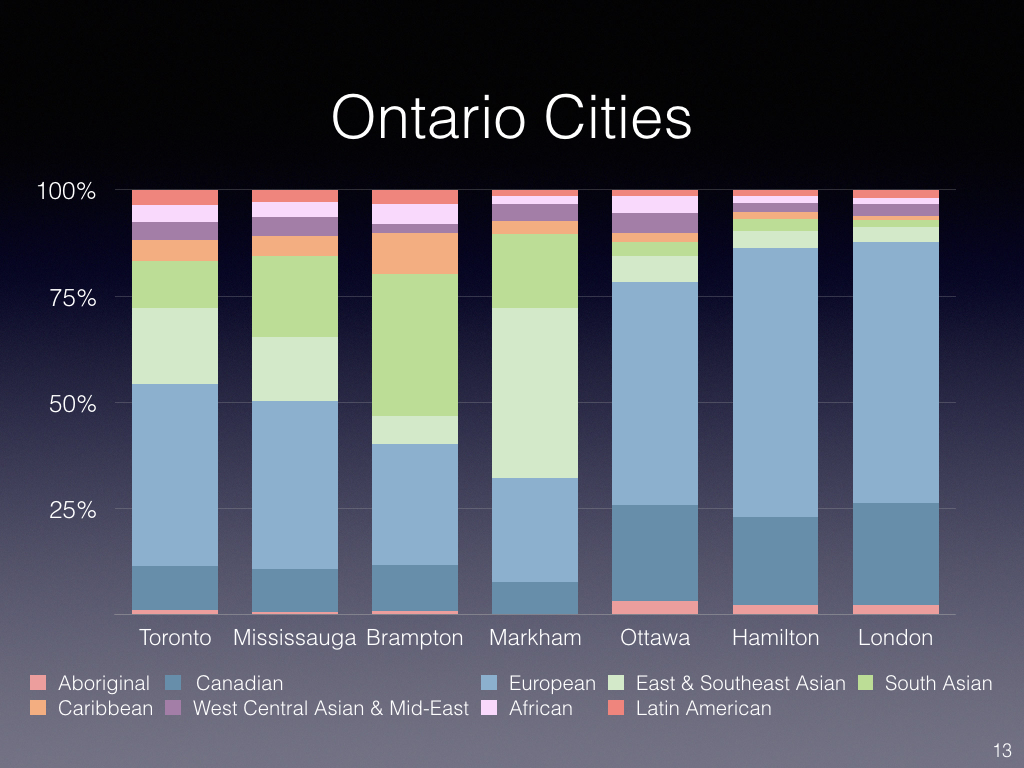
Numbers: While Canada does have more diverse newcomers than most other countries at the national level, the same cannot be said at the regional or municipal levels. The various controversies that emerge from time-to-time in places such as Brampton, Surrey or Richmond illustrate that.

Political system:

Similarly, his treatment of how Canada’s political system lacks understanding of the numbers of new Canadian voters and their relative concentration in ridings.

The more fundamental reality is that no political party can win a majority (and would be hard placed to win a strong minority) without the support of new Canadian voters, particularly those in the suburban areas of Toronto (the 905) and Vancouver.

Moreover, he overstates the impact of the first-past-the-post system on the far right given that UKIP, at least in the 2015 election, was able to attract almost 13 percent (but less than two percent in 2017).

Personally, I find Keith Banting’s recent analysis of “Canadian exceptionalism” at a “Big Thinking” Parliament Hill event more convincing (see Big Thinking video).

The five factors of Heath:

1. Very little illegal immigration

2. Bringing people in from all over

3. A political system that encourages moderation

4. Immigrants are part of larger nation-building project

5. Protection of majority culture clear from the start

Source: Canadian exceptionalism | In Due Course

Why Google’s newest AI team is setting up in Canada – Recode

The Canadian advantage includes immigration and related policies:

DeepMind, Google’s London-based artificial intelligence research branch, is launching a team at the University of Alberta in Canada.

Why there? Two reasons come to mind:

1. Canada has a history of AI research

DeepMind is launching a team at the university partly for proximity to the broader AI research community in Canada.

A number of leading AI researchers in Silicon Valley hail from Canada, where they plugged away at deep learning, a complex automated process of data analysis, during a period when that technology — now popular at major tech companies — was considered by the larger computer science community to be a dead end.

Plus, almost a dozen DeepMind staff came from the university, according to a blog post by DeepMind co-founder and CEO Demis Hassabis announcing the new lab. An Alberta PhD and a former post doc from the school played key roles in one of DeepMind’s hallmark accomplishments, getting its AlphaGo software to beat the human world champion at Chinese strategy game Go.

“Our hope is that this collaboration will help turbocharge Edmonton’s growth as a technology and research hub,” wrote Hassabis, “attracting even more world-class AI researchers to the region and helping to keep them there too.”

2. The Canadian government is friendlier to AI research than the U.S.

Political realities also make Canada a particularly attractive place for Google to expand its AI efforts.

The Canadian government has demonstrated a willingness to invest in artificial intelligence, committing about $100 million ($125 million in Canadian currency) in its 2017 budget to develop the AI industry in the country.

This is in contrast to the U.S., where President Donald Trump’s 2018 budget request includes drastic cuts to medical and scientific research, including an 11 percent or $776 million cut to the National Science Foundation.

Another contrast to the U.S. is in immigration policies. Canada doesn’t have an equivalent of the U.S. travel ban, which restricts travel for immigrants and refugees from Iran, Libya, Somalia, Sudan, Syria and Yemen. In the U.S., the ban makes it more difficult for tech and academic talent to enter the country.

Something interesting: One of the three researchers leading the team, Dr. Patrick M. Pilarski, is part of the university’s Department of Medicine. Google won’t comment on whether Pilarski’s medical background will play a role in his machine learning work for DeepMind, but Google is working on ways to integrate AI for health care as part of its cloud offering.

Source: Why Google’s newest AI team is setting up in Canada – Recode

Toronto Councillor Kristyn Wong-Tam withdrawing ‘intersectional’ motion that clashed with Black activists: Paradkar

Eating their own rather than moving forward – action starts with awareness:

Toronto councillor is withdrawing a motion asking the council to establish an “Intersectional Awareness Week” after it ran afoul of detractors from unexpected quarters.

“I will be withdrawing the motion,” said Kristyn Wong-Tam, who also released a statement Wednesday morning, barely five days after the motion was launched. “I was hoping . . . that it was the beginning of a powerful movement to raise awareness that we are not single-issue people.”

The city council had directed Toronto’s city manager to create an “Intersectional Gender-Based Framework to Assess Budgetary Impacts” in next year’s budget, her statement said.

“A dynamic young, LGBTQ2S+ racialized woman working with my office proposed the creation of an Intersectionality Awareness Week. She diligently did her research and with the input of my office staff, drafted a motion which was wholeheartedly endorsed.”

The opposition to her proposal came not from the usual suspects such as Councillors Giorgio Mammoliti or Jim Karygiannis, who tabled an openly hostile motion against Black Lives Matter couched as support for Toronto police, but from several high-profile Black scholars, activists and community workers.

Intersectionality is the term coined by the American scholar and civil rights advocate Kimberlé Williams Crenshaw to describe the invisible overlapping or intersection of issues of class, race, gender, ethnicity and sexuality when it comes to discrimination. She first applied it in the context of Black feminism.

While she used the term in 1980s, it has entered the mainstream only in recent years, and though I have a distaste for what I call “academese” — jargon that serves to obfuscate rather than clarify — the word “intersectionality” has expanded into an exceptionally effective descriptor of marginalized people at the crossroads of multiple identities.

Wong-Tam’s proposal aiming to commence an educational campaign fell apart after her critics released an open letter asking for the motion to be withdrawn.

At issue were the following points:

  1. The timing. The proposal came on the heels of the inquest that ruled the death of Andrew Loku — a mentally ill Black man killed by police — a homicide, a verdict with no criminal liability. The timing suggested it was, yet again, a token gesture of mollification by the city, a symbolism without substance.
  2. The motion did not take into account the contribution of Crenshaw (an omission that was later amended) for the term intersectionality, and the work of other Black feminists, and it did not reference Blackness, suggesting it ignored Black struggles.
  3. The exclusion of Black activists from the planning of the proposal that suggested a disregard for their experiences.

“I was prepared to amend it after some of the comments I heard. I recognize there are individuals deeply attached to the discussion,” Wong-Tam told me. She says Crenshaw, whom she reached out to after the initial motion, was supportive of her proposal and described it as incredibly exciting news. The hope was that city council could partner with local universities to bring Crenshaw to Toronto to launch the initiative, she said.

The proposal also had the support of the Urban Alliance on Race Relations.

“Now that there’s this open letter,” Wong-Tam said. “I also want to be respectful of what they say. I understand their skepticism especially in light of police shootings.

“There was nothing behind the motion that was meant to harm anybody. It would allow us to create a forum to better understand the concept of intersectionality.”

Her critics didn’t see it that way. They saw the proposal as celebratory.

“What exactly has the city done in order to warrant the celebration of Intersectionality Awareness Week? What awareness does the city have that it feels that it can lead such an initiative?” asked OmiSoore Dryden, chair, department of women’s, gender and sexuality studies at Thorneloe University (at Laurentian). “I would really like councillors to focus on this job, instead of the time and energy they have put into the pretence of this ‘awareness week.’ ”

There are no bad people in this conflict — a rarity these days — only people on the same side disagreeing on the way forward.

As a racialized immigrant woman of colour in the LGBTQ community, Wong-Tam gets intersectionality.

As people experiencing daily oppression, Black people are opposed to yet another government awareness program with brochures and seminars.

There’s also a chicken-and-egg tension; Black activists want Wong-Tam to establish credibility and see action before words. “We want a commitment from the City of Toronto to actually do some substantive work in helping Black people live our lives fully,” the activists’ open letter says.

For Wong-Tam, spreading awareness would lead to action. “I don’t believe we can get to a place of full equity by not having these dialogues. This is how we build allyship.”

There is a gap in the understanding of the term “intersectionality” in the broader population, and Wong-Tam has identified it as one that needs to be addressed.

It does.

With the shock waves of the Loku verdict still reverberating, the time to address that gap may not be right now. But in time I hope these two sides get together to hammer out concrete steps to make it happen.

Source: Councillor Kristyn Wong-Tam withdrawing ‘intersectional’ motion that clashed with Black activists: Paradkar | Toronto Star

Groups ask Federal Court to strike down Safe Third Country deal with the U.S. – Politics – CBC News

Not entirely unexpected. Court case may as much to raise the political profile as expected a ruling in their favour:

A legal challenge is being launched against the Canada-U.S. agreement that governs where people can make asylum claims on either side of the border.

Three advocacy groups are throwing their support behind a woman being named only as “E” in asking the Federal Court to strike down the so-called Safe Third Country Agreement.

Under the deal, most people who make an asylum claim at the land border are denied entry; as a result, there’s been an influx of people crossing illegally into Canada in recent months to file asylum claims.

The Canadian Council for Refugees, Amnesty International and the Canadian Council of Churches are among the many groups urging Canada to suspend the arrangement following major changes to U.S. immigration and refugee policy since the election of President Donald Trump.

But now they’re asking the Federal Court to step in, arguing that sending claimants back to the U.S. is morally and legally wrong because it risks violating their basic rights.

The litigant in the case is described as a Salvadoran woman who fled after being targeted by a gang and who believes she won’t be protected in the U.S.

It’s not the first time the deal has been tested in court.

A legal challenge was mounted after it came into force in 2004, and while the Federal Court at the time agreed the U.S. may not be safe for all refugees, the decision was overturned on appeal.

Ensuring ‘human dignity’

“Our organizations have pressed repeatedly, expecting that Canada would move to suspend the Safe Third Country Agreement as regard for the rights of refugees has rapidly plummeted under the Trump administration,” said Alex Neve, secretary general of Amnesty International Canada in a statement.

“To our astonishment and disappointment, however, the Canadian government continues to maintain that the U.S. asylum system qualifies as safe. We are left with no choice but to turn to the courts to protect refugee rights.”

Despite the deal, there are people showing up at the land border and getting through based on the exemptions that exist, including having family already in Canada.

Data obtained under the Access to Information Act showed that over a six-day period in March, 123 people showed up at legal entry points along the border and requested asylum; 66 were judged eligible and 57 turned away.

But Canada needs to go further, Rev. Karen Hamilton, general secretary of The Canadian Council of Churches, said in a statement.

“The government of Canada has a responsibility to ensure that the human dignity of all persons is respected. So it is imperative that all who seek refuge in Canada are afforded the protections guaranteed to them under the Canadian Charter of Rights and Freedoms and international human rights treaties.”

A spokesperson for Immigration Minister Ahmed Hussen said the government’s position on the agreement has not changed, and the deal remains in force

The federal Liberals have said they believe the deal does not need to be suspended or altered, as the asylum system in the United States is still functioning.

Source: Groups ask Federal Court to strike down Safe Third Country deal with the U.S. – Politics – CBC News

Egerton Ryerson doesn’t deserve an anti-Indigenous label: Smith

Good historical account of Ryerson’s life and relationships with some Indigenous persons by Don Smith:

A variant of the line “those who forget history are condemned to repeat it” could be “those who are ignorant of history are condemned to ignorance:”

As a Canadian historian of nearly half a century’s standing, I find the current controversy over Egerton Ryerson, the namesake of Ryerson University, totally baffling. I wonder how deeply his critics have probed into the past of the founder of the modern Ontario public-school system. Their portrayal of him as anti-Indigenous misrepresents the man completely.

Egerton Ryerson (1803-1882) was a Christian minister. Perhaps this is the central problem. As the University of British Columbia anthropologist Kenelm Burridge said so well in his book, In the Way: A Study of Christian Missionary Endeavours (1991): “Whatever missionaries do or have done will be perceived as good by some, otherwise by others.”

At the Credit Mission, located in what is now Mississauga, young Egerton set out in 1826/27 to learn Ojibway. As he later wrote: “I must now acquire a new language, to teach a new people.” The first Methodist (now the United Church) minister to the Mississauga (Ojibwa, or Anishinabeg) acquired a basic speaking knowledge. The future Mississauga chief, Kahkewaquonaby (Sacred Feathers), known in English as Peter Jones, became a close life-long friend. The Credit Mississauga liked Ryerson. He rolled up his sleeves, worked beside them in the fields, ate and lived with them. He gained their respect. At a council meeting in December, 1826, they gave him the Ojibway name of one of their deceased chiefs: “Cheechock” or “Chechalk.” The name meant “Bird on the Wing.”

A decade later, Ryerson did his best to advance the studies of Henry Steinhauer or Shahwahnegizhik, an Ojibwa from the Lake Simcoe area, at the Methodist College that is now Victoria University in the University of Toronto. In the 1850s, Ryerson, as the superintendent of education for Canada West, welcomed Allen Salt, a Mississauga from the Rice Lake area near Peterborough to the Toronto Normal (teacher training) School, the predecessor of what is now Ryerson University.

So grateful was Steinhauer for his assistance and encouragement that he named one of his sons Egerton Ryerson Steinhauer. At Rev. Salt’s last mission on Parry Island (Wasauksing) on Georgian Bay, the mission day school bore the name Ryerson. Only recently was the First Nations day school renamed, to Wasauksing Kinomaugewgamik.

As educational historian Robin Harris wrote in 1959: “Ryerson was Christian, first, last, and all the time; his religious principles were his first principles.” Yes, he had a Christian agenda, but he also supported the Credit Mississauga’s fight for a title deed to their Credit River reserve and their efforts to build a strong economic base for their community.

Ryerson was not the creator of the Indian residential-school system. The Final Report of the Truth and Reconciliation Commission of Canada, vol. 1. The History, Part 1. Origins to 1939 (Montreal and Kingston: McGill-Queen’s University Press, 2015), pp. 75-78, clarifies his outlook toward Indigenous education. In 1847, he did write a short report on Indian boarding schools where older male students could learn European-style agriculture.

In preindustrial Ontario, farming was the motor of the economy. As his educational model, he favoured the respected Hofwyl School for the Poor near Berne, Switzerland.

Jones and Ryerson were true friends, perhaps best described as “blood brothers.” Toronto’s Dundas Square borders Victoria Street. The site ofRyerson’s home 150 years ago is located toward the eastern end of the urban park. Its actual site is now under Dundas Street East.Ryerson welcomed Mr. Jones and his wife to stay with his family for a month in the spring of 1856 while Ryerson sought the best medical advice to restore Jones’s health. After the attempt to find a cure failed, Jones returned to his home in Brantford, where he died two weeks later. As Jones had requested while he stayed at the Ryerson’s that spring, Ryerson gave the eulogy at his funeral on July 1, 1856.

To describe Egerton Ryerson, or Chechalk as the Mississauga called him, as anti-Indigenous misses the mark. Back to you, Ryerson Students’ Union, for further study.

Source: Egerton Ryerson doesn’t deserve an anti-Indigenous label – The Globe and Mail