The Daily — Police-reported hate crimes, 2015 (with annual 2008-15 data)

The annual Statistics Canada hate crimes report. Three charts to summarize the latest report in comparison with previous years. The first chart shows the total number by category:

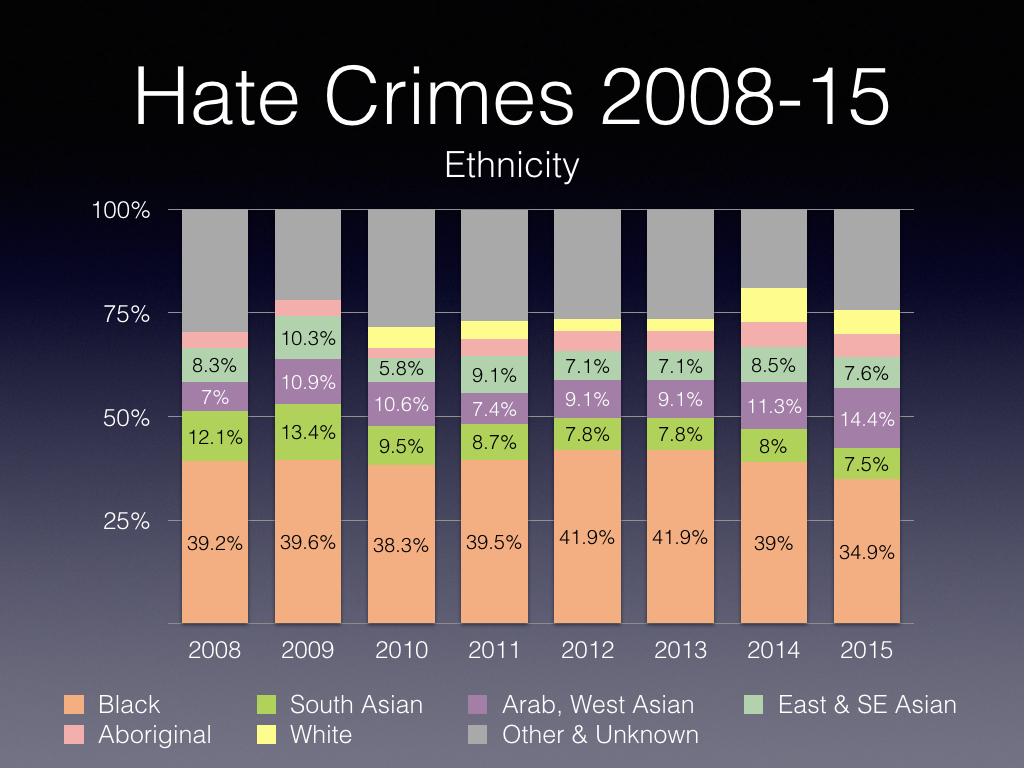
The second shows how the percentage of hate crimes against ethnic groups has shifted over time:
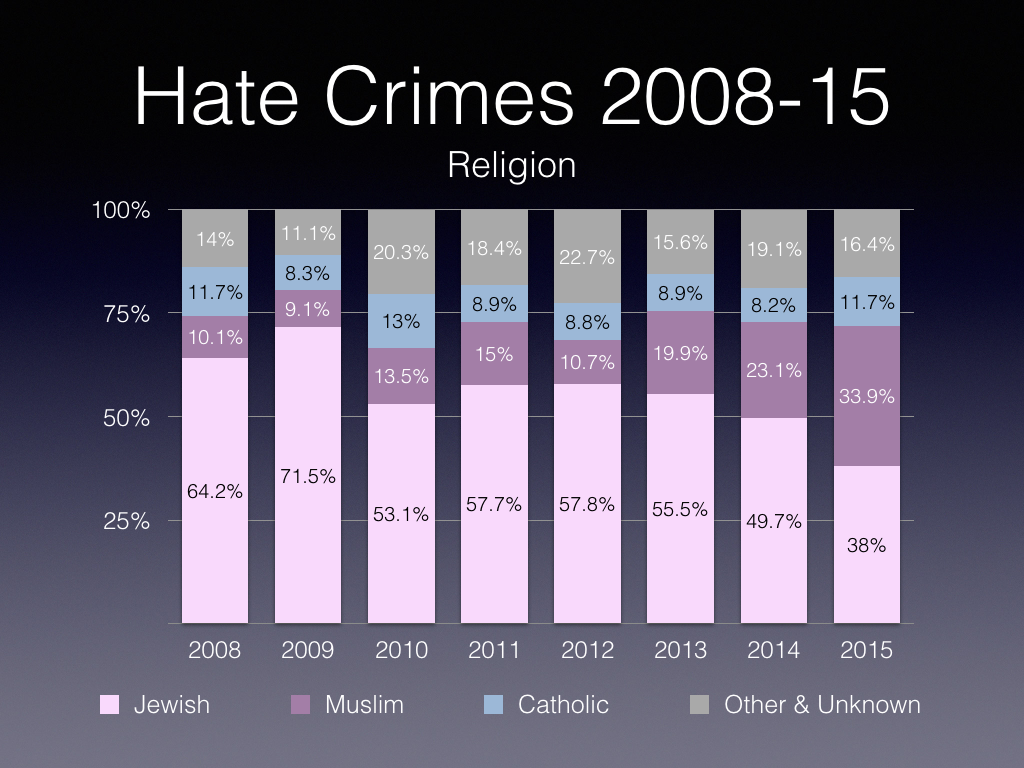
Lastly, this chart shows how religiously-motivate hate crimes have shifted, with the increase of hate crimes against Muslims notable:
Hate crimes rose by 5% in Canada in 2015, largely due to an increase in incidents targeting certain religious and ethno-cultural groups, specifically the Muslim population and Arabs or West Asians. For the year, police reported 1,362 criminal incidents that were motivated by hate in Canada, 67 more than the previous year.

These findings are included in the new Juristat article “Police-reported hate crime in Canada, 2015” released today.

Police-reported hate crimes refer to criminal incidents that, upon investigation by police, are found to have been motivated by hatred toward an identifiable group, as defined in subparagraph 718.2(a)(i) of the Criminal Code of Canada. An incident may be against a person or property and may target race, colour, national or ethnic origin, religion, sexual orientation, language, sex, age, mental or physical disability, among other factors. In addition, there are four specific offences listed as hate propaganda offences or hate crimes in the Criminal Code of Canada: advocating genocide, public incitement of hatred, willful promotion of hatred, and mischief motivated by hate in relation to religious property. Police determine whether or not a crime was motivated by hatred based on information gathered during the investigation and common national guidelines for record classification.

Overall, police reported 469 Criminal Code incidents in 2015 that were motivated by hatred of a religion, 40 more incidents than the previous year. These accounted for 35% of hate-motivated crimes reported in 2015.

Police-reported hate crimes targeting the Muslim population increased from 99 incidents in 2014 to 159 incidents in 2015, an increase of 61%. At the same time, the number of police-reported crimes targeting the Jewish population declined from 213 in 2014 to 178 in 2015. Hate crimes targeting the Jewish population accounted for 13% of all hate crimes, followed closely by hate crimes targeting the Muslim population (12%).

Approximately 10% of the population in Canada were part of a non-Christian religion in 2016. According to recent projections by Statistics Canada, the number of people in Canada with a non-Christian religion could almost double by 2036. Within this group, the Muslim, Hindu and Sikh faiths would see the number of their followers grow more quickly, although still representing a small portion of the population overall. In 2015, a number of police services increased outreach to ethnic groups, including Muslim communities. In addition, the National Council of Canadian Muslims made efforts to encourage reporting of hate crimes to police.

Increase in hate crimes against Arab and West Asian populations

From 2014 to 2015, the number of police-reported crimes motivated by hatred of a race or ethnicity increased 5%. Much of this increase was a result of more hate crimes targeting Arab and West Asian populations (+33%). Although down in 2015, crimes targeting Black populations remained the most common type of hate crime related to race or ethnicity (17% of all hate crimes). Overall, 48% of all police-reported hate crimes in 2015 were motivated by hatred of a race or ethnicity.

National increase in hate crimes driven by more incidents being reported by police in Alberta

In all, 8 of 10 provinces reported an increase in the number of police-reported hate crimes from 2014 to 2015. The increase was most pronounced in Alberta, where police reported 193 hate crimes compared with 139 the year before (+39%). This increase was primarily driven by a higher number of police-reported crimes motivated by hatred against the Muslim population (+12 incidents), Arab or West Asian populations (+10), Black populations (+9), and the Jewish population (+8). It should be noted that Alberta also reported an overall increase in their 2015 crime statistics.

In contrast, in Ontario, which historically records close to half the total number of hate crimes in Canada (46%), the number of police-reported hate crimes declined by 5% from 2014. The decrease in Ontario was primarily driven by fewer police-reported hate crimes motivated by hatred against the Jewish religion (-30 incidents) and against the Black population (-19).

From 2014 to 2015, police-reported crime motivated by hatred against the Muslim population increased in all provinces except Newfoundland and Labrador, Prince Edward Island, and Saskatchewan and Manitoba, where the totals remained virtually the same.

Number of hate crime incidents grows in four of Canada’s ten largest census metropolitan areas

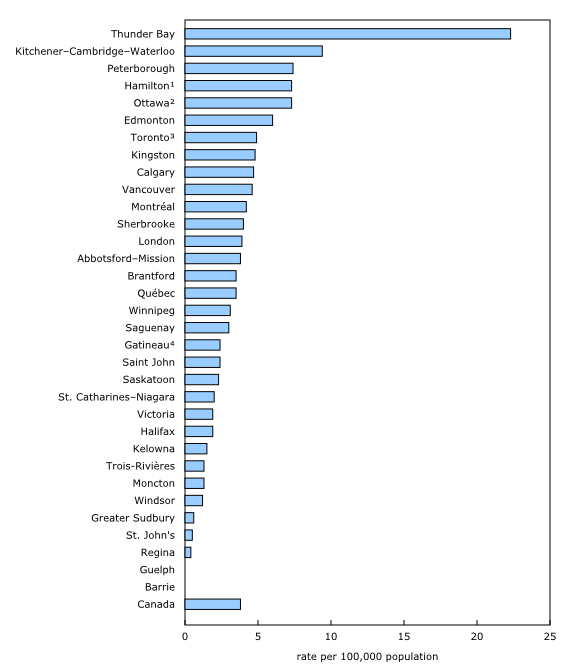
Chart 1  Chart 1: Police-reported hate crimes, by census metropolitan area, 2015
Police-reported hate crimes, by census metropolitan area, 2015

Chart 1: Police-reported hate crimes, by census metropolitan area, 2015

More than 80% of police-reported hate crimes in Canada occurred in census metropolitan areas (CMAs). The 10 largest CMAs in Canada, home to over half of Canada’s population, accounted for 71% of hate crimes in 2015. The three most populous CMAs of Toronto, Montréal and Vancouver together accounted for 43% of police-reported incidents in 2015.

Of the 10 largest CMAs in Canada, 4 reported more hate crimes in 2015 compared with the previous year, while 5 reported fewer such crimes. Vancouver reported the same number of incidents in 2015 as in 2014. The largest increases in hate crime incidents were reported in Edmonton (+45 incidents), Montréal (+39) and Kitchener–Waterloo–Cambridge (+23).

The increase in the Edmonton CMA was driven by more reported hate crime incidents against a race or ethnicity (+25) and against a religion (+17), mainly targeting the Muslim (+8) and Jewish (+7) populations. The number of hate crimes in Montréal was attributable to 33 more reported incidents targeting a religion. Of the additional incidents, 20 of these targeted the Muslim population. In the CMA of Kitchener–Waterloo–Cambridge, counts were primarily driven by more incidents targeting different races or ethnicities (+12) and religions (+10).

Increase reported in number of female victims of violent hate crimes

Females were more likely to be victims in incidents targeting a religion, and the presence of female victims in violent crimes motivated by hatred of a religion increased in 2015. That year, 53% of these victims were female, compared with 40% in 2014. The increase in female victims of religious hate crimes is attributed to an increase in female victims for Jewish and Muslim hate crimes from 2014 to 2015.

Victims of hate crimes targeting a sexual orientation are most likely to sustain an injury and know the accused

Police-reported hate crimes targeting sexual orientation declined 9% for the year, down from 155 incidents in 2014 to 141 incidents in 2015. They accounted for 11% of the hate crimes reported in 2015.

Unlike other types of hate crimes, almost 6 in 10 of reported crimes motivated by hatred of a sexual orientation were violent. This compares with 45% of anti-race or ethnicity offences, and 24% of anti-religion hate crimes. Just over 4 in 10 victims of hate crimes targeting a sexual orientation (42%) reported an injury, compared with victims of violent crimes motivated by hatred of a race or ethnicity (29%) and of a religion (12%).

Victims of violent hate crimes targeting sexual orientation were more likely to list the relationship as acquaintance or family member (47%). This compares with victims of violent crimes motivated by hatred of a race or ethnicity (36%) and of a religion (26%).

Violent hate crimes increase in 2015, but still account for less than half of hate crimes

Violent offences accounted for 38% of police-reported hate crimes in 2015. Violent offences included such things as assault, uttering threats, and criminal harassment. Overall, the number of violent hate crimes increased 15% from the previous year, driven by increases in common assault and uttering threats.

From 2014 to 2015, the total number of non-violent hate crime incidents increased by 5%. Mischief, which includes vandalism and graffiti, was the most commonly reported offence among police-reported hate crimes, accounting for 44% of all hate crime incidents in 2015.

Source: The Daily — Police-reported hate crimes, 2015

Australia: Labor disputes Peter Dutton’s claim party was briefed on citizenship changes

The politics are fascinating (policy not so much).

Not releasing the results of the consultations (Australia: Feedback on controversial citizenship changes to be kept secret) and now Labour contesting the degree of consultations …:

The shadow minister for citizenship, Tony Burke, has accused Peter Dutton of misleading journalists about having properly briefed Labor on the government’s proposed changes to citizenship laws.

Dutton, the immigration minister, announced on Sunday he would introduce legislation to parliament this week that made it harder to get Australian citizenship.

He said the Turnbull government wanted to toughen English language competencies, introduce a values test, extend the amount of time before permanent residents could apply for citizenship, and require people to demonstrate they had integrated into Australian society.

He called on Labor to support the legislation, and said Labor had been briefed on the bill.

“The Labor party will receive a copy of the bill this week,” he said on Sunday. “They’ve already had a briefing in relation to the bill.”

On Monday, Dutton then announced the legislation would give him power to overrule decisions by the Administrative Appeal Tribunalon citizenship applications that he didn’t think were in Australia’s national interest.

He called on Labor to support the bill again.

“It won’t pass through the Senate unless we can get Labor’s support, so that’s the key objective for this week, to speak with the Labor party,” he told Sky News.

“They’ve already had a briefing in relation to many of these matters and once they’ve seen the legislation this week they can ask questions.”

Labour response

But Burke said on Tuesday that Labor hadn’t been briefed on the policy details that appeared in media reports over the last couple of days.

He said the last briefing Labor received was before the 9 May budget, over a month ago.

“I was given a briefing on the 8th of May,” Burke said. “Was I briefed on the issues of the citizenship changes that were in the papers on the weekend? No, not at all. That’s all new. None of that existed as part of the proposal at the time of the briefing.

“[During that briefing], when I asked which parts of what I was being briefed on the government was committed to, the answer was none.

“When I asked, on the English-language test, how many people who currently apply for citizenship would pass the test, the government didn’t know.

“When I asked how many Australians would pass the test at a university level, the government didn’t know.

“Today I see in the papers, a claim that it is somehow linked to national security … once again, we’ve got changes here that have appeared in the paper that weren’t part of the briefing, that weren’t part of the government’s original proposal,” he said.

ICYMI – Enquête: le Montréal des sans-papiers

One of the relatively rare articles that I have seen regarding sans-papiers. And being undocumented, we have no good data on how many there are:

Nous les croisons sans les voir dans les rues de Montréal. Ils font le tri de nos rebuts, récurent les toilettes de nos cliniques médicales, passent l’aspirateur, la nuit, dans les couloirs de nos bureaux. Ils sont des dizaines de milliers, mais ils sont invisibles. Sans eux, l’économie de la ville subirait un dur coup, puisque ces travailleurs de l’ombre occupent les emplois dont personne ne veut. Sans le moindre filet de sécurité. Bienvenue dans le monde occulte des sans-papiers de Montréal.

Les travailleurs invisibles

Alors qu’un flot de demandeurs d’asile, apeurés par le national-populisme de Donald Trump, déferle à la frontière canado-américaine, alors que Denis Coderre déclare Montréal «ville sanctuaire», nous avons voulu mettre en lumière le quotidien des sans-papiers. Nous avons découvert que Montréal est encore loin d’être la terre d’asile proclamée par le maire. À bien des égards, elle est moins hospitalière que des métropoles américaines comme Los Angeles et New York, qui ont depuis longtemps adopté des politiques concrètes pour soutenir les sans-papiers sur leur territoire.

Montréal suivra bientôt les traces de ces villes américaines en offrant divers services et, surtout, en limitant au maximum la collaboration de ses policiers avec les agents d’immigration, a assuré le maire Coderre.

Mais ce n’est encore qu’un projet. Pour le moment, 70% des sans-papiers de la métropole n’arrivent peu ou pas à satisfaire leurs besoins personnels ou ceux de leur famille, révèlent les données préliminaires d’une étude menée par l’Institut de recherche en santé publique de Montréal. Près de la moitié d’entre eux manque carrément de nourriture. Et 40% craignent d’être déportés s’ils tentent d’obtenir des services publics.

Cette crainte pesante, omniprésente, les pousse à tolérer les abus de ceux qui profitent de leur vulnérabilité, en sachant parfaitement qu’ils n’ont pas le loisir de se plaindre.

Source: Enquête: le Montréal des sans-papiers | Isabelle Hachey | Enquêtes

SCOTUS strikes down citizenship law – CNNPolitics.com

Surprising it took this long for a case to test the discrimination:

The Supreme Court on Monday struck down a federal law that treats children born overseas to unmarried parents differently for purposes of citizenship depending upon whether the biological father or mother is a US citizen.

Under the law, US citizen fathers have to spend at least five years in the states before the child could become a citizen, while the mother only had to spend one year.
The plaintiff in the case, Luis Ramon Morales-Santana, was born in 1962 in the Dominican Republic to unmarried parents. His mother was a citizen of the Dominican Republic and his father was a US citizen who had not spent more than five years in the United States after his 14th birthday.
Morales-Santana was admitted to the US as a lawful permanent resident in 1975. After years of living in the US he was put in removal proceedings after convictions for various felonies. He claimed he was a US citizen because of his father’s citizenship. But the Board of Immigration Appeals denied the claim because the father had not satisfied the physical presence requirements.
Justice Ruth Bader Ginsburg, who dedicated her career to the issue of gender discrimination before taking the bench, wrote the decision.
The section of the 1952 Nationality Act, she wrote, could not “withstand inspection under a Constitution that requires the government to respect the equal dignity and stature of its male and female citizens.”
But while the law “violates the equal-protection principles,” the court also said it is “not equipped” to grant the relief that Morales-Santana seeks — striking down the law and grant him citizenship. Congress would have to make that determination, Ginsburg wrote.
Under the Immigration and Nationality act of 1952 as originally written, a child born outside of the United States to an unwed citizen father and a non-citizen mother has citizenship at birth only if the father was present in the United States for a period totaling at least 10 years, with at least five of those years occurring after the age of 14. But the statute has since been amendedto decrease the time requirement for those born since November 14, 1986, to 5 years in the United States, at least two of which were after age of 14. A child born abroad to an unwed citizen mother has citizenship if the mother lived in the United States for at least one year at some point prior to the child’s birth.

Source: SCOTUS strikes down citizenship law – CNNPolitics.com

The casual indifference of Dachau’s selfie-taking Holocaust tourists: Mark Milke

We did not have the same experience as Milke at Dachau during a fall visit.

However, his points are valid, as selfies and other photos are about the person visiting, not about the place and history, whether it be a concentration camp, great works of art at the Louvre or other galleries etc:

So how to explain this unfortunate phenomenon? I’d like to hope it was only the day I visited: it was sunny that morning which can produce a parallel optimism; perhaps overcast or rainy weather would better provoke a somber mood in those walking around the first Nazi death camp. Or maybe it’s the camp’s proximity to Dachau, the town. Neatly arranged townhouses overlook the bunker, with only a fence and a few metres separating them. Normality long ago returned to Germany, including Dachau, and perhaps it is difficult to sustain a sense of unique horror when everyday life continues around the 84-year-old camp, and when so many of those with direct memories of the horrors are no longer with us.

Whatever the explanation, the casual indifference at Holocaust sites is something others have also begun to notice. Last year, Ukrainian filmmaker Sergei Loznitsa set up cameras at Dachau and also at Sachenhausen (near Berlin) and let them roll. He recorded selfie after selfie, along with all the other self-obsessed behaviour all too common in what he labeled “Holocaust tourism.”

One Guardian columnist, reviewing Loznitsa’s documentary, Austerlitz, suggested selfies be banned at concentration camps, though not photography. That’s a sensible proposal, though I found myself unable to even take my camera out of my backpack; to snap a photograph seemed too casual.

Another approach to confronting self-absorbed selfie tourism: shame. Earlier this year Israeli artist Shahak Shapira superimposed cut-outs people had taken at the Berlin Holocaust memorial (including people engaged in yoga and rap poses) over ghastly Holocaust images of starved camp prisoners and corpses in trains. It helped show the disrespect that Holocaust tourism communicates to the dead and to those who were fortunate enough to survive.

It would be too easy though, to blame the young and engage in generational stereotypes. To complain of the ignorance of youth is to engage in circular reasoning—why should young people be expected to know that which they have not been taught? Or that which has not been emphasized? Fact is, if some children or young adults lack historical knowledge and awareness of why such sites should be treated as akin to holy shrines, with the greatest of reverence and respect, the blame falls elsewhere: on adults who by a lack of instruction, presence or example, fail to signal the importance of sober, even somber, remembrance.

Thus, examples matter: As I exited Dachau, walking along a path from the main gate back to the visitor centre, a forty-something fellow trotted by in the opposite direction. He walked casually, licking a fudgesicle, or popsicle or some similar frozen creation. His gait and casual cluelessness said it all: he was approaching just another “attraction” of sorts, as if he were about to enter Disneyland and not Dachau.

Source: The casual indifference of Dachau’s selfie-taking Holocaust tourists – Macleans.ca

Australia: Queen’s honours list awards diversity, multiculturalism and Indigenous service | SBS News

Another illustration of the differences between Australia and Canada: this article highlights in a positive sense that 1.6 percent of the Australian honours list (equivalent to the Order of Canada) are from visible minorities or Indigenous peoples (or have made major contributions to these communities).

By way of comparison, in Canada 2013-16 Order recipients were 4.7 percent visible minority, 3.3 percent Indigenous peoples (The Order of Canada and diversity):

The list of almost 900 Australians included a dozen honoured for their contribution to Indigenous Australia and fourteen honoured for their contribution to multiculturalism and diversity.

Source: Queen’s honours list awards diversity, multiculturalism and Indigenous service | SBS News

‘It is a battle for hearts and minds’: Trudeau’s $35 million gamble to counter radicalization

No easy solutions but these approaches are part of the toolkit. Small change compared to security expenditures:

A growing number of experts are advocating for a more holistic approach to countering violent extremism — one that attempts to address community grievances and feelings of social exclusion, he said.

Still, some say the terrorist propaganda and violent narratives on the Internet and social media sites — often infused with glorious references to past and valiant warriors — cannot be ignored and efforts must be made to squarely refute  their often misleading claims.

“It is a battle for hearts and minds,” Shaikh said.

Some of this is already happening in Canada. In 2015, Public Safety Canada threw its support behind a video project, Extreme Dialogue, that highlighted the stories of individuals who had walked away from extreme Islamist groups or far-right groups, as well as family members impacted by extremism.

Last year, Montreal’s Centre for the Prevention of Radicalization Leading to Violence created a comic book that used humour to try to address some of the underlying causes of radicalization.

But do these counter-narrative campaigns ring hollow for their intended audiences? And how do you gauge success? By clicks and web visits?

Phil Gurski, a former CSIS strategic analyst, said trying to deconstruct and counter every piece of propaganda ends up being a never-ending game of “whack-a-mole.” He suggested putting more emphasis on alternative narratives, for example, emphasizing Muslim empowerment and success stories.

But that still leaves the question of how to deal with individuals who are more deeply entrenched in their radicalization, such as foreign fighters who have returned to Canada. About 180 Canadians are known to have participated in terrorist activities overseas — mostly in Turkey, Iraq and Syria — and about 60 have returned.

If police fear someone may commit a terrorism offence, but don’t have enough evidence to charge them, they have sometimes gone to court to apply for peace bonds, which temporarily restrict an individual’s movements. But as the case of Aaron Driver showed, these bonds cannot always be relied upon to prevent violence.

Driver had been the subject of a peace bond that restricted access to his computer and cellphone and barred him from possessing firearms or explosives. Yet, last August, the Islamic State sympathizer was able to shoot a martyrdom video and get into a taxi with a homemade bomb before being shot and killed by police in Strathroy, Ont.

For those not quite as far down the path of radicalization, police in Toronto last year announced they had been experimenting with an early intervention model, not dissimilar to the one in Britain. Individuals deemed at-risk for violence are steered to “hubs” of community representatives who assess whether they might benefit from spiritual guidance, family counselling or mental-health support. Calgary police have a similar program in place.

Yet this approach creates other conundrums: Should such voluntary programs be mandatory? And should the goal be “de-radicalization” — the suppression of extreme ideology? Or is it more realistic to settle for “disengagement” — allowing a person to continue to harbour radical ideas so long as they do not resort to or support violence?

“The dangers to democracy are obvious here and not at all easy to reconcile,” Littlewood said. And, “success in one year may be undone two or three years later,” he added.

Whoever takes the helm of Canada’s new counter-radicalization office is in for a “mind-boggling” ride to try to create a coherent national framework for best practices, Gurski said.

“I don’t know if we’ll ever know what works,” he said. “But that doesn’t mean we shouldn’t do it.”

Les questions de diversité divisent les péquistes

The PQ coming to terms with diversity, and its preference for a softer “encouragement” approach than one with more fixed objectives and processes:

Les 400 délégués du Parti québécois ont refusé dimanche d’appuyer les propositions phares destinées à attirer plus de Québécois d’adoption et de jeunes contenues dans le rapport « Faire partie de la solution » de Paul St-Pierre Plamondon.

Après que l’exécutif national eut rejeté les appels de l’ex-candidat à la chefferie du PQ à réserver des postes dans les exécutifs de circonscription à des personnes issues de la diversité, les délégués d’un conseil national spécial ont voté dimanche contre une proposition édulcorée proposant de « favoris [er] la présence d’au moins une personne de la diversité » dans cette instance.

Selon un militant de Saint-Henri–Saint-Anne, le PQ a raté une occasion en or d’« envoyer un bon message d’ouverture », et ce, moins d’un mois après avoir été taxé par des membres de Québec solidaire de « porter en lui » la « bête » du racisme.

Les délégués avaient été convoqués à Drummondville afin d’entériner la feuille de route d’accession vers l’indépendance avalisée par tous les membres des Organisations unies pour l’indépendance (OUI Québec). Mais, entre-temps, Québec solidaire a renié sa signature au bas de l’entente de principe. Le PQ s’adapte à cette « nouvelle conjoncture politique », a souligné le président sortant du PQ, Raymond Archambault.

Dans ce premier Conseil national « post-convergence », la déléguée de l’exécutif péquiste de la circonscription de Vachon, Marie Imatta Pierre-Lys, a appelé ses confrères et consoeurs à battre la proposition de M. St-Pierre Plamondon, puis à déployer toute leur énergie à rédiger un « beau programme qui va inclure tout le monde » en vue des élections générales de 2018. « Avant tout, je me considère comme une Québécoise. Que je sois noire ou femme, mes intérêts sont comme [ceux] de toutes les autres personnes. Si je me présente à un poste de conseillère, [il ne faut]pas que je sois favorisée parce que je suis noire, mais par d’autres qualités que j’ai », a-t-elle déclaré lors du débat.

L’émissaire de l’exécutif de Berthier, Patrick Gaétan Parent, a aussi voté contre la proposition de l’exécutif national, estimant que le concept de « diversité » prête à différentes interprétations : il n’est pas seulement ethnoculturel. « La diversité, c’est beaucoup plus que ça. C’est pas juste d’être noir. Ça, ça se voit vite quand on est noir », a-t-il illustré, suscitant des rires amusés… et des rires gênés.

Le résultat du vote, à main levée, était flou. « Proposition rejetée », a pourtant lancé le président d’assemblée sous le regard ébahi de M. St-Pierre Plamondon. « Je pensais qu’il [le vote] avait passé », a-t-il dit dans un impromptu de presse dimanche soir. Il a attribué le rejet de sa proposition principalement à l’intervention de Mme Pierre-Lys. « Ç’a beaucoup influencé le débat. C’est une bonne nouvelle dans la mesure où quelqu’un issu de la diversité au sein du PQ nous dit : il n’y a aucun problème au Parti québécois sur le plan de la diversité », a-t-il affirmé à moins de 15 mois des prochaines élections générales.

Il ne se satisfait pas pour autant du refus opposé à cette proposition centrale de son rapport « Faire partie de la solution » par les délégués. D’ailleurs, l’avocat promet de revenir à la charge avec une proposition similaire au congrès national du PQ en septembre prochain. « Malgré les succès individuels que certains ont pu avoir […], on a de l’ambition, on veut plus de diversité. Donc, je continue à penser qu’il faut mettre des mesures pour favoriser des places à des Québécois d’adoption ou des Québécois issus de la diversité. »

Quotas ou pas, la volonté du PQ de recruter en grand nombre des Québécois issus de la diversité culturelle (16 % de la population québécoise) qui partagent à la fois ses « valeurs », ses « propositions » et son « objectif indépendantiste » est réelle, a fait valoir le chef du parti, Jean-François Lisée. Il s’est fixé dimanche l’« objectif » de présenter au moins 20 candidats issus des communautés culturelles (sur 125) aux prochaines élections générales. « Je ne dirais pas qu’il y aura un quota, a-t-il précisé. C’est un souhait. C’est un objectif. » Mais, chose certaine, ces candidats ne seront pas tous dépêchés dans des circonscriptions imprenables, a promis le chef péquiste.

Source: Les questions de diversité divisent les péquistes | Le Devoir

Australia: Feedback on controversial citizenship changes to be kept secret

Hard to understand the rationale apart from stifling discussion and debate. Indicates a certain insecurity:

The Turnbull government will keep secret the public’s feedback on its proposed changes to the Australian citizenship test, in a marked departure from normal processes, as the controversial bill goes before Parliament this week.

The immigration department confirmed it will not publish submissions to the consultation process designed to inform the final version of its revamped citizenship regime – particularly the introduction of an Australian values test.

Open for the six weeks until June 1, the consultation was supposed to help the government define “Australian values” and to word a new pledge of allegiance to Australia. “We are looking for views,” Prime Minister Malcolm Turnbull said in April.

But the department will not air those views publicly, citing confidentiality, nor confirm the volume of feedback received. “Submissions were provided in confidence and were not for publication by the department,” a spokesperson said in a statement.

However, several organisations that made submissions told Fairfax Media they did not request the department keep their recommendations private.

The Refugee Council, Federation of Ethnic Communities Councils and the Liverpool Migrant Resource Centre have all published their submissions – critical of the government’s proposal – on their websites.

Immigration Minister Peter Dutton on Sunday confirmed a bill to enact the major changes – including a four-year wait before permanent residents can attain citizenship, and tougher English language requirements for aspiring citizens – will be introduced to Parliament this week.

The new regime would allow him, as minister, to revoke the citizenship of migrants suspected of gaining citizenship fraudulently – by lying on the test, for example. It will also require minors to pass a “good character” test to gain citizenship, in a move designed to target young migrant criminals.

“It is a bill that suits the times we’re living in and the government is very serious about making sure that people who pledge their allegiance to our country abide by our laws and our values,” Mr Dutton said on Sunday.

The citizenship reform package, the second in three years, has attracted the ire of migrant groups and some in Labor’s Left faction, who have voiced concerns about unfairly strict English testing and disenfranchising permanent residents for four years.

Labor reserved its position on Sunday, with citizenship spokesman Tony Burke promising to “deal responsibly with any sensible proposal” from the government. Mr Dutton also indicated he was willing to negotiate with the Senate crossbench.

The decision against publishing the public’s feedback defies routine practice for government consultations, whereby public submissions are usually published online unless they contain sensitive or defamatory material.

Source: Feedback on controversial citizenship changes to be kept secret

Too many Canadians don’t recognize the Islamophobia in their country

Melayna Williams on Islamophobia:

Indeed, plenty of work has already been done to capture, contextualize and fully understand what Islamophobia means. A paper published in 2011 by the Ontario Human Rights Commission highlights the “negative stereotyping and discrimination as a result of pre-existing perceptions of Muslims as ‘different’ from the rest of Canadian society, along with negative associations of their communities with violence and terrorism” in the decade following the Sept. 11, 2001, terrorist attacks in New York City.

These problems even occur in institutions that pledge tolerance and inclusion, like Canadian universities. Following the Quebec City mosque attack, Muslim students publicly recounted incidents that are part of their daily reality: the defacing of posters for a conference on Islam at Durham College and the University of Ontario Institute of Technology; and the distributing of anti-Muslim flyers and insults on student election materials at McGill University, the University of Calgary and the University of Ottawa. A student at Simon Fraser University was told to remove her hijab, and horrifyingly, last year, a woman had her hijab pulled, was punched and spat on in a grocery store in London, Ont.

We don’t need more evidence—yet there’s still denial by many white Canadians. Exercising privilege in this way has clear detrimental effects, argues Tim Wise, an anti-racism writer and activist. “That white Americans don’t by and large see what people of colour see doesn’t mean that white folks are horrible people, of course,” he writes in an essay called “White Denial.” “What it does suggest is a degree of isolation and provincialism that should lead us to think twice before pontificating about a subject that we simply don’t have to know nearly as well as those who are the targets of it.”

This is why “recognition of Muslims as part of the fabric of this country is so critical,” argues Shirazi. Many Canadians have the luxury of not acknowledging racism, and they’ve done so to the extent that white denial has become its own narrative. Any attempt to ignore the problem—or treat its victims as “other”—undercuts any effort toward inclusion in the next 150 years.

Source: Too many Canadians don’t recognize the Islamophobia in their country – Macleans.ca