Chris Selley, Simona Chiose: Two takes on the business interests of Jordan Peterson, hero of the anti-PC crowd

Interesting analysis of the business models supporting Peterson in both the National Post and Globe.

Peterson canbe judged to some extent by the company he keeps as detailed in the longer and more comprehensive Globe article:

On Sept. 1 last year, Peterson had 161 supporters on the crowdfunding site Patreon, contributing US$1,058 a month; as of this week, he had 3,609 supporters contributing an astonishing US$39,084 a month. That’s about three-and-a-half times his salary from the university. When Peterson was denied a research grant to study the link between personality and political beliefs, including belief in political correctness, Ezra Levant’s Rebel Media framed it as a left-wing conspiracy and launched a crowdfunding campaign on his behalf. It currently sits at 266 per cent of its goal: $195,230.

“It’s unbelievable. But all of it is unbelievable,” says Peterson, referring both to the money and to the last eight months in general.

Naturally, this outcome does not sit perfectly well with Peterson’s detractors on campus. “It does seem to me rather tacky that he has been posing as a victim of PC prejudice and representing himself as at risk of jail or dismissal from his job,” says Ronald de Sousa, an emeritus professor of philosophy at U of T. Lawyers’ opinions have convinced de Sousa that Peterson has nothing legitimate to fear from the law, and nothing except a “tut-tutting letter” — which he calls a “regrettable decision” — to fear from the university administration.

Physics professor A.W. Peet is rather more blunt: “He has been dehumanizing trans and gender-diverse people … for fun and profit.”

Rebel’s intervention certainly adds an edge. Peterson says he watches very little of the online news outlet’s output, which is not surprising: it is not known for its academic or journalistic rigour, or indeed for consistent sanity. At one anti-Peterson rally on the U of T campus, then-Rebel contributor Lauren Southern took the microphone as if she were an attendee, not a reporter; when organizers said they wanted to give trans people priority to speak, she lied and said she was one. Rebel contributors have included Paul Joseph Watson, a 9/11 Truther and friend of uber-conspiracist Alex Jones; Pizzagate delivery man Jack Posobiec, who was briefly Rebel’s “Washington bureau chief”; and Tommy Robinson, former leader of a gang of racist hooligans called the English Defence League. Peterson says he knows “for a fact” Levant isn’t Islamophobic, noting they were recently at a meeting with several moderate Canadian Muslims. But the network did spend the hours after the massacre at a Quebec City mosque torquing garden-variety confusion into a conspiracy theory that the killer was, in fact, Muslim.

Peterson says he would always prefer his work be associated solely with himself but that he’s “disinclined to look a gift horse in the mouth.” Peet has no qualms with crowdfunding academic research per se, but thinks there should be rules governing it — for example, when a third party like Rebel intervenes on a professor’s behalf. Such guidelines are under development at U of T, says spokesperson Althea Blackburn-Evans. But if they put any crimp in Peterson’s plans, he could easily make up the difference some other way.

If Peterson’s fundraising numbers are astounding, perhaps the astounded have underestimated the fury being inspired by modern preoccupations like white privilege and cultural appropriation, and by the marginalization, shouting down or outright cancellation of other viewpoints in polite society’s institutions. The biggest applause line at last weekend’s Conservative Party of Canada leadership convention came when winner Andrew Scheer promised to withhold federal funding from universities that “shut down debate.”

“It’s (bad) enough that the media elites find the views of many conservatives unfashionable or outré,” says one Conservative strategist, describing the mood among party supporters. “Now the trendline on university campuses seems to be to ban any expression of conservative ideas … or any questioning of liberal orthodoxy.”

Peterson is by no means appealing only to reactionaries or partisan conservatives, however. His YouTube channel, which has 290,000 subscribers, is not a source of Rebel-style rants and conspiracies. Recent videos include the first two of his ongoing 12-part lecture series, The Psychological Significance of The Biblical Stories. (Some of his crowdfunding money went toward renting the Isabel Bader Theatre at U of T for the series, but he says he made it back through ticket sales.) His Patreon account promises “lectures about profound psychological ideas.”

“History has shown that political correctness, and all that comes with it, is the first step on a very dark path,” says Philip Sibbering, a games designer in the U.K. who contributed to the Rebel-sponsored crowdfunding effort. Sibbering notes the intellectual intolerance of the Nazis, which all of society now rejects, and of the Marxists, which all of society does not. “Any research that could allow us to understand the root cause and effect that brings political correctness into being is vital.”

Stephen Kaiser-Pendergast, a film editor based in Los Angeles and another crowdfunding contributor, first discovered Peterson through his interviews with Dave Rubin and Joe Rogan, two prominent critics of political correctness. (The interviews have 185,000 and 1.9 million views on YouTube, respectively.) “Working in narrative film, I have a vested interest in any kind of remedy for politically correct thinking, which I see as among the most significant of threats to artistic expression,” he says. “However, I mostly remain on his (YouTube) channel for the academic material. I have had a lifelong interest in understanding human behaviour and I find Prof. Peterson’s channel to be a treasure-trove.”

Peterson has big plans, and money to make them happen. He plans to curate “a series of conversations with moderate Muslims about the possibility of developing a bridge between that faith and the fundamental beliefs of the West.” It began on Thursday when he interviewed Ayaan Hirsi Ali (though she is more of a former Muslim than a moderate one). [a rabid anti-Muslim activist would be a more accurate description]

Source: Chris Selley: Jordan Peterson, hero of the anti-PC crowd, just keeps winning | National Post

The Globe’s Simona Chiose also covers the story more in depth from a more critical angle, along with analysis of follower comments:

Prof. Peterson’s vociferous defence of free speech isn’t new to universities. What is new, however, is the way that social media has amplified the discourse – and “weaponized” and globalized this long-running drama. The professor’s unrelenting stance has earned him scores of angry critics, but the attention has also helped him rack up followers. He now has almost 300,000 subscribers on YouTube and thousands of patrons on Patreon, a crowd-funded subscription content site where he earns more than $30,000 a month. On Twitter, his followers hail from Shanghai and Berlin, St. Petersburg and Pune, Toronto and San Francisco. And under the guise of anonymity, these anti-PC warriors can harass their opponents through posts, memes and videos and organize campaigns on no-holds-barred message boards.

The existence of this parallel, online space is hardly mentioned in free speech debates or arises only in lateral mentions of concerns about “safety on campus.”

But an investigation into the controversy around Jordan Peterson shows how this world grows and operates. With his vast online reach, Prof. Peterson has attracted small volunteer armies willing to defend his views. The Globe and Mail reviewed hundreds of pages of discussions about Prof. Peterson and his views on anonymous message boards, including 4chan and voat – two of the least moderated or monitored online forums. The conversations, which range from immature to obscene, show that the professor’s critics were the subjects of “doxing” campaigns, where activists are personally identified and harassed online.

Prof. Peterson says he can’t be held responsible for the harassment that his critics endure online, however, and justifies his hardline position on free speech by saying it allows hateful views to be exposed to the cleansing light of day.

“It’s extraordinarily dangerous to drive hate speech underground,” he said in a conversation last fall. “There are a lot of terrible things that people shouldn’t say, but that does not mean you should stop them from saying them, because you want to know who is saying them and you want to bring discourse to bear on their perspective,” he said.

In short, Jordan Peterson has redefined the notion of the faculty celebrity and pushed the university into new territory, trying to decide what protecting free speech means in the age of Internet trolls.

How U of T’s Jordan Peterson has made money from online notoriety

Liberals face pressure to crack down on crooked immigration consultants

More on the problems of immigration consultants (see earlier Agency that oversees immigration consultants appears to be in turmoil):

The government is facing pressure from MPs of all political stripes to crack down on bogus immigration consultants who prey on people who are desperate to work or live in Canada.

The Commons immigration committee has just wrapped up weeks of hearings on unregistered representatives called “ghost consultants.” MPs are now considering recommendations ranging from overhauling or even scrapping the independent oversight body, to imposing heavier penalties for perpetrators.

Members heard harrowing stories from duped clients who testified behind closed doors. Some were ripped off for thousands of dollars, or brought over with the promise of work only to be dumped at the side of the road or left in a warehouse. In all, they heard from 50 witnesses and read 24 written submissions.

Liberal MP and committee chair Borys Wrzesnewskyj said testimony about crooked and ghost consultants made it clear the status quo can’t continue.

“There is an appetite to fix this. It’s just not acceptable that the present set of circumstances continue,” he told CBC. “It won’t be an easy job. The fact that it’s been studied a number of times and we’re still having to listen to circumstances and their very poignant stories speaks to that.”

Wrzesnewskyj hopes the committee can table its report, which is expected to include recommendations for sweeping reforms, before the House rises for the summer.

Conservative immigration critic Michelle Rempel believes there is broad consensus that the current system is broken and needs an urgent fix. The “hair-curling” stories heard underscore the need for major reforms.

Blacklist for bad actors

While there are many above-board immigration consultants, their reputation has been stained by reports of unethical representatives preying on vulnerable people.

Along with suggesting a possible blacklist for bad practitioners, Rempel said the government must work to modernize and simplify the complex system so people can navigate it themselves instead of turning to third parties.

“More broadly, the fact that there even needs to be an industry suggests there are a lot of improvements that could be had within the actual department in terms of ease, efficacy of approaching the Canadian immigration system,” she said.

Rempel said testimony about significant governance problems with the Immigration Consultants of Canada Regulatory Council (ICCRC), which was established in 2011 to oversee registered consultants, raised questions about its ability to fulfil its mandate.

Source: Liberals face pressure to crack down on crooked immigration consultants – Politics – CBC News

To Honor Canadian Natives, a Lawmaker Speaks in Mohawk – The New York Times

Nice:

Cultural appropriation is a touchy topic in Canada these days, with the recent controversy in Canadian media over whether it is appropriate for nonindigenous writers to take on a native voice for artistic expression. But Marc Miller, a member of Canada’s Parliament, decided he was on solid ground in giving a speech in Kanyen’kéha, the language of the Mohawks, in the House of Commons on Thursday.

“Language is one of those things that, if you apply the appropriation rule, would die faster,” Mr. Miller said in a telephone interview. He said he was inspired to learn the language because the district he represents in Quebec covers traditional Mohawk land.

“I stand here to honor the Mohawk language, and I pay my respects to their people,” Mr. Miller said in Kanyen’kéha to mark the beginning of Canada’s National Aboriginal History Month. He said in the short speech that he hoped to hear the language more often in Parliament, and that more Canadians would “be proud to use it to speak to one another.”

Marc Miller delivers a statement in Kanyen’kéha, the language of the Mohawks. Video by CBC News

Indigenous languages are dying in Canada, as they are in much of the industrialized world, largely as a consequence of past government efforts to stamp out their use and force assimilation into the larger population. In Canada, that was accomplished through residential boarding schools where indigenous students were forbidden to speak their native tongues.

The government has tried to make amends for this history in recent years, after a wrenching Truth and Reconciliation Commission laid bare the amount of abuse some 150,000 indigenous students experienced at the government-financed schools over more than a century. The former prime minister, Stephen Harper, apologized on behalf of the government. His successor, Prime Minister Justin Trudeau, followed up with a vow to adopt all 94 recommendations from the commission, known in Canada as calls to action.

The government has promised to spend about $90 million Canadian (in United States currency, about $67 million) over the next three years to support indigenous languages and culture, including $69 million Canadian for such things as classes to keep alive native languages.

It has also committed to work with the indigenous population to codevelop an Indigenous Languages Act that will help ensure the preservation and revitalization of indigenous languages.

Fewer than 600 people in Canada cited Kanyen’kéha as their mother tongue in the country’s 2011 census. All but a few of the 60 indigenous languages that still exist in the country are expected to disappear within the next generation.

U.S. consultants slam Shared Services Canada for failing projects

To the current government’s credit, it engaged Gartner to review the implementation of the shared services initiative.

The question remains whether officials who promoted and supported the previous government’s strategy provided sound advice on the risks and mitigation strategies, and whether or not Ministers and the government accepted it or not.

Complex IT projects are hard, and government by its very nature is not agile, further exacerbating risk:

Ottawa is in way over its head by attempting a massive transformation of its information-technology (IT) systems under Shared Services Canada, says a scathing indictment of the agency’s failings since 2011.

The government of Canada “has vastly underestimated the size, scale and complexity of this effort. … They are attempting the largest and most complex public-sector shared-service implementation ever considered,” concludes a $1.35-million report by international consultants.

“We … lack confidence in the ability of SSC (Shared Services Canada) and the GC (Government of Canada) to successfully execute the plan.”

The Jan. 12, 2017, report by consultant Gartner Inc. was ordered by the federal government last August, after repeated failures of the Phoenix payroll system and complaints from departments about Shared Services Canada’s inability to deliver technology upgrades, including new email systems.

U.S.-based Gartner brought together a five-person expert panel to examine the agency and its projects, a group that included executives experienced in public-sector digital transformations in California, Massachusetts and Northern Ireland, as well as the former IBM executive who handled big projects within that firm.

Shared Services Canada outsourcing

A $1.35-million consultants’ report, obtained by CBC News under the Access to Information Act, says Shared Services Canada is in way over its head trying to manage a massive transformation of technology. (Shutterstock)

The report lauds the project of consolidating the federal government’s information technology, including creation of a single email system, but says “very little progress” has been made in the last six years because of persistent management failures.

“Decision making cannot follow current approaches,” said the document, obtained by CBC News under the Access to Information Act.

“Execution must be based on agile, effective decision making, with clear and singular accountabilities. This is the antithesis of governance today.”

The report repeatedly underscores the enormous scale of the consolidation project, likening it to combining the infrastructure of between 30 and 40 large banks.

Slow-footed

The consultants say Shared Services Canada is slow-footed, partly hobbled by complex procurement rules, so that an email solution it chose in 2011 and still has not completed has since been outmoded by new cloud services.

“The world in 2016 is much different from how it was in 2011, and the expert panel and Gartner believe developments such as cloud services should be given much more prominence in SSC’s future,” said the 198-page report.

Some of the document is redacted, including key financial information. The authors make a series of recommendations, chief of which is the appointment of a deputy minister for IT for all of government, to whom the head of Shared Services Canada would report.

In April 2011, then-prime minister Stephen Harper lauded the project to consolidate the government’s IT systems and data centres, saying on the election campaign trail that year that “we know we can save all kinds of money there.”

‘The project was set up to fail through underfunding, lack of service standards, and poor planning from the previous government.’– Jean-Luc Ferland, spokesperson for Treasury Board President Scott Brison

The new agency charged with carrying out the transformation, Shared Services Canada, was announced on Aug. 4, 2011, after Harper won a majority.

But two projects in particular went off the rails in the early going, one to consolidate cell and telephone services, the other to consolidate email services. Both have been plagued by delays, among other problems.

And the new agency was immediately required to cut costs as part of a government-wide effort to wipe out the federal deficit by 2015.

Shared Services Canada data centre

Shared Services Canada is the department responsible for the federal government’s IT services, including its data centres. A new report says the federal government must create a new deputy minister of IT, to help get the troubled agency back on track. (Shared Services Canada)

Jean-Luc Ferland, a spokesperson for Treasury Board President Scott Brison, welcomed the consultants’ conclusions and recommendations, pinning much of the blame for the bad results on the former Conservative government.

“As the report makes clear, the motivation and objectives behind the creation of Shared Services Canada are even more relevant today than they were when it was conceived in 2011,” said Ferland.

“The report is equally clear that the former Conservative government failed to put in place the basic fundamentals for success at the time SSC was created. The project was set up to fail through underfunding, lack of service standards, and poor planning from the previous government.”

No timeline

Ferland said the government is still reviewing the recommendations, alongside those of the auditor general, House of Commons committees and other consultations. He did not provide a timeline for solutions.

“Our government’s ambition is to provide exemplary service to Canadians while making a seamless transformation to the age of digital government — not booking false savings, arbitrarily hobbling the public service, or cutting corners.”

Source: U.S. consultants slam Shared Services Canada for failing projects – Politics – CBC News

Wayne Smith, former Chief Statistician, continues his critique of Shared Services: Questionable transfers from Statistics Canada to Shared Services Canada


Newcomers grabbing at Canada’s brass ring: Canada Project findings

Some of the interesting points regarding newcomers:

One of the key findings from a Canada Project poll is that 44 per cent of immigrants have access to over $10,000 in savings. That far exceeds the 27 per cent of multi-generationals who say they do—and that didn’t surprise the two women. “The anxiety and instability is always there for immigrants,” says Maramba. “So, having access to a chunk of funds that’s easy to access is a priority for us. It’s a ‘protection-from-instability fund’, a ‘just-in-case fund’ if we have to go home on short notice to see mom and dad, or help the family in other ways back home.”

Another key finding from the poll, a partnership led by Maclean’s and includes MoneySense, came when it asked the question: ‘For most transactions, how do you prefer to pay?’ In this case, 67 per cent of those who identified as immigrant respondents replied ‘credit’ whereas only 55 per cent of first generation Canadians did. “This can be explained by the immigrant’s desire to build a strong credit history,” notes Yap. “It’s almost as if we need to catch up with the local-born Canadians who have had their credit cards from the start.”

Many immigrants come from countries where the banking system is quite different from Canada’s. The importance placed on property ownership, both as a hold of value and as a status symbol, is amplified by Asian immigrants who are more likely to own their own home and have property investments—a key reason why as many as 81 per cent of immigrant poll respondents say they feel happily middle class.

Bernice Cheung, a Vice President of Cultural markets and Financial Services at Environics Research in Canada notes another reason for the financial success of immigrants. “Established immigrants, meaning those who have been here 11 years or more—often fare better than native born Canadians,” says Cheung.

“I’d say it’s likely because education and the strong work ethic are strongly valued, and better incomes often come with better educations and hard work.” Cheung, who conducts the 2017 Financial Services Among New Canadians Study, also mentions the Tiger Mom phenomenon, defined as a very strict, very disciplined, high-expectations family upbringing. “Especially for those coming from Asian countries, the desire to achieve is very highly placed,” she says.

…Certified financial planner Heather Franklin has seen the same disciplined approach to getting ahead amongst her own immigrant clients. “It’s important to them to do well, whereas for Canadians born here, it’s more about keeping up appearances and ‘keeping up with the Jones.’ Immigrants value hard work, a home and security—not all the bells and whistles.”

These days, immigrants have a lot of help getting them started in building wealth and financial success in their new country and most Canadian banks have newcomer packages. “Set up a chequing account in the first few weeks of your arrival,” advises Cheung to immigrant newcomers. “After all, before you can apply for a credit card, mortgage or personal loan, and before you can start building up your Canadian credit history, you need an account.” Often these newcomer banking packages mean they won’t charge monthly account fees for the first six-to-12 months and they’ll give immigrants discounts on other financial products like safety deposit boxes or auto insurance.

….As well, Newcomers should consider attending seminars hosted by banks on taxation, credit cards, Tax-Free Savings Accounts (TFSAs), Registered Retirement Savings Plans (RRSPs) as well as other tax deferring vehicles. “It’s also helpful to have a financial advisor set up a financial plan, starting with learning to use a TFSA,” says Cheung. Maramba agrees, adding that she found it beneficial to visit a fee-for-service financial advisor who gave good financial advice and didn’t simply take her money for selling her investments.

The Canada Project

In the bigger economic picture, Canadians should be very happy with social policy issues that see Canada welcoming about 300,000 immigrants a year. “Without immigration there is no growth,” says Cheung. “Without immigrants, Canadians will become a rapidly aging country, and the economy will decline. A healthy immigration policy is key to a healthy economy and more prosperity for everyone.”

Source: Newcomers grabbing at Canada’s brass ring – Macleans.ca

Brexit: EU nationals seeking British citizenship more than triples in past year, new figures show | The Independent

Not surprising given the insecurity caused by Brexit.

Given the cost of UK citizenship £1,236 (CAD 2,150), it is highly skilled and other wealthy professionals or individuals who are applying:

The number of European Union (EU) nationals seeking Britishcitizenship has more than tripled during the past year, in a huge surge since the Brexit vote.

In just the first quarter of 2017, 9,400 EU applicants sought UKcitizenship –  three times as many as in the same period as last year, according to The Times.

Applications from the founding EU states France, Germany and Italy more than quadrupled to 4,790 — the highest such figure in at least seven years.

Those from German nationals rose from 163 to 832. Applicants from Italy meanwhile, increased from 180 to 1,062, while Spanish applications rose from 124 to 463. Polish applications rose from 728 to 1,937.

Source: Brexit: EU nationals seeking British citizenship more than triples in past year, new figures show | The Independent

A Bargain Price on American Citizenship – Diplomatic Courier

Another good analysis of the US EB-5 immigrant investor program:

Of all the innovations and new products that have breached the competitive global market, U.S. citizenship is now one of them. As part of a sales pitch presented at an investment conference in Beijing, Nicole Kushner Meyer (sister of Jared Kushner, President Trump’s son-in-law and a top White House adviser) offered American citizenship in return for a $500,000 investment.

The only scandal about this is that the offer is completely legal. How? Through the EB-5 visa program. According to U.S. Citizenship and Immigration Services website, this 25-year-old EB-5 Immigrant Investor Program grants immigrants a path to a green card if they invest $1 million into a project that creates 10 or more U.S. full-time jobs. However, the minimum investment price drops to $500,000 if the development is “within a high-unemployment area or rural area in the United States.”

After two years, a foreign investor with an EB-5 visa can prove he or she put $500,000 into a developing or high unemployment area and created ten American jobs. Once that proof is confirmed, the investor is finally issued a Green Card, meaning permanent residency status that transforms into citizenship after five years. Fast and easy, if you have the money.

While Nicole Kushner Meyer’s dropping of her brother’s name and political ties have stirred up an ethical debate, the United States is not the only nation to advertise residency via an EB-5-esque immigration program. So you want to be a citizen of the Netherlands? That’ll $1.4 million, please. What about France? $10 million and a two-month wait. According to a studyby Allison Christians, citizenship by investment around the world range from $5.4 million in Russia to as low as $5,000 in Paraguay. On average, the price of citizenship is approximately $1 million internationally. However, the program has been accused of being susceptible to fraud and abuse with little oversight. Developers, such as the Kushner Company, can get investments offering very low rates of return because the investors are getting something they care about even more: U.S. citizenship.

While the EB-5 offers a simplified and expedited route to citizenship, the unfortunate truth is that for many entering the United States, $1 million is not exactly petty pocket cash that can be thrown into an ambiguous investment. It seems that the path to citizenship is different for those bringing economic capital and jobs into the country. Their stimulation of the domestic economy is so valued that the government rewards their investment in America’s continued growth with U.S. citizenship. A Department of Commerce review of EB-5 shows that in calendar years 2012 and 2013, more than 11,000 immigrant investors provided $5.8 billion in capital, roughly 35% of the total investment ($16.7 billion), for 562 EB-5 related projects, creating an estimate total of 174,039 jobs. In essence, the government is financing private real estate developers.

Although the EB-5 visa program received bipartisan support for its termination at the end of April, President Trump recently signed a bill to extend that program through the end of September. While attracting foreign investment and generating jobs in the U.S. is undoubtedly supported, advocates for the end of EB-5’s exploitation propose better options, like thoughtful tax and regulatory policies that open the U.S. for more pro-business opportunities rather than through the sale of something quite invaluable: the right—and privilege—to be an American citizen.

Source: A Bargain Price on American Citizenship – Diplomatic Courier

Uprooting anti-Semitism in Greece, starting in the classroom | ekathimerini.com

Ongoing challenge in Greece:

Experts are urging authorities to take active measures to combat anti-Semitism in Greece after a recent study confirmed the high levels of hatred toward Jews in the country – believed to be the highest in Europe.

Αnti-Semitism, which is shown to thrive at both ends of the ideological spectrum, is believed to be particularly strong in Greece as a result of a deep-rooted sense of collective victimhood nurtured by an overly ethnocentric education system.

“Unfortunately, the findings confirm older surveys showing that Greece has rates of anti-Semitism matching those recorded in countries that neighbor Israel rather than ones in the European Union,” Elias Dinas, political scientist at the University of Oxford, told Kathimerini English Edition.

Conducted by a team of researchers based in Greece and the UK, the 50-page report brings together the findings of two opinion polls conducted in 2014 and 2015. It was published earlier this month by the Thessaloniki branch of the Heinrich Boll Foundation, a political think tank affiliated with the German Green Party.

Of the 1,000 Greeks polled, 65 percent said “Jews exploit the Holocaust to receive better treatment at global decision-making centers.” A similar percentage agreed with the statement that “Israel treats Palestinians exactly the same way that the Nazis treated the Jews” – a view seen as relativizing the Holocaust by placing it in the context of other acts of wholesale violence.

Just over 90 percent of respondents agreed with the statement that “Jews have a major influence in the business world.” About 21 percent said Jews should be prohibited from buying land.

More than 37 percent said they have zero level of trust in Jews. Overall, those polled said they trust Jews less than they trust the Orthodox Church, homosexuals, migrants or the European Union. Jewish people were said to be more reliable only when compared to the Greek Parliament, Turks and Americans.

The results echo the findings of an infamous 2014 survey by the Anti-Defamation League (ADL), which indicated that 68 percent of Greeks “harbor anti-Semitic attitudes” – on a par with Saudi Arabia and more so than Iran.

Valid criticism

Experts found anti-Jewish sentiment to be as strong on the far left of the political scale as on the right. But whereas anti-Semitism among the hard-right is mostly associated with denial or minimization of the Holocaust, hostility from the left is less straightforward and often animated by solidarity with the Palestinians.

“It is true that harder facets of anti-Semitism are more evident on the right, but the left is no stranger to conspiracy theory-driven anti-Semitic attitudes,” said Dinas.

Critics, mostly on the left, complain that the term “anti-Semitism” is often misused to stigmatize legitimate criticism of Israeli settlement policies. However, the report suggests that condemnations of Israel often cross the boundary from valid criticism into territory of denigration that can be considered anti-Semitic. Instances of anti-Semitism can include denying the Jewish people their right to self-determination; using symbols and images associated with classic anti-Semitism (for example claims that the Jews killed Christ or the classic anti-Semitic charge, known as the blood libel, that Jews use Christian blood for religious rituals) to characterize Israel or Israelis; drawing comparisons between contemporary Israeli policy and that of the Nazis; or holding Jews collectively responsible for actions of the state of Israel.

Source: Uprooting anti-Semitism in Greece, starting in the classroom | Comment | ekathimerini.com

Lyft just published its first diversity report and it’s not much better than Uber’s – Recode

More tech diversity numbers:

Lyft has just raised the curtain on its corporate diversity numbers for the first time and — surprise, surprise — it’s not a pretty picture.

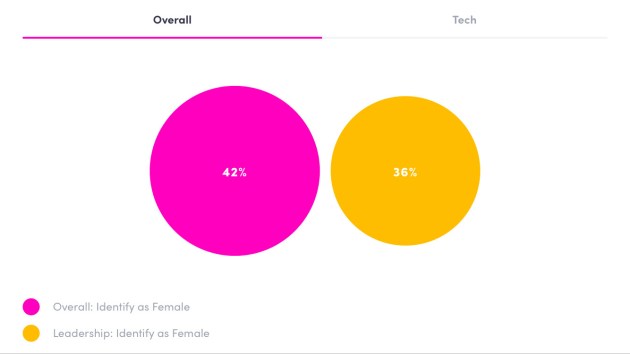
While 42 percent of the company’s 1,600 employees are women, only 18 percent of its tech and engineering teams identify as female. That’s just a little bit better than Uber, where only a little more than 15 percent in tech and engineering are women.

Looking at other kinds of employee diversity at the company paints an even bleaker picture.

Some 63 percent of its total employee base are white, and 70 percent of its executive team are white. Only 1 percent of its leadership team are black, and black people make up only 6 percent of its overall pool of employees.

For context, almost half of Uber — which also recently published its first diversity report and had fairly dismal numbers — employees are white and about 64 percent are men. Only 8 percent of Uber’s 12,000 employees are black, on last count.

Compare that to Google, which now has around 62,000 employees. As of 2016, the company’s workforce was 31 percent female and around 90 percent white and Asian. Only 5 percent of its employees are black or Hispanic.

When asked why Lyft hasn’t published a report before, a spokesperson said the company was one of 30 that signed a White House tech inclusion pledge in June 2016 and plans to publish a report every year. (In other words, Lyft didn’t provide a real answer.)

“Releasing our data will hold us accountable, but it’s the actions we take that will make a difference to the people who come to work every day at Lyft,” the company said in a blog post. “Our diversity data exposes gaps in important areas. So we’re doing something about it.”

When it comes to diversity, numbers are certainly not everything, but it’s definitely a start.

Source: Lyft just published its first diversity report and it’s not much better than Uber’s – Recode

Half of the most highly valued tech companies in the U.S. were founded by immigrants – Recode

Speaks for itself:

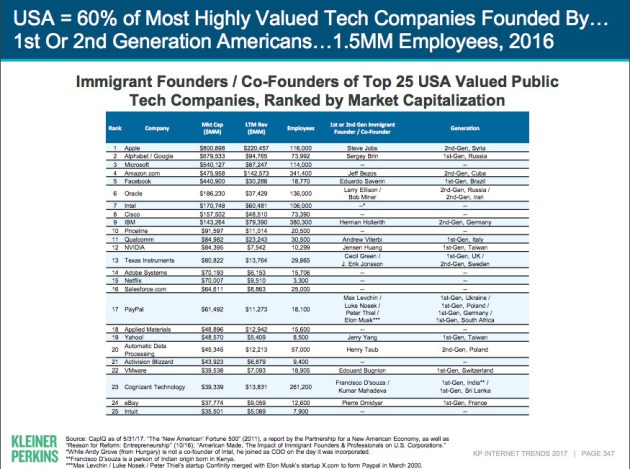
It turns out immigration is a boon for innovation in the United States. Sixty percent of the highest-valued tech companies were co-founded by first- or second-generation immigrants, according to Kleiner Perkins Caufield & Byers partner Mary Meeker’s annual internet trends report, which she presented at the Code Conference at Terranea Resort today.

Mary Meeker internet trends report

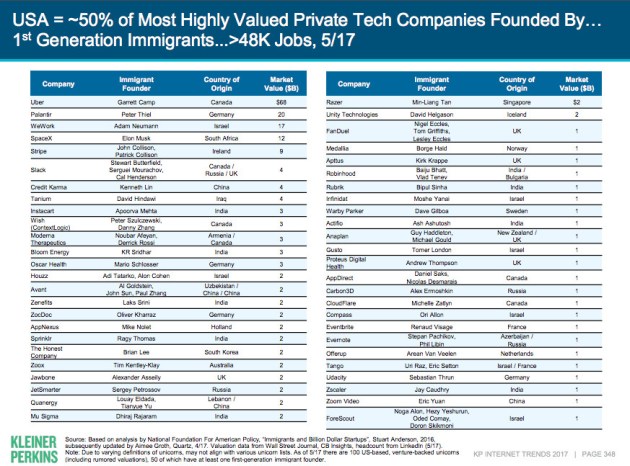
That number is still pretty high even if you count just first-generation Americans. Half of all of the most valuable private tech companies in the United Sates were co-founded by immigrants — including Uber, SpaceX, Instacart, AppNexus and FanDuel.

Mary Meeker internet trends report

Source: Half of the most highly valued tech companies in the U.S. were founded by immigrants – Recode