More on the arrest and trial of the jailed Christian governor of Jakarta:
Legal experts noted that the verdict seemed to be based more on public reaction to the governor’s comments than what he had actually said, in effect holding him accountable for the mass protests organized against him by hard-line Islamist groups.
“That’s the problem with the blasphemy law,” said Bivitri Susanti, head of the Jakarta chapter of Indonesia’s Association of Constitutional Law Lecturers. “It’s not about the speech itself and whether it’s condemning Islam itself. It’s about whether society believes it’s wrong or annoys them.”
The governor, Basuki Tjahaja Purnama, was convicted on Tuesday for comments he made in September challenging Muslim hard-liners who argued that a verse in the Quran prohibited Muslims from voting for a non-Muslim. Mr. Basuki said those who made that argument were misleading Muslims, a statement interpreted by some as insulting the Quran and Islam.
The verdict by the five-judge panel hearing his case repeatedly said that Mr. Basuki, known as Ahok, had caused public unrest and offended the Muslim majority, citing an article in the decades-old blasphemy law banning “words that degrade, harass or insult a religion.”
Sidney Jones, director of the Institute for Policy Analysis of Conflict, said the decision “underscored the rot at the core of the Indonesian legal system” and would further polarize the country.
“It isn’t the first time Indonesian judges showed no concern for evidence in a high-profile case, but it could be one of the most damaging,” Ms. Jones wrote in a commentary for the Lowy Institute. “It instantly sent a signal that non-Muslims are lesser citizens.”
Legal experts said the ruling relied heavily on public anger from hard-line Islamic groups, who have long opposed a Christian such as Mr. Basuki running Jakarta, and on the testimonies of “expert witnesses” on Islam and blasphemy — none of whom were present in September when the governor told a group of fishermen and local civil servants that it was acceptable to vote for a non-Muslim.
Photo
Police officers outside Cipinang Penitentiary in Jakarta, where Mr. Basuki was first taken and which houses violent criminals. He was transferred to a city police detention facility on Wednesday for security reasons.CreditMast Irham/European Pressphoto Agency
“I believe that the street protests influenced the judges’ ruling,” Ms. Bivitri said. “You can really see in the decision, that instead of using other articles, they are using one about condemning religion.”
Experts also expressed concern about the motive for the seemingly vindictive two-year prison sentence. The prosecutors had asked for two years’ probation on a lesser charge, which would have spared Mr. Basuki prison time.
In explaining the sentence, the judges said they determined that the governor “did not feel guilty” about his comments.
“The judges didn’t think Ahok apologized enough,” said Melissa Crouch, a senior law lecturer at the University of New South Wales in Sydney, Australia.
Mr. Basuki apologized publicly months ago for any offense caused, but he has steadfastly denied that he insulted the Quran or committed blasphemy.
Shortly after the verdict was read live on national television, Mr. Basuki was driven past throngs of crying supporters outside the courthouse to the maximum security Cipinang Penitentiary, which houses violent criminals.
On Wednesday, he was transferred to a city police detention facility for security reasons, officials said.
I let her know that plenty of people use terms like, say, “racism” without having a textbook definition for it, but they know when they experience it or witness it.
When I read Barbara’s Kay’s column about me, it was with a mixture of anger, frustration and a heavy heart.
I informed her that I found the traditional definition of Islamophobia as a “fear or hatred of Islam and Muslims” to be limiting. So in my definition, I place it in a broader sociological framework where fear and hatred manifest into individual, ideological, and systemic practices (on this, other scholars might differ). Individual practices include things like name-calling, vandalism, assaults, and the like. And that the ideologies that justify these actions include stereotypes such as seeing Islam as a violent faith or seeing Muslims as terrorists, or as people who do not accept “Canadian values,” and these notions are inculcated into systemic practices such as racial profiling and domestic security policies targeting Muslims.
In my exchange with Kay, I pointed out that while she often criticized the concept of Islamophobia in her writing, I was surprised that she did not have a definition of it herself. And, yet, her lack of knowledge on the subject had not stopped her from critiquing something she was clearly unsure about.
She began to lecture me about “free speech,” proceeding to argue that a non-binding federal motion — one that looks to study manifestations of Islamophobia in Canada in the aftermath of a massacre of Muslim men praying in a Canadian mosque — would curtail her right to criticize Islam. I reminded her that hate-speech laws would govern what can and cannot be said within the boundaries of lawful dissent. While the law permits a legitimate critique of religion, the demonization of a particular faith is different. This type of demonization becomes mapped onto its adherents and can lead to mass violence and genocide, and to argue otherwise works against the weight of history. Kay might not see how Islamophobia and anti-Muslim racism and violence are connected, but we have already seen how this has led to unprecedented and deadly consequences in our country.
It is telling that Kay admitted to me that she was concerned that after M-103 passed, her columns would be branded Islamophobic. I told her that ship had already sailed and that this motion alone would not curtail her from expressing her views. Still, it was interesting that she was more worried about being labelled Islamophobic than she was about the Islamophobia that evidently led to the deaths of six innocent Canadian men.
While Kay lamented to me the backlash against people like Bridget Bardot and Georges Bensoussan in France for their views criticizing Islam and Muslims, she has no problem lambasting my research on Islamophobia, which she paraphrases poorly, twists and takes of out context, while stopping just short of accusing me of supporting terrorism, all to further her fearmongering against Muslim academics.
Kay needs to acknowledge that the things she writes play a part in this onslaught of hate directed towards Muslims. Her rhetoric is taken up by and helps fuel the white supremacist and neo-fascist groups that are on the rise in Canada. In the aftermath of her column, since arriving home from California I’ve received several hate-filled emails, with subject lines such as “Islam is Satanic.” I admit this is nothing compared to the 50,000 hate-filled emails Khalid received after she proposed M-103 and many Muslim academics I know have received death threats.
Along with my fellow Muslim academics and our allies, I will not sit quietly as Kay discredits, maligns and slanders me and other scholars who work in this field. The day Kay applauds my work is the day I’ll be concerned. For now, attacks by her and others of her ilk confirm that I am standing on the right side of history.
Interesting analysis by Faegheh Shirazi, University of Texas at Austin, on the Islamic fashion industry:
This growth has had its share of controversies: Many designers use the term “Islamic” for their clothing. Religious conservatives and Muslim scholars have raised questions about what types of apparel would fit that category and whether defining clothing as “Islamic” was even permitted or lawful by Islamic principles – a concept known as “halal.”
In particular, critics have objected to the fashion catwalk presentations, which actually draw the gaze and attention of spectators to the bodies of models, while the purpose of a hijab is to distract and move the gaze away from the body. In Iran, for example, Islamic fashion is viewed by the ulama (religious scholars) as another Western influence and referred to as “Western Hijab.”
Defining clothing as Islamic has been controversial.karmakazesal, CC BY
Nonetheless, the Islamic fashion industry has managed to initiate marketing campaigns that capitalize on the very core of Islamic precepts: Sharia, or the Islamic religious law. A Malaysian apparel company, Kivitz, for example, uses the phrase “Syar’i and Stylish.” In Malay, Syar’i is the same as Sharia.
In establishing a nominally Islamic brand, marketers make every effort to align their products with the core value of Islam. So, even when following the trendy fashionable seasonal colors and materials, clothing styles would include some sort of head covering.
Who are the consumers?
The question still remains: What led to such a rapid growth over a span of just three years?
My research has demonstrated that Muslims are more brand aware than the general population. However, in the past they were largely ignored by the fashion industry, perhaps, due to misconceptions that being a Muslim restricted people’s lifestyle.
And now, with a growing Muslim population, there is an increased demand for modest but also fashionable clothing for the youth, who have significant spending power. At the same time, traditional elite and wealthy Middle Eastern consumers who used to shop for fashionable clothing from European nations now prefer to shop from homegrown Muslim fashion designers.
Indeed, the halal logo on food and other products in addition to modesty in clothing has proved to be an effective strategy in creating a global Islamic identity.
As I have seen in my research, consumerism is changing what is means to be modern and Muslim today. As Vali Nasr, a Middle Eastern scholar, explains,
“The great battle for the soul of the Muslim world will be fought not over religion but over market capitalism.”
Jakarta’s Christian governor was sentenced to two years in jail for blasphemy against Islam on Tuesday, a harsher than expected ruling that is being seen as a blow to religious tolerance in Indonesia, the world’s largest Muslim-majority nation.
The guilty verdict comes amid concern about the growing influence of Islamist groups, who organized mass demonstrations during a tumultuous election campaign that ended with Basuki Tjahaja Purnama losing his bid for another term as governor.
President Joko Widodo was an ally of Purnama, an ethnic-Chinese Christian who is popularly known as “Ahok”, and the verdict will be a setback for a government that has sought to quell radical groups and soothe investors’ concerns that the country’s secular values were at risk.
As thousands of supporters and opponents waited outside, the head judge of the Jakarta court, Dwiarso Budi Santiarto, said Purnama was “found to have legitimately and convincingly conducted a criminal act of blasphemy, and because of that we have imposed two years of imprisonment”.
Andreas Harsono of Human Rights Watch described the verdict as “a huge setback” for Indonesia’s record of tolerance and for minorities.
“If someone like Ahok, the governor of the capital, backed by the country’s largest political party, ally of the president, can be jailed on groundless accusations, what will others do?,”
Good ruling. Senate review of C-6 included restoration of procedural protections in case of revocation for fraud or misrepresentation (along with two other amendments) and still no sign from the government whether they intend to accept the one or more of the amendments:
A landmark ruling from the Federal Court means that Ottawa will no longer be able to strip Canadians of their
A landmark ruling from the Federal Court means that Ottawa will no longer be able to strip Canadians of their citizenship without a hearing.
In ruling on the case of a group of dual citizens who had their citizenship nullified because the Canadian government believed they obtained it through fraudulent means, the court found the government’s revocation powers unconstitutional.
Under the Citizenship Act, thanks to changes brought in by the previous government, the minister of immigration could revoke the Canadian citizenship of any dual resident who, they believe, obtained it through fraud or misrepresentation, or who has been convicted of a terrorist offence.
It was at the government’s discretion whether or not there would be a trial on the matter. Thanks to those streamlined rules, revocation could take place after merely sending a letter to the person affected.
Today, the court ruled that such a process ran afoul of the Bill of Rights, a rarely-used piece of the constitution and a precursor to the more widely-known Charter of Rights and Freedoms.
Those facing citizenship revocation “should be afforded an oral hearing before a court,” Justice Jocelyne Gagné wrote, adding that they deserve to be afforded “an opportunity to have their special circumstances considered when such circumstances exist.”
Today’s ruling means that all current citizenship revocation cases will be put on hold.
In some ways, these changes were inevitable.
Justin Trudeau’s Liberal government pushed forward legislation in early 2016 to make similar changes to the Citizenship Act, removing the government’s ability to strip the citizenship of terrorists, and to afford the right to a trial to all those facing revocation. That legislation has been making its way through Parliament for more than a year, and was most recently amended by the Senate earlier this month — meaning it now heads back to the House of Commons for another vote.
Previously, under both the Trudeau and Harper governments, the government has moved to take away citizenship from Canadians who obtained their citizenship as children.
Joel Sandaluk, a Toronto immigration lawyer, represents a client who got notice that Ottawa was moving to take away his citizenship as recently as last month.
“It’s always been kind of a mystery as to why the government was still pursuing revocation,” Sandaluk says, noting that the government was pursuing legislation to make that very change, and it knew that this case was to be decided imminently.
“It’s either very canny politics or it just kind of feels a little bit manipulative,” he says.
It’s quite possible that the Liberals will need to go back to their own legislation, which is currently making its way through the Senate, to make sure it complies with today’s ruling, Sandaluk says. That means Ottawa likely won’t bother appealing the decision.
For those interested, this is the latest version of my citizenship deck, being delivered later today at the Conference Board Immigration Summit. A mix of 2016 and 2015 data as some of the specialized datasets have not yet been updated by IRCC.
Interesting insight at yesterday’s Conference Board of Canada Immigration Summit during the session with IRCC Minister Hussen.
In response to a broad question regarding multiculturalism from the moderator, CBoC Senior VP Craig Alexander, the Minister responded that the world has two choices: give into fear or make a “deliberate choice” to be open to people, skills and talent. This was not only “morally right” but also beneficial to economic development.
The Minister noted that when questioned in other countries about diversity, he replied that Canadian citizenship is based upon shared values, not on ethnicity, cultural origin or religion as in many other countries.
Canada’s ability to welcome all, whatever their origins, and integrate them well, is key to our success.
He noted that as Canadians, “we all assume that when people come as immigrants, they will become citizens” and that was not the case in many other countries.
He went on to emphasized that not becoming a citizen affects the ability to integrate and never becoming part of society and never able to contribute to their full potential. Canada does not that problem. Again, we assume that all immigrants will become Canadian.
Canada is unique in the regard. We take this for granted. It is our history of immigration that makes us open to immigration. By welcoming and including everyone, Canada can realize the potential of all and use the full resources of its population.
Powerful words, eloquently stated.
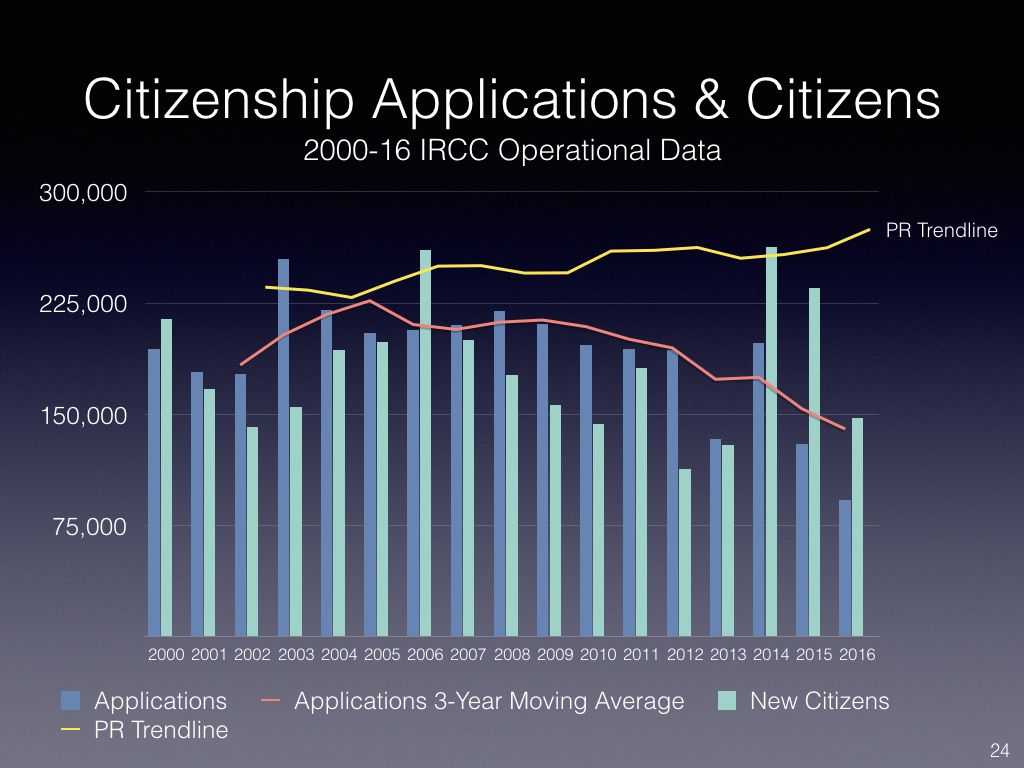
However, someone at IRCC should point out to him the recent data that show a dramatic drop citizenship applications – from 198,000 in 2014 to 92,000 in 2016 – and the increasing gap between new permanent residents and new citizens (296,000 compared to 148,000 in 2016, following the elimination of the backlog in 2014-15).
The key chart captures the trends.
So rather than assuming the immigrant-to-citizen path, we need to recognize the impact of previous changes and take steps to address this decline, starting with reviewing the steep fees as I have noted previously (and repeatedly).
Useful and encouraging post-Trump update of Focus Canada’s annual survey:
As debates rage through much of the developed world over whether to close doors to newcomers, Canadian attitudes toward immigration remain positive.
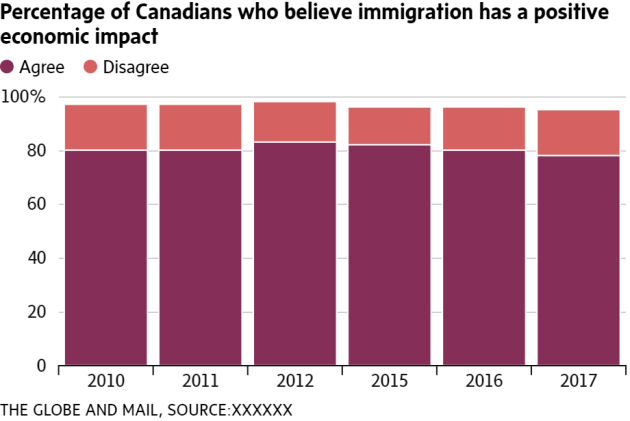
Canadians’ sentiment towards immigration hasn’t wavered in the past six months, with eight in 10 people still agreeing that immigrants benefit the economy, a national survey released exclusively to The Globe and Mail shows.
“Public opinion about immigration among Canadians generally has either remained stable or become even more positive” in the past half year, said Keith Neuman, executive director of the Environics Institute for Survey Research, which released the results publicly on Monday.
The survey was conducted last month as a follow up to a similar set of questions in October. It sought to gauge whether public sentiments have shifted since the election of Donald Trump in the United States, and amid intensifying public debate in the United States and Europe over whether to tighten immigration rules. It comes as France’s defeated presidential candidate, Marine Le Pen, campaigned on an anti-immigrant, anti-EU platform, and as Britain preps for Brexit while Mr. Trump remains intent on deportations and building a U.S.-Mexico border wall.
Some views in Canada have shifted, markedly. Attitudes towards the United States have soured, with fewer than half of Canadians now holding a favourable view of the United States – the lowest level since the survey started tracking this in 1982.
In opinions about the United States, “there’s been a dramatic change,” said Mr. Neuman. Nearly a fifth of respondents said they have already changed their travel plans for visiting the United States this year due to the current political climate there, and another 8 per cent are thinking about doing so.
On immigration, Canadians appear still supportive. When asked if there is too much immigration in Canada, more than six in 10 people disagreed, the highest level in nine years.
Nearly eight in 10 respondents said immigration has a positive impact on the economy, little changed from the previous survey and over the past 15 years. Young people are more likely to agree that immigration boosts the economy, along with those in Toronto, people born outside of Canada and those with higher levels of education and income.
Several reasons may explain why Canadians have not jumped on the nationalist, anti-immigrant bandwagon. Immigration is an integral part of this country’s recent history and most Canadians are themselves newcomers or children of immigrants; Canada does not have to contend with mass migration at its borders; and it “doesn’t have the same strong national identity as in many European countries,” Mr. Neuman said.
Canada’s “not perfect. We do have racism, and there are lots of challenges in terms of finding jobs – it’s hardly utopia. But compared to those other countries, it has been relatively smooth,” he said.
Census numbers last week show the pace of aging in Canada’s population is accelerating, with the share of the working-age shrinking. That demographic shift will put more fiscal pressure on governments and, some experts say, underscores the need for Canada to maintain or increase its immigration levels.
The numbers come as Canada has accepted 40,100 Syrian refugees since November, 2015, about half of whom are government assisted and 14,000 of whom are privately sponsored. In recent months, more asylum seekers have crossed the border from the United States to claim refugee status.
The survey showed a growing share of people now disagree that refugee claimants are not legitimate. In fact, disagreement with this statement is at its highest level since 1987.
Opinions are split on whether too many immigrants are not adopting Canadian values. Just over half of respondents agree with that statement, a level that’s unchanged from October, though still the lowest level recorded in more than two decades.
Respondents in Alberta were more cautious on immigration. The province “stands out as the one part of the country where attitudes have become more negative,” since October, the survey noted. This could stem from economic concerns and more vulnerability in the jobs market – Calgary continues to have the highest jobless rate in Canada, at 9.3 per cent.
Respondents are divided on whether anti-government populism, underway elsewhere, could happen in Canada, with nearly half saying it is somewhat or very likely in the next few years.
Attitudes towards immigration differ according to party lines. A separate online survey by Abacus Data, conducted last month of 1,500 Canadians, shows Liberal voters tend to see immigration as helping Canada’s future economic prospects; Conservatives see it as negative while New Democrats are evenly split. Those more likely to see immigration as beneficial are millennials and higher-income earners, it found. Its survey suggests a more divided opinion on immigration, with 53 per cent per cent saying it will help the economy and 47 per cent saying it is harmful.
The Environics survey is based on telephone interviews conducted with 2,002 Canadians between Apr. 3 and Apr. 15, and is considered accurate to within plus or minus 2.2 percentage points in 19 of 20 samples.
Since 1908, when the Canadian government passed the Opium Act prohibiting the “importation, manufacture and sale of opium for other than medicinal purposes,” race has been a key aspect of Canada’s drug laws. It was impossible to separate the government’s thinly developed health concerns about opium from its much more deeply developed racist views on Chinese immigrants. Banning opium then was a part of the larger, shameful goal of preventing Chinese immigration. Fast-forward to 2017 and the Liberal government’s new Cannabis Act, which will legalize the recreational use of marijuana. Amidst the debate about production, distribution and criminalization, one dirty little secret remains: this is still about race.
“One of the great injustices in this country is the disparity and the disproportionality of the enforcement of these laws and the impact it has on minority communities, Aboriginal communities and those in our most vulnerable neighbourhoods,” said Bill Blair, the parliamentary secretary to the minister of justice said back in February of 2016. It was an astonishing admission. In outlining the rationale behind the government’s legalization plans, Blair made race a central issue. For a former police chief to suggest that minority groups have been unfairly hit by Canada’s pot laws was startling to some, and a long overdue admission to others. Has the criminalization of pot really masked a race issue that the legalization act will now fix? If Blair is right, the new act will, among other things, expose a nasty social injustice and deeply troubling issue for police. The trouble is, there is no systemic data available to support his claim.
I asked the minister of justice’s office to send me the statistics that supported Blair’s claim and got nothing in return. “Not going to be a lot of help to you on this one,” said David Taylor, the spokesperson for the minister. He asked around to see if any other department had an answer and found nothing. “What I am being told is that stats on race and ethnicity are not tracked at the police or court level, so we cannot determine whether or not Indigenous or black people have higher conviction rates due to cannabis,” he said. That’s odd, since Blair said the exact opposite. For a government that touts its commitment to evidence-based policy, where did his claim come from?
There is not one source, but a few reports suggest Blair is right. In 2013, Howard Sapers, then Canada’s federal correctional investigator, tabled a report on ethnicity in Canada’s prison system that revealed troubling data. “Over the past 10 years, the Aboriginal incarcerated population increased by 46.4 per cent while visible minority groups (e.g. Black, Asian, Hispanic) increased by almost 75 per cent,” he wrote. “During this same time period, the population of Caucasian inmates actually declined by 3 per cent.” As Sapers discovered, black and Aboriginal people in Canada are disproportionately represented in federal jails: “9.5 per cent of federal inmates today are Black (an increase of 80 per cent since 2003/04), yet Black Canadians account for less than 3 per cent of the total Canadian population. Aboriginal people represent a staggering 23 per cent of federal inmates yet comprise 4.3 per cent of the total Canadian population.” Sapers openly questioned the fairness of our justice system.
While that report opened a window on the race issue, it didn’t focus on drug arrests or specifically on cannabis. I went to the public safety minister to get more data on this, and his office simply sent me back to Justice. I was running in circles. Finally, after three days of asking, Correctional Services Canada sent me some data on the number of drug-related arrests as they correlate to race. In 2014, there were 2,177 inmates in federal prison for drug related reasons (Schedule 2). Close to 270 of those were black. About the same number were Indigenous. While the vast majority was Caucasian, 1,360, it still represents a significant overrepresentation of black and Aboriginal people relative to their share of the general population.
These stats are revealing but still not specific about what kind of drug is at play. ”Canada does not collect this kind of data,” Neil Boyd, a professor at Simon Fraser University’s School of Criminology told me. “It’s fair to say that Indigenous Canadians are overrepresented with respect to almost all criminal arrests, convictions and sentences to imprisonment. Legalization of cannabis would, then, have a disproportionate impact on Indigenous Canadians.” But even he can’t say for sure by how much.
There have been other reports that fill some gaps. The results of the recent Traffic Stop Race Data Collection Project in Ottawa, in which a York University research team analyzed 81,902 traffic stops over a two-year period between 2013 and 2015, found that Black and Middle Eastern-looking people were stopped two to three times more frequently than Caucasian drivers. The police association argued this did not prove racial profiling, but it was hard to see it another way.
In 2002, the Toronto Star conducted its own analysis on the difference between how blacks and whites were treated by police regarding basic drug charges and they found a wide ranging disparity. “Black people, charged with simple drug possession, are taken to police stations more often than whites facing the same charge,” the Star found after using data from previously unseen police databases of more than 480,000 incidents. “Once at the station, accused blacks are held overnight, for a bail hearing, at twice the rate of whites.” The Star showed what many in the black community already felt: they were being unfairly targeted. “
“Prophet Mohammad forever,” chant the young Indonesian Muslim musicians. But instead of a mosque, the men are singing at an outdoor concert with a mosh pit full of followers of the country’s first Islamic punk movement.
The movement is the first of its kind in the world’s largest Muslim-majority nation, and has hundreds of members in three of the country’s biggest cities – Jakarta, Surabaya, and Bandung.
Sporting mohawks, leather jackets and baggy jeans, members of the “Punk Muslim” group claim that they, like the original British punk rockers, are still defined by rebellion and an anti-establishment ideology. But they express it by singing about Islamic values, freedom for Palestine, and other social issues facing the global Muslim community.
Ahmad Zaki, one of the movement’s founders, believes the genre of punk is often associated with a “tendency towards misbehaviour” but he wants to change that.
“We can redirect ourselves to better, more positive things,” he said.
Many of the group’s members used to be street performers, and say they have changed drastically since joining the movement. They are now encouraged to form their own bands and write their own songs.
Reza Purnama, a member and a former alcoholic, says others like him are slowly quitting alcohol and their lyrics are becoming more positive.
“People aren’t looking down on us anymore,” he said, referring to a stigma against punks in Indonesia’s largely conservative society.
After every concert, the head-banging audience bow their heads in prayer and listen to sermons – something the movement’s founders hope will redirect their fans on to a more pious path.
Muslims make up nearly 90 percent of Indonesia’s 250 million people and the vast majority of them practise a moderate form of Islam.


 As debates rage through much of the developed world over whether to close doors to newcomers, Canadian attitudes toward immigration remain positive.

 Multicultural Meanderings