Doug Todd: “Techno-immigrants” fuel Vancouver’s high-tech sector

Interesting study, which recalls an earlier Globe article, Microsoft reminds us that Canada is still a branch-plant economy, on how Microsoft (and likely others) strategically use Canadian immigration as a way to bring talent to their US headquarters:

In light of the political manoeuvring in B.C. over local high-tech jobs and training, the study by Froschauer and Wong quotes the president of a large B.C. high-tech association who says a key reason “Microsoft chose to open a Vancouver office was because of the easier immigration rules.”

The unidentified high-tech CEO told the researchers there’s a crucial reason Microsoft did not simply open its computer development “campus” in Redmond, Washington, which is headquarters for the global tech giant.

“It’s like two hours away, so why would they open up this campus in Vancouver?” said the CEO.

“It’s much easier to bring in (migrants from India) and others, and that’s the reason they came. And their intention is not to recruit people away from other companies in the Lower Mainland but to bring fresh people in, and that’s what the larger companies do. Small ones don’t have the means.”

High-tech companies in B.C. and Alberta also often cross the U.S. border to recruit Chinese and other foreign students, say the authors, because international students in the U.S. are generally not allowed to remain in the country after they graduate, whereas they can stay after graduation in Canada.

The sociologists do not estimate the proportion of Metro Vancouver’s high-tech sector that is made up of immigrants, international students or temporary foreign workers, but they quote the CEO in confirming migrants are “very, very useful. I don’t think we could evolve our sector without” them.

Many of the techno-migrants interviewed in the study say it’s often an advantage to be a migrant in Canada’s high-tech sector.

But others said being born outside the country can be a disadvantage, particularly because of difficulties with language.

Some people from China told the researchers that migrants from India don’t have as many problems with language, since many in the former British colony were educated in English from their childhoods.

Some high-tech executives in Metro Vancouver and Calgary favour temporary foreign workers over immigrants, add Froschauer and Wong, whose article appears in the new book, Trans-Pacific Mobilities: The Chinese and Canada(UBC Press), edited by Wong.

The sociologists learned some corporations prefer “to bring employees to British Columbia on a temporary work permit” because they can be retained longer than immigrants, who have more freedom regarding where to work.

Provincial and federal immigration programs “do not tie employees to the company, whereas the temporary work permit does,” the authors say.

The number of high-tech migrants to Canada, especially from China, is likely to continue to grow in the future, say the authors.

Source: Doug Todd: “Techno-immigrants” fuel Vancouver’s high-tech sector | Vancouver Sun

In Egypt, Pope Francis Upstaged By Top Islamic Imam | The Huffington Post

Commentary by Daniel Williams, Author, Forsaken: The Persecution of Christians in Today’s Middle East:

The Pope seemed as determined to put distance between the image of Islam and the global terrorist wave as address the Christian plight. For instance, Francis dropped statements he had made in other countries that Christian communities in the region face genocide.

Instead, and maybe hopefully, it was left to Ahmed al-Tayeb, the chief imam of al-Azhar, the influential educational and religious complex in Cairo, to offer up a prescription for ending persecution of Christians and other minorities.

Two days in advance of the Pope’s visit, al-Tayeb dismissed the formal discrimination against Christians (and Jews) as practiced under Islamic Caliphates dating from the Seventh Century until the fall of the Ottoman Empire in the 1920s. Presumably, this would include the special poll tax demanded from Christians and Jews living under Islamic rule and any other kind of inequity.

“The Caliphate era was being ruled by certain legislations suited to its era regarding non-Muslims and their rights in the Caliphate. However, it makes sense, and according to Islam as well, that if the political system changes, many related legislations change with it,” Al-Tayeb said.

“There is no doubt that citizenship is the true guarantee to achieving the absolute equality of rights and duties between Muslims and non-Muslims.”

Two months earlier at al-Azhar, a conference between Muslim officials and representatives of Eastern Christian churches concluded with a call for equal citizenship under “the practice of coexistence in a single society founded on diversity, pluralism and mutual recognition.”

The meeting’s closing declaration endorsed the concept of a “National Constitutional state founded on the principles of citizenship, equality and the rule of positive law.” Under such an arrangement, no one could speak of citizens, including Christians, as belonging to a minority, the statement said.

In addition, the conference demanded that any “association of Islam or any other religions with violence be brought to a stop.”

The endorsement of equal citizenship is clearly welcome for anyone seeking an end to persecution of minorities. Al-Azhar is a prestigious institution throughout the Islamic world, although neither al-Tayeb nor any one religious leader speaks for all Muslims.

Of course, the call for a constitutional state and rule of law might ring hollow in Egypt itself, governed as it is by an ex-general who seized power in 2013 from an elected, if incompetent and authoritarian president, Muhammed Morsi, a Muslim Brotherhood leader.

Morsi and thousands of suspected Brotherhood followers have been jailed. Many have death sentences hanging over them. Human rights groups report widespread torture and disappearances.

Although Sisi’s anti-Brotherhood campaign is being carried out in the name of anti-terror, he has found time to imprison secular opposition figures, including some who were involved in the 2011 popular uprising to oust long-time ruler Hosni Mubarak. Sisi has pledged to put Egypt on the road to democracy, yet freedom of the press, speech and labor rights to strike have all been proscribed.

And Copts, the main Christian sect in Egypt, continue to be subject to terrorist brutality and the government’s inability to curb sectarian violence. The Palm Sunday bombings of Coptic churches in the Nile Delta town of Tanta and in Alexandria that took 46 lives were the worst so far this year. In December, a bomb killed 29 worshippers at a church in Cairo. Francis visited the Cairo church on Friday.

Sisi is dealing with a terrorist uprising centered in the Sinai Peninsula, but which has also spread to other parts of Egypt with groups claiming allegiance to the Islamic State, the fundamentalist rebel organization in Iraq and Syria.

In that context, perhaps al-Tayeb was simply limiting his call for plurality and tolerance to the religious realm, and put civil rights issues aside so as not to offend Sisi. This, unfortunately, puts the al-Azhar establishment and even the Coptic hierarchy as tacitly complicit with Sisi’s iron rule.

Francis did a little better, calling for, “unconditional respect” not only for equality and religious freedom but also freedom of expression.

Walking In Their Footsteps At A Former Japanese Internment Camp : NPR

Good long read about one family’s visit to a former internment camp:

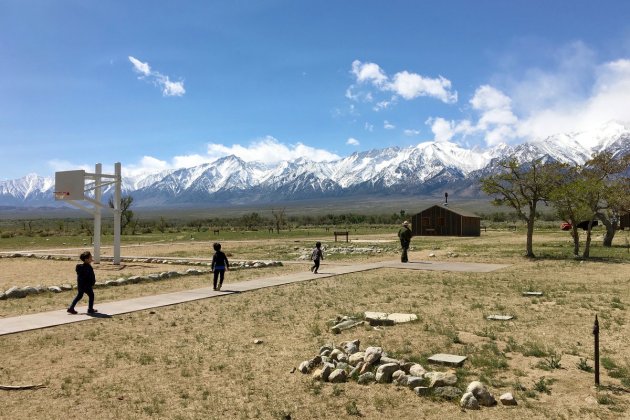
The military-style camps were intentionally located in remote areas. Manzanar is about four hours north of Los Angeles by car and 3,800 to 4,200 feet above sea level. It is on U.S. Route 395, east of the Sierra Nevada and west of Death Valley. The nearest populated area is a tiny village six miles north named Independence. Before the trip, I debated whether I should go. The drive from Northern California is long, and my car is old. But I decided that I wanted to see Manzanar with my own eyes, so that my understanding of history might feel deeper through the experience of place.

Two reconstructed buildings stand in the former Manzanar War Relocation Center. Once, 10,046 people were imprisoned here.

Melissa Hung for NPR

What we saw was a flat desert with vegetation scrappy and close to the ground, stubborn trees here and there, tumbleweed bounding across the landscape, propelled by the wind. In the distance, Mount Williamson, majestic and snow-covered, looked like a painting.

“I hadn’t pictured it this beautiful,” I said.

“I imagine it must have felt ironic for the people living here,” Erin replied.

Manzanar opened on March 21, 1942, so the weather would have been similar to what we were experiencing on this sunny April day. I was wearing a sweatshirt and a vest. But here spring gives way to summers of up to 110 degrees and winters below freezing. In all seasons, the wind covers surfaces with sand and dust. Like the force of history, it is a constant that cannot be ignored.

Our guide for the day was park ranger Mark Hachtmann. He dressed the way I imagined a park ranger would: a uniform of green pants, a matching green jacket with a U.S. National Park Service patch on the arm, and a brimmed hat. He led us through the few buildings in Block 14, which now serve as exhibits. After the war, most of the buildings at Manzanar were dismantled. After Manzanar became a historic site in 1992, buildings were recreated according to historical photographs. The two barracks in Block 14 were built in 2010.

From what had been rebuilt, we were to imagine the entirety of the camp. There were 36 blocks in all for Japanese Americans. Each block contained 20 buildings: 14 barracks, a mess hall, a recreation hall, a laundry facility, an ironing room, a women’s latrine, and a men’s latrine. Between 250 and 400 people lived in each block, the blocks separated by open areas to prevent fires from spreading, a real threat in this land of wind. The whole camp was just under one square mile.

The residents were resigned to being in the camp ¾ Shikata ga nai(nothing can be done) ¾ and tried to make life a little more normal and comfortable. They created sports teams, published a newspaper, and started a co-op store. I was impressed by their self-organizing and resilience, but also felt a lingering sadness, especially for the older adults who had built their businesses and professions in the face of discrimination, only to have almost everything taken away. Did they ever recover? As we walked from building to building, the boys picked up sticks and dug at the dirt. I wondered how much they understood and if they would remember any of this. They played, I imagined, as kids their ages had done when the camp was full of families.

While in use, the camp included a 250-bed hospital, a fire station, an orphanage for 101 children, and baseball fields. More than 10,000 people ¾ 6,000 adults and 4,000 children ¾ had lived here in a hastily built, temporary city of concrete blocks, wood, and tarpaper. The War Relocation Authority staff ¾ the camp director, police chief, fire chief, social workers, and others who were mostly white and often referred to as the “Caucasian staff” ¾ lived in other blocks with their families, in buildings with their own bathrooms, kitchens, and lawns.

Trudeau devalues citizenship: Gordon Chong

Over the top criticism and fear-mongering by Gordon Chong:

When Paul Martin Sr. introduced the bill in the House of Commons that became the Canadian Citizenship Act on Jan. 1, 1947, he said: “For the national unity of Canada and for the future and greatness of the country, it is felt to be of the utmost importance that all of us, new Canadians or old, … have a consciousness of a common purpose and common interests as Canadians, that all of us are able to say with pride and with meaning ‘I am a Canadian citizen.’”

Despite new acts in 1977 and 2002, as well as more recent legislation, those foundational words should be forever etched in our minds.

Subsequent revisions have vacillated between weakening and strengthening the requirements for granting citizenship.

The Harper Conservatives strengthened the value of Canadian citizenship in 2014 by increasing residency and language requirements with Bill C-24, the Strengthening Canadian Citizenship Act.

Applicants aged 14 to 64 were required to meet language and knowledge tests.

Permanent residents also had to have lived in Canada for four out of the six previous years prior to applying for citizenship.

The Liberals’ Bill C-6, an Act to Amend the Citizenship Act, proposes to reduce knowledge and language requirements (they only affect applicants aged 18 to 54) and reduce residency requirements to three of the previous five years.

Bill C-6 also proposes to repeal the right to revoke Canadian citizenship of criminals such as those convicted of terrorism.

As a citizenship court judge for several years in the ’90s, I can assure doubters that acquiring citizenship was relatively easy, especially for seniors over 65 with a translator.

Skilled professional translators have difficulty capturing the nuances between languages. It is not uncommon, for example, to see significant errors and omissions in the Chinese-language media when reporters rush to meet deadlines.

Obviously, without a comprehensive grasp of English, it is impossible to meaningfully participate in Canadian life.

Meanwhile, our federal government is frivolously throwing open our doors to potential terrorists and providing fertile conditions for the cultivation of home-grown terrorists by indirectly subsidizing the self-segregation and ghettoization of newcomers, further balkanizing Canada.

The cavalier Trudeau Liberals, peddling their snake oil political potions, are nothing more than pale, itinerant imitations of the Liberal giants of Canada’s past, shamefully repudiating their predecessors for immediate, short-term gratification.

These privileged high-flying Liberal salesmen with colossal carbon footprints should be summarily fired, solely for seriously devaluing Canadian citizenship!

Source: Trudeau devalues citizenship | CHONG | Columnists | Opinion | Toronto Sun