2016 Refugee Claim Data and IRB Member Recognition Rates | Canadian Council for Refugees

This is really an impressive analysis  suggesting (no surprise) that individual decision-makers are not as objective and consistent as desired (as Kahneman and others have demonstrated in different contexts). All Canadian government tribunals should conduct this kind of analysis to improve consistency in decision making:

The following note and the accompanying data are provided by Sean Rehaag, Associate Professor, Osgoode Hall Law School.

8 March 2017

Data obtained from the Immigration and Refugee Board (IRB) through an Access to Information Request reveals vast disparities in refugee claim recognition rates across decision-makers in 2016. This is consistent with similar findings from prior years for Canada’s previous and new refugee determination systems.

Refugee claims referred to the IRB after 15 December 2012 are subject to the new system, whereas claims referred to the IRB prior to that date are legacy cases that are decided under the old system. Legacy and new system cases are not only decided under different rules, but are also decided by different cohorts of decision-makers. Because of these important differences, the data on RPD decision-making for 2016 is separated into legacy cases and new system cases.

In 2016, some Refugee Protection Division (RPD) decision-makers granted refugee status in most of the cases they heard, including R. Tiwari (95.9%, 74 new system cases), I. Singh (92.5%, 53 new system cases) and K. Genjaga (91.8%, 85 new system cases). Others granted refugee protection much less frequently, including B. Lloyd (23.8%, 63 new system cases), R. Gibson (26.0%, 77 new system cases) and M. Beatty (29.8%, 57 new system cases).

Some of the recognition rate variation may be due to specialization in particular types of cases. For example, some decision-makers specialize in geographic regions with especially high or low refugee claim recognition rates. For further possible explanations for variations in recognition rates, please see an IRB explanatory note, which was provided with a response to an earlier Access to Information Request: http://ccrweb.ca/files/7.irb_explanatory_note-2012.pdf

Although some of the recognition rate variation can be explained by factors related to specialization, the tables below suggest that country of origin specialization alone fails to fully account for the variations. The tables show substantial variance for some decision-makers between the recognition rates that would be predicted based on the average recognition rates for the countries of origins in the cases they decided, and their actual recognition rates. For instance, in new system cases B. Lloyd (predicted 57.4%; actual 23.8%), R. Gibson (predicted 53.9%; actual 26.0%) and J. Daubney (predicted 59.7%; actual 32.3%) had much lower recognition rates than predicted, whereas R. Tiwari (predicted 62.6%, actual 95.9%), J. Eberhard (predicted 56.5%; actual 87.4%) and J. Bousfield (predicted 63.6%; actual: 89.3%) had much higher recognition rates than predicted.

This year’s data also includes information about outcomes on appeals at the IRB’s Refugee Appeal Division (RAD). As with RPD decision-making, outcomes at the RAD appear to vary greatly depending on who serves as the decision-maker. For example, in RAD cases decided on the merits, claimants were much more likely to succeed in their appeals before S.S. Kular (56.5%, 46 cases), R. Dhir (50.5%, 32 cases) or L.F. Agostinho (46.6%, 58 cases) than before L. Favreau (5.3%, 94 cases), Stephen Gallagher (17.1%, 35 cases) or D.E. Sokolyk (20.6%, 63 cases). Remarkably, claimants were more than 10 times as likely to succeed on appeals with S.S. Kular than with L. Favreau.

A few implications of this year’s data are worth highlighting:

  • Some countries that are designated as “safe” in Canada’s refugee determination system produced many positive refugee determinations in 2016. Consider for example, Hungary, which had a 66.9% recognition rate, and which produced 184 successful refugee decisions (involving 529 individual claimants) in the new system in 2016. It is difficult to understand how such countries can reasonably be designated as “safe” or what could justify limitations on procedural rights (e.g. expedited processes, limitations on pre-removal risk assessments) that come with such designations. For further analysis, see: http://ssrn.com/abstract=2588058
  • The persistence of unexplained variations in recognition rates across adjudicators in the new refugee determination system, combined with the devastating potential impact of false negative refugee decisions (i.e. refugees being returned to face persecution), make robust oversight mechanisms essential. Unfortunately, many refugee claimants continue to be denied access to the appeal at the Immigration and Refugee Board and are ineligible for automatic stays on removal pending judicial review at the Federal Court. This includes large numbers of claimants who transited to Canada via the United States – even though one’s route to Canada has little to do with whether one has a well-founded fear of persecution. For further analysis, see: http://ssrn.com/abstract=2647638
  • While substantial variation in recognition rates persist, it should be noted that no new system decision-makers in 2016 who made 20 or more decisions denied every single claim they heard. This is in contrast to the old refugee determination system (S. Roy in 2013: 0.0%, 23 decisions; D. McSweeney in 2011: 0.0%, 127 decisions; D. McBean in 2010: 0.0%, 62 decisions; D. McBean in 2009: 0.0%, 72 decisions). It is worth considering whether this change relates to the professionalization of refugee decision-making and the shift to civil servant decision-makers (rather than political appointees as was the case under the old system).
  • The overall success rates on RAD appeals are remarkably high. Indeed, appeals brought by claimants and decided on the merits were granted in almost one third of cases (33.1%). On the one hand, the fact that the RAD is correcting large numbers of claims that were wrongly denied at the RPD emphasizes the importance of this form of oversight. On the other hand, however, it also suggests that there is room for improvement in initial decision-making at the RPD.

For a discussion of the methodology used to obtain the data and to calculate the statistics, as well as an analysis of the implications of similar data for a previous year, see Sean Rehaag, “Troubling Patterns in Canadian Refugee Adjudication” (2008) 39 Ottawa Law Review 335. This article is available via links here: http://ssrn.com/author=404046

Source: 2016 Refugee Claim Data and IRB Member Recognition Rates | Canadian Council for Refugees
Canadians abroad have a right to vote too: Frank and O’Brien

The reply to Rob Vineberg and my earlier article (Canadian expats shouldn’t have unlimited voting rights – Bill C-33 critique). As behind paywall, sharing full draft.

Weak on numbers, just relying on APF overall numbers (which include children and permanent residents) and not acknowledging the range of government data available that captures to a greater extent the degree of connection (summarized in our article).

And their reference to s.3 of the Charter avoids the key question: can s. 1 “reasonable limitations” be invoked to restrict voting of non-resident Canadians to some extent. The Ontario Court of Appeal ruled that restrictions can be justified and the appeal to the Supreme Court was suspended pending C-33.

Our brief to the House committee will counter these arguments, as well as being data rich, unlike Frank and O’Brien who skirt the numbers and connection issue:

By GILLIAN FRANK, SHAUN O’BRIEN

PUBLISHED : Wednesday, March 8, 2017 12:00 AM

Bill C-33 recognizes the right to vote of Canadians living outside the country by removing the arbitrary limit for those abroad five years or more.

Contrary to the views in the recent Hill Times article “Canadian expats shouldn’t have unlimited voting rights,” by Andrew Griffith and Robert Vineberg, Canadians should view our citizens abroad as assets and ambassadors for our country, whose charter-enshrined right to vote must be protected.

The connections of and commitments to Canada of citizens living abroad should not be understated. In examining the right to vote of Canadians abroad, advocates have not used “a general estimate of over one million expatriates, without any assessment of the degree of connection that expatriates have with Canada.”

Rather, we have relied on comprehensive research by an independent think-tank (the Asia Pacific Foundation), which found that at the time of study, there were approximately 2.8 million Canadians abroad, the size of an average Canadian province. Approximately half of these Canadians have been abroad for five years or more and are of voting age, though some were not prohibited from voting by the five-year rule because of a number of exceptions to the prohibition.

Still, well over a million Canadians were prohibited from voting. There is no dispute that not all Canadians abroad will take up the right to vote. The evidence, though, is that many Canadians abroad have strong ties to and care deeply about Canada. Of Canadians abroad surveyed by the Asia Pacific Foundation, two-thirds had left Canada for work-related reasons, 94 per cent had visited Canada since moving abroad and 69 per cent planned to return to Canada in the near future. More than 60 per cent identified more closely with Canada than with their country of residence. Most were born in Canada and solely Canadian citizens. They currently have no right to vote anywhere.

Many non-residents pay taxes to Canada, including property taxes, taxes on Canadian source investment income and taxes on their pensions, among others. In 2009, non-resident individuals paid almost $900-million in taxes to Canada. That said, Canada long ago discarded the exclusionary notion of tying voting to property or wealth.

It also is not correct to say that Canadian citizens living abroad are not subject to or affected by Canadian laws. As a starting point, their very right to be abroad, on their Canadian passport, and their ability to obtain employment in another country, is based on Canadian laws and multilateral agreements (e.g. NAFTA). They are further affected by laws governing family members living in Canada. Importantly for the many who intend to return in the near future, they are affected by the short- and long-term direction the country is taking.

What is missing from an analysis that lays out a host of options for deciding which Canadians will be allowed to vote (those abroad for the first 10 years, those with a minimum residency requirement of three years or 25 years) is the critical point: the right to vote is not a matter of policy and it is not subject to popular sentiment. Rather, the right to vote is a fundamental democratic right enshrined in our Charter of Rights and Freedoms. Our charter guarantees that, “every citizen of Canada has the right to vote in an election of members of the House of Commons….” The right to vote is the cornerstone of our democracy and cannot be taken away at the whim of Parliament.

When Parliament tried to limit the right to vote for prisoners, the Supreme Court of Canada struck down the limits as breaching the charter right. If we protect the right to vote of individuals convicted of the most heinous crimes, why would we disenfranchise citizens who are passionate about Canada, many of whom are abroad for employment reasons and intend to return? If Canadians abroad make the effort to vote from abroad, they care deeply about this country. These are Canadians we should embrace, not reject.

There is simply no air of reality to Griffith and Vineberg’s unsupported claim that restoring voting rights to Canadians abroad can or will devalue the voting rights for resident Canadians. When it comes to the sacred voting rights of all Canadians, alarmist policy proposals, which are little more than flawed solutions chasing imaginary problems, do not deserve serious consideration.

Bill C-33 should pass in its current form. It is drafted to recognize the right to vote of all Canadian citizens. Indeed, the government should take a further step and discontinue its opposition to the legal challenge to the five-year prohibition. Canadians abroad are entitled to a legal acknowledgment that all Canadian citizens are guaranteed the right to vote and are not at the mercy of each new government’s legislative choices.

Source: Canadians abroad have a right to vote too – The Hill Times – The Hill Times

Standing Senate Committee on Social Affairs, Science and Technology (SOCI) Report on C-6 Citizenship Act Changes

The text of the committee report, dated 7 March 2017. presented to the full Senate for Third Reading:

Your committee, to which was referred Bill C-6, An Act to amend the Citizenship Act and to make consequential amendments to another Act, has, in obedience to the order of reference of December 15, 2016, examined the said bill and now reports the same without amendment.

Your committee has also made certain observations, which are appended to this report.

Respectfully submitted,

KELVIN KENNETH OGILVIE, Chair

Observations to the Tenth Report of the Standing Senate Committee on Social Affairs, Science and Technology (Bill C-6)

Language Exemptions: The committee observes a need for greater flexibility to allow exemptions to the language and knowledge testing requirements in order to obtain citizenship. While Bill C-6 makes changes to the age group that is required to take language and knowledge tests, there are other exceptional circumstances that can prevent a person from learning English or French which are not addressed by the bill. These circumstances may involve social, or physical and mental health factors. The committee heard that people from different socio-economic backgrounds have differential ability and capacity to acquire a new language. The committee suggests that the scope and accessibility of exemptions to language and knowledge testing should be reviewed with the goal of ensuring that applicants do not experience unreasonable delays or hardship to obtain citizenship.

Smart Permanent Resident Cards: During the committee’s hearings on Bill C-6, the committee was made aware that keeping a record of residency requirements would be easier with “smart” Permanent Resident Cards. The committee heard from one witness that the benefit of the smart card system is the maintenance of an accurate record of a person’s time spent in Canada would be kept. This will allow for more transparency on citizenship applications. Therefore, the committee urges the government to review and consider the implementation of a smart card residency program.

Fees: The committee also notes that citizenship application fees are rising at an accelerated pace. In February 2014, an individual application fee cost $100. Today, the cost is $530. This is more than a 500 per cent increase. There is an additional $100 right of citizenship fee. Altogether, the cost to acquire citizenship for a family of four with two minor children is $1,460. When extra costs such as language training and testing are taken into consideration, the costs are much higher. High citizenship fees can present a significant financial burden to potential applicants, and could act as a barrier for traditionally low income groups such as those with disabilities, single mothers and minorities. To ensure that potential applicants are not barred from citizenship based solely on their income, the committee advises the government to consider lowering these fees.

Source: Report details – Standing Senate Committee on Social Affairs, Science and Technology

Canada’s last lines of defence against populism: Geddes and Gilmore contrasting views

Two contrasting views on the risks of populism in Canada, starting with the stronger one IMO by John Geddes:

If the Canadian election map makes taking an anti-immigrant line a losing proposition, and the Canadian way of choosing party leaders makes it hard for a populist outsider to win, there’s still the possibility that the Conservatives might try to activate the economic side of populism.

Even there, though, the formula behind Trump and Brexit doesn’t look like a natural fit in Canada. Trump blended his anti-immigrant rhetoric with promises to scrap or overhaul free-trade agreements. The Brexit forces linked discomfort with foreigners to resentment of the EU free-trading order. But in Canada, liberalized trade enjoys broad buy-in—particularly on the political right, and notably in the Conservatives’ resource-exporting western strongholds.

So echoing Trump and the Brexiters in railing against unfair foreign competition is a non-starter for Canadian Conservatives. That leaves, perhaps, finding a way to give voice to the anxieties of that broad swath of Canadians who, as Graves portrays them, fear that the middle class is shrinking and that opportunities for their children and grandchildren are dwindling.

But the Tories would find themselves playing catch-up with the Liberals when it comes to tailoring a populist message for those worried voters. Trudeau has been arguing since 2014 that failure to push income growth down from high-earners to middle-class families would eventually prompt a dangerous backlash. His answer, or at least part of it, came in last year’s budget, in the forms of a modest middle-income tax cut, an upper-income tax hike and a significant boost in federal payments to parents.

Is more policy in the same vein coming in next month’s 2017 budget? In a significant recent speech in Germany, at Hamburg’s annual St. Matthew’s Day Banquet, Trudeau strongly suggested he isn’t done trying salve that middle-class sense of grievance. “With the pace of globalization and technological change,” he said, “there is a very real fear out there that our kids will be worse off than we are.”

Adopting his own version of the populist line, Trudeau took direct aim at corporations that post record profits but somehow can’t afford to offer job security to their workers. “Increasing inequality has made citizens distrust their governments, distrust their employers,” he added. “It turns into ‘us vs. them.’ ”

From the sounds of his Hamburg speech, Trudeau doesn’t intend to leave the next Conservative leader any easy opening to outdo him when it comes to giving voice to the disquiet of Canadians who believe the economic order is stacked against their families. It remains to be seen what additional policies the Liberals unveil in the upcoming budget to back up that rhetoric.

If Trudeau fails to deliver, a right-leaning populist might seize the chance to try to fill the vacuum. Overall, though, the prospects for a right-of-centre populist movement in Canada look dim, even though opinion in Canada, according to pollsters like Graves and academics like Donnelly, contains plenty of the same mix of fear and pessimism that fuelled Trump and Brexit.

There’s no shortage of Canadians who, if they’d heard Ted Falk wishing God’s blessing for Donald Trump, might well have said, “Amen.” But if they’re hoping that Trump-style populism will slip across the border and succeed in Canadian politics, they’re likely to discover that Canada’s welcoming reputation has its limits.

Less convincing, in my view, is Scott Gilmore’s, who views the increased number of foreign-born as a risk, in contrast to Geddes who notes the political importance of that demographic, particularly in the battle ground suburban ridings needed to win:

Which brings us to Canada. Will we see a similar rise in populism here? When I sat down to write this column, my instinctive answer was “no.” I agreed with many of the arguments made by my colleague John Geddes, who sees systemic and political barriers to Canadian populism. My thinking was that the apparent growth in global populism is because we are focused on Trump and starting to pay attention. But where I could find data, it didn’t support my conclusion. One study from Harvard, for example, found that support for populist parties on both the left and the right has grown undeniably and steadily since the 1960s, doubling its support since then.

But it was another study completed late last year by a group of academics from the U.S., Europe and Japan that left me especially troubled. They looked at a dozen European countries to see if there was a correlation between the relative size of the immigrant population and the support for right-wing populist movements. The researchers found that there was a direct connection, and that support grew at an increasing rate as the size of the immigrant population grew. And what is more, their data suggested there was a “tipping point” in western societies: when immigrants comprised 22 per cent of the population, support for anti-immigrant parties approached a political majority. If a country takes in too many immigrants, a populist backlash may be unavoidable.

In Canada, our foreign-born population is already at 20 per cent and growing. This is far higher than in the United States and (except for Luxembourg and Switzerland, where there are large numbers of itinerant professional residents like bankers) it is far higher than in any other European nation. And it’s getting bigger. Statistics Canada just released a report that projected Canada’s immigrant population will increase to between 26 per cent and 30 per cent within two decades. This puts Canada well beyond the theoretical 22 per cent threshold in the European study.

It makes sense that countries become unstable with too many foreigners. I have first-hand experience in places like Pakistan and Timor Leste, where sudden massive influxes of refugees can pull a country apart at the seams. But is it possible that even when immigrants arrive gradually and they are integrated successfully, it can still destabilize a country? Perhaps a populist backlash is inevitable in Western democracies when the immigrant population grows to a certain size.

This is not because the newcomers bring crime or undermine our democratic institutions (they do neither), but because the native citizens, whether they are Canadians or Austrians or Americans, instinctively feel threatened by newcomers. Perhaps the experiences add up—new faces on TV, new clothes in the street, new music on the radio—until the average person reaches a tipping point and pushes back. After all, a fear of strangers is wired into our brains, an instinct that kept us alive in our tribal past.

If this is true, it upends a lot of assumptions that this country is built on regarding multiculturalism, pluralism and immigration. Canada may be facing larger global forces, tectonic shifts which are are not felt until it’s too late and a populist earthquake shatters our carefully built house of peace, order and good government.

Ontario government unveils 3-year plan to battle racism

More ambitious and extensive than I had expected.

Particularly important is the emphasis on collecting race-based data as well as a race-based lens (the federal government could learn from this: Canadian Heritage, responsible for multiculturalism, to note):

The provincial government has announced a sweeping new plan for tackling systemic racism that includes Ontario’s first anti-racism legislation, $47 million for black youth, and a framework for collecting race-based data — something community activists have long demanded.

The “pan-government” strategy — developed over the last year by the province’s still-fledgling anti-racism directorate — was unveiled Tuesday at a crowded news conference attended by the Attorney General and several cabinet ministers.

In his remarks, Minister of Children and Youth Services Michael Coteau, who heads the directorate, promised “concrete steps” to end systemic racism in government institutions.

One of these steps is proposed legislation to be introduced this spring — which, if passed, will mandate the collection of race-based data across multiple sectors, including child welfare, education, health and justice. Another is a new framework to apply an anti-racism lens to future policies and programs.

The “A Better Way Forward” strategic plan highlighted specific barriers faced by black youth, who will become the beneficiaries of a four-year, $47-milllion “action plan” aimed at reducing disparities and helping them succeed. “I want black youth in this province to know that their lives matter,” Coteau said.

The plan also calls for education initiatives and public awareness campaigns — something Coteau believes is “especially needed when we talk about Islamophobia.”

“Our government is ready to take responsibility and to make change,” Coteau said. “It’s taken us decades to get to this point. And I believe that it’s never too late for us to correct our course.”

The anti-racism directorate was formed to “address racism in all its forms” in February 2016 — 10 years after the Ontario government first passed legislation that enabled them to create an office for tackling systemic racism.

The directorate fills a long-time void left by the province’s former anti-racism secretariat, which was killed in the mid-1990s by the Progressive Conservative government at the time.

In February 2016, Premier Kathleen Wynne said the need for an anti-racism directorate had “sharpened” in recent times, pointing to ongoing issues like police carding and the debate over Syrian refugees.

Arguably, the need has since become more acute. In the hours before the anti-racism strategy was unveiled, news broke of bomb threats made against Jewish community centres in Toronto and London.

Tuesday’s threats come on the heels of several other, troubling events: the Quebec City mosque shooting in January; last week’s bomb threat against Muslim students at Concordia University; and a string of racist and anti-Semitic vandalism attacks, to name a few.

The anti-racism directorate has spent the past year holding a series of emotionally-charged public meetings across Ontario, meeting with community members everywhere from Toronto to Thunder Bay.

Last July in Toronto — where the first of 10 meetings was held — a crowd of more than 1,000 people packed Daniel’s Spectrum in Regent Park. Some criticized the province for only allocating $5 million to the anti-racism directorate and the crowd periodically broke out into chants of “black lives matter.”

Attendees expressed frustration over what they described as an endless cycle of proposed — and failed — initiatives to address systemic racism in Ontario.

“There hasn’t been a time in the last 50 years when we have not marched on the streets of Toronto calling — calling out, calling out, calling out — to put an end to racism,” said Akua Benjamin, a longtime black activist and professor with Ryerson University.

“There hasn’t been a time when we have not faced (policymakers) — whether it is the Liberals, whether it is the NDP, whether it is the Conservatives — around this issue of racism. And so here we are again.”

On Tuesday, some community members again expressed skepticism of the new strategy, especially with a provincial election looming.

But the mood was markedly more optimistic. While Avvy Go was disappointed by the strategy’s lack of focus on employment inequities, she was heartened by the strategy’s embrace of race-based data collection.

“The collection of disaggregated data is foundational to the success of any anti-racism strategy,” said Go, a founding member of the Colour of Poverty campaign and director of the Metro Toronto Chinese & Southeast Asian Legal Clinic.

“Without such data, we simply cannot properly measure the progress over time of any plan that the government might choose to adopt and implement.”

Donna Harrow, executive director of the Alexander Park Community Centre, also stood up to thank Coteau for his work with the directorate.

Harrow has seen many government promises come and go in her 40-some years of black activism. But this new strategy, she believes, “is different.”

“This is the first time that they have actually named systemic racism (and committed) funds to African-Canadian young people who have not had an equitable chance in our society,” she said.

“For the first time, I can say that someone from the Ontario government has listened and has acted for a specific group of people — my specific group of people.”

Source: Ontario government unveils 3-year plan to battle racism | Toronto Star

Senate staff diversity under a microscope #cdnpoli

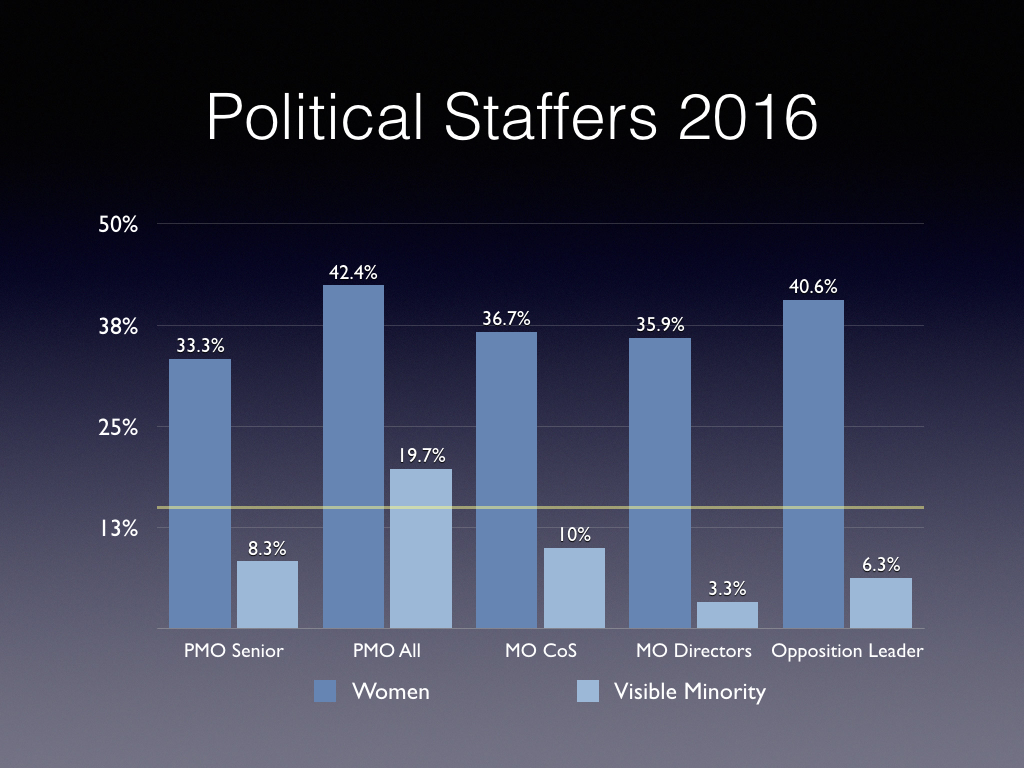
The same study should be made with respect to MP and Ministerial staff (the latter, when I looked at in late 2015 and early 2016, showed considerable under-representation in Ministerial offices, particularly of visible minorities and Indigenous peoples):

Women made up 59 per cent of Senate administration staff as of March 2016, according to the Senate administration report tabled in December. That’s a bump of 10 percentage points from the same month a year prior, and the highest level since at least 2009.

That shift was enough to prompt Sen. Marshall to ask the subcommittee’s witness, Senate human resources director Luc Presseau, whether the Senate’s efforts to ensure equal representation for women had created an overrepresentation.

The Senate administration has been working for several years to ensure proper representation of women, aboriginal people, disabled people, and visible minorities.

“When you swing one way to fix something, sometimes you swing the other way a little too far,” Sen. Marshall told The Hill Times in an interview.

In this case, the large jump in representation seems more dramatic than it really was; there were actually six fewer women working in the Senate administration staff last year than the year prior, but the total number of Senate staff had declined by an even greater proportion over that time, from 437 employees (215 women) to 354 (209 women). The Senate administrative staff dropped by 83 people last year after the Senate Protective Service was merged into the Parliamentary Protective Service, which is now a separate entity.

Last year women represented more than half of the top-earning Senate staff—55 per cent of those making six-figures—and exactly half of those in senior and middle management.

The Senate administration report, the fifth of its kind, shows modest changes to representation of visible minorities (15 per cent last year), aboriginal peoples (3.4 per cent), and persons with disabilities (5.6 per cent) since 2009. The report did not cover staffers working in the offices of Senators, but included all components of the Senate bureaucracy.

Mr. Presseau flagged underrepresentation of individuals with disabilities as a problem, telling the subcommittee, “our numbers are not quite as good as what the availability of the population might be.” He also said that indigenous people, particularly from the North, continue to be underrepresented.

None of the Senate administration’s 30 managers identified themselves as aboriginal last year, according to the report.

The Senate has been working to improve diversity among the ranks of its administrative staff for years. The Senate diversity subcommittee isn’t unprecedented either, as a similar subcommittee was set up in 2011 and tabled a report on the subject in 2012.

Mr. Presseau noted that the statistics included in the Senate report are based on individuals identifying themselves as belonging to a minority group—though that is not the case for gender—and said the numbers might look different if staff were reminded to self-identify.

Sen. Tannas, who also sits on the Senate Aboriginal Peoples Committee, asked whether the Senate could track whether those who identify as aboriginal could be verified as having official status—registered with the government as “status Indians”—as a way to prevent false claims.

“It’s becoming a bit of an urban legend that if you want to get ahead in the civil service that you suddenly identify with your aboriginal roots. And we don’t want that,” he told The Hill Times, adding it seemed unlikely that the Senate would be able to meet that request.

Sen. Tannas also urged the Senate to focus on increasing regional diversity among its staff, suggesting a program to temporarily exchange staff with provincial legislatures, in part to combat the perception out West that the government is run by people from Central Canada.

“I think it’s important in the national Parliament that we don’t wind up with a perfectly sealed bubble, where everybody involved in the affairs of the country drives no more than an hour to work,” he told The Hill Times.

Senators on the subcommittee also stressed the importance of hiring more veterans to work in the Senate, and finding a way to guard against name-based bias, wherein job applicants are overlooked, consciously or unconsciously, because their name suggests they belong to a minority group.

Sen. Jaffer told The Hill Times she hoped the subcommittee could wrap up its work and put together a report before June.

Source: Senate staff diversity under a microscope – The Hill Times – The Hill Times

Black People Are Wrongly Convicted Of Murder More Often, Data Show : NPR

Speaks for itself:

A record number of people, at least 166, were exonerated last year after being wrongly convicted of crimes, according to the most recent annual report from the National Registry of Exonerations.

It’s the third year in a row that data collected by a group of law schools showed a record number of exonerations in the U.S. — with 149 in 2015 and 125 the year before that.

Using information on exonerations going back to 1989, the latest report also shows that black people continue to be more likely to be wrongly convicted in America than people of other races. There is no standardized reporting system for exonerations, but the registry is the most complete national data collected on the subject.

Take the crime of murder. Last year, the report collected data on 52 people who were exonerated of murder. More than half of them, 28, were black.

companion report on race and wrongful conviction, also released Tuesday, states:

“African Americans are only 13% of the American population but a majority of innocent defendants wrongfully convicted of crimes and later exonerated. They constitute 47% of the 1,900 [total] exonerations listed in the National Registry of Exonerations (as of October 2016).”

As NPR’s Joe Shapiro reported last year, “after almost nine years in prison, his conviction was overturned when a state investigation found that the real killer had later confessed to Wayne County police and prosecutors.”

Joe also reported that court fees, including a $1,500 bill for a public defender, nearly kept the now-23-year-old man from being released — even after he had been exonerated.

Last year, The Texas Tribune reported that the state had paid 101 people who were wrongly convicted nearly $100 million over the previous 25 years.

Why Mixed-Race Americans Will Not Save The Country : NPR

Interesting and useful discussion on whether an increased percentage of mixed race reduces bias and discrimination, with some compelling examples and notes of caution:

What Biracial People Know,” a recent op-ed in The New York Times, argues that the growing multiracial population may act as a “vaccine” to the bigotry that buoyed Trump’s campaign, granting America “immunity” to the longstanding politics of exclusion shaped by racism.

But this hope that a mixed-race future will result in a paradise of interracial and ethnically-ambiguous babies is misleading. It presents racism as passive — a vestigial reflex that will fade with the presence of interracial offspring, rather than as an active system that can change with time. A 2015 study by Pew Research Center concluded that mixed-race Americans describe experiences of discrimination in the form of slurs, poor customer service, and police encounters. These figures were highest among people of black-white and black-Native American descent.

In their personal lives, mixed-race people may feel pressure to identify with one group or the other. They may have their sense of identity or belonging dismissed by the groups to which they belong, or by the dominant society.

Diana Sanchez, an associate professor in psychology at Rutgers University and a scholar of multiracial identity and experiences, says mixed-race individuals may face subtle forms of aggression in their daily interactions. “People have trouble putting multiracial people in a box … and have opinions about how they should be racially categorized,” she explained. In such instances, mixed-race people may not seamlessly blend in with others’ perceptions, but rather be told that they do not belong to a group, or that they must choose only one, contrary to their personal identity. For some, this disconnect between their sense of self and how the world identifies them can be difficult to navigate.

But when it comes to systemic barriers, experts point out that instances of racial discrimination for mixed-race people may not be very different from the experiences of people who identify as belonging to a single race. Tanya Hernandez, professor of law at Fordham University and the author of the forthcoming book Multiracials and Civil Rights, points out that in legal cases covering a wide-range of contexts, including education, employment, public accommodations, and criminal justice, “people who identify as mixed-race … describe … strikingly binary, black/white or White/non-white forms of discrimination.” Hernandez adds that many mixed-race people find themselves discriminated against, not explicitly because of their mixed-ness, but because of their belonging to a non-white group. She explained that in most of these cases, “the individual…is lumped together in stark contrast to whites, so it’s a white/non-white racial hierarchy.”

The fact that mixed-race people who present as non-white face discrimination because of their proximity to a non-white group reinforces the idea of racial discrimination emphasizing categorization with one group, rather than hybridity. As Sanchez notes, regardless of personal identity, “a lot of research points [out that] mixed-race people tend to be perceived along the lines of their minority identity.”

But what happens to those who aren’t easily categorized?

While not all mixed-race people are considered racially ambiguous, and not everyone perceived as racially ambiguous is of mixed parentage, there is evidence that the inability to categorize people as one race or the other may itself present new forms of bias. Sanchez’s research suggests that white people from less-diverse neighborhoods have more difficulty processing the faces of mixed-race individuals, and that this may result in bias. White people with less exposure to non-whites “have more discomfort trying to make decisions about mixed-race people…and that has consequences for their beliefs around those groups,” she notes.

The upshot, according to Sanchez, is that “the more [people] are exposed to racially-ambiguous individuals, the more likely they are to see race as a social construct, not a biological one.” That realization, that race is a social fiction, “would be a step in the right direction … in terms of trying to reduce racial prejudice and social inequalities,” she says. If people are willing to accept that race is a human fabrication, they may also be more willing to shift their attitudes and perceptions about other groups.

Acknowledging that mixed-race people may experience discrimination and that institutional racism, along with individual prejudice can take forms that target mixed-race people is central to developing policies that address the dynamic face of racism and the effects it has on our communities. But realizing that a mixed-race society can also uphold racism is crucial to a nuanced understanding of the challenge of recognizing and overcoming racism and bias.

Ultimately, the narrative that imagines mixed-race people as a panacea for racism is a flawed one that reinforces ideas around the very existence of race. Instead, we might want to refocus our conversation around how the collective fiction of race is weaponized to limit access to equality and justice for some groups and not others, then maybe we’re onto something.

Source: Why Mixed-Race Americans Will Not Save The Country : Code Switch : NPR

Some permanent residents of Canada can be barred from U.S. under Trump order

Too early to tell, but stories will emerge about the extent whether the waiver is being consistently applied or not (and important that Canada is appears to be the only country to have obtained such a waiver):

Permanent residents of Canada with citizenship from any of six Muslim-majority countries can be denied entry to the United States under the new version of U.S. President Donald Trump’s travel ban.

After Trump issued the first version of the 90-day ban in January, federal Immigration Minister Ahmed Hussen said he had been assured by the White House that permanent residents could go to the U.S. as usual. But the language of the second version is not nearly so straightforward.

The revised ban, signed by Trump on Monday, explicitly says that a “landed immigrant” from Canada needs to apply for a “waiver” that “may” be granted, on a “case-by-case basis,” at the discretion of a consular officer or another official from U.S. Customs and Border Protection.

It is not yet clear how strict or generous the U.S. government will be in giving such waivers to people applying at consulates in Canadian cities — or whether there will be any consistent policy at all.

“Canada will work with its counterparts in the United States to clarify the impacts of this order on Canadian citizens and Canadian temporary and permanent residents,” a spokesperson for the immigration ministry said Monday.

Public Safety Minister Ralph Goodale told reporters Monday that the waiver requirement “would not substantially change the process” for permanent residents from the six countries, since they already had to apply for a visa to enter the U.S. A top Canadian immigration lawyer, though, said other kinds of waivers often take much longer to obtain than visas.

Waivers for Canadians with criminal records, for example, currently take about six months to process, said lawyer Lorne Waldman. While the U.S. might create a faster process for this new kind of waiver, he said, the existing process is the best guide for now.

Trump’s order says waivers “could” be granted. The general requirement: “the foreign national has demonstrated to the officer’s satisfaction that denying entry during the suspension period would cause undue hardship, and that his or her entry would not pose a threat to national security and would be in the national interest.”

Despite the waiver requirement, Canada is still getting privileged treatment in the new order. There is no explicit waiver provision allowing entry by permanent residents of Australia or the United Kingdom.

The new order bans all refugees for 120 days and visitors from Syria, Sudan, Iran, Somalia, Libya and Yemen for 90 days. It does not affect dual citizens of Canada and the affected countries, such as Iranian-Canadians and Syrian-Canadians, who are still allowed to travel to the U.S. with their Canadian passports.

The revised ban was immediately blasted by civil liberties and human rights groups as bigoted and unconstitutional; the American Civil Liberties Union called it “Muslim Ban 2.” But it represents a major concession from a president who had mocked a “so-called judge” for putting it on hold, then defiantly promised in a tweet to “SEE YOU IN COURT” after he lost on appeal.

“The president has capitulated on numerous key provisions that we contested in court about a month ago,” Washington state attorney general Bob Ferguson, who challenged the original order, told reporters. “It bears pointing out that the administration, since that tweet, has done everything in its power to avoid seeing anyone in court when it comes to the original executive order.”

The new order is an attempt to impose a ban that can be seen to satisfy Trump’s campaign promises — first a “total and complete shutdown” on Muslim entry, then something he called “extreme vetting” — while also withstanding scrutiny from federal judges. Legal analysts said it has a much better chance in court than the vague and hastily imposed order of a month ago.

Unlike the original order, which took effect without any warning, this one is being introduced with a 10-day grace period — though Trump had defended the rapid introduction of the original order by saying that, “If the ban were announced with a one week notice, the ‘bad’ would rush into our country during that week.”

The new order excludes Iraq, whose inclusion in the first order was especially controversial because it harmed military interpreters and others risking their lives to work with the U.S. military. While the initial order singled out Syrian refugees for an indefinite ban, the revised version subjects them to the same four-month ban as other refugees.

Attempting to weaken the case that the policy amounts to anti-Muslim discrimination, the new order eliminates special treatment for refugees who are religious minorities in their home countries, a provision widely seen to be aimed at Christians.

Source: Some permanent residents of Canada can be barred from U.S. under Trump order | Toronto Star

Trump’s administration will be making it harder to get H-1B visas starting in April – Recode

Great opportunity for Canada:

United States Immigration and Customs Services has announced that, starting in April, it will no longer offer its 15-day “premium processing” program for applicants of H-1B visas.

H-1B visas allow employers to temporarily hire non-U.S. born workers to take highly skilled positions at U.S. companies. These visas are frequently used at large technology companies to bring top engineering talent to their U.S. offices. The U.S. only allows 85,000 people per year to enter the country on H-1B visas.

The announcement means that new H-1B visa applications could take months to process. With premium processing, U.S. immigration services offered a 15-day expedited service for a $1,225 filing fee, but come April that will no longer be an option.

“I’ve seen these applications take anywhere from 8-12 months,” said Tahmina Watson, a Seattle-based immigration lawyer, in an interview. “Even though the advertised processing time is four months, I’ve never seen anything take four months.”

This will not only affect new workers coming to the country on the H-1B program, but those who already hold an H-1B visa and are changing jobs within the country too, says Watson, like if an engineer who had an H-1B visa with Microsoft is taking a new position at Google, for example.

The suspension of the premium processing may last up to six months, according to the USICS website.

USICS says that it’s suspending premium processing in order to catch up on “long-pending petitions” — which the agency says has been difficult because of the large number of H-1B applications and requests for premium processing it receives.

Google, Apple, Amazon, Facebook and many other tech companies condemned Trump’s immigration and refugee ban that was issued by executive order in January, which blocked people from seven primarily Muslim countries from entering the U.S.

Dozens of companies, mostly in technology, signed onto a brief that claimed the ban inflicted “substantial harm on U.S. companies.”

Although that executive order was suspended after review from a panel of federal judges, Trump says his administration is working on a new version of the immigration ban.