Dutch love-child fathered by First Nations’ Canadian veteran finds lost identity, gets citizenship

A nice story about one “lost Canadian” whose situation was addressed in the further measures regarding “lost Canadians” in the 2014 C-24 legislation, reminding us of the complexities of families and identities:

Six weeks before Christmas a retired Dutch carpenter named Will van Ee met with Sabine Nolke, Canada’s ambassador to the Netherlands at the Canadian embassy in The Hague. Van Ee brought a small bottle of liqueur crafted in his small hometown of Sas van Gent, near the Belgian border, as a gift.

The two drank coffee and chatted for about an hour. Conversation shifted from the German-born ambassador’s roots to van Ee’s father’s war record to their shared passion for Canada before a photographer arrived to capture what was, for van Ee, an occasion 70 years in the making.

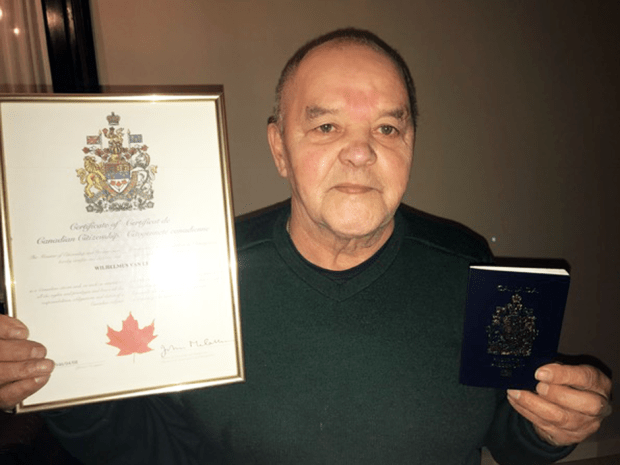
It was the day Van Ee, the illegitimate son of an aboriginal Canadian soldier and a Dutch girl who met during the end days of the Second World war, became a Canadian.

“I am a carpenter, a bricklayer and a furniture-maker,” van Ee says from Holland. “So I have always said, well, my body is definitely Dutch. But, in my heart, I am a Canadian, because that is how I truly feel, and I feel very connected to my native roots.”

Van Ee spent years searching for his Canadian family. Now he is a full-status member of the Sagamok Anishnawbeck First Nation in Northern Ontario, has a totem pole in his backyard (that he carved) and, after his November meeting with the ambassador – his Canadian citizenship.

It is a lost identity that stayed hidden from him until well into adulthood.

The Dutch refer to “the wild summer of 1945.” The war was over and about 170,000 Canadian soldiers were stationed in a country that nearly starved to death under German occupation. Young people let loose. Couples, from two different worlds, drew close. Dutch clergy scolded the older generation for letting their daughters run wild. The Canadian military scolded the soldiers, while Ottawa took the position that children born out of wedlock to Canadian servicemen were not Canada’s responsibility. But the party didn’t stop. There were 7,000 illegitimate births in Holland in 1946.

Will van Ee was one of them.

His mother, Hendrike Herber, married Albert van Ee a few years later. The couple had seven additional children. The eldest harboured suspicions about his true origins, and thought he might actually be Japanese or Italian.

“I was the only sibling with dark skin,” van Ee says, chuckling. “The real Dutch — all blond hair and blue eyes — but not me.”

But he was loved and happy, and only became interested in digging into the past after getting married in the late 1970s. His mother grew quiet when he started asking questions. Van Ee believes out of a sense of “shame,” and from knowing, perhaps, that her true “love,” wasn’t the man she married. The truth came out after a cousin gave van Ee an old photograph. Hendrike is glowing in the image, alongside a beaming Canadian soldier named Walter Majeki. Van Ee’s aunt told her nephew that their family loved Walter, and then he had left.

“My mother once told my wife that had Walter called for her — even after she had children with Albert — that she would have gone to Canada,” van Ee says.

Courtesy Will van Ee

Courtesy Will van EeWill van Ee is now a Canadian citizen and a full-status member of the Sagamok Anishnawbeck First Nation.

But how to find Walter, almost 40 years after the fact, in a pre-Google world? Van Ee enlisted Olga Rains, a Dutch war bride in Peterborough, Ont., dedicated to reuniting other so-called “Liberation” children with their Canadian families. (Post-war estimates put the number of European-born children fathered — and abandoned — by Canadian soldiers at 30,000.)

Rains told van Ee that his father appeared to be First Nation. She had Walter Majeki’s photo published in several Canadian newspapers. In 1984, the son he left behind picked up the phone and dialed a number for Walter’s brother, Neil, in Latchford, Ont.

“I was shaking,” van Ee recalls.

Soon after he was on a flight to Toronto to meet his uncle and a cousin, Richard.

“When my father first saw Willy getting off that plane he said to me, ‘My God, there is Walter, my own brother,’ ” Richard Majeki says from North Bay, Ont. “Willy was a Majeki from the get-go.”

The story, as van Ee heard it from the Majeki clan and his father’s oldest childhood friends — and that he believes in his heart to be true, is that Walter returned from the war with every intention of sending for Hendrike. But his mother forbid the relationship. She said European girls were “no good.” Richard Majeki recalls a conversation with his father, Neil, in which he said that Walter spoke to him of Hendrike on only one occasion. Walter said that he hoped she would love and “look after” their child. And then he moved to Milwaukee, leaving behind a box of photographs of the Dutch girl he fell for during the wild summer of 1945.

Walter worked in a brewery. He married an American. They started a family. He died in 1972.

“I believe 100 per cent that my parents truly loved one another,” van Ee says. “It changed me, finding my father — even though we never met. I came to wish that I had started looking for him much earlier in my life.”

The Sagamok Anishnawbeck First Nation welcomed van Ee as one of its own at a traditional ceremony in Massey, Ont. Sweet-grass was burned, a pipe smoked and van Ee informed that his ancestors had “tears in their eyes,” over his return.

“I felt something that day,” he says.

He went fishing with his father’s best friends off Manitoulin Island. They said they felt as though their old friend had come home to them. Uncle Neil gave van Ee two miniature totem poles as gifts. The Dutch carpenter carved a giant replica — and put it in his backyard.

“We are proud to know Willy,” Richard Majeki says. “He is one of us.”
Van Ee wrote to Walter’s widow in Milwaukee asking if he could visit. He received a reply through a lawyer requesting he never contact the family again.

“That was hard,” he says.

What van Ee has found in three trips to Northern Ontario over the past 30 years is a sense of belonging.

“I now know where I come from,” he says.

Wilhemus van Ee became a full-status member of his tribe in 1992. But getting Canadian citizenship was more complicated. Involving, as it did – until the legislation was amended in 2015 — an archaic law barring individuals born out of wedlock to a foreign mother, prior to 1947, the right to citizenship.

“My father fought for Canada and here I was fighting to become Canadian,” van Ee says.

Four weeks after his audience with the ambassador, the 70-year-old received his Canadian passport. He is planning a trip to Canada soon.
Source: Dutch love-child fathered by First Nations’ Canadian veteran finds lost identity, gets citizenship | National Post

Un Néerlandais arrivé au Canada en 1958 expulsé lundi | Actualités

Have not seen this story in the English language press but it is a good example of the impact of the previous government’s efforts to deport those guilty of violent crime.

But someone who arrived at the age of 8 months who has lived all his life in Canada? At that point, doesn’t Canada “own” him, notwithstanding his lack of citizenship?:

Len Van Heest, un Néerlandais de 59 ans arrivé au Canada quand il était bébé, va être expulsé lundi vers les Pays-Bas, un pays dont il ne parle pas la langue, a décidé vendredi la justice au terme de neuf ans de procédures.

Arrivé avec ses parents en 1958 à l’âge de 8 mois, Len Van Heest « n’a jamais obtenu la nationalité canadienne » et a été diagnostiqué bipolaire à l’âge de 16 ans, selon les attendus du jugement d’expulsion du tribunal fédéral de Vancouver, en Colombie-Britannique.

Alcoolique et dépendant aux stupéfiants, il est poursuivi à partir du milieu des années 70 et jusqu’en 2013 pour une quarantaine de délits. Il assure qu’ils ont été commis pour la plupart dans « la phase maniaque de la maladie », selon le tribunal.

Depuis un durcissement de la législation par le précédent gouvernement conservateur, un ressortissant étranger condamné à plus de six mois de prison est passible d’une expulsion du Canada. La précédente loi ouvrait à une possible expulsion au-delà d’une condamnation de deux ans de prison.

Len Van Heest avait engagé plusieurs recours contre son expulsion dont la première décision remonte au 2 janvier 2008. Le corps médical avait permis de surseoir à son expulsion au motif que les troubles psychologiques pouvaient le pousser au suicide en l’envoyant dans un environnement totalement inconnu.

Le Néerlandais avançait également que sa santé mentale nécessitait des traitements auxquels il n’aurait pas accès aux Pays-Bas, faute de ressources financières sur place d’autant qu’il ne parlait pas la langue.

Domicilié à Courtenay, à 200 km au nord de Victoria, sur l’île de Vancouver, Len Van Heest voulait également rester auprès de sa mère âgée de 81 ans.

« J’ai payé ma dette envers la société […] et maintenant c’est une condamnation à perpétuité », avait-il déclaré fin février à la télévision locale Chek News.

Dans ses attendus, le juge Paul Crampton a reconnu que Len Van Heest « peut souffrir d’un inconvénient et d’une difficulté à s’installer aux Pays-Bas » plus importante que toute autre personne expulsée du Canada.

Néanmoins, le juge a estimé que l’individu n’avait pas pris les mesures préalables nécessaires « pour minimiser cet inconvénient et cette difficulté ».

En conséquence, Len Van Heest doit être expulsé le lundi 6 mars, conclut le juge dans ses attendus de 15 pages.

Families divided after Ottawa tells thousands they’re not indigenous | Toronto Star

I have a lot of sympathy for the people who have had to develop and implementation the criteria used, as well as the people interviewed below whose applications have been denied. Identity is as much if not more subjective and yet needed to be “objectified” for the purpose of status cards:

Belonging. Identity. Who do you think you are? Who do they say you are? For thousands of indigenous Canadians, it’s complicated. Records have been obscured or obliterated through hundreds of years of assimilation. The federal government — from bureaucrats to Indian agents — made these decisions based on the political mandates of the day. First Nations have made their decisions. So have individuals. In this occasional series, The Status Card, Tanya Talaga, the Star’s indigenous affairs reporter, will look at the complexities and who is making these decisions and how.

CORNER BROOK, N.L.—Retired master corporal Matthew Connolly has spread his prized spiritual possessions on his dining room table.

He carefully touches each as he explains its significance. He starts with a beautifully carved drumstick made from the wood of an old sweat lodge. Then he unrolls the red leather case that holds his eagle feather, given for service to the community. He moves to a hand-held drum, then a smudge kit, then a satchel of tobacco.

From his wallet, he retrieves a small, laminated white card to show the words “Teluisi Kelusit Paqtism” — Speaking Wolf, Connolly’s Mi’kmaq name. He grew up proud knowing he is a direct descendant of Mattie Mitchell, the revered trader and explorer who is recognized as a founding father of the Mi’kmaq in western Newfoundland, likely arriving here in the 1700s from Cape Breton.

Connolly, 57, may believe he is indigenous but the government of Canada does not. Connolly was one of 82,630 people who received a letter dated Jan. 31, 2017, from Indigenous and Northern Affairs Canada, denying his application for membership in the Qalipu Mi’kmaq First Nation, a landless band headquartered in Corner Brook, Newfoundland.

His rejection came at the end of an unprecedented enrolment drive that saw 101,000 claiming Mi’kmaq ancestry and applying to join the Qalipu, a band made up of nearly a dozen Newfoundland indigenous communities. Applicants were judged on a points system developed by six government representatives and six from the Federation of Newfoundland Indians (FNI) to assess how Mi’kmaq someone is.

Thirteen points grants membership. Points were given to those who live in one of Newfoundland’s 66 Mi’kmaq communities, and to those who could prove they were culturally involved with the Mi’kmaq before June 2008, when the federal government officially recognized the Qalipu. Points were also given if applicants could produce affidavits that they had engaged in activities such as hunting and powwows, and if they had airline receipts to show frequent visits to Mi’kmaq areas.

But how and why points were given to some but not others has caused endless confusion and can border on the absurd. In many families, some siblings were accepted and others rejected. In the case of twin toddlers, one gained membership and the other did not. The first president of the Federation of Newfoundland Indians was rejected and so was a recent Indspire Awards recipient. Indspire Awards are handed out only to indigenous people.

The 100,000 applicants came from across Canada and beyond — from Hong Kong, California and Australia — all claiming Mi’kmaq ancestry. But Ottawa and the Qalipu band council agreed “it was neither reasonable nor credible” to expect that all of them would become members of the First Nation, “particularly given that approximately two-thirds of the applicants did not reside in any of the Mi’kmaq communities targeted for recognition in this initiative,” Qalipu’s website states.

Connolly’s rejection was blunt: “You did not meet the requirements for acceptance by the Mi’kmaq group of Indians of Newfoundland.”

He only received three points. This stunned Connolly, who has a home in Corner Brook, has participated in cultural events and powwows and has worked for the Qalipu band. He believes multiple mistakes were made when his application was assessed and is “emotionally devastated.”

Source: Families divided after Ottawa tells thousands they’re not indigenous | Toronto Star

Diversity in GiC appointments – 2016 Update

My latest in IRPP Policy Options:

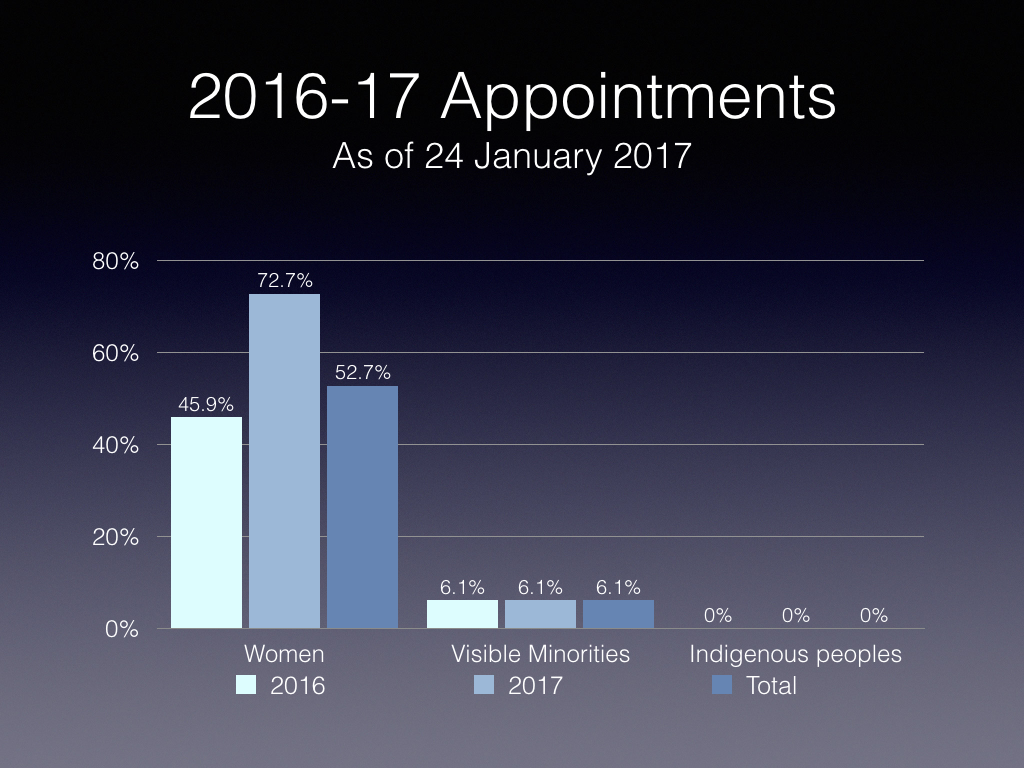
election-2015-and-beyond-implementation-diversity-and-inclusion-062Following my 2016 baseline study of the diversity of Governor in Council (GiC) appointments (Governor in Council Appointments – 2016 Baseline), I have analyzed 2016 and early 2017 appointments using the GiC appointments index. There has been a strong push towards gender parity but no clear trend with respect to visible minorities and Indigenous peoples.

Baseline data below:

GiC Baseline 2016.010

Source: Diversity in GiC appointments

Women-only English program in Metro Vancouver hopes to expand

Good initiative:

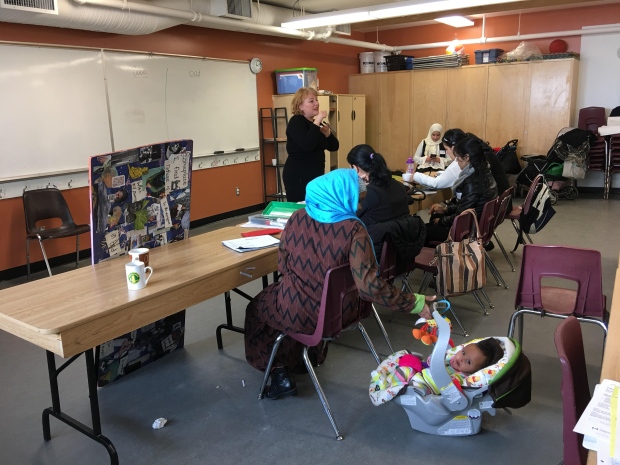
A unique English program for immigrants and refugees in Metro Vancouver is hoping to expand after finding success with women-only classes where participants can also bring their children.

The focus is not just on language, said teacher Diana Jeffries, but also on supporting mental health.

“So learning the language through taking care of yourself … making connections through community, through working together in this classroom.”

Unlike federally funded language programs like Language Instruction for Newcomers to Canada (LINC), there are no eligibility requirements or tests to join the Pacific Immigrant Resources Society’s community English classes for refugee women.

“We’re different in that we’re trauma informed, that we allow young children in the classroom, we don’t have the same kind of assessment processes the LINC has,” said program director Amea Wilbur.

“We are specific to women and also we can be a lot more responsive in terms of curriculum.”

The program is open to refugees and immigrants from any country.

Farzana Fakrhi said the flexible atmosphere is the main reason she’s able to attend the classes in Burnaby.

“It’s very helpful — especially for the women who have small kids. They have daycare for the small babies, which the other classes didn’t have it.”

Some federally funded classes do provide child minding for children, but they usually have to be 18 months or older.

Community english classes

The female-only language program in Metro Vancouver allows women to bring their children to class. (Bal Brach/CBC)

Outreach worker Zarmina Ali said some of the women have never stepped foot in a classroom before arriving in Canada.

“This program is very important for them because most people haven’t been at school in their life — this is the first time they come to school and they enjoy it so much.”

Sharing stories of loss

Jeffries said the supportive environment in the class has given students the confidence to share their stories of loss and struggle.

“[They talk about] the era of the Taliban and wearing burkas,” she said.

“And experiences of great loss, family members, of even children. They carry around a huge weight of their past but [they are] just looking to Canada as an opportunity for a better future for themselves and their children.”

Wilbur created the program after witnessing a gap in services for newcomers.

Source: Women-only English program in Metro Vancouver hopes to expand – British Columbia – CBC News

Officials confirm rise in asylum seekers [with data] crossing illegally into Canada, but RCMP lay no charges

Good that the numbers are being released, along with the close monitoring – an increase of 26.5 percent compared to last year (January 1 to February 21) :

Canadian officials are keeping close tabs on the number of people illegally crossing the border into Canada, but they don’t expect the winter increase will necessarily lead to a spring surge.

Government officials, who spoke on background and did not wish to be named, provided journalists with an update on illegal crossings today and confirmed an increase in three provinces.

Between Jan. 1 and Feb. 21 this year, there were 290 illegal crossings in Quebec, 94 in Manitoba and 51 in British Columbia, totalling 435.

That compares with 2,464 illegal entries apprehended by the RCMP in the same regions in all of 2016.

These numbers do not include people who may have crossed illegally without being caught by police.

While it is a criminal offence to cross into Canada outside a legal border point, no one has yet been charged, according to an official. If caught, the person who has entered the country without authorization is arrested and required to undergo a criminal background check.

“To my knowledge we haven’t charged the people for crossing the border illegally,” one official said. “We determine if there’s any criminality … then we would follow up. If there’s no criminality, we would turn them over to our counterparts at CBSA.”

The Canada Border Services Agency can detain people who have a criminal record, who can’t be properly identified or who are at risk of not showing up for a hearing. Officials stressed that all people are carefully screened by CBSA before they are released.

No charges until after refugee claim process

Refugee and human rights lawyer Lorne Waldman said police cannot lay a charge until the refugee claim process is complete.

“There’s a clear provision in the law that says people who cross the border or use false documents in order to come to Canada to make a refugee claim cannot be charged unless their claim is rejected, because the UN convention says people shouldn’t be punished for illegal entry if it’s for the purpose of making a refugee claim,” he told CBC News.

Careful screening process

“We are not releasing anybody that we have concerns about,” an official said. “Their identity is confirmed, the biometrics have been confirmed, the biographic data is confirmed … they are deemed admissible and they are eligible for proceeding towards a refugee claim.”

The total number of people who made refugee claims in Canada inland — not at official border points — climbed to 2,281 this year between Jan. 1 and Feb. 21, up from 1,803 during the same period in 2016.

Source: Officials confirm rise in asylum seekers crossing illegally into Canada, but RCMP lay no charges – Politics – CBC News

Canadians have different attitudes on immigrants versus refugees: poll

Two contrasting polls released: the annual IRCC tracking survey and a SOM poll of attitudes in Quebec  (methodologies and questions vary).

Canada-wide results show 52 percent believe the current levels are about right, down from 58 percent a year earlier. The Quebec poll asks this question differently, showing 55 percent are opposed to an increase in immigration levels while 36 percent support an increase.

Starting with the tracking survey:

A newly released federal survey on attitudes towards immigration suggests Canadians are somewhat more enthusiastic about accepting economic migrants than they are about refugees.

While 52 per cent of those polled in the Immigration Department’s annual tracking study felt the right number of immigrants were coming to Canada, 23 per cent thought it was too high.

Meanwhile, 40 per cent felt the right number of refugees was being admitted and 30 per cent thought that figure was too high.

The 2016 survey was done long before immigration and refugee policy became a centrepiece of the U.S. presidential campaign and the eventual new administration of Donald Trump, and before the question of what values immigrants to Canada ought to hold became a centrepiece of Conservative leadership politics here.

So while the data might not reflect how attitudes have shifted since those developments, it’s telling for what it was probing for in the first place, suggested Jack Jedwab, the executive vice president of the Association for Canadian Studies and co-chairman of an upcoming conference on integration and immigration.

“I think what the government is trying to get at is the issue of the extent to which people are more preoccupied by the increase in refugees that’s happening in a lot other places in the world,” he said.

While the survey did suggest some differences in viewpoints on refugees versus other classes of immigrants, Jedwab said they aren’t substantial.

“Right now, we’re seeing globally an effort on the part of elected officials to try to make those distinctions – refugees bad, economic migrants good, that’s the distinction that’s being made in the States to some extent,” he said.

“And I don’t think, based on what we’re seeing now in this poll, that we’re seeing that idea take effect here.”

Pollsters were in field between August 11 to 31, 2016, asking 1,598 Canadians for their opinions on immigration. The survey has a margin of error of 2.45 per cent, 19 times out of 20.

The survey was done ahead of the release of the immigration levels plan, published in October, and also before the federal government received a report from its economic advisory council that would recommend a massive increase in the number of immigrants to Canada, from what had been about 260,000 a year to 450,000.

The survey did probe Canadians’ appetite for an increase. Respondents were asked to what extent they’d support boosting levels of economic immigration by 100,000 people over the next five years and 42 per cent exhibited some level of support for the idea. If the number ratcheted up further to 200,000 over five years, support fell to 38 per cent.

The Liberals eventually nixed any major increase, going instead with a modest uptake in admissions to around 300,000.

While the survey is done annually, not all the questions are repeated each year, making it difficult to compare attitudes over time unless the questions are exactly the same.

There was some crossover between this year and last year’s study.

Fifty-two per cent of those polled in 2016 thought the government is accepting the right number of immigrants, down from 58 per cent of those polled in 2015.

Meanwhile, about 46 per cent of those polled in 2016 felt that refugees have a positive impact on the Canadian economy, up from the 41 per cent who felt that way in the survey done last year.

Source: Canadians have different attitudes on immigrants versus refugees: poll – The Globe and Mail

The Quebec poll:

Une majorité de Québécois est défavorable à l’idée d’accueillir davantage d’immigrants au Canada à la suite des mesures anti-immigration du président américain Donald Trump.

Un sondage SOM publié mercredi par Cogeco Nouvelles précise que 55 % des répondants croient que le Canada ne devrait pas accueillir davantage d’immigrants à la suite des mesures anti-immigration du président américain.

En revanche, 36 % des gens approuvent l’idée d’en accueillir davantage, alors que 9 % se disent indécis.

Les catégories de personnes qui sont les plus favorables à l’idée d’accueillir davantage d’immigrants à la suite des mesures adoptées par l’administration Trump sont les 18-24 ans, dans une proportion de 55 %, ceux qui ont une langue maternelle autre que le français, dans une proportion de 49 %, et ceux qui ont une scolarité de niveau universitaire, dans une proportion de 49 %.

De même, 75 % des personnes interrogées se disent d’accord avec l’idée de resserrer la surveillance aux frontières pour empêcher l’arrivée d’immigrants illégaux.

Les personnes ayant le français comme langue maternelle sont encore plus nombreuses à le penser, soit 79 %.

Seulement 19 % s’opposent à l’idée.

De plus, moins du tiers des Québécois interrogés jugent que le premier ministre du Canada, Justin Trudeau, gère correctement le dossier de l’arrivée au pays des immigrants illégaux, soit 29 % d’entre eux.

La majorité des Québécois dit non à plus de migrants, selon un sondage

Canada’s Immigration System, Lauded by Trump, Is More Complex Than Advertised – The New York Times

Following Trump’s ‘shout-out’ to Canada’s (and Australia’s) immigration system, more coverage in US media:

Canada’s merit-based immigration system received a loving mention by President Trump this week in his speech to Congress. Mr. Trump, who has railed against illegal immigration and talked tough about tightening borders, said adopting that kind of system would cost American taxpayers less and help increase wages for poor workers.

But in Canada, immigration is not just about selecting newcomers based on their skills. It is part of a system that promotes both the economy and the country’s multicultural society, which has arguably become as much a part of Canadian identity as hockey. And it is largely seen as a way to increase immigration, not reduce it.

“Canadians are more likely than citizens of any other industrial country to think immigration is essential to the economy and the future of the country,” said Jeffrey Reitz, a professor of ethnic and immigration studies at the University of Toronto.

Canada, a country of 35 million, aims to take in 300,000 immigrants this year — 0.85 percent of its population, compared with the United States’ 0.3 percent — and polls show Canadians are happy with this. In fact, the finance minister’s advisory council on economic growth wants 150,000 more.

Part of that enthusiasm is the country’s recognition that, with an aging population, immigration is essential to economic growth. Add to that Canada’s geography — a long border with the prosperous United States to the south and the Arctic to the north — and illegal immigration is less of an issue.

And finally, Canadians have a wholehearted belief in the merit-based immigration system, which creates a positive feedback loop.

“The advantage of our system is the people who come in — everyone agrees they’ve passed some sort of merit system,” said Ravi Pendakur, a professor of public and international affairs at the University of Ottawa. “The Canadian population in particular is more willing to buy into immigration. They can see it’s managed, and that’s an advantage.”

The program does have its drawbacks. It has become enormously complex, ever-morphing and a source of huge backlogs.

Created in 1967, the merit-based system was seen as a way to select immigrants based on their “human capital” and not simply their country of origin, as had been the tradition. The idea was to bring in immigrants, regardless of where they were born, with vetted qualities that would make them the most successful at integrating into the Canadian economy.

Candidates received points for their level of education, ability to speak one or both of the country’s official languages, work experience, age, a job offer and what immigration officials called adaptability, which meant they came with family or had family here.

Initially, this system was the smallest of three streams of immigrants. People reuniting with their families and refugees were the other two. But increasingly, Canadian leaders have favored these “economic immigrants” to the point that this year, the government projects they will make up 57.5 percent of newcomers.

….“I teach this stuff and I find it confusing,” said Prof. Audrey Macklin, director of the University of Toronto’s Center for Criminology and Sociolegal Studies. “It’s inherently confusing, plus it keeps changing.”

Still, the principle remains: The immigrants coming in under this system are well educated, literate in the local language and have great credentials.

Not surprisingly, studies have shown that economic immigrants, arriving with more education and language skills, land higher-paying jobs with greater potential for raises. Their children also have higher college graduation rates.

“If America changes toward our system, the Apples and Microsofts and Googles will be very happy,” said Robert Vineberg, a retired regional director general of immigration. “But the vegetable growers in California will not be so happy.”

Mr. Vineberg offered government immigration statistics from 2015 as an example. That year, Canada identified 66,360 newcomers as economic immigrants for their occupational skills.

Around 36,300 were categorized in the top two classes, meaning they were fluent in one national language and had a college degree. Most would have been recruited for a specific job, Mr. Vineberg said: for instance, vice president of a company or administrator of a hospital. Another 22,700 were picked for a job in skilled trades, like an industrial electrician. They needed the language skills to read a blueprint and follow complicated directions, and at least some postsecondary training and certification in their trade.

Only 2,177 were brought in as laborers, and even they would have been chosen for specific positions, most likely in a hard-to-fill job or a remote location — for instance, a Japanese-speaking hotel receptionist in Yellowknife, Northwest Territories, Mr. Vineberg said.

His example, however, illuminates the contradiction at the center of the immigration system.

In 2015, almost 272,000 people were granted entry, and only a quarter were picked for their merit. Most of those counted in the economic class were family members, chosen not for their human capital — although many might also be educated and intend to work — but their blood ties.

“The statistics convey the impression that Canada chooses most people based on economic criteria, and perhaps policy makers think this reassures Canadians that immigration serves Canada’s economic interests,” Professor Macklin said. “In reality, most people still enter on the basis of kinship. The idea that this can be easily or significantly altered is a bit of a fantasy.”

The other distinctive aspect of Canada’s immigration policy is what the country does not face: a tidal wave of migrants. Surrounded on three sides by enormous and frigid oceans, Canada has few people sneaking in. Even the increasing number of asylum seekers illegally crossing the border from the United States in recent years is comparatively small.

“It’s easier to be relaxed about immigration when your only land border is a huge wall with the United States,” Professor Reitz said.

Senate hearings on C-6: Clause-by-clause complete, on to third reading March 2

Summary: C-6 was approved on division by the SOCI and reported out to the full Senate for third reading, with Conservative senators opposed. Three observations were appended to the report: greater flexibility for exemptions to knowledge and language assessment, reviewing possible use of smart permanent residency cards, and considering a reduction in citizenship fees. Senator Eggleton, as Deputy Chair, while supporting C-6 noted that an amendment was needed with respect to revocation in cases of fraud or misrepresentation, given the lack of due process, and an amendment would be tabled at third reading.

Clause-by-clause: All clauses of C-6 were carried on division, with Conservative senators opposed to all provisions. Clause 3 (repeal of the revocation provision for dual nationals convicted of terrorism or treason) and the related clause 20 (reinstatement of citizenship of those whose citizenship was revoked for terrorism or treason) were subject to recorded votes, with all Conservative senators opposed.

Observations

Citizenship for children born abroad (non-genetic link): Senator Omidvar noted testimony of the Barreau du Quebec (check) flagging issues related to children born abroad but without any genetic link to their Canadian parents (e.g., surrogates, in vitro). After consideration discussion, officials noted that children adopted abroad had direct access to citizenship (C-14 in 2008) with no difference in treatment between male-female and same sex couples. With respect to surrogates or in vitro children, a genetic or gestational (Canadian mother born) was required. With this clarification, the observation was withdrawn.

Greater flexibility for exceptions to knowledge and language assessment: Senator Omidvar noted the testimony by a number of witnesses regarding the difficulty some immigrant have with respect to testing. Under “exceptional circumstances” (e.g., social, physical, mental health, disabilities, lack of time for women with caregiving responsibilities).

A number of senators expressed concern that the language was overly broad. Moreover, questions had already been raised by former citizenship judge Watt that the assessment process was not strong enough. Officials indicated there was already considerable scope for discretion in such cases and that 80 percent of waiver requests were granted (320 waivers). Officials also noted that the citizenship test was available in large print and brail versions. The Minister had broad grounds to waive these requirements and the department was confident it had the needed authorities and instructions in place.

Omidvar noted that language and knowledge assessment had become more difficult since the time judge Watt was active. She noted that often applicants in this situation had to go to court to obtain waivers and the system was not as flexible and accommodating as portrayed and reminded all of the wording “exceptional circumstances.” In the end, observation carried.

Smart permanent residence cards: Senator Frum, picking up on lawyer Julie Taub’s point about the need for smart cards to automatically track entry and exit to minimize the burden on immigrants and reduce residency fraud, tabled an observation that asked the government “to implement” smart PR cards. However, she also offered a softer version: “review or consider.” A number of senators expressed support for the concept but noted the practical difficulties of implementation The Chair deftly secured agreement for the “review and consider” language.

Fees: Senator Eggleton returned to the issue of the sharp increase of citizenship fees from $100 to $530 plus right of citizenship fee of $100, resulting in a cost of $1,460 for a family of four, with possible additional costs of language assessment. This posed a financial burden and barrier to low-income immigrants and thus his observation requested the government consider lowering fees.

Referring extensively to my submission (https://sencanada.ca/content/sen/committee/421/SOCI/Briefs/C-6_A_Griffith_e.pdf) and its attribution of the much of the 50 percent drop in  applications to this increase, he noted that it belied the assertion in the Canada Gazette notifications that no drop was anticipated. Historically, about 200,000 applications were submitted, the current trend would see less than 100,000. Departmental staff believe that other reasons are involved which may be the case given other elements of C-24.

Canada should not discourage people from becoming citizens and becoming a citizen shouldn’t be based on financial means. Cost recovery may have been supported by one witness but other witnesses noted that this created a barrier for many immigrants. Income testing for waivers was “not the way to go” as it marginalized people more. He did not agree with the department’s position.

Senator Frum probed regarding waivers for those who submitted evidence of hardship while those who could pay should pay. Senator Neufeld noted that the committee had heard from officials and the Minister and that the fees were what was needed to cover the cost of the program.

Senator Eggleton noted that an increase from $100 to $530 is a problem. One did not need to roll back the fee to $100 but perhaps to $300, addingg that the right to citizenship fee of $100 was “ridiculous. He reiterated his concern that an income test would stigmatize low-income immigrants.

Observation carried.

Revocation for fraud or misrepresentation amendment (Hill Times):

Independent Senator Ratna Omidvar, who was appointed last year by Prime Minister Justin Trudeau, says Senators are preparing to amend a key plank of the government’s mandate next week, the Citizenship Bill C-6, a move she calls “necessary” and says she’s received support from some Senate Liberals as well.

Sen. Omidvar, an international expert on migration who is sponsoring Bill C-6, An Act to amend the Citizenship Act, in the Senate, told The Hill Times on Thursday that she’s nearing the completion of drafting an amendment that would put an end to Canadians being stripped of their citizenship without a hearing. Sen. Omidvar wants to remove a law brought in by the previous Conservative government which allows for the revocation of citizenship of anyone who the government deems to have been fraudulent or misrepresented themselves during the application process.

Currently, the provision is not part of Bill C-6, despite the fact that the legislation features other repeals of Conservative legislation. As it stands, Bill C-6 addresses promises made by the Liberals during the last election campaign to amend parts of the previous Conservative government’s Bill C-24 from the last Parliament.

….The amendment would include the right of the individual whose citizenship is in question to appeal their case to the Federal Court, without leave, she said. “It would have a timeline attached to it, it would enable the appellant in this case to have access to full disclosure of documents that were used to reach the original decision. The individual would have the right to provide more evidence that may or may not have been available,” said Sen. Omidvar.

On Thursday, the Senate Social Affairs, Science and Technology Committee passed the legislation without amendment, but warned that the proposed amendment was still coming.

Sen. Omidvar said she believes she will have enough Senate support for her amendment to pass when she brings Bill C-6 back up for debate in the Upper Chamber next week.

“Everyone feels an amendment is necessary, we are now arguing about its shape and size … but I’m confident that we will craft an amendment that is hopefully accepted, first by the Chamber, and then by the House,” she said.

Amending government’s Citizenship Bill ‘necessary,’ says Sen. Omidvar, Senate sponsor of Bill C-6


Schools are teaching values. But whose values?

Interesting trend in education and assessment, and how to measure “character:”

To formally assess children’s characters, schools between Ontario and British Columbia have begun distributing a questionnaire created by psychologist Wayne Hammond. “We’ve proven that the tool is statistically predictable,” says Hammond, owner of a Calgary-based human resources consulting firm called Meritcore. “I can tell you where your character’s at.”

The questionnaire, called the Resiliency Assessment Survey, contains 62 to 82 questions, depending on a school’s preference. Students rank how strongly they agree or disagree with statements similar to “I try to avoid unsafe things” or “I feel hopeful about my future.” The tool creates profiles of each student’s top strengths and weaknesses, such as acceptance, restraint or safety. The results belong to each school board and are used to identify at-risk students and trends within schools. “It starts to give them a round-up,” says Hammond. “Who needs resources? Who needs stretching?”

Alternative measures include the Character Growth Card, invented by American Angela Duckworth, a pioneer of the character movement. Duckworth argues that character, specifically “grit,” is the key determinant of student success. Her hard-copy questionnaire gauges attributes such as gratitude, self-control and zest (defined as approaching life with enthusiasm) by asking students and teachers to rank how often they’ve done things like “kept their temper in check” and “stuck with a project for more than a few weeks.”

A third tool comes from psychologist Mark Liston at the University of Missouri-St. Louis. His online multiple-choice survey measures 11 character strengths in as many minutes, giving students and teachers percentage scores on attributes such as wisdom, empathy and “love/closeness” (one school in Denver had to remove the questions on spirituality because it feared a lawsuit from parents). The results compare each person to “national averages” derived from 1,000 Americans. Schools pay up to $500 per student to take the survey.

A “character portfolio” is another concept of Liston’s. It presents a student’s character scores through Grades 4 to 12, paired with extracurricular and community service hours, journal entries and mentor reports, decorated with personal statements and pull quotes. Liston plans to sell a portfolio program to schools and parents, for students to use in university applications. “When kids start seeing this will help them get into a better college, they’ll start to use it,” he says. “In the past, it’s pretty much been a reference letter. We can do more than that. We must do more than that.” Even if students lie about their empathy, kindness and optimism to buff up their portfolios, Liston says, “How long can you fake it before it actually becomes who you are?”

Alarmingly, some schools are taking character scores more seriously than the researchers intended. This year, nine school districts in California will begin to incorporate character assessments into school accountability, affecting their funding. “We’re nowhere near ready,” warns Duckworth in a column in the New York Times, “and perhaps never will be, to use feedback on character as a metric for judging the effectiveness of teachers and schools.” Duckworth notes that the new measurement tools may not be accurate due to cultural biases—for example, at one school, students from Korea ranked themselves lower on all attributes—and because students hold different standards for character indicators such as “comes to class prepared.” Regardless of the limitations, the measurements threaten to become “high-stakes metrics for accountability,” Duckworth writes. When a California teacher told her that she worried the school’s low scores would mean less funding per student, Duckworth writes, “I felt queasy.”

At W.J. Mouat, character grades range from 50 to 100 per cent, and final grades appear on student transcripts. Fraser hopes to learn more about the concept of character portfolios and their use for university applications. “I think it’s fascinating,” she says. Her students are currently spending their class time publicizing orange shirt day in remembrance of residential schools in Saskatchewan and planning an Aboriginal feast. Fraser expects character education to flood into Eastern Canada as schools show quantitative evidence of its success. “This wave is here,” says Fraser. “This wave isn’t going away.”