Turkey a late entry in lucrative economic citizenship bandwagon – Daily Sabah

citizenship-investmentOne of the latest countries to embrace the trend, without the pretence that this will help the economy beyond real estate:

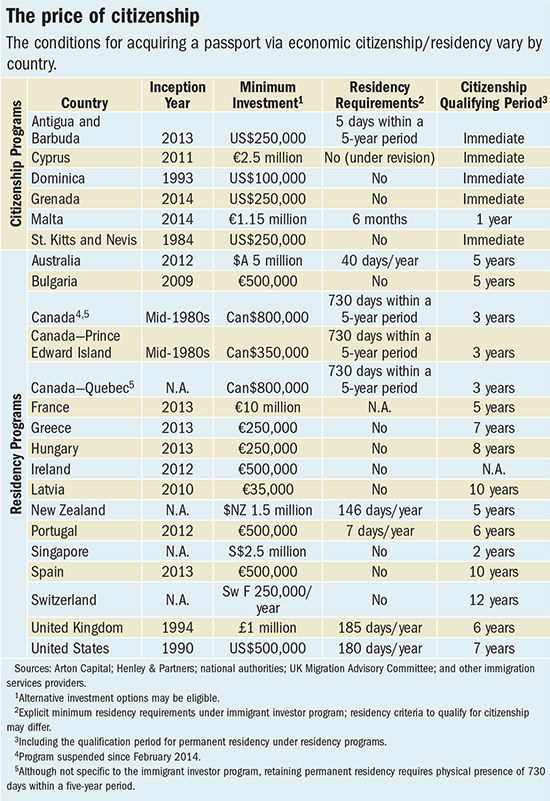
The increasing phenomenon of citizenship-by-investment – economic citizenship – has come to occupy the Turkish agenda with Thursday’s amendment of a citizenship law that offers citizenship to foreigners via four types of investment choices, including a real-estate investment of $1 million. In particular, the real-estate option is expected to boost Turkey’s real estate market and increase the ratio of real estate purchased by foreign investors.

Granting citizenship to foreigners in return for a determined amount of investment is a global phenomenon applied in many developed and developing countries, such as the U.S., Canada, the U.K., France, Australia, Dominica and Bulgaria. The growing phenomenon of “buying citizenship” is defined as “economic citizenship” by the International Monetary Fund (IMF).

Economic citizenship is offered by a number of small states and advanced economies, some of which, such as Canada, the U.K. and U.S., have had immigrant investor programs since the late 1980s or early 1990s, offering a route to citizenship in exchange for specific investment conditions with significant residency requirements. The rapid growth of private wealth, especially in emerging market economies, has increased the interest of wealthy people in greater global mobility and fewer travel obstacles posed by visa restrictions.

Source: Turkey a late entry in lucrative economic citizenship bandwagon – Daily Sabah

Note to Conservatives: There is no future in Donald Trump Lite – The Globe and Mail

From the ‘big shift’ to understanding Canadian political realities, John Ibbitson reflects on the Conservative leadership race.

While I share his general assessment, I always worry about complacency and assuming that Canada is resilient to the overall political trends in the US and Europe. Better to be less categorical; after all, whenever European leaders pronounce multiculturalism dead, there is an echoing chorus in Canada:

To varying degrees, several candidates for the Conservative leadership seek to unravel the conservative coalition forged by Stephen Harper, hoping to replace it with a populist, nativist movement similar to the one that elected Donald Trump.

Either they will fail and a Harper Conservative will win the leadership, or one will succeed, condemning the Conservative Party to many years in the wilderness. Because the Trump coalition simply doesn’t exist in this country.

Canada routinely ranks among the happiest nations on earth. The 2016 United Nations World Happiness Report had us at sixth, behind the Nordic countries and Switzerland.

Happy countries share in common governments that are committed to sound finances. They also enjoy high-quality public health care, education and other social services, something Harper Conservatives support. Harper Conservatives also join other Canadians (six-in-10, according to most polls) in endorsing high levels of immigration. Immigrants are welcome in Canada because our immigration policy is based on economic self-interest rather than compassion, and because the points-based system ensures that no one ethnic group dominates others.

And although the Ontario manufacturing sector has shed hundreds of thousands of jobs since 2000, the province as a whole is prospering, powered by the service-sector economy of Greater Toronto, the high-tech sector centred in Kitchener-Waterloo, and new, smaller, manufacturers springing up in Southwestern Ontario….

In this context, another word for happiness is trust. If citizens trust their government to spend tax dollars on needed services, their police to treat them fairly, their central bank to protect a sound currency and so on, then populist uprisings will be few and weak. All in all, Canadian citizens trust the Canadian state.

But in the United States, trust is eroding, thanks to foolish wars, government waste and free-riding fat cats, leading to ideological warfare and populist rebellions.

In the rust-belt states that swung to Mr. Trump, white working- and middle-class voters blame foreigners for taking away their factory jobs, environmentalists for shutting down the coal mines, Latino migrants for changing the ethnic mix of their communities, and Muslims for making them feel less safe. They trust neither the state nor each other.

There are doubtless some Canadians who are this angry. But you won’t find many of them in the suburban ridings of Greater Toronto and Greater Vancouver, dominated by new Canadians. You won’t find many of them in Calgary and Edmonton. People are hurting there, but they know the downturn in oil and gas prices is to blame for the slump, not immigrants or low-wage factory workers overseas.

That doesn’t mean Kellie Leitch, who is channelling a toned-down version of Trump memes, has no chance of winning the leadership. Only about 100,000 Conservative party members will vote for a leader, and that membership is older and whiter than the nation itself.

But whoever wins will have to appeal to voters in Mississauga-Erin Mills, to choose just one Greater Toronto example. That riding is 60 per cent non-white. In 2011, the Conservatives won the riding with 21,646 votes. In 2015, that vote went up slightly, to 21,716. Contrary to popular belief, the Conservatives held their suburban immigrant base in the last election.

But the Liberals took the riding by nearly 6,000 votes. Two thousand NDP voters switched to the Liberals, and the overall turnout increased by about 9,000 votes. (At 68 per cent nationally, turnout in the 2015 election was the highest since 1993).

Will turnout in 2019 drop back down to the post-2000 norm of around 60 per cent? How many disillusioned Liberal voters can be won over to the Conservative side? Can Conservatives broaden their support among suburban immigrant voters? These are the questions Conservative strategists should be asking – not whether the party can foment and surf a populist backlash.

Riding a wave of anger won’t get you very far in the sixth-happiest place on earth.
Source: Note to Conservatives: There is no future in Donald Trump Lite – The Globe and Mail

We can’t let Canada’s politicians divide us with populist labels: Goldy Hyder

While I agree with Hyder on the risk of playing to divisions, ignoring class and other differences also entails risk of denial and addressing issues.

Generally those who decry ‘class warfare’ do so from a position of privilege. What is needed, hard to do so in politics, is more nuanced debate about difference, barriers, and ways to overcome them:

Prime Minister Justin Trudeau’s decision to cancel his plans to attend the World Economic Forum in Davos so he can undertake a cross-country tour and engage directly with Canadians is a symptom of a much larger and more troubling trend where it has become increasingly fashionable for political leaders to frame public-policy decisions in terms of their potential impact on “ordinary,” “real” or “average” Canadians.

These terms, which are now at the heart of debates about everything from health-care funding to the benefits of globalization, have come to be used almost interchangeably with the equally popular “middle class.” To the extent that many Canadians consider themselves, rightly or wrongly, to be part of the middle class, these labels are intended to convey a sense of inclusiveness.

Yet the opposite is true. As we have seen in the United States and Britain, when these types of generic terms are used to describe large groups, they are generally defined on the basis of who they exclude: the so-called elites.

These terms are, in fact, inherently divisive. Just as few of us would self-identify as being “abnormal,” our characteristic Canadian modesty prevents us from thinking we are particularly exceptional. If we are not among those frequently maligned “elites,” we must therefore, be part of some “middle-class” majority. (Even the math holds up, as we’re told “elites” are only the top 1 per cent.)

The problem with vague terms like these is that they invite people to fill in the blanks with their own biases about who fits into each group – and we’ve seen the consequences that has had in other countries. Canadians should not be urged to divide themselves on the basis of income, education, ethnicity, religion or region. To do so would be to unravel our rich multicultural tapestry by pulling on loose threads.

We don’t want Canadians to be inherently distrustful of experts, to presume that a person is less ethical because they have a higher or lower net worth, or to believe that those with global outlooks aren’t patriotic. Any proliferation of populist labels risks creating an “us versus them” conflict within the country, something that can be exploited by those looking for an easy way to galvanize and mobilize a political base.

Some may suggest I am being alarmist, but I have spent the better part of my career in the field of communications, and in my professional experience our choice of language matters a great deal. It has also been my personal experience. As an immigrant and a Muslim, I have witnessed firsthand how quickly the word “different” becomes “foreign,” and how easily “foreign” can become “un-Canadian.”

At a certain point, assigning some meaning to arbitrary or artificial terms inevitably becomes a question of defining values. That is where things get complicated and where the real fissures can emerge. Canada’s 150-year story has many chapters in which divisions between people defined the politics of an era. Some of our worst mistakes have been made by governments in attempts to satisfy one group over another.

Without question, governments must consider the very different realities in which Canadians live when they develop policy res-ponses to pressing issues – but that is about technical implementation. What governments must avoid doing is using the levers of policy to divide Canadians on the basis of their different circumstances, as opposed to building a broad consensus based on shared values and interests.

Moreover, governments must avoid making decisions – such as whether to attend a global conference with the world’s most powerful economic stakeholders – based solely on the perceived optics of those decisions.

In these uncertain times, we cannot afford to make mistakes or miss opportunities. We need to seize every advantage we have, and that means ignoring those who call for us to marginalize or vilify others. Instead of targeting a particular class of Canadian – whether upper, lower or middle – let’s avoid entirely the temptation to engage in any type of class distinctions or, worse still, to inflame class warfare.

When the Fathers of Confederation created our country 150 years ago, they sought to unite us in common cause. Let us invoke that same spirit in this anniversary year by uniting Canadians, not dividing them.

Source: We can’t let Canada’s politicians divide us with populist labels – The Globe and Mail

Countries that forget history become easy prey for demagogues – The Globe and Mail

I agree with Paris’s assertion of the need for greater emphasis on critical thinking skills, incorporated into school curriculums, and it is alarming that Ontario is considering ending its mandatory grade 10 civics course (Civics classes may disappear in Ontario. That’s a mistake. – Maclean’s) – Correction Ontario’s education minister subsequently announced no plans to do so.

However, I am not sure that the Global Centre for Pluralism and the Institute for Canadian Citizenship have the needed reach to make much of a difference.

The liberal triumphalism of the 1990s after the fall of the Soviet Union may partly account for our inattention, but there may be a more pertinent cause. Few in the world today were reasoning adults when the Second World War ended in 1945. We matured in the postwar era, as the international community created a multitude of protective institutions such as the United Nations. Hope underscored the trials of war criminals in Nuremberg and Tokyo, the birth of the International Criminal Court and the creation of the European Union.

The postwar liberal order was a rational global response to the events of the early 20th century. And if we assumed the 70-year status quo would endure, it is because we collectively forgot that irrationality is a core human attribute. In addition, few among us were trained to recognize warning signs. In Canada, the study of contemporary world history has not been mandatory on most high school curricula, a lacuna that has lessened our aptitude for awareness.

Which brings me back to Tom Lehrer and his pithy advice. Be prepared.

Economic well-being is a central indicator of social peace, and since Canada’s economy is dep-endent on trade with the United States, the government of Justin Trudeau has wisely attempted to position itself with the incoming administration in positive ways. The Prime Minister also shuffled his cabinet for similar reasons.

But there are other ways to be vigilant. It is worrisome that Conservative Party leadership hopeful Kellie Leitch opportunistically admires Mr. Trump and thinks his “exciting message” needs to be delivered in Canada. Stephen Harper thankfully failed to ins-pire voters with his anti-Muslim provocations, but the Conservatives haven’t yet chosen their new leader, and those tea leaves, with their capacity to threaten our core acceptance of multiculturalism – the driver of Canadian social peace – remain unread.

As for long-term preparations, I hope ministries of education across Canada will create mandatory courses in critical thinking and human rights studies at the secondary level, possibly assembling elements of current social studies and history programs with a new focus. Such courses should have both historical and contemporary content. Young Canadians need to understand how, and why, pluralist societies have failed in the past in order to be vigilant about preserving their own. As “fake news” threatens the media, young people will need the tools of critical thinking in order to differentiate sources of credible information from propaganda.

Organizations such as the Global Centre for Pluralism, based in Ottawa, might consider making public preparedness for what lies ahead a priority. So might the Institute for Canadian Citizenship, an entity dedicated to the basic principles of belonging and diversity.

Without these defences, we will become easy prey for demagogues. An unpredictable historical juncture is upon us, and we must pay attention.

Source: Countries that forget history become easy prey for demagogues – The Globe and Mail

Multiculturalism is unpopular with the majority – even though it makes for happier societies : Democratic Audit UK

Interesting study looking at multiculturalism policies and their impact on majority populations in Europe:

With data from the European Social Survey for 14 western European states, we used multiple and logistic regression to investigate whether the eight “rights” areas within Banting and Kymlicka’s (2013) composite Multicultural Policy Index (MCP) differentially satisfied or unsettled members of the three self-identified groups.  The “rights” areas include: constitutional/legislative/parliamentary affirmation of multiculturalism; school curriculum; media sensitivity and representation; dress-code exemptions; dual citizenship; funding of ethnic group organisations’ cultural activities; bilingual education; and affirmative action.

To assess individuals’ unease and satisfaction, we looked at their sense of being in a group that is discriminated against, whether they felt safe walking alone locally after dark, their satisfaction with life and with the government.

We found that all but two of the nine measures of state multicultural orientation increase the majority’s sense that people like them are being discriminated against – even when background characteristics are controlled.  The impact is more consistent for the majority than for either of the self-identified minority respondent groups.  Multicultural policies affecting the school curriculum, media, dress-code exemptions, in the form of dual citizenship, in funding for ethnic group cultural preservation and in the form of affirmative action all increase the sense of discrimination indicated by majority group members.  They were also more likely to report lower feelings of safety when walking alone near home in states with greater multicultural orientation, even when background factors were controlled.  In particular, multicultural policies relating to the media, dress code exemptions and affirmative action had a negative impact on how safe majority groups felt.

Muslims were less likely to feel discriminated against in states with more pro-multicultural policies (after controls for background characteristics) and, in particular, where dress code exemptions were available and affirmative action policies in place.  At the same time, Muslims were more afraid of victimisation in countries with dress code exemptions, underscoring the precariousness of the religious minority’s position.  When their cultural lifestyle claims (to wear headscarves, for example) are legitimised, this increases their visibility and sense of vulnerability.

Our findings about satisfaction with life and with the national government show the complicated political terrain politicians face.  Majority group members are more satisfied with both in states that have embraced multiculturalism. These findings represent a quandary for political leaders, who face short-term pressure from nativists – but a population that, in the long term, will be unhappier if they take an isolationist approach. By making them available to everybody, politicians may try to avoid the negative reactions to multicultural policies that fan the flames of support for far-right parties.

But the growth in extreme-right support across Europe suggests that by backing away from a rigorous defence of multiculturalism, public officials left space for far-right groups, permitting majorities to feel justified in articulating their unease at the presence of minorities and dissatisfaction with the benefits intended to support them.  Xenophobia has moved to the fore. The claims made by Muslims and ethnic minorities who seek rights commensurate with their status as citizens in Europe, and asylum applications by migrants at risk of harm, are no longer seen as legitimate.

Europe’s pressing need for immigrant labour and population growth mean the political establishment and the press will have to change direction if they want to maintain current prosperity.  They will have to explain why global economic systems need diversity, and provide for the security of voters who feel that they have lost out to globalisation.  Programs to counter violent extremism (CVE) among young people who show signs of alienation from Europe should focus not only on Muslim youth attracted to Islamic State and al-Qaeda, but also on majority group members who show signs of violence against those of migrant background.  Broadening the focus of CVE programmes to all extremists is a logical and necessary step where mainstreaming has replaced multiculturalism in public policy.

Source: Multiculturalism is unpopular with the majority – even though it makes for happier societies : Democratic Audit UK

Éthique et culture religieuse: contre tous les dogmatismes | Le Devoir

Good defence of the Quebec ethics and religious culture course by Christine Cossette who teaches it:

Je dis aussi à mes élèves que le doute fait partie de la foi et la rend plus intelligente en l’éloignant des dogmatismes. La foi n’est pas une évidence ; elle doit se soumettre constamment à l’esprit critique. Je la présente donc non pas comme une instance qui dit quoi penser, mais plutôt comme celle qui donne des outils pour mieux penser sa vie. C’est alors que la religion est au service de l’homme et non le contraire.

Ce que le volet Culture religieuse m’autorise à faire, c’est de mettre en lumière le nécessaire travail d’exégèse sur les textes sacrés. En étudiant par exemple la question de l’origine de la vie, je vois le darwinisme et j’analyse le contexte d’écriture des récits de la Genèse qui peuvent, s’ils sont lus mot à mot, mener à de l’obscurantisme. Mes élèves comprennent donc que, dans ces textes, scientifiques et bibliques, deux discours se côtoient mais ne s’opposent pas et qu’un scientifique peut donc être croyant ou non.

Le cours d’ECR m’offre aussi l’occasion de parler de la spiritualité qui est la commune condition humaine (qu’on soit religieux ou pas). En effet, l’être humain n’a pas nécessairement besoin de se lier à une quelconque divinité pour vivre de valeurs qui le grandissent. La spiritualité appartient à l’homme dans son humanité la plus profonde, précisément parce qu’il porte en lui un mystère qui le dépasse. L’occasion est belle ici de parler de ceux qui ont ouvert d’incroyables chemins d’humanité grâce à leur foi, à leur générosité ou à leur réflexion philosophique.

La mondialisation, avec ses limites et ses grandeurs, nous oblige à réfléchir sur l’avenir de l’humanité : comment en arriver à sauver un espace de dialogue entre chacun de nous ? Le combat n’est plus à faire entre les athées et les croyants, mais bien entre les esprits ouverts et les esprits dogmatiques qui, eux, prétendent connaître la Vérité. Or, on sait que le dogmatisme se cache autant dans le monde religieux que dans l’univers anti-religieux. « Pour mener ce combat pour la liberté et pour la tolérance, dit Comte-Sponville, nous avons besoin de faire la paix entre croyants et incroyants, de nous allier contre notre ennemi commun, qui n’est pas la religion, qui n’est pas l’athéisme, mais qui est le dogmatisme. »

Le cours d’ECR me permet de proposer cet espace de réflexion pour une humanité plus respectueuse des uns et des autres. Il me donne cette possibilité aussi de présenter ce que l’orthodoxe Olivier Clément appelle le « noyau de feu » de chacune des grandes religions en mettant en lumière ce qui les unit. Après tout, n’est-il pas honnête de dire que d’autres avant nous ont laissé des trésors pour vivre en humanité ?

J’aime donner ce cours. J’estime qu’il contribue à former des citoyens justes, courtois et à l’esprit critique. Mais je suis fatiguée de lire toutes les inepties qu’on peut en dire. Je rêve du jour où, enfin, ses détracteurs se donneront la peine de lire, non pas les cahiers d’exercices, mais bien le programme tel qu’il a été pensé, tout en précisant qu’il devrait être un peu plus balisé pour obliger ses professeurs à toujours plus de rigueur à travers l’apprentissage de fondements philosophiques, historiques et théologiques.

No exceptionalism please, we’re Canadian: Mark Kingwell

Good piece against Canadian smugness:

Here’s the basic argument. Canada, unfettered by what Michael Ignatieff condemned as “ethnic nationalism,” has carved out a whole new way of being a country.

It is post-national. Its banking system is centralized and immune from wacky market fluctuation. Its health-care system is impeccably public. And above all, its immigration policy is tolerant and open-minded, making for the truly multicultural polity that provokes the world’s envy.

Now, far be it for me to dispute this vision. In fact, it is so familiar that some of us have been touting it lo these many long years. Back in 1999, I wrote a book that defended Canada’s postnational advantages and suggested we should be proud of our transcendence of the tired narratives of identity based on bloodline or ideology. I wasn’t the only one: Richard Gwyn and John Ralston Saul, plus a few other familiar names, made their own versions of the argument.

Right now, the advocates are slightly younger (and cooler) Canadian intellectuals, such as Stephen Marche (in The Walrus) and Charles Foran (in The Guardian). In a country as small as this one, it can be no surprise that I count these two men as friends. It happens that I also claim friendship with Andrew Potter, a former graduate student, who mocked Mr. Foran’s Guardian article on his Twitter feed, even as he is about to convene a serious conference on the topic of exceptionalism that features still more friends.

To repeat: It’s a small country. Maybe that’s the true exceptionalism in play here? Anyway, stories about how we are unique, paired with push-back replies, feel to me like those predictable-as-the-weather Canadian weather stories, where writers deplore the inability of once-staunch Canadians to deal with cold and snow. Were we ever really so robust that -30 C temperatures and a blizzard were just, you know, a lark? I doubt it.

I likewise doubt the new tales of exceptionalism, which have the feeling of a national theodicy. You remember the idea: Theodicy is the claim that God’s will is inevitably working itself out in this world, never mind all signs to the contrary. We may confront vast stretches of misery and suffering, but that is all part of the plan! As the refrain goes, paraphrased from the philosopher Leibniz, everything is for the best in this best of all possible worlds!

After the 1755 Lisbon earthquake, which devastated the city and killed thousands of innocents, Voltaire was moved to lampoon this sad, evil idea. His satire Candide (1759), a kind of proto-novel, remains one of the essential texts in the literature of enlightenment and good sense. The young protagonist, Candide, is a devotee of the new Leibnizian philosophy; his outrageous misfortunes, bravely borne, eventually force a change of mind.

Canadian exceptionalism is the new Leibnizian philosophy. The reasons for this are instructive, even if the argument itself is suspect.

We might note, first, that the term itself is tainted – another borrowing from the expansive republic to the south. U.S. exceptionalism is the covering-law theory that assumes the United States, different from all other countries, can do no wrong and brook no objection. Mr. Trump’s call to “Make America Great Again” (#MAGA) is just the most recent expression of this perpetually self-renewing delusion.

Worse, though, is the self-congratulation contained in the position. Don’t get me wrong: This is a great country, and I would not choose to live anywhere else. But I don’t think we Canadians have any special purchase on justice, diversity or fellow feeling. This is not the best of all possible countries, as recent arrivals and indigenous peoples will certainly attest. We are as rife as anyone else in intolerance, bigotry and ignorance.

Unless and until we confront these facts about our political life, tales of exceptional virtue will continue to strike a sour note. Sorry, friends.

Source: No exceptionalism please, we’re Canadian – The Globe and Mail

Niqabs make witnesses more truthful? Not so fast, says critique of landmark Canadian study 

Strikes me as a valid critique but look forward to debate and further research:

A team of researchers schooled in deception has cast doubt on a landmark Canadian study which found that the wearing of niqabs actually improves courtroom truth-telling.

A critique of the study published this week claimed there were so many “limitations” to the niqab study that any move by the Canadian justice system to adopt its findings would be “naıve and misinformed” and could cause “irremediable harm to the judicial system.”

“The benefits of paying less attention to witnesses’ and lawyers’ facial expressions are neither theoretical nor empirically grounded arguments,” read the critique, published in Psychiatry, Psychology and Law and written by Vincent Denault, a lawyer and co-director of the Montreal-based Center for Studies in Nonverbal Communication Sciences.

Last year, a study out of the University of Ontario Institute of Technology directly challenged Canada’s Supreme Court ban on witnesses testifying while wearing a niqab.

The study, published in the journal of the American Psychological Association, had women don niqabs and tell lies while being questioned on camera. Then, volunteers were asked to judge the women’s truthfulness as compared to liars who weren’t wearing veils.

The results were that the veiled women were less likely to get away with lying.

“People were focusing on what the women are saying, rather than what they look like,” lead researcher Amy-May Leach told the National Post in July.

Most notably, Leach added at the time that “the courts were incorrect.”

The critique by Denault, which was co-written with deception psychologists in France and the U.K., criticized Leach’s methodology, asserting that the degree of truth detection may not have been as dramatic as depicted.

“The experimental setting improved the lie detection ability of the participants above chance, but the improvement is very weak,” wrote Denault in an email to the National Post.

But the main thrust of the paper was how the Leach study did not accurately replicate courtroom conditions.

For one thing, liars in the study were given only two minutes to craft false testimony, while under Canadian law a witness can practise their testimony for months.

The liars were asked “open-ended questions” rather than having to cope with the leading questions that would have been posed in a real cross-examination.

The women in Leach’s study were cast as impartial witnesses to a crime, when in reality most courtroom lying comes from either plaintiffs or defendants.

And the study only tested how a visible face affected truth-telling. “The function of witnesses’ and lawyers’ facial expressions goes well beyond the issue of lie detection,” it read.

Source: Niqabs make witnesses more truthful? Not so fast, says critique of landmark Canadian study | National Post

Correctional Service flip-flops on transgender inmate placement policy – Politics – CBC News

That was a fast reversal. Town halls may prove more substantive in terms of policy development:

Canada’s prison service has abruptly reversed course on its new policy for transgender inmates, one day after Prime Minister Justin Trudeau promised to promote equality for all trans Canadians, including those behind bars.

Correctional Service Canada spokesman Jean-Paul Surette said trans inmates will now be considered for placement in prisons based on their gender identity rather than their genitalia.

“We are currently assessing — on a case-by-case basis — individual inmates’ placement and accommodation requests to ensure the most appropriate measures are taken to respect the dignity, rights and security of all inmates under our custody,” he told CBC News in an email.

That is a sharp departure from CSC’s revised policy directive on trans inmates that was released on Monday, which confirmed a previous rule that based placement on birth sex rather than gender identity.

“Pre-operative male to female offenders with gender dysphoria will be held in men’s institutions and pre-operative female to male offenders with gender dysphoria will be held in women’s institutions,” the Jan. 9 policy reads.

The change in course comes after Trudeau, during a town hall meeting in Kingston, Ont., made an off-the-cuff promise to ensure transgender inmates can serve their sentences in institutions based on their gender identity.

The pledge came in response to a question from a transgender woman and advocate who described Canada’s current placement policy as “torture.”

Trudeau said the issue hadn’t been on his radar, but would act now that it is.

“I will make sure we look at it and we address it and we do right in recognizing that trans rights are human rights and we need to make sure we are defending everyone’s dignity and rights in every way we can,” he said.

Source: Correctional Service flip-flops on transgender inmate placement policy – Politics – CBC News

Just How Many LGBT Americans Are There? – The Daily Beast

Noteworthy generational change:

Estimates of the size of the LGBT population have always been murky, bordering on mythological. The 1-in-10 figure first emerged out of post-World War II studies by the pioneering sexologist Alfred Kinsey, who reported that 10 percent of men were “more or less exclusively homosexual.” That number wasn’t perfect—and it’s been continuously revised—but it became a politically expedient tool in the Stonewall era.

Now, over 60 years after Kinsey’s death, new Gallup data shows that the estimated size of the U.S. LGBT population as a whole is getting closer than ever to the legendary “1-in-10” number—among millennials, at least.

Using Gallup data taken from interviews with over 1.6 million adults, demographer Gary J. Gates reported that 10 million Americans—4 percent of the population—now identify as LGBT.

That includes a record-high 7.3 percent of people born between 1980 and 1998 who now identify as LGBT—up from 5.8 percent in 2012. (This new data reinforces a 2015 conclusion from the Public Religion Research Institute—first highlighted by The Daily Beast—that “7 percent of millennials identify either as lesbian, gay, bisexual, or transgender,” based on a survey of 2,000 adults.)

But will that number ever reach 10 percent in the population at large?

“It’s not a completely unrealistic figure,” Gates told The Daily Beast. “Certainly it appears as if—given a little more time—it might, in fact, be [the case] that close to 10 percent identify as LGBT.”

Gates is one of the top demographers of the LGBT population in the United States, and the author of a widely-cited 2011 Williams Institute meta-analysis on the subject, which estimated that 3.5 percent of adults identify as lesbian, gay, or bisexual, and 0.3 percent identify as transgender. He told The Daily Beast that the increasing size of the LGBT population estimate can largely be attributed to “people feeling more comfortable and more willing to identify [as LGBT].”

Source: Just How Many LGBT Americans Are There? – The Daily Beast