Surprising – or perhaps not – that this commentary by Shimon Fogel of the Centre for Israel and Jewish Affairs, Carlos A. Godoy of Ga’ava, a Quebec-based LGBTQ organization and Tobin Ansong is of the Ghanaian Canadian Association of Ontario is virtually silent on hate directed at Muslim Canadians.
They propose strengthened measures against hate crimes: two general in nature that apply to all groups, one specific to radicalization, targeted largely at Muslim Canadians.
While I have no general issue with measures that focus on specific communities where needed (as is the case with respect to Al-Qaeda/ISIS inspired radicalization), it would have been a stronger statement had it more explicitly acknowledged anti-Muslim sentiment and had been a joint statement with a Canadian Muslim group:
In this same vein, federal officials should consider three more initiatives that could have significant impact in countering hate crime.
First, every MP should support Bill C-305 proposed by Nepean MP Chandra Arya. Currently, vandalism targeting a religious site—such as a church, synagogue, mosque, temple, or cemetery—is a specific offence with substantial penalties. But this designation does not apply to schools or community centres associated with an identifiable minority group. C-305 is an essential, common sense bill to close this clear gap in the Criminal Code.
Second, there is a need for greater federal leadership to aid local police in enforcing hate crime provisions of the Criminal Code by offering more training, uniform guidelines, and resources. This is especially crucial given that this is an issue far beyond Canada’s largest cities. In 2013, the four most frequently affected cities per capita were Thunder Bay, Hamilton, Moncton, and Peterborough. Federal authorities can play a central role in identifying and sharing best practices. British Columbia, for example, is in many ways a model for a successful approach, with police agencies maintaining dedicated hate crime units providing experience and systems required to respond effectively to such incidents.
Third, as the federal government implements its counter-radicalization program, we must recognize the link between radicalization and hateful views toward minorities, whether they manifest as antisemitism, homophobia, or racism. There is ample research and tragic evidence—whether at a kosher supermarket in Paris, or an LGBTQ nightclub in Orlando, or a church in Charleston—these forms of hatred often go together with violent extremism.
Identifying early warning signs, in the form of hate and propaganda against these communities, must be an integral part of the government’s overall anti-terrorism strategy. Likewise, countering these hateful ideologies is essential in reclaiming a psychologically vulnerable person from the path of radicalization.
While these suggestions are relatively modest, taken together, they would represent a significant step forward in the effort to ensure Canada remains a safe home for all minorities.
Sheema Khan highlights some recent counter radicalization initiatives aimed at youth, arguing for more initiatives to help parents detect and act upon early signs of radicalization. No doubt she will be consulted by the new Office of the Community Outreach and Counter-Radicalization Co-ordinator:
Another recent creative venture is a comic book, Radicalishow, developed by youth who have received counselling from the Centre for the Prevention of Radicalization Leading to Violence (CPRLV) in Montreal. Having taken ownership of their misguided choices, they have helped to produce a valuable teaching tool about the factors that lead some down an extreme path, the challenges and vulnerabilities associated with the search for identity, and the devastating impact that ensues. As in Tug of War, this platform should be disseminated widely, for it addresses complex issues by the youth in a thoughtful manner.
The CPRLV deserves much credit for its attempt to approach radicalization in a holistic, comprehensive manner, by engaging as many stakeholders as possible, such as youth, teachers, counsellors and Muslim community leaders. For example, the centre’s most recent report, Women and Violent Radicalization, provides a historical context of violent female radicalization across cultures and ideologies.
It also sheds light on the reasons why a number of Quebec women between the ages of 17 and 19 decided to leave for Syria. Many felt that it was difficult to live as a Muslim in a hostile environment that left them feeling stigmatized and/or marginalized. The Western feminist model of emancipation seemed to clash with their desire to stay home and raise a family. In contrast, calls to build and join a utopian state where one can live as a “true” Muslim without harassment, seemed like a panacea for some. The report concludes with the need for more research.
In spite of the laudable efforts by the CPRLV, one key group seems to have been ignored: parents.
Currently, there are scant resources for parents about radicalization. Just as there has been an explosion of parental resources on Internet safety for children, so too should there be development of parental workshops on prevention of radicalization, for parents are often the first to notice subtle changes in their children. What should parents be aware of? How do they speak to their children? What signs should they look for? And what resources are available in case one’s child seems to have fallen prey?
At the film screening in Ottawa, the majority of those in attendance were youth. They were eager to address radicalization head on – through dialogue, debate and activism. They have the energy, the passion and the will; what they lack, however, is a seat at the table with federal policy makers to help devise a comprehensive prevention strategy. This omission should be addressed by the new Office of the Community Outreach and Counter-Radicalization Co-ordinator.
Interesting interview with Alain G. Gagnon, le nouveau titulaire de la Chaire du Québec contemporain de l’Université Sorbonne Nouvelle (Paris 3). Although headline cites Quebec model, Gagnon has a more pan-Canadian view:
Au-delà du multiculturalisme, c’est l’aspect plurinational du Québec et du Canada qui intéresse tant ses compatriotes français, constate le professeur. «Dans l’espace géopolitique canadien, le fait que nous ayons des Premières Nations, une nation québécoise, une nation acadienne, une nation canadienne-anglaise qui n’ose pas trop souvent parler d’elle de cette façon, il y a vraiment un enjeu super intéressant.»
Ainsi, il estime que le Québec peut également apporter à la France et à l’Europe des outils sur le plan de la reconnaissance.
«Québec forme aujourd’hui une nation qui est reconnue par à peu près tous les acteurs politiques au pays et, sur la scène internationale, il n’y a personne qui remet en question l’existence de la nation québécoise au sein d’une fédération plurinationale. Pourquoi l’Espagne [qui connaît des tensions avec les Catalans] ou la France, qui est parfois aux prises avec des difficultés en Corse, en Alsace ou en Bretagne, ne prendraient-elles pas ce modèle-là?»
«Ces nations-là souhaitent avoir une voix. La République doit trouver des moyens d’accommoder ces diversités profondes et non pas simplement dire: on efface toutes les diversités culturelles, sociétales ou autres pour faire advenir une seule France où tous les citoyens sont interchangeables. Ce modèle-là est un modèle du XIXesiècle et me semble dépassé. Il faut penser autrement la diversité et les relations sociétales. C’est l’enjeu principal du cours que je vais offrir à la Sorbonne.»
Le nouveau titulaire de la Chaire sur le Québec contemporain a également invité toute une série d’auteurs, d’historiens et de spécialistes pour aborder la réalité québécoise à travers la littérature et la culture.
I always find the spin in these puff pieces amusing, defending consulting industry practices:
On January 1, CBS aired an episode of 60 Minutes entitled “Passports for Sale” that highlighted the growing Citizenship by Investment industry, fueling globalization and facilitating the movement of capital and individuals around the world. During the segment, multiple on-camera interviewees brought forward concerns surrounding the due diligence performed by countries providing citizenship in exchange for a one-time fee or investment within said country.
Apex Capital Partners Corp. is an internationally recognized financial services firm that provides end-to-end execution in areas such as second citizenship; business immigration; wealth management; and real estate investment opportunities. The firm interacts directly with many governments mentioned in the segment including Antigua and Barbuda, Cyprus, Saint Lucia, Dominica, and Saint Kitts & Nevis on behalf of its clients. Many of the countries APEX works with provide citizenship that facilitates ease of travel, simplifies financial management, and offers a high quality of life.
“While 60 Minutes certainly featured concerns expressed over the years, most of the countries and services providers participating in these Citizenship by Investment Programs are doing so via a successful process that supports domestic growth as well as the individual citizen,” said Nuri Katz, Founder and President of Apex Capital Partners Corp. “Our team witnesses it firsthand the extensive due diligence process which involves background checks and interviews, while also conducting information exchanges within the international community, including numerous foreign governments. The programs we recommend are credible, best of breed programs which rely upon maximum possible oversight.”
“The country of Dominica realizes not only the importance of providing a transparent Citizenship by Investment Program, but also the key role the industry plays in fueling economic growth,” said Dominica Prime Minister Roosevelt Skerrit. “We have carefully developed this program, conducting extensive background checks and reviews for global citizens who wish to contribute to our country.”
“Saint Kitts and Nevis has taken great strides to present what we consider to be one of the most attractive and well-guarded Citizenship by Investment Programs in the world,” said Saint Kitts and Nevis Prime Minister Timothy Harris. “First and foremost, our efficient process is designed to benefit our citizens and the local economy, attracting only top-tier international citizens, while remaining supremely conscious of our responsibility and commitments to the international community of nations. Saint Kitts and Nevis is highly regarded as a responsible member of the international community, and is compliant with its international obligations.”
The segment, while likely inadvertent, incorrectly claims that the industry was created by a service provider in the last decade. In fact, the industry was created in 1984 by Saint Kitts and Nevis when they launched the first Citizenship by Investment Program, which was then followed by Dominica with the launch of a similar program in 1994. Similarly, in a clear conflict of interest, an individual named Peter Vincent raises significant questions surrounding due diligence for countries mentioned in the segment, while curiously omitting that his present employer, Thomson Reuters, is actually a due diligence services provider, commercially competing to be hired by those countries that have Citizenship by Investment programs. Unfortunately, his role and clear conflict of interest in participating in the segment is not mentioned by the journalists or its producers.
APEX applauds 60 Minutes for the focus it has placed on the Citizenship by Investment industry and believes due diligence is of the utmost importance to these programs. In fact, many of the due diligence providers relied upon by these countries are first world and internationally acclaimed. As one of the leading international boutique investment firms to operate in this sector, APEX is proud to identify much-needed alternative sources of financing, for domestic infrastructure and other budgetary needs. APEX looks forward to the positive economic support these programs have for countries around the world, their respective citizens, and the future growth of the industry.
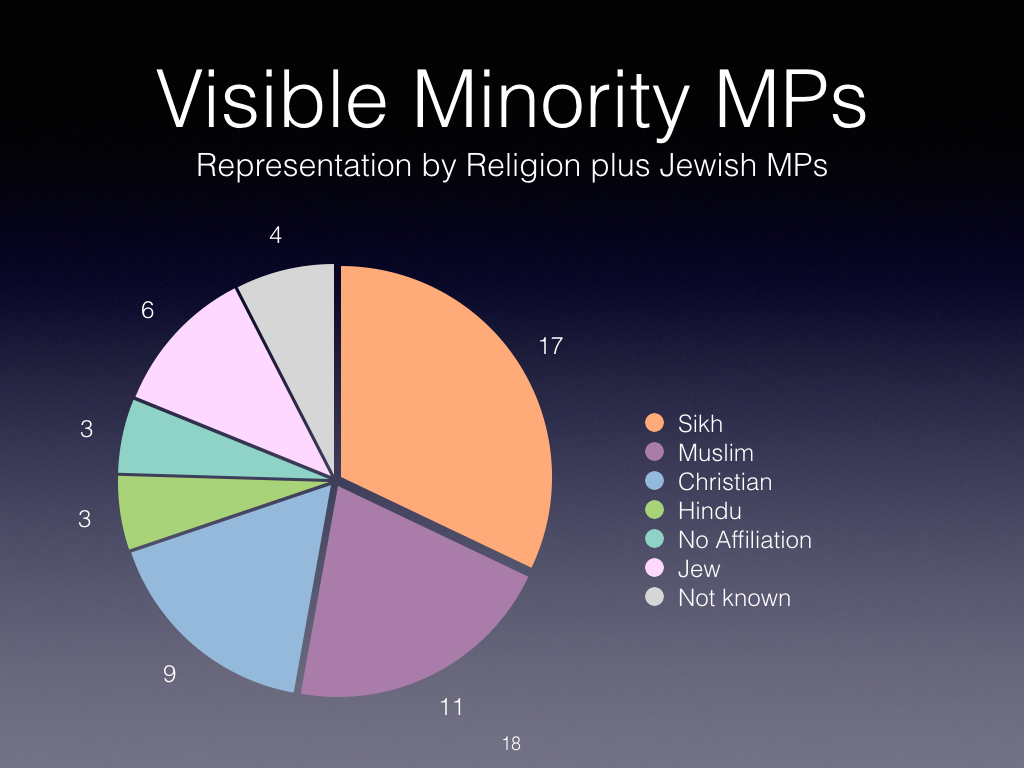
Interesting comparison between the US Congress and the population it represents (in Canada, it is about one in four). In terms of the religion of Canadian MPs, my analysis of visible minority MPs is below:
One in five Americans is religiously unaffiliated. Yet just one of 535 members of the new Congress is.
That’s what the latest data from the Pew Research Center show on the opening day of the 115th Congress. The nation’s top legislative body remains far more male and white than the rest of the U.S. population as well, but religion is one of the more invisible areas where legislators in Washington simply aren’t representative of the people they represent.
Only Arizona Democratic Rep. Kyrsten Sinema admits to being “unaffiliated,” which Pew defines as people who are atheist, agnostic or who describe their religion as “nothing in particular.” That means only 0.2 percent of Congress is unaffiliated, compared with 23 percent of U.S. adults. That group is faster-growing than any religious group in America, as Pew found in 2015.
Meanwhile, nearly 91 percent of congressional members are Christian, compared with 71 percent of U.S. adults. Here’s a full breakdown of how Congress’ religious affiliations compare with those of the U.S. population:
America’s nonreligious are young — and not politically organized
Why the massive gap? For one, religiously unaffiliated people tend to be young, and Congress just isn’t that young. In the 114th Congress, the average age for House members was 57 years old and for senators it was 61. (To a modest extent, this is a reflection of age rules: Senators must be 30 or older, and representatives have to be at least 25.)
In addition, younger Americans tend to have much lower voting rates than older people. That may also contribute, though the logic requires a couple of leaps — if this means the (relatively young) religiously unaffiliated population isn’t voting as much, and if the religiously unaffiliated are more drawn to likewise unaffiliated politicians — that could also help explain the lack of “nones” in Congress. Likewise, the inverse is true: If older (and more religious) Americans are voting for more religious politicians, it means less room for the nonreligious ones.
(Perhaps unsurprisingly, the unaffiliated Sinema is also relatively young for a congressional member at 40.)
One more potential reason unaffiliated people aren’t in power: Not being affiliated often also means not being politically cohesive.
“At our first coffee date, Haan mentioned that he has wanted to host a dinner bringing together mixed people,” says Oades, who identifies at Filipino and Canadian (her father was adopted), “It wasn’t until we ran into one another with our sisters at a concert that we all became mixed Asian best friends for life and realized that we should do this. It’s a perfect platonic marriage.”
The two got to work on a $25 ticketed event that would showcase live music by local multiracial musicians like Bray, and Charlene Dorland, while guests dined over Palcu-Chang’s fusion-style feasts.
“I think for most people, but particularly those in mixed families, food is a very important element to their stories. It’s a reference point we use to ground us, give us perspective and make us happy,” says Palcu-Chang, who identifies as Chinese-Romanian. “For me, the food element is more than just feeding people. It’s a symbol for what we are trying to do with Mixed in the Six: generosity, community, family, nourishment.”
As the former president of the Mixed Students Association of York, Oades was reunited with members she hadn’t seen in nearly 10 years. And although the 2006 census indicated that 7.1 per cent of GTA marriages were interracial (a number that is expected by Statistics Canada to grow), the sold-out dinner showed Oades that there is still a need for mixed-race spaces in Toronto.
“People have shared with us that they feel a sense of belonging and acceptance at MIT6,” says Oades. “That feeling of not being, for example, ‘black enough or white enough’ seems to dissolve when you get to connect with other people who have had similar experiences as you.”
Professor G. Reginald Daniel, who edits the Journal of Critical Mixed Race Studies, both based out of the University of California, Santa Barbara, understands mixed-race events are naturally fun and exciting but he hopes young attendees recognize the legal, physical and psychological struggles and trauma older multiracial generations have gone through. For example, the U.S. law against interracial marriage was only outlawed in 1967.
And while MIT6 guests often cheekily gush over one another’s attractiveness (many attendees happen to work as models, actors and performers), Daniel hopes mixed-race millennials don’t get caught up in a strictly superficial multiracial discourse.
He notes how the mainstream media has latched onto the “happy hapa,” “magical mixie,” “happy hybrid,” “racial ambassador,” and “post-racial messiah” stereotypes of multiracial individuals that are dangerous because they portray “overenthusiastic images, including notions that multiracial individuals in the post-Civil rights era no longer experience any racial trauma and conflict about their identity.”
MIT6 attendees know too well that a post-racial world free of racial prejudice and discrimination does not actually exist.
“The key is to ground that enthusiasm and capture it in a way that is meaningful so you can work with other groups. So you aren’t seen as so self-centred and seem solely focused on your ‘mixie’ concerns,” Daniel stresses. “This would mean moving beyond the specific concerns of multiracial individuals and see the link with the concerns of other communities relating to anti-immigrant sentiments, Islamophobia, native American land rights, and even the concerns of women, or the LGBT community, etcetera.”
MIT6 is going beyond bringing people together for food, taking on an advocacy role, with a donation drive for Syrian refugees as well as highlighting the difficulty of those with a mixed-race background to find bone marrow transplants. Oades met 11-year-old Aaryan Dinh-Ali, who is Vietnamese and Afghani and is suffering from aplastic anemia and desperately needs a bone-marrow transplant. MIT6 invited U of T’s Stem Cell Club and Canadian Blood Services to set up a clinic at the dinner, successfully registering 17 new mixed-race donors.
Another take on profiling or targeting those deemed at greater risk of crime:
Those who have branded Europe, and Germany in particular, too weak and politically correct to stop a purported wave of crime brought on by the arrival of more than a million asylum seekers, should pay attention to the news. German police haven’t taken long to get their act together, and immigrant crime is down sharply. Their methods, which include a sort of racial– or at least behavioural –profiling may be controversial, but they are proving effective.
On New Year’s Eve, 2016, more than 500 women were sexually assaulted, and 22 raped, in the vicinity of the central station in Cologne by crowds of young men, many of them of North African extraction. Police were outnumbered and humiliated. A few days later, the city’s police chief was fired. Mayor Henriette Reker was ridiculed for advising women to stick to a “code of conduct” that included keeping at “arm’s length” from strangers. It made Germany look enfeebled and confused, and the many critics of Chancellor Angela Merkel’s decision to open the country’s borders to asylum seekers had a field day.
On Dec. 31, 2016, the central station neighborhood in Cologne was flooded by 1,700 police. They were checking documents and pushing young men, more than a hundred at the last count, into vans. While this was going on, a tweet appeared on the Cologne police force’s account: “At Central Station, several hundred Nafris are being checked.” Nafris is shorthand for North Africans, and it set off waves of predictable criticism from left-wing politicians who called the term “dehumanizing” and accused Cologne police of racial profiling. The police chief, Juergen Mathies, apologized for “Nafris” — it was only a “working term” police used, he said — but not for his officers’ actions. After all, only a handful of assaults, and no rapes, were reported.
“From the experience of last New Year’s Eve and from experience gained in raids in general, a clear impression has emerged here about which persons to check,” he said. “There were no gray-haired older men or blonde, young women there.”
Though the German Interior Ministry also winced at the “Nafris” tweet, Mathies will not be fired. His pre-emptive action has been lauded by federal and local officials including Mayor Reker, that softie from a year ago. Lip service has been paid to politically correct language, but everyone knows what the police chief had to deal with.
German police didn’t catch the perpetrator of the pre-Christmas terror attack in Berlin — an Italian patrolman ended up shooting him — but the investigation that led to a Europe-wide manhunt for Anis Amri was quick and precise. Just before New Year’s, police arrested a Syrian who had apparently planned another terror attack. Germany’s security apparatus is clearly on high alert, and it’s been increasingly well-funded. In 2016, the Ministry of the Interior received a 1.5 billion euro ($1.56 billion) budget increase compared with the previous year, and the federal police were allowed to hire 3,000 additional officers. In 2017, the ministry’s budget is set to rise by another 500 million euros to 8.3 billion euros.
High immigration — in the 11 months through November, 723,027 asylum applications were filed in Germany, compared with 476,649 in all of 2015 — is driving the budget increases. That’s based on some hard facts. In 2015, 6.5 percent of all crimes in Germany were committed by immigrants, compared with 3.6 percent in 2014. In 2016, the proportion is likely to be higher — in the first nine months, immigrants committed 214,600 crimes, more than the 206,201 registered in all of 2015, and the general crime rate in Germany has been steady in recent years. Immigrants from North Africa are the least law-abiding group: They make up 2 percent of Germany’s immigrant population, but in the nine months of 2016, they accounted for 22 percent of immigrant crime.
In the third quarter of 2016, however, crime by immigrants dropped 23 percent compared with the first three months of the year. One reason could be that police are taking account of the numbers and the trends they reflect, and they are not being too sentimental or too careful of being branded racist.
Not surprising. While the underlying technology may or may not be neutral, how it is used and which terms it looks for, is not:
A London company’s software has been implicated in racial profiling by police departments in the United States and banned from Twitter.
Media Sonar has sold software to police and law-enforcement agencies, marketing it as a tool to gather data from social media to help identify threats to public safety.
But an investigation by the American Civil Liberties Union (ACLU) has found that police used the London-made technology to monitor such hashtags as #BlackLivesMatter, #DontShoot, #ImUnarmed and #PoliceBrutality, to name a few.
“Law enforcement should not be using tools that treat protesters like enemies,” the ACLU, which did not have a spokesperson available to comment directly, said in a blog entry about the issue that it sent to The London Free Press.
“The utter lack of transparency, accountability and oversight is particularly troubling because social media surveillance software used by California law enforcement” — “ tools like Media Sonar … — have been marketed in ways to target protesters.”
David Strucke, a partner in Media Sonar, was unavailable for comment in response to repeated Free Press phone calls and emails.
“Their software is very intelligent, tracking activities online. It is a great tool for law-enforcement agencies,” said Jaafer Haidar, a London technology observer and entrepreneur who founded Carbyn and is launching Socialseek.
“But it is not the responsibility of the technology company to police their customers. Customers have to be held responsible for how they use technology.”
The online news site Daily Dot reported that Media Sonar, from 2014 to 2016, sold the technology to 19 government services that spent at least $10,000 on the software.
The larger issue is the balance, and tension, between technology firms and law enforcement in using technology, added Haidar.
He pointed to Apple’s refusal to aid the FBI in hacking the phone of a shooter in the attack on a San Bernadino, Calif., Christmas party in 2015 that left 14 dead, and reports that BlackBerry has for years worked with police to hand over data from phone users, as proof that it’s uncharted territory.
“There is a lot of pressure on companies from government and law enforcement to use technology to survey (suspects)” Haidar said.
In an October interview with The Free Press, Strucke, chief executive of Media Sonar, described the company’s software as a “social media and online data investigation platform.”
The software tracks online actions, especially social media, and gives customers the ability to gather online and social media data and filter, analyze and search to gather information on individuals police want to keep an eye on.
Media Sonar’s software is being used by police forces in Toronto, Cleveland and Tampa Bay, and by the Los Angeles County sheriff’s office, to name a few.
The company also sells to sports teams, universities and corporations for “asset and executive protection.”
In recent years, sales at Media Sonar have grown by about 300 per cent every year, on average.
“This is an ethical issue a lot of (technology) companies are facing,” Johanna Westar, a Western University professor and technology analyst, said of privacy versus security.
She draws a parallel to the police carding issue, where police stop people to gather data, frequently targeting visible minorities.
“We have to decide how technology will be used, and it is a decision we have to make as a society.”
The ACLU of California scoured “thousands of pages” of public records and found law-enforcement agencies were secretly acquiring social media spying software.
The investigation also found that police did not receive approval or permission to buy or use the software.
Social-media monitoring software — two U.S. software businesses also have been implicated and banned from social media sites — was used by police to monitor protesters in Ferguson, Mo., and rioters in Baltimore after the killing of unarmed black men by police.
“The racist implications of social-media surveillance technology are not surprising. We know that when law enforcement gets to conceal the use of surveillance technology, they also get to conceal its misuse,” said the ACLU.
“Discriminatory policing that targets communities of colour is unacceptable … and secretive, sophisticated surveillance technologies supersize the impact of racial profiling and abuse.”
In contrast to Canada, US CIS is a revolving fund, with all fees raised used for the citizenship program. In Canada, any increase in fees goes to the Consolidated Revenue Fund (general government revenues), with no direct link to the citizenship program expenditures:
The U.S. Citizenship and Immigration Services, the agency charged with handling immigrant applications, said in a statement the proceeds will help cover detecting fraud, processing cases and a range of other administrative costs, in what USCIS called a “weighted average” price hike of 21 percent.
Experts say the stiffer bureaucratic costs means the path to becoming an American could become a heavier burden for many cash-strapped would-be citizens. However, USCIS justified the price hike by arguing the agency was almost exclusively funded through the fees paid by petitioners, and needed the cash infusion.
Still, USCIS Director Leon Rodríguez said in a statement that the agency was “mindful of the effect fee increases have on many of the customers we serve,” which is why it waited so long to increase fees.
Peter Boogaard, a spokesperson for the Department of Homeland Security, told CNBC that along with the new fees, “USCIS will also offer a reduced filing fee for certain naturalization applicants with limited means.”
Still, “these changes are now necessary to ensure USCIS can continue to serve its customers effectively,” he added.
US citizenship ‘as soon as possible’
The new pricing could have far-reaching implications for the vast number of immigrants that vie for U.S. citizenship on an annual basis. Each year, USCIS naturalizes hundreds of thousands of new citizens.
A number of articles I found particularly interesting over the past few weeks.
Starting with Joe Friesen of the Globe’s overview of how increased numbers of urban Indigenous peoples are shaping our cities, particularly but not exclusively in the Prairies:
Look around Winnipeg’s downtown and it’s clear the city is in the midst of a demographic shift. In the elevated walkways that offer shelter from the legendary winds, it seems roughly half the people shopping, walking or stopping to chat, are indigenous. In fact, more than 70,000 residents identify as aboriginal. Like many the other cities with a growing indigenous population, Winnipeg has seen more than its share of racially charged conflict, but the signs of an increasingly prominent indigenous community are apparent.
Storefronts in Winnipeg’s downtown now bear messages of greeting in indigenous languages, ranging from Cree to Dakota, Michif and Inuktitut, distributed by the local business association. At the University of Winnipeg, students who began their studies this year are now required to take a course on indigenous peoples and culture. A community group is petitioning to rename a street in Ojibwe. The national aboriginal broadcaster, APTN, headquartered on Portage Avenue, plans to expand to the United States. On the main street of the predominantly aboriginal North End, Selkirk Avenue, once the heart of the city’s Eastern European communities, schools of social work and urban studies from the province’s two largest universities offer off-campus degree programs for indigenous students, producing a stream of graduates and nourishing a growing middle class.
Every home game for the NHL’s Winnipeg Jets now opens with an announcement recognizing that the MTS Centre is located on Treaty One land, and the homeland of the Métis Nation. It also pledges that the Jets ownership, True North Sports and Entertainment, is committed “to a spirit of reconciliation for the future.” Winnipeg’s mayor, Brian Bowman, is Métis. In the provincial legislature, speculation about who might lead the Official Opposition has swirled almost exclusively around several indigenous contenders.
Winnipeg is the largest of the 28 cities across Canada where the indigenous population has reached the symbolic threshold of 10 per cent of the broader community (including those rounded up from 9.5 per cent and higher), according to the 2011 National Household Survey.
Just 10 years earlier, in 2001, there were only 17 communities with indigenous populations of that size. The list will almost certainly grow once the results of the 2016 long-form census are available, and not just because indigenous people living off-reserve were among the groups considered at risk of being undercounted in 2011. First Nations and Inuit people tend to have higher fertility rates than the rest of the population: In 2006, it was 2.7 children per woman for Inuit women and 2.4 for First Nations women, compared to 1.8 for Métis women, and 1.6 for the population overall.
The city with the highest proportion of indigenous people in Canada is Prince Albert, Sask., a community of roughly 35,000 located 140 kilometres north of Saskatoon. It’s considered a hub for many Northern communities, including 12 nearby First Nations reserves in the Prince Albert Grand Council. Over the decade, the city’s indigenous population grew by 37 per cent, far faster than growth in the city overall.
On the city’s police force, a little less than 40 per cent of officers self-identify as indigenous, and the chief of police is Métis. One member of the eight-seat city council is Métis, and in the last election there was an indigenous candidate for mayor, though he did not win, the city manager, Jim Toye, said.
“The relationship with First Nations is very important to us,” Mr. Toye said. “This is their lands that we are operating on.”
He said the city acknowledges the Treaty relationship at public gatherings and, in its 2016 cultural plan, recognizes its history as a meeting place, known by its Cree name Kistahpinanihk, long before European arrival. The city officially defines itself as a multicultural community with indigenous roots.
As I start to think about my update to Multiculturalism in Canada: Evidence and Anecdote with 2016 Census data, I plan on using more economic, social and political data at the municipal level to help me incorporate this development.
Next, a good long read by Doug Saunders arguing that 1967 marked the emergence of the new Canada, driven largely by the changed and increased diversity by post-war immigration:
Yet to look back from Canada’s 150 th year is to realize that this feeling is not just solipsism: 1967 is the hinge upon which modern Canadian history turns and, in certain respects, the key to understanding the challenges of the next half-century.
Today, we live in the country shaped by the decisions and transformations of 1967, far more than by the events of 1867. Anniversaries are usually symbolic moments of reflection, but Canada’s hundredth was a very real bid to create an almost entirely new country, and, to a large extent, it succeeded. If you spend some time immersed in the Canada of a few years before 1967, and then in the Canada of a few years after, you feel like you’ve visited two countries – the former still colonial, closed, dependent, paternalistic and pretending to be homogeneous, a place whose sleepy streets you’d have to leave if you wanted to make something of yourself; the latter a country of self-invention and iconoclasm, a North American place whose several peoples began to build something much bigger, more complex, but also safer and more educated and urban, and something entirely their own.
Pierre Berton, the historian, famously referred to 1967 twenty years ago as “The Last Good Year” – a book title that appealed to a nostalgic belief in a placid antediluvian Canada that even he admitted had never existed. The centennial euphoria, he argued, gave way in later years to “the very real fear that the country we celebrated so joyously … is in the process of falling apart.”
There’s a better way to express that thought: After the centennial, we started to confront seriously the schisms and divisions and gross inequities that had been masked before beneath a patina of colonial gloss. We would have, over the next 50 years, two secession crises, a battle over our North American economic identity and a hard-fought political reawakening of our indigenous nations. Yet, these were the crucial struggles of becoming a real country, of finding a governing mechanism and a common culture to bring together those long-disparate peoples.
Let me make the case, then, that 1967 was Canada’s first good year. We should spend this year celebrating not the 150 th year of Confederation, but the 50th birthday of the new Canada.
But let me also make the case that our conventional story about the birth of second-century Canada is largely wrong. We like to believe that starting in the late 1960s, a series of political decisions, parliamentary votes, court rulings and royal commissions descended upon an innocent, paternalistic, resource-economy Canada and forced upon it an awkward jumble of novelties: non-white immigration, bilingualism, multiculturalism, refugees, indigenous nationhood, liberation of women and gays, the seeds of free trade, individual rights, religious diversity.
But the explosions of official novelty that were launched in and around 1967 weren’t a cause; they were an effect of profound changes that had taken place in Canadians themselves during the two decades after the war, in their thinking and their composition and their attitude toward their country, in Quebec and English Canada and in indigenous communities.
Canada was not remade by the decisions of 1967; it was reflected by them, for the first time. What began in 1967 was official Canada beginning to catch up with the real Canada. And that is also the lesson to be carried forward to 2017: Canadians tend to be ahead of their institutions, and every few decades it is time for a dramatic catching up, like the explosion of adjustment we saw in ‘67.
A War of Symbols
…Consider the ripples of change that took place on the day of my birth, as the centennial bash roared on.
Eight hours after I was born, the directors of the Canadian National Exhibition filed into a banquet hall for their annual luncheon. The exhibition’s president, W.H. Evans, asked them to remain standing to sing the national anthem – and then chaos ensued, as half the audience broke into God Save the Queen before the pianist had struck the first note of O Canada. A debate over Canada’s true national anthem, begun in 1964, had been winding its way through a special House of Commons-Senate joint committee all year and filling the media with debate. It wouldn’t fully be resolved until a law was passed in 1980, and many people (especially in Toronto) still considered the British national anthem “official.”
National symbols remained subjects of heated contention in 1967. The flag debate had officially been resolved two years earlier with the choice of the Maple Leaf, but defenders of the old colonial Red Ensign remained outspoken in Parliament, the press and even at Expo 67. Everything about the way Canada represented itself to the world was up for grabs.
But something deeper was taking place, involving not just the symbols but the realities they represented.
The postwar decades were defined by large-scale decolonization around the world: Across Africa, Asia and the Americas, scores of countries were freeing themselves from centuries of control by European masters, and struggling, sometimes violently, to find ways to represent and govern themselves as independent entities. People were learning to think of themselves not as colonial subjects but as autonomous individuals within self-created states.
In that light, 1967 can only be seen as the apex of Canada’s postcolonial moment. The wars over symbols were one small manifestation of a larger shift.
It’s worth remembering how new this all was. We still remained, in important ways, a colony. In 1967, Canadian citizenship had only existed for 20 years – before January 1, 1947, everyone in Canada was a British subject and had to travel with a United Kingdom passport. But it still didn’t quite exist: That 1947 law creating Canadian citizenship declared in its main clause that “a Canadian citizen is a British subject” (this would remain in place until 1977).
That idea was still hotly defended by many in the Ottawa of 1967: The Progressive Conservative leadership still opposed Canadian citizenship, and the flag, and the anthem. There was still a sizable political faction in Canada who supported the idea that all Canadians were simply a slightly different, less important flavour of British people.
But the great majority of Canadians had moved on – or moved in – and you could see the centennial struggling to catch up with them.
Two, Three, Many Canadas
The morning of my birth, opposition leader John Diefenbaker (still sitting, anachronistically, in the House four years after his prime ministership had ended) denounced prime minister Lester B. Pearson for having declared the previous week that “we are a nation of two founding peoples” (in French, the prime minister went further and called them “nations”).
Mr. Diefenbaker considered this a catastrophic blow to a country he had always insisted was purely British: “Adoption of the two-nation concept,” he explained to his fellow MPs that day, “would lead to the breakdown of confederation.” But he was swimming against his own party’s tide: a few days earlier, a Progressive Conservative policy conference had gone further than the Liberals by concluding that Canada should be seen as a federal state “composed of two founding peoples (deux nations), with historic rights, who have been joined by people from many lands.”
In other words: A hundred years into Confederation, the leader of the official opposition still did not seem to believe that French Canadians existed. The notion that Canada contained more than one language and people was still hotly contested in some circles.
But that era was ending fast. A day later, Ontario Premier John Robarts would announce that his province was to build a system of French-language secondary schools. This was not an act of expansive idealism: He was recognizing the reality of a population, including millions of Francophones outside of Quebec, who were no longer capable of seeing themselves, or their children, as subjects of a homogenizing foreign ruler.
These debates sprawled across Canada’s newspapers and TV screens all year. Everyone taking part in them knew there was a looming transformation about to take place. There was a name for it: “Bi and Bi,” the household name for the mammoth Royal Commission on Bilingualism and Biculturalism, the largest and most powerful government inquiry Canada had seen. It had been established by Mr. Pearson in 1963 to find a way to address growing Quebecois disenchantment with a Canada that tended to ignore its French fact, and was widely expected to endorse some version of the “two nations” model so hotly discussed that week.
On Oct. 8, 1967, it released its first report – a national event almost rivalling Expo in its media and political attention. And to the great surprise of many, the idea of Canada as two peoples and nations was not its most dramatic proposal – though it certainly did call for a fully bilingual country. That was expected. What was not expected was the very large part of the report, and the subsequent reports over the next two years, devoted to what the commission’s original mandate had called “Other Cultural Groups.” People who were neither British nor French in identity or origin had become a significant share of the Canadian population during the 20 th century.
And while the commission was clear in calling for two official languages, it found a Canada that could no longer be described as having merely one or two or three founding “peoples,” “nations” or “races” (a term still used to describe English and French communities in 1967). Its implication, not quite spelled out, was that Canada was becoming a place that could no longer be defined by its colonial origins.
Over the next several years, that reality would become impossible to ignore. So that when, in 1971, prime minister Pierre Trudeau first used the word “multiculturalism” to define Canadian policy, it was not simply a political ploy to defuse French-English rivalries and rising separatist sentiment (though it was certainly that). It was an inevitable, and perhaps even somewhat late, recognition of what Canada had already been for a long time.
While I would argue that it was a mix of the underlying realities and conscious political decisions that resulted in these changes, not just these realities as other countries were less successful in managing this transition, the contrast is clear.
Lastly, a good primer for Americans trying to understand Canadian immigration and related policies, and their relative success in integrating newcomers by Paul May in the LA Times:
To a lot of commentators, Canada looks like a sanctuary for progressive thinking on immigration, an exception to the nativist wave sweeping the United States and Europe.
A recent cover of the Economist put a maple leaf crown on the Statue of Liberty and proclaimed Canada “an example to the world.” Famously, on election day, the Canadian immigration website crashed because of the number of Americans reportedly considering a move to their northern neighbor as Donald Trump won the presidency. Year after year, polls show that Canadians are, by far, more open and more optimistic about immigration than the citizens in any other Western country.
But such optimism is perhaps easier to achieve in Canada than in other nations: For historical and geopolitical reasons, Canada does not have to cope with the same immigration challenges as the U.S. and Europe.
To start, Canada has pursued a much more selective immigration policy than the United States or any western European country. It accepts far more immigrants legally than most Western nations, but under a policy designed primarily to dovetail with the economic interests of the nation.
In consequence, Canada accepts far fewer immigrants on the basis of family ties than in the U.S., for example, and the proportion of skilled immigrants is much higher. Further, the country sets a higher education standard for immigrants than the U.S. (which is in turn more demanding than Europe). This more-selective immigration policy is likely to lead to fewer integration problems and easier access to jobs.
Canada’s selectivity is helped by its geographical position. It does not share a border with a country where wages are much lower (as the U.S. does with Mexico), and it isn’t next door to unstable regions (as Europe is to North Africa and the Middle East). The result is that few undocumented migrants move across the country’s southern border, as is the case in the U.S.; and few migrants land on its shores by boat, as in Europe.
The points system and geography also have a noticeable effect on where Canada’s immigrants come from.
Official data show that the leading countries among foreign-born residents in Canada are the United Kingdom, China and India. In the U.S., 28% are Mexicans and 24% are from other Latin American countries. In Europe, foreign-born residents originate mainly from the Muslim world (in the Netherlands, for instance, Turkey, Suriname and Morocco; in France — Algeria and Morocco). Consequently, Canada does not have to deal (at least not on the same scale) with the complex problems associated with integrating newcomers from a rural and conservative Muslim background into a highly secular environment.
Not that Canada hasn’t welcomed Muslims. Between November 2015 and November 2016, it resettled more than 35,000 Syrian refugees; most European countries have been much more reluctant to extend permanent status to these immigrants. But again, Canada can and does exert a great deal of control over the process.


 Multicultural Meanderings