400 years of African-Canadian history in a Dalhousie minor

An often neglected part of our history:

The marginalized study of African-Canadian history and culture has taken centre stage at Dalhousie University this fall. A new interdisciplinary minor, black and African diaspora studies, will offer a contemporary and historic view of black history in Canada. It’s an area that program creator Afua Cooper says has long been ignored. “It’s still a submerged area of study,” she says. “Frankly speaking, I would say people in the university system haven’t seen black studies as something worthy of scholarly inquiry.”

Many courses only focus on certain branches of black history, and it often tends to be about the United States. Cooper, who is Dalhousie’s James R. Johnston chair in black Canadian studies, finds many Canadians don’t know about our black history beyond this past century. In fact, the presence of blacks in Canada dates back to 1604 and the Port Royal settlement. It’s this 400-year legacy, along with arts, culture and other topics, that Cooper wants to focus on. “Students will learn about the long-lasting black communities all over this country and the struggles and triumphs of black Canadians,” she says. “They faced a lot of discrimination throughout these centuries: social exclusion, segregation, segregated schools.”

Having this branch of study is even more important today, in the wake of Black Lives Matter. “Students may say, ‘Why do we have to learn about Viola Desmond, because it was 1946 and she was protesting racial segregation,’ ” says Cooper. “That’s gone, but here we are with Black Lives Matter . . . there’s a thread from Viola Desmond and events before her that connects to this.”

While she has been successful with her endeavour, Cooper isn’t the only one who saw an education gap and pushed for change at Dalhousie. In 1970, the late Halifax lawyer and activist Rocky Jones and James Walker, a professor in the University of Waterloo’s department of history, helped establish Dalhousie’s Transition Year Program (TYP), which helps Aboriginal and black students prepare for university. “Our intention was to break a syndrome of discrimination and disadvantages that were affecting black kids’ educational opportunities,” says Walker.

In doing so, they set the stage for something much bigger—even though it took more than 40 years to establish. Walker says he and Jones thought about a black studies program and brought it to the attention of Dalhousie’s then-president Henry Hicks and Nova Scotia premier Gerald Regan when setting up the TYP. However, it didn’t go past the idea stage. “We didn’t draw up a plan, and it wasn’t as advanced as what is happening now,” says Walker. “There wasn’t someone who studies that area, like there is with the black studies chair.”

Now that the new program is established—as a minor with three required courses and electives totalling 12 credit hours—Cooper is looking forward to seeing what it can bring to the Dalhousie community. “We will see what the interest is from students and the community and take it from there, with the intention of turning it into a major,” she says.

Aussies Say Yes to Multiculturalism, Marriage Equality But No To Politics | PBA

The key findings of the annual Scanlon Foundation report:

The Mapping Social Cohesion report is the annual study tracking Australian attitudes on issues including immigration, multiculturalism, discrimination and political trust and is described as the largest study of its kind with a collective sample of more than 35,000 people since 2007.

Report author Professor Andrew Markus said while Australia was overall a stable and cohesive society, some indicators showed a negative trend.

“There was an expectation that following the victory of the Coalition government in 2013, there would be a significant increase in trust. However, in 2016 only 29 per cent of respondents have a high level of trust in the government, which is 19 per cent lower than in 2009,” Markus said.

The report shows one-third of Australians were politically disengaged with this year’s federal election. Some 34 per cent of survey respondents indicated that they had little or no interest in the election. Among young men aged 18 to 24 years, 23 per cent indicated that they had no interest at all in the election.

Results showed there was also a significant increase in support for change to the system of government – 31 per cent of respondents believed major change was needed, an increase of 8 per cent since 2013.

“One factor influencing disengagement and a lack of trust in the system may be a disconnect between politicians and the public on key topical issues,” Markus said.

Of those surveyed, 83 per cent of respondents supported medical use of marijuana, 80 per cent supported medically approved euthanasia, and 67 per cent supported marriage equality. Reduced reliance on coal for electricity generation was supported by 70 per cent.

The report said the findings also challenged the view that negative attitudes toward Muslim Australians, immigration and multiculturalism were increasing.

“Over the course of the last six surveys, there has been no significant shift in negative opinion towards Muslims, which remains in the range of 22 to 25 per cent,” it said.

Support for multiculturalism has also remained high. The 2016 report found 83 per cent agreed that multiculturalism had been good for Australia.

“There is a positive view of multiculturalism. Most people see multiculturalism as a two-way process of change, involving adaptation from Australian-born and migrants,” Markus said.

Scanlon Foundation CEO Anthea Hancocks said the report provided valuable insight for government, business and the community and those working towards building welcoming, inclusive communities.

The 2016 survey was conducted in July and August, in the weeks immediately after the federal election, and employed a national representative sample of 1,500 respondents.

Hancocks said the findings build on the data collected in eight earlier national surveys, produced in partnership with Monash University and the Australian Multicultural Foundation.

Summary of findings by demographics:

  • Almost a quarter of young males had no interest at all in the federal election, compared to 7 per cent of young women.
  • The biggest predictor of acceptance of immigration and cultural diversity is age, followed by the level of completed education and financial status. Strong rejection of immigration and cultural diversity was around 7 per cent among those aged 18 to 44 years and 4 per cent among those with a bachelor or higher level qualification, compared to 22 per cent of those over 65 years of age and 22 per cent of those whose highest level of education was year 11.
  • A minority of respondents, 26 per cent, opposed marriage equality. Further insight into attitudes to marriage equality by age group shows that of those over 75 years of age, 47 per cent were opposed, 34 per cent aged 65 to 74, and a much lower 17 per cent aged 18 to 24.
  • Support for multiculturalism remains high at 83 per cent, and the strongest positive association of multiculturalism is with its contribution to economic development.
  • Sense of belonging in Australia remains high at 91 per cent, but is lower than the 94 per cent to 96 per cent reported between 2007 and 2012.
  • Just 34 per cent considered that the immigration intake was “too high”, the lowest recorded in the Scanlon Foundation surveys.

Source: Aussies Say Yes to Multiculturalism, Marriage Equality But No To Politics | PBA

Is the Mainstream Media Normalizing Neo-Nazis? – The Daily Beast

Valid criticism:
The Los Angeles Times stands criticized for normalizing the white supremacist National Policy Institute, after a tweet that read, ‘Meet the new think tank in town: The ‘alt-right’ comes to Washington.’

When the Los Angeles Times’s social media team tweeted a link to a story about last Saturday’s celebratory post-election gathering in Washington of racists, anti-Semites, and white nationalists, the reaction—at least by some—was collective outrage.

“Worthless @latimes covers resurgent neo-Nazi movement as if it was a new boy band,” one of dozens of aggrieved readers tweeted after the paper touted the story on the benignly yet deceptively named National Policy Institute with the cheeky tweet, “Meet the new think tank in town: The ‘alt-right’ comes to Washington.”

“This tweet by the @latimes is beyond offensive,” liberal radio host Roland Martin posted on Twitter. “Calling these white nationalists a ‘think tank’ is atrocious.”

Another critic, actor Adam Shapiro, who was in the cast of Aaron Sorkin’s Steve Jobsbiopic, objected to the respectful attention the Times’s coverage of the conference accorded National Policy Institute president Richard Spencer, who is credited with coining the term “alt-right” for his fellow twenty- and thirty-something clean-cut millennials who would rather not be tagged as xenophobic thugs.

“WTF?! Why are you glamorizing this guy, @latimes? This is not a think tank. It’s a hate group,” Shapiro tweeted in response not only to Lisa Mascaro’s story—which quoted Spencer as hailing “the alt-right as an intellectual vanguard”—but also to an accompanying video in which the telegenic and articulate white nationalist was given four unchallenged minutes to reasonably explain his dream “to influence politics and influence culture” to restore white people of European descent to unquestioned power and social dominance, adding, “I think we have an amazing opportunity to do that with Donald Trump.”

Another tweeter, technology reporter Jack Smith IV, posted: “What ‘normalization’ ACTUALLY looks like: the @latimes running straight uploads of Richard Spencer sermons without qualification.”

In fairness, Mascaro’s story—which eventually carried an altered headline, dropping the “think tank” idea in favor of “White nationalists dress up and come to Washington in hopes of influencing Trump”—did point out that “the formally dressed men more resembled Washington lobbyists than the robed Ku Klux Klansmen or skinhead toughs that often represent white supremacists, though they share many familiar views.”

But unlike more unsympathetic accounts of the gathering in The New York Times and The Daily Beast, it made no mention of partygoers, including former MTV host Tila Tequila, jubilantly giving the Nazi salute and engaging in other less than democracy-friendly behavior.

Still, the LA Times story also quoted Heidi Beirich, of the anti-hate group nonprofit, the Southern Poverty Law Center, as warning against the “mainstreaming” of pernicious ideologies that the National Policy Institute represents.

“I don’t want anything to normalize the National Policy Institute,” she told The Daily Beast. “I think there has been a tendency in the press to not understand what the alt-right is—which is white supremacy. And I think we’re letting haters basically rebrand themselves to sounds less threatening—and that is very disappointing. I worry about that.”

Apple’s executive ranks are still overwhelmingly white and male – Recode

The latest diversity reports from Apple and Microsoft:

Even tech companies with a commitment to boosting the diversity of their workforce are finding gains hard to come by.

A case in point is Apple.

The iPhone maker released new data Monday night showing that the company’s highest ranks remain even more white and male than the company as a whole.

Just 20 of Apple’s top 107 executives are women, according to a government filing, while only five are from underrepresented minority groups (defined as black, Hispanic/Latino, Native American or Hawaiian/Pacific Islander). Another 14 executives are Asian, while the remaining 88 are white.

Those numbers are roughly unchanged from a year ago.

In the next layer of management, women made up 27 percent of the workforce. More than 65 percent of those managers and mid-level executives are white, 23 percent are Asian, with just 11 percent from underrepresented minority groups and 1 percent who define themselves as multiracial. As with the executive ranks, those numbers are little different than they were in 2015.

The data is included in a form known as the EEO-1, which companies must file with the U.S. Equal Employment Opportunity Commission.

Even while publicly sharing the data, Apple has said that the EEOC data doesn’t reflect how the company itself breaks down its workforce, and is not the way it measures its diversity progress.

In August, Apple released its last public numbers, noting that 32 percent of its workforce was female and 22 percent of employees were from underrepresented minorities. The numbers, which represented slight increases from 2015, reflect global hiring for women, and only the U.S. with regard to underrepresented minorities.
Apple HR executive Denise Young Smith, speaking with Recode's Ina FriedApple

In terms of new hires, Apple’s figures were higher than its workforce as a whole, with 37 percent being women and 27 percent being from underrepresented minorities. (The data used for both the EEOC and Apple’s companywide diversity report covers the same time period.)

But if Apple’s gains are small, at least it’s moving in the right direction.

Microsoft, by contrast, released figures last week showing that the overall number of women at the company dropped in 2016 for the second year in a row. Microsoft blamed layoffs in its phone unit for the decline. The total number of black and Latino employees at Microsoft did go up compared to last year, but just barely.

And at least Microsoft and Apple continue to share their data. While many tech companies started sharing diversity reports several years ago, many have yet to offer updates this year, and fewer still have shared this year’s EEO-1 filing.

The EEOC, meanwhile, has used aggregate data to highlight that whites, men and Asians are overrepresented in high-tech jobs, while women, blacks and Latinos are less present in the high-tech industry than in the workforce as a whole.

While Apple is ahead of many peers in its percentage of women, and a leader in terms of employing underrepresented minorities, it has not been immune to criticism. Earlier this year, reports from Mic and Gizmodo raised allegations that some corners of Apple were home to a significantly sexist culture.

In an exclusive interview with Recode, Apple HR chief Denise Young Smith said the incidents described in the articles didn’t reflect the Apple she knows, but that the company did investigate, adding that “commensurate actions have been taken.” Such actions can range from an informal conversation to dismissal, and Apple didn’t disclose what actions it took.

Source: Apple’s executive ranks are still overwhelmingly white and male – Recode

Val-d’Or is forcing Quebec to think about big problems

More on Val-d’Or and its relations with its Indigenous communities:

Like many mining towns across northern Canada, Val-d’Or, pop. 31,862, is close geographically to a number of First Nations communities.

And people here say the allegations have strained relations between the town and the local Algonquin and Cree populations. Some Indigenous people are even calling for a boycott of the municipality for events and meetings.

If you say it three times, does it suddenly appear?

But the provincial legislature seems reluctant to discuss racism.

Parliamentary reporters in Quebec City noticed last week that both Public Security Minister Martin Coiteux and Native Affairs Minister Geoffrey Kelley refused to endorse the concept of “systemic racism” when asked about Lafontaine’s findings.

They preferred instead to speak of “social issues” or a “larger perspective” that needed to be considered.

That reticence was shared by members of the opposition. François Legault, leader of the Coalition Avenir Quebec, said he didn’t “like the word ‘systemic.'”

As for the Parti Québécois, Indigenous affairs critic Alexandre Cloutier would only say that the events in Val-d’Or raised the question of whether systemic racism was an issue among Quebec police. He left reporters guessing about the answer.

Ghislain Picard, chief of the Assembly of the First Nations of Quebec and Labrador, attributes this reluctance to talk about systemic racism to the government’s opposition to an independent inquiry into the relations between indigenous Quebecers and police.

‘A government in complete denial’

To date, the Liberals have been steadfast in their refusal to hold such an inquiry. They maintain it would simply rehash the work of the federal inquiry into murdered and missing Indigenous women, which has promised to look into the Val-d’Or allegations.

“They have refused from the beginning to acknowledge that there is systemic racism,” Picard said of the Quebec Liberals. “This is a government in complete denial.”

Indigenous leaders, though, have not been the only members of civil society pushing the government to take a sustained look at systemic racism.

A group called Québec Inclusif, based in Montreal, has also called for a public commission on institutional discrimination. They have the backing of the small progressive party Québec Solidaire and several prominent intellectuals.

While the government has indicated it is receptive to the group’s concerns — which include discriminatory hiring practices — it has yet to respond to their specific demand.

Is there, perhaps, a reason other than political stubbornness for ducking the question of systemic racism?

Our system of laws is designed to hold individuals -— people or corporate entities — responsible. The problem with systemic racism is that there is no Oz behind the curtain, pulling the strings.

The arc of the moral universe

Responsibility for such types of injustice don’t lie with one person, advocates suggest.

Structural injustice, the American philosopher Iris Marion Young once wrote, “is an unintended but unjust consequence of the actions of millions of differently positioned individuals … all usually acting on normal and accepted rules.”

Their argument is that confronting systemic racism may entail accepting that some of our most trenchant social problems are not anyone’s fault, but everyone’s faults— some more than others, to be sure, but each of us, if only a little.

The Indigenous leaders of Val-d’Or, and their advocates, have proposed a smaller step, one they nevertheless believe will help bend the arc of the moral universe back towards justice.

“We issue a message to the Quebec population to believe these women,” Michel said, after her meeting with the Crown prosecutors in Val-d’Or.

“Show these women, these victims, that there is someone, somewhere, who believes them.”

Source: Val-d’Or is forcing Quebec to think about big problems – Montreal – CBC News

Liberals To Expand Voting Rights For Canadian Expats

Sigh…

While we have to see whether the Government tables legislation prior to the Supreme Court ruling or after (preferable), and what exactly the legislation includes, my general critique still applies, What should expatriates’ voting rights be? – Policy Options.

In my opinion, should the government proceed, some variant of the Australian or New Zealand approach that requires some action by expatriates to extend their right (e.g., declaration or periodic visit) would be preferred, rather than indefinitely extending voting rights as some advocates have argued:

The Liberal government is preparing to expand the voting rights of non-resident Canadians, The Huffington Post Canada has learned.

Canadians who have lived abroad for more than five years are essentially banned from casting a ballot right now. They cannot receive a special mail-in ballot, and although they can technically come to Canada vote in person, they have a near impossible task of proving residency here.

Two sources told HuffPost that Democratic Institutions Minister Maryam Monsef is looking at tabling legislation that would give expatriate Canadians the right to vote by special ballot no matter how long they have been away.

The Supreme Court is scheduled to hear a case in February involving two Canadians who live in the United States and want to vote. Jamie Duong and Gillian Frank first challenged the law in an Ontario court and won in 2014, placing an estimated 1.4 million Canadians back on the voter rolls, but the Conservative government successfully appealed the ruling before last year’s election.

maryam monsef
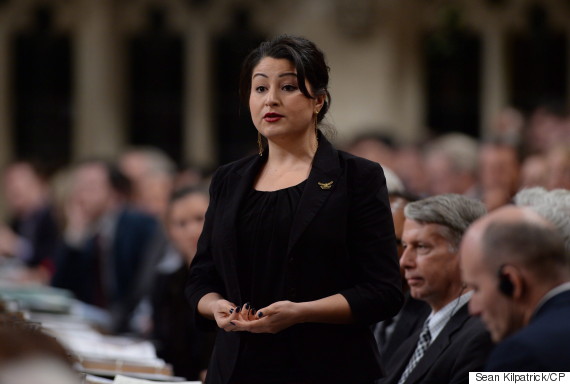
Maryam Monsef Minister of Democratic Institutions responds to a question during question period in the House of Commons on Parliament Hill in Ottawa on Feb. 2, 2016. 

In a statement last month, Monsef announced that the federal government had filed a memorandum of argument defending the current restrictions on non-resident Canadian citizens — a move that angered many expats who felt the Liberals were betraying their campaign commitment.

During the 2015 election, the party told the Canadian Expat Association: “We believe that all Canadians should have a right to vote, no matter where they live, and we are committed to ensuring this is the case.”

In her October statement, Monsef signalled that legislation would be introduced before the end of the year that would “meet the needs of highly mobile Canadian citizens who live in today’s increasingly interconnected world” but she did not elaborate.

Source: Liberals To Expand Voting Rights For Canadian Expats

Let’s get real. Facebook is not to blame for Trump. – Recode

While I think Williams downplays the role and responsibility of social media (see Social Media’s Globe-Shaking Power – The New York Times), his raising of confirmation bias is valid.

Communications technology is not neutral, and perhaps it is time to reread some of the Canadian classics by Harold Innis (Empire and Communications) and Marshall McLuhan (Understanding Media: The Extensions of Man):

Much of the coverage and outrage has been directed toward social media, its echo chambers, and specifically those of the Facebook platform. While, to be sure, much of the fake or inaccurate news is found and circulated on Facebook, Facebook is not a news outlet; it is a communication medium to be utilized as its users so choose. It is not the job of Facebook’s employees, or its algorithms, to edit or censor the content that is shared; in fact it would be more detrimental to do so. This is for two very good reasons:

One, either human editors, or artificial intelligence editors, by removing one item or another will appear to introduce bias into the system. The group who’s content is being removed or edited will feel targeted by the platform and claim it, rightly or wrongly, is biased against their cause. Even if the content is vetted and found to be true or false.

Two, censorship in any form is bad for the national discourse.

So rather than blaming Facebook or other platforms for the trouble in which we find ourselves, let’s give credit where credit is due: The American people.

This comes down to two very important concepts that our society has been turning its back on, in the age of social media: Confirmation bias and epistemology.

Explained by David McRaney, the You Are Not So Smart blogger and author of “You Are Now Less Dumb: How to Conquer Mob Mentality, How to Buy Happiness, and All the Other Ways to Outsmart Yourself,” confirmation bias is the misconception that “your opinions are the result of years of rational, objective analysis,” and that the truth is that “your opinions are the result of years of paying attention to information which confirmed what you believed while ignoring information which challenged your preconceived notions.” Or, more precisely: The tendency to process information by looking for, or interpreting, information that is consistent with one’s existing beliefs.

If we find a piece of content that says that Donald Trump is clueless, or that Hillary Clinton belongs in prison, we accept the one because it reinforces our like for one candidate over the other, and discard the negative item as some falsehood generated by the opposing party to discredit your candidate. We don’t care about the information or what it says, as long as it reinforces how we feel.

That brings us to epistemology, “the study or a theory of the nature and grounds of knowledge especially with reference to its limits and validity,” a branch of philosophy aptly named from the Greek, meaning “knowledge dscourse.” This is a concept that has existed since the 16th century and very likely conveniently ignored in political campaigns ever since, perhaps because it’s just easier to believe and propagate than it is to read and validate.

In fact, a recent Pew Research Center survey called the American Trends Panel asked if the public prefers that the news media present facts without interpretation. Overwhelmingly, 59 percent of those posed the question preferred facts without interpretation, and among registered voters, 50 percent of Clinton supporters, and 71 percent of Trump supporters preferred no interpretation. While those numbers may seem incredible, the telling result is that 81 percent of registered voters disagree on what the facts actually are. Aren’t facts just facts? Yes, they are, but our biases and distrust of intellectual sources say otherwise.

Does Facebook create echo chambers on both sides of the political spectrum? No. Facebook and other social media only serve to provide a high-speed amplifier of what already exists in our society; especially to those who enjoy the communal effect of sharing information with others in their personal circles. Facebook goes give them a wide and instant audience.

In a 2012 study published in the journal Computers in Human Behavior, computer scientists Chei Sian Ma, and Long Ma said, “… we also establish that status seeking has a significant influence on prior content sharing experience indicating that the experiential factor may be a possible mediator between gratifications and news sharing intention.”

Or, in other words, it’s fun to share something and get congratulatory high-fives from your like-minded friends. Facebook does make that activity almost instantaneous. Sharing news, or fake news, and being liked for doing so feels good. Never mind the ramifications on the accuracy of cultural or political discourse.

During his final press conference in Berlin with Angela Merkel, President Obama puts this as succinctly as it could possibly be said: “If we are not serious about facts, and what’s true and what’s not . . . if we can’t discriminate between serious arguments and propaganda, then we have problems.”

Vaunted First Nations jobs plan misses target inside Indigenous Affairs Ministry

Harder to achieve than it sounds but still striking. As to the comment of the frustrated applicant, there is a distinction between the role of a public servant and an activist:

The Liberals’ vaunted support for First Nations, Métis and Inuit job-seekers appears to be absent in the government’s own hiring practices.

Indigenous and Northern Affairs Canada went on a hiring spree this year — and so far there are relatively few Indigenous workers among the lucky recruits for stable, full-time jobs.

In a 1996 written agreement with First Nations, the department promised to “make every reasonable effort” to hire one Indigenous employee for every two new job vacancies.

But for more than two decades officials have failed to deliver, often arguing that hiring freezes tie their hands or that there are no suitable or willing Indigenous candidates for jobs that do come open.

The Liberal government of Justin Trudeau has since opened the jobs spigot, with plans to hire 278 people in the department this fiscal year alone to help administer new water-quality and infrastructure programs, among others. Another 184 jobs will be created in the following three years.

‘Extremely frustrating’

But of the 117 new workers hired so far, just 21 are self-identified Indigenous people.

That works out to 18 per cent, far fewer than the long-standing promise of 50 per cent. It’s even lower than the current makeup of the department’s 4,100-member workforce, which is about 30 per cent Indigenous.

“For me it is extremely frustrating, not just as an individual who is more than qualified and looking for a career,” said a First Nations woman with two degrees who has repeatedly applied without success for full-time work at the department.

“But on a larger scale, I find it frustrating for all Indigenous people and for Canada as a whole. Here we have a new government that talks about a nation-to-nation relationship and engagement and all that good stuff.

“But wouldn’t the best way to start that process be to hire more Indigenous staff who are passionate about working with the government and their people to bridge gaps and make positive changes?”

CBC News has agreed to withhold the identity of the woman because she worries any publicity will damage her job prospects.

A spokeswoman for Carolyn Bennett, the minister responsible, confirmed the 50 per cent hiring target still stands, as the government works on “advancing reconciliation” with Indigenous people.

Source: Vaunted First Nations jobs plan misses target inside Indigenous Affairs Ministry – Politics – CBC News

House more diverse, but still has a long way to go – The Hill Times Editorial

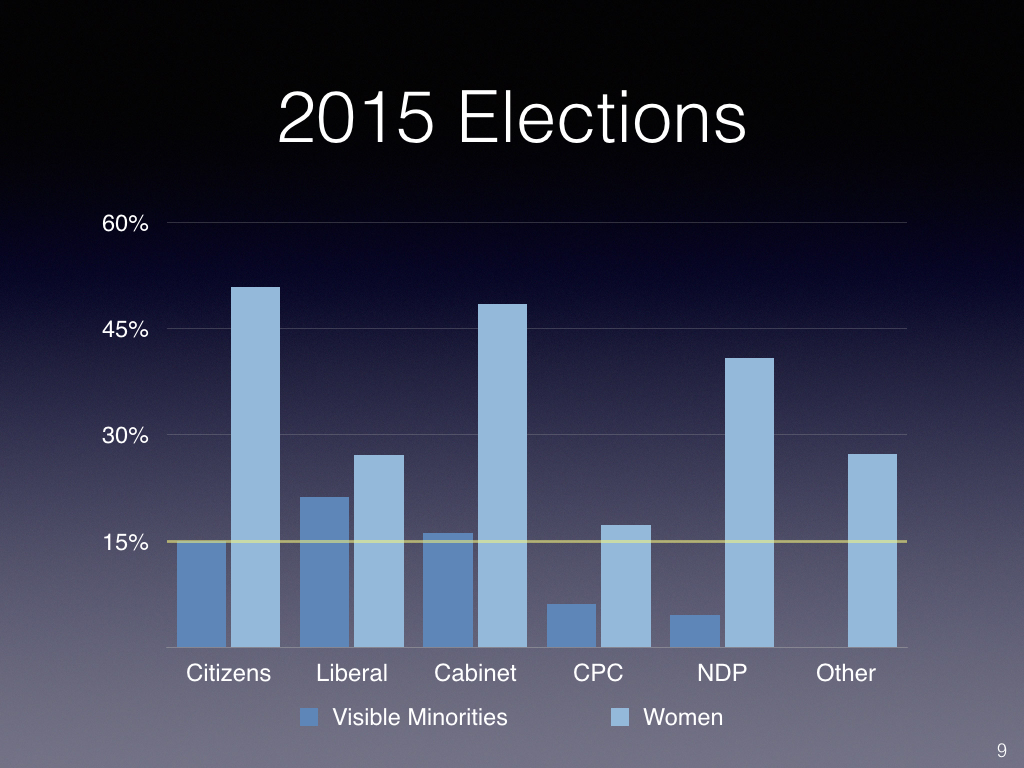
While hard to disagree with the overall tenor of this editorial, the more interesting aspects of Kai Chan’s in-depth work is less with traditional diversity – women, visible minorities, foreign-born, Indigenous peoples – is with respect to the lack of occupational, age, education etc where some of the differences between parties are striking.

Election 2015 - VisMin and Foreign-Born MPs.002

Note: Baseline for visible minorities is 15 percent, those who are Canadian citizens

The Hill Times conclusion only focuses on the former and is silent on the latter:

As The Hill Times reports in this week’s issue, this is one of the most diverse House of Commons in Canadian history, but it still has a long way to go to reflect Canada’s diverse population. More work must be done to elect more women, more indigenous peoples, more visible minorities, and more people with diverse educational and professional backgrounds. The House is still too white, too male, and too English.

According to research by Canadian expatriate economist Kai Chan, who has a PhD in economics from New Jersey’s Princeton University and is a self-described “data-junkie,”of 338 MPs elected in the last general election, the average group in the House is 50-59; the most common professional background is law; and the most studied subject is politics. Some 104 MPs, or 30 per cent of MPs, are bilingual; 47 MPs, or 13 per cent, were born outside Canada; and there are 88 female MPs, or 26 per cent of the House. Of the 47, or 14 per cent of MPs who were born outside Canada, 11 were born in India, six in the U.K., and four in Lebanon. Out of the 291 MPs, or 86 per cent of the House, born in Canada, 28 MPs were born in Montreal, 25 in Toronto, and 12 in Winnipeg.

According to the 2011 National Household Survey, of Canada’s 32.8 million total population, 6.2 million, or 19 per cent, are visible minority Canadians, including 1.5 million South Asians, 1.3 million Chinese Canadians and about 945,665 black Canadians. The Filipino population numbers 619,310, Latin American 381,280, Arab 380,620, Southeast Asian 312,080 and West Asian 206,840. And the total aboriginal population is 1.4-million.

“Canada is such a diverse country, it’s good to get all different voices,” Mr. Chan told The Hill Times. “It’s especially good because we live in a globalized world, and for Canada to really capitalize on its demographic dividend, we really should have all those people at the table.”

Canadians elected 60 lawyers, 47 consultants, 43 professors, 42 business people, and 41 executives. Some 63 MPs studied politics, 60 studied law, 27 studied business and 27 studied economics. Some 199 prefer English and 35 prefer French only.

In the education category, a total 136, or 40 per cent of MPs, have bachelor’s degrees; 75 MPs, or 22 per cent, have master’s degrees; and 30 MPs, or eight per cent, have PhDs. And 81 MPs have secondary or lower levels of education. The Liberals lead the pack with 22 MPs who have doctorates, followed by the Conservatives with five MPs who have doctorates, the NDP two and Bloc one MP. Of the MPs who have secondary or lower education, the Conservatives have the highest with 42 MPs, followed by the Liberals with 27, the NDP eight and the Bloc four MPs. The Liberals are far ahead of other parties when it comes to MPs who have master’s or bachelor’s degrees with 47 and 82, respectively. In the Conservative caucus, 14 MPs hold their master’s and 31 their bachelor’s. On the NDP side, 12 MPs have their master’s and 19 MPs have their bachelor’s degrees. Some 32 MPs attended the University of Toronto, 22 McGill University in Montreal, and 16 went to Queen’s University in Kingston.

Hopefully, all political parties will make a much stronger effort to recruit more candidates who are underrepresented in the House right now, including more visible minorities, more women, more indigenous peoples to run in the next election. Canada is a diverse country. It’s time that diversity was better reflected in the House.

Source: House more diverse, but still has a long way to go – The Hill Times – The Hill Times

Douglas Todd: Are schools pushing aboriginal, ‘Buddhist’ spirituality? | Vancouver Sun

Good analysis, commentary and recommendation, slightly different take to the  column posted earlier (Ashley Csanady: Indigenous prayers in the classroom and all-Muslim suburbs are equally dangerous attacks on our secular society).

That being said, I am a great fan of mindfulness, as have found that useful in both my professional life (being more aware of my internal biases) and during my cancer treatments:

The aboriginal blessings and mindfulness exercises, while fine in themselves, inject a confusing shot of religion into academia, given many scholars would revolt if a university event began with prayer rooted in Christianity, Judaism or Islam.

What’s a way forward?

B.C. Supreme Court Justice Kenneth Mackenzie ruled in 1999 that public education should be “strictly secular,” which he interpreted to mean it should not show favoritism to one religion over another. Beyond that, he said, schools should be ”pluralist,” or ”inclusive in the widest sense.”

Canadian religion professor John Stackhouse believes the B.C. parents objecting to having aboriginal spirituality and mindfulness imposed on their children have a case — and that the public-school system has “crossed a line.”

Just as there is no place for the Christian practice of baptism in public schools, Stackhouse says there is no room for aboriginal smudging or Buddhist-based mindfulness. And rather than creating the awkwardness of students opting in or out, he believes educators should just not invite participation in such practices.

There is a third approach.

Like many, including myself and the B.C. Humanist Association, Stackhouse believes schools should teach far more world-religion courses, so students can learn, in age-appropriate ways, about a variety of spiritual observances and worldviews, from Catholicism to Confucianism.

That should also fit with the recommendations of the Truth and Reconciliation Commission, which recommended doing more to educate students about aboriginal traditions.

The actual practice of such rituals, however, is probably best reserved to individuals, families and spiritual communities.

Source: Douglas Todd: Are schools pushing aboriginal, ‘Buddhist’ spirituality? | Vancouver Sun