Muslim Women’s Clothing: Alia Hogben

Good piece by Alia Hogben of the Canadian Council of Muslim Women:

We would agree that clothes are a form of non-verbal communication as they can transmit social signals and identify a person’s class, income, beliefs and employment.

In addition to this kind of cultural norm, they may also communicate religious beliefs. For example, the Amish, the Mennonites, Hasidic Jews and many Muslims express their ideas of modesty by the attire they wear. The rules affect both genders but more emphasis is on women’s dress. For all these women, modesty includes covering their head and their hair, and being physically segregated at certain times or places.

We don’t have to like or agree with the different ways women choose to dress, but surely we can accommodate these choices about clothing as long as they don’t impinge on others, or require onerous accommodation, or become obligatory for all of us.

For example, there is no consensus among Muslims about whether women’s head coverings are mandatory. So any state or country which mandates women’s dress, especially Muslim women’s, is wrong. In the same way, no state should decree that these women should be uncovered.

The burkini is a bathing suit that covers all of the female body except the face. Some communities in France, the land of liberte, egalite et fraternite, have decided that the burkini is incompatible with the values of France. The bikini is now considered more consistent with French values. The burkini apparently threatens French secularism.

However, the bikini has not always illustrated French values. There is a 1957 photograph of a woman in a bikini who is being given a ticket by a policeman for her indecent attire.

A point of interest is that the woman who dons the burkini may still displease the more traditional Muslim males. This is because they would tell her that the profile of her body can be seen and thus her burkini is still not acceptable. She is caught between the “secularists” and the “religious.” Best that she dress as she wishes!

I would plead with the French to pay less attention to women’s clothing and instead deal with the far more serious issues that they have, including immigration, integration, discrimination and identity.

In Canada we are relatively tolerant and accepting of diversity, so that the hijab under the RCMP hat has now become part of the uniform. It became official policy this year. I think the reasoning is that if it does not impede safety or security and does no harm to the wearer or those around, then we can make these accommodations.

However, in Canada, there are some demands for accommodations that I think are unreasonable and to which we should not acquiesce.

The majority of Canadians are willing to accommodate issues around modesty of dress. but related to the attire of women is the demand for gender segregation. Enforced gender segregation as an extension of modesty should not be condoned by any of us, Muslims or non-Muslims. It can be damaging to both men and women.

In my view, that’s accommodation too far.

Why?  Gender segregation can also mean gender stereotyping. For example, women are seen as emotional, men as rational and also more highly sexed. Women, therefore – so goes the rationale – must hide their own sexuality and cover up so as not to “tempt” men. This is patriarchy at its worst, laying the blame and responsibility on women and girls.

There is a false assumption that gender segregation will protect men and women from licentiousness. I don’t think so!

How wise is Einstein: “If most of us are ashamed of shabby clothes and shoddy furniture let us be more ashamed of shabby ideas and shoddy philosophies.”
Denying Quebec woman day in court because she was wearing of hijab went against Canadian law principles: judge

Surprised that the judge, while making the correct ruling in the particular case, refused to make a general ruling that wearing a hijab (or kippa, or turban) is permissible in court. Hard to understand what hypothetical situation he was thinking of:

Seventeen months after a Quebec Court judge told her to remove her hijab in court, Rania El-Alloul has received partial vindication from the justice system, but no guarantee it will not happen again.

In a ruling released this week, Superior Court Justice Wilbrod Décarie writes, “The court has a lot of sympathy for (El-Alloul) and deeply regrets how she was treated.”

Judge Eliana Marengo’s February 2015 refusal to hear El-Alloul in the “secular space” of a courtroom unless she removed her Muslim head scarf flew in the face of a 2012 Supreme Court of Canada decision that a witness was entitled to testify in a face-covering niqab, Décarie found.

But he did not issue the judgment sought by El-Alloul — declaring that her rights under the Charter of Rights and Freedoms had been breached and affirming her right to appear in court wearing her hijab.

“Each case is a specific case that has to be evaluated in the context of the witness’s court appearance,” Décarie wrote. “It cannot be declared in advance, absolutely and out of context, that El-Alloul will have the right to wear the hijab during her future appearances before the Court of Quebec. Nobody can predict the future.”

What happens next, I don’t know. I hope no one ever feels what I felt in the past

Julius Grey, one of El-Alloul’s lawyers, called Décarie’s finding “wrong in law and very dangerous.” It opens the door to litigants trying to destabilize a witness by filing motions asking she remove her hijab.

“A person will feel insecure before the courts,” Grey said, adding he favours an appeal.

The lawyer said the issue is important as restrictions on religious dress become more common.

“It’s not a particularly Quebec matter. All over the West there is an unhealthy irritation, I would say, with religious garb, with religious practice, with other customs,” Grey said.

Source: Denying Quebec woman day in court because she was wearing of hijab went against Canadian law principles: judge | National Post

Increased immigration urged to support economic growth amid aging population: Conference Board

This boosterism is in contrast to the more sober assessment (see Jason Kirby’s Canada’s demographic gap can’t be filled with immigrants):

Ottawa will need to raise its annual immigration level by one-third to 407,000 by 2030 to sustain its economic growth amid an aging population, says a new report on Canada’s demographic trends.

Currently, Canadians 65 and over account for 16 per cent of the total population, but the ratio is expected to rise to 24 per cent in the next two decades, according to the report by the Conference Board of Canada, released Thursday.

With a birth rate hovering around 1.55 children per woman and a longer life expectancy, researchers examined five scenarios of population targets between now and the year 2100, and their impact on labour force growth and government expenditures for health care and old age security benefits.

“The aging of Canada’s population will have a significant impact on Canada’s potential economic growth. Weaker labour force growth will have a negative impact on household spending, while a more slowly expanding economy will engender less investment spending,” warns the 54-page report.

“Weaker economic growth over the long-term will limit the amount of revenue that governments in Canada collect over the forecast period at a time when the aging of Canada’s population will require significantly more expenditures. . . Higher immigration can increase the growth of Canada’s labour force over the long-term and generate higher economic growth.”

The call for a higher immigration level came just as a new Angus Reid Institute poll this week found 68 per cent of Canadians said they prefer minorities to “do more to fit in” with mainstream Canada — and a drop in public support for multiculturalism.

While Immigration Minister John McCallum has hinted the Liberal government’s intent to increase the number of immigrants “substantially,” the Conservative party’s leadership race has sparked a debate over the needs to test would-be immigrants on “Canadian values.”

According to the conference board report, Canada’s natural rate of increase currently adds about 120,000 people to the population each year, but will drop progressively in the coming years as the number of deaths rises steadily and births decrease.

With the current annual immigration level at 260,000 (or less than 1 per cent of the 35 million population) and birth rate, Canada’s economic growth would slow from the current 2 per cent to around 1.6 per cent by 2050.

By reaching the 100 million population target in 2100, the report said Canada would need to increase its annual immigration levels to 407,000 a year by 2030.

From 2030 to 2050, it said, the immigration growth must be raised annually to 2.1 per cent of the population in order to improve Canada’s economic growth to 2.3 per cent by the middle of the century from the current projection of 2 per cent.

The impact of growing to 100 million people in 2100 can reduce old age security spending from 12 per cent to below 10 per cent of government revenues, as well as cutting the provincial health costs from 34.5 per cent to 29.2 per cent of provincial spending.

At that population growth rate, the number of new houses built would rise to 432,000 rather than 268,000 under the status-quo projection of 53.7 million population in 2100. Spending growth will also spread to durable goods and in investment, said the study.

“Higher immigration and fertility rates soften the significant cost strains on the Canadian system in the long-term,” the report noted. “However, over the next 25 years, Canada must also look to other solutions to address the impact of an aging population . . . Growth in the population is one level that can be part of the mix.”

Source: Increased immigration urged to support economic growth amid aging population | Toronto Star

We’re All a Little Biased, Even if We Don’t Know It – The New York Times

Thanks to the VP debate, implicit bias has become the new political correctness term for the right. Good piece explaining what it is and is not.

As I have argued before, confronting implicit bias means becoming more mindful and aware, rather than just using automatic thinking:

“Senator, please,” Mr. Pence said, addressing his Democratic opponent, Tim Kaine, “enough of this seeking every opportunity to demean law enforcement broadly by making the accusation of implicit bias every time tragedy occurs.”

The concept, in his words, came across as an insult, a put-down on par with branding police as racists. Many Americans may hear it as academic code for “racist.” But that connotation does not line up with scientific research on what implicit bias is and how it really operates.

Researchers in this growing field say it isn’t just white police officers, but all of us, who have biases that are subconscious, hidden even to ourselves.

Implicit bias is the mind’s way of making uncontrolled and automatic associations between two concepts very quickly. In many forms, implicit bias is a healthy human adaptation — it’s among the mental tools that help you mindlessly navigate your commute each morning. It crops up in contexts far beyond policing and race (if you make the rote assumption that fruit stands have fresher produce, that’s implicit bias). But the same process can also take the form of unconsciously associating certain identities, like African-American, with undesirable attributes, like violence.

The science of how this submerged bias affects your actions is still a work in progress; studies have found a link between the biases and specific actions in some situations but not others. But because this bias is a function of universal human psychology, researchers say, we all experience it — and you can’t exactly get “rid” of it.

Well-intentioned people may also hold implicit biases that run counter to their stated values. That’s why it’s hard to square Mr. Pence’s description with the science. To broach implicit bias isn’t to impugn someone’s values; it’s to recognize that our values compete on an unconscious level with all the stereotypes we absorb from the world around us. And even black police officers aren’t immune to internalizing them.

“These types of cultural biases are like smog in the air,” Jennifer Richeson, a Yale psychologist, wrote in an email, citing an analogy often used by a former president of Spelman College, Beverly Daniel Tatum. “To live and grow up in our culture, then, is to ‘take in’ these cultural messages and biases and do so largely unconsciously.”

In the context of race, implicit bias is considered a particularly important idea because it acknowledges forces beyond bigotry that perpetuate inequality. If we talk less about it, as Mr. Pence suggested — this “really has got to stop,” he said Tuesday night — we lose vocabulary that allows us to confront racial disparities without focusing on the character of individual people.

“You’re removing the language that allows you talk about the mechanism of inequality,” said Phillip Atiba Goff, the president of the Center for Policing Equity at John Jay College of Criminal Justice and a professor there. “If you take away that language, what that means is inequality gets stronger and justice gets weaker. It really gets that serious.”

Mr. Goff said he hears objections similar to Mr. Pence’s every time he gives presentations or leads training sessions with police departments. “Someone will say, ‘I’m tired of being called a racist,’ ” he said. To which he explains that racism and implicit bias aren’t interchangeable.

“That wrong formulation is so ingrained,” Mr. Goff said. “That’s what’s dangerous. It’s so easy to call it a slight, and if that metastasizes in our political discourse, we really have lost out on an incredible opportunity to take great strides forward.”

He fears that implicit bias could become a political trope, dismissed as an insult and not as science, or worse, tugged into the realm of political correctness. He acknowledges that the left mistreats the topic, too, citing implicit bias as a catchall to explain all the forces of racial unfairness in society that aren’t bigotry.

In fact, implicit bias is just one of many psychological processes that shape how we interact with one another. We also tend to be better at remembering the faces of people in our own racial group, or to subconsciously favor people in our group. The fear of being stereotyped psychologically weighs on people, too. In police training, Mr. Goff has watched officers using other kinds of mental shortcuts in which they assume “active shooters” must be men. He now talks more broadly about “identity traps” that encompass implicit biases and much more.

The challenge, he argues, isn’t to eliminate biases, but to try to interrupt them so we can act more often in ways that line up with our values. Researchers, though, still have a lot to learn about how to do that. And it would be unfortunate, Mr. Goff argued, if implicit bias became politically unmentionable right at the moment when science was trying to uncover the answer.

For now, laboratory simulations don’t easily translate to the real world, and it’s hard to convert beliefs into behaviors. It’s unclear how well nascent police training programs work. And police officers are not the only ones facing implicit-bias training — this fall, the home-sharing company Airbnb announced it planned to offer such a program to its hosts. It’s not clear that will work, either.

Tony Greenwald, a professor of psychology at the University of Washington, said training can even backfire, as a result of another tendency we have: People who attend programs like these may falsely believe they’ve rooted out their biases and so don’t need to worry about them any more.

“Just wanting to eliminate implicit bias is not sufficient,” Mr. Greenwald said. “You can’t unlearn implicit biases. We live in a society and culture where the influences that create these are so strong and pervasive, that we’re not going to get rid of those influences in any short period.”

Canadians think immigrants should do more to blend in; immigrants would do well: Tarek Fatah

Tarek Fatah on Canadian values and integration:

How else would 30 million Canadians offer three of the most liveable cities of the world – Toronto, Vancouver and Calgary – considering our large size and low population.

It’s our values and culture that makes us the envy of the world. What are those values that we wish all newcomers embrace, as we welcome them to become part of our family?

More than Canada being a liberal, secular democracy, newcomers find our embracing of the disabled, and the intellectually challenged a pleasant shock.

It’s also how we, over the years, have come to accept gays and lesbians as our sisters and brothers and live next to them as neighbours with who we chat, bake, help clear their snow despite the recognition that just a few decades ago this would not have been possible, but we did it.

Our cities are relatively safe; young women can jog late in the night without the fear of posses of young men taunting and throwing sexual epithets at them.

And then there is that colour bar and anti-black racism that has been largely defeated – even though we have miles to go before we rest.

If there is a nirvana, this is it.

However, this is our inheritance from generations gone before us and it is our duty to ensure these values and this culture does not get tarnished or diluted. Because there is still that awful disease that pushes newcomers into ideological, cultural, ethnic and religious ghettoes of old. Sad to say, anti-black racism still thrives in some corners, homophobia is still common in Asia, Africa and Latin America, and the disabled are still viewed in many parts as a curse from the gods for sins committed by their parents. A visit to Uganda or Pakistan, Somalia or Saudi Arabia, will confirm those observations.

Source: Canadians think immigrants should do more to blend in; immigrants would do well

Ottawa softens stand on stripping citizenship over false papers

More on revocation for fraud and misrepresentation, and the Minister’s openness to suspend revocation pending changes to the Citizenship Act that restore some measure of greater procedural protections to those accused of fraud:

Immigration Minister John McCallum says he is open to granting a moratorium on the revocation of citizenship from Canadians who misrepresented themselves in their applications, an issue that has been thrust into the spotlight by the circumstances of cabinet minister Maryam Monsef’s citizenship.

Mr. McCallum’s comments come a week after the British Columbia Civil Liberties Association and the Canadian Association of Refugee Lawyers filed a legal action with the Federal Court asking the government to put a stop to all revocations until it could fix a law that allows citizenship to be stripped without a hearing.“I will consider that moratorium. I won’t rule it out unconditionally,” Mr. McCallum told Senate Question Period on Tuesday. “What I am saying is that we would welcome a reform to the system.”

The Federal Court application made headlines when lawyers on the case said that Ms. Monsef, Democratic Institutions Minister, could have her citizenship revoked under the current law for having an incorrect birthplace listed on her citizenship papers. Ms. Monsef said she only learned that she was born in Iran, not Afghanistan as she had believed, after an inquiry from The Globe and Mail last month. She said her mother never told her and her sisters they were born in Iran because she did not think it mattered.

While Ottawa is considering the moratorium on revocations, the government says it is committed to eventually reinstating the right to a hearing for Canadians who face losing their citizenship because they misrepresented themselves in their citizenship and permanent residency applications.

Independent Senator Ratna Omidvar said she is going to propose an amendment to the government’s citizenship Bill C-6 to reverse the Conservative law that took away the long-standing right.

“I am hopeful that they will allow this amendment to be tabled,” Ms. Omidvar said. “Everybody’s hoping they’re able to do it in this bill at the Senate. But if not, I’ve been told that it will be fixed through legislation.”

MPs tried to table the amendment to Bill C-6 at the House immigration committee earlier this year, but was it declared to be out of scope by the committee chair. Ms. Omidvar noted that the Senate procedure rules are different, so the amendment still has a chance in the Red Chamber.

Source: http://www.theglobeandmail.com/news/politics/ottawa-softens-stand-on-stripping-citizenship-over-false-papers/article32254296/

Trudeau may change law to protect Monsef | Malcolm

Malcolm conveniently ignores that Minister McCallum during the spring committee hearings on C-6 committed to reviewing the revocation process in light of testimony regarding the lack of procedural protections in C-24 for those accused of fraud or misrepresentation: “less protection than for parking tickets.”

So while the Monsef case may have accelerated this review, it was already underway.

And calling C-6 “comprehensive changes” is incorrect. C-24, the 2014  changes of the Conservative government, were comprehensive; C-6 is a relatively surgical set of changes, significant to be sure, but limited in scope:

The Trudeau Liberals have spun themselves into a corner when it comes to Maryam Monsef.

It now looks as if Prime Minister Justin Trudeau is willing to change Canada’s citizenship and immigration laws to protect one of his own.

Monsef says her mother recently told her she was born in Iran, not Afghanistan, as she had previously been told.

If her immigration application, when she was a child, included false information about her birthplace, then it is possible her immigration application was fraudulent.

The penalty for providing false representation to immigration officials is steep.

In similar cases where a parent provided untrue information on behalf of a child, it has led to the stripping of citizenship and even deportation from Canada.

As I pointed out in my last column, the Trudeau government recently stripped citizenship from an Egyptian national who became a Canadian citizen at age eight.

In that case, the woman’s parents lied on her application, and therefore, as per Canadian law, she risks being deported.

But when it comes to their own star cabinet minister, Monsef, the Trudeau Liberals are scrambling to deal with the controversy.

On Tuesday, Immigration Minister John McCallum testified in front of a Senate committee discussing Bill C-6, the Trudeau government’s controversial citizenship bill.

Under pressure from Liberals in the Senate, McCallum suggested that his government would consider placing a moratorium on the practice of citizenship revocation.

How convenient.

“I will consider that moratorium. I won’t rule it out unconditionally,” McCallum told the Senate committee. “What I am saying is that we would welcome a reform to the system.”

The Trudeau government had no problem imposing this law during its first eleven months in office. None at all.

During the last session of Parliament, Trudeau and McCallum introduced comprehensive changes to Canada’s citizenship and immigration laws through Bill C-6.

On the issue of citizenship revocation, Bill C-6 halted the government’s ability to strip citizenship from convicted terrorists and those who commit treason against Canada.

As Trudeau said famously during the last election campaign, after all, “a Canadian is a Canadian is a Canadian.” Even if that Canadian is a foreign-born terrorist.

But when it came to cases of fraud and misrepresentation, no changes were made under Bill C-6.

Quite the opposite, in fact, as Trudeau said he supported citizenship revocation under these circumstances.

On the campaign trail last September, Trudeau less-famously said that, “revocation of citizenship can and should happen in situations of becoming a Canadian citizen under false pretences.”

At the time, this statement contradicted Trudeau’s own position that Canadian citizenship is an absolute and inalienable right.

Now, that contradiction is catching up on him.

Until the Monsef scandal surfaced, the Trudeau government had no problem in stripping citizenship away from those who committed fraud and those who lied on their applications.

They had no issue with the process of revocation — determined by the relevant cabinet minister and not through lengthy court proceedings.

They agreed with the law, and implemented it routinely.

But suddenly, this law threatens to damage the Trudeau government’s reputation and punish a Liberal insider.

And all of the sudden, they’re willing to change course.

The Trudeau government is now suggesting it would rather change Canada’s longstanding immigration law, ad hoc, than face the inconvenient fact that, based on the story she’s provided, Monsef’s immigration application may have been fraudulent.

Source: Trudeau may change law to protect Monsef | Malcolm | Columnists | Opinion | Toro

CBC-Angus Reid Institute poll: Canadian millennials hold off on their love of country

And this poll, showing young Canadians have less pride in Canada, again suggesting less local citizenship:

According to the results of a national polling partnership between CBC and the Angus Reid Institute, those aged 18 to 34 have a much cooler relationship to Canada than older Canadians.

Overall, the majority of Canadians polled said they were proud of Canada. Those 65 and over were the most proud, with 65 per cent saying they were very proud of Canada.

However, pride diminished with the age of the respondents. The poll revealed that only 40 per cent of Canadians aged 18 to 34 said they were very proud of Canada.

“It’s a stark finding, and one that certainly jumps out and isn’t something we’ve seen before,” said Shachi Kurl, executive director of the Angus Reid Institute.

One possible reason for this changing relationship, Kurl said, is that a global technological revolution has made this generation more globally connected in real time than any previous group.

“This is the first generation of watching movies or TV from other parts of the world. It’s not just what they’re reading from a local newspaper but consuming from the internet, from the pipeline of communication and information that’s coming at them, and shaping their views and thoughts.”

Trust issues

But this “pipeline of information” has profound consequences for how millennials think and act.

A clue lies in another key finding in the poll.

While the majority of people over 34 said the news media do a good job presenting the facts, 64 per cent of those 18 to 34 said the opposite — that most of the stories you see in the news can’t be trusted.

Source: CBC-Angus Reid Institute poll: Canadian millennials hold off on their love of country – British Columbia – CBC News

Theresa May criticized the term ‘citizen of the world.’ But half the world identifies that way. – The Washington Post

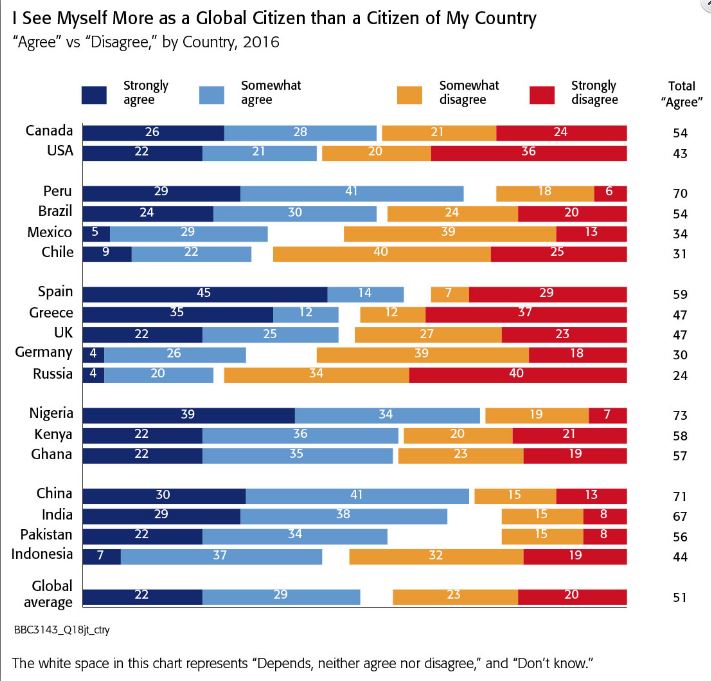
global-citizenInteresting poll showing the relative identity balance between local and global citizenship:

In defense of the Brexit decision she now must implement, British Prime Minister Theresa May said Sunday that no “divisive nationalists” would hold up the process of exiting the European Union, and she firmly asserted that all four of Britain’s constituent “nations” — England, Wales, Scotland and Northern Ireland — would Brexit together.

But the Brexit decision was fueled in many ways by nationalist sentiments, centering on perceived threats to Britain’s sovereignty and many of its citizens’ desires to prevent the supposed dilution of their national identity by immigrants crossing the European Union’s open borders.

Just three days after her comment about “divisive nationalists,” at her Conservative Party’s annual conference, May espoused her own brand of nationalism — one that seems to encompass all of Britain, but excludes those who may feel as though they have multiple nationalities, or identities.

“Today, too many people in positions of power behave as though they have more in common with international elites than with the people down the road, the people they employ, the people they pass on the street,” she said. “But if you believe you are a citizen of the world, you are a citizen of nowhere. You don’t understand what citizenship means.”

As it turns out, about half of the people “down the road” or whom one might “pass on the street” identify with the very phrase May disparaged — being a “citizen of the world” or global citizen.

In an 18-nation survey conducted by GlobeScan in conjunction with the BBC World Service that was released just over a month ago, 47 percent of Britons said they somewhat or strongly agreed that they considered themselves more as global citizens than citizens of the United Kingdom.

That number is just slightly below the 51 percent of all respondents who felt the same way. Below is a look at how respondents from each of the 18 surveyed countries responded. It is worth noting that “urban-only” samples were used in Brazil, China, Indonesia and Kenya.

Source: Theresa May criticized the term ‘citizen of the world.’ But half the world identifies that way. – The Washington Post

Where is the love: How tolerant is Canada of its interracial couples?

Minelle Mahtani’s study of mixed couples:

Is love the last frontier of racial bigotry in Canada?

It’s a question that intrigues Minelle Mahtani, who has dared to ask whether interracial couples and their families still test the limits of tolerance in this country.In her recent book Mixed Race Amnesia: Resisting the Romanticization of Multiraciality in Canada, Mahtani, an associate professor in human geography and journalism at the University of Toronto Scarborough, questions whether we’ve not just put rose-coloured glasses on our multiculturalism, especially where mixed-race families are concerned.

While interracial relationships are on the rise in Canada (we had 360,000 mixed-race couples in 2011, more than double the total from 20 years earlier), the numbers remain slim. Just 5 per cent of all unions in Canada were between people of different ethnic origins, religions, languages and birthplaces in 2011, the last year Statistics Canada collected such data. That figure rises only marginally in urban areas: Just 8 per cent of couples were in mixed-race relationships in Toronto, 10 per cent in Vancouver.

How do people in interracial relationships experience that multiculturalism on the ground, when they introduce their boyfriends and girlfriends to family, or hold hands on a date? How do mixed-race families and their children feel about it, in their communities and in their schools?

Mahtani was the keynote speaker at last month’s Hapa-palooza, an annual festival celebrating mixed heritage in Vancouver, and she will present at the next Critical Mixed Race Studies Conference in California in February. She spoke with The Globe and Mail about the daily realities of mixed-race families.

How tolerant are Canadians of interracial relationships today?

It’s an early kind of euphoria around celebrating multiracialism in Canada. We’ve romanticized this notion far too quickly. All the numbers from Statistics Canada show that yes, we are seeing more interracial relationships, but it doesn’t necessarily mean that the racism is decreasing. People who are in interracial relationships are still experiencing a lot of racism.

What kind of criticism do mixed-race people in this country still get for their dating choices?

So much depends on where the relationship is happening and the class background of the people who are getting involved. Even though there’s a greater tolerance of interracial relationships, some researchers talk about this as a kind of “repressive tolerance”: it’s not quite acceptance but a kind of toleration.

So many of the mixed-race people I interviewed spoke about the challenges that their own parents faced as interracial couples. We’re talking about kids whose parents met in the seventies and earlier when there was much more outright, blatant racism experienced by interracial couples.

Source: http://www.theglobeandmail.com/life/relationships/where-is-the-love-how-tolerant-is-canada-of-its-interracial-couples/article32206930/