Race, School Ratings And Real Estate: A ‘Legal Gray Area’ : NPR

Not surprising that neighbourhoods become a proxy for race:

With her infant son in a sling, Monique Black strolls through a weekend open house in the gentrified Shaw neighborhood of Washington, D.C. There are lots of factors to consider when looking for a home — in this one, Monique notices, the tiny window in the second bedroom doesn’t let in enough light. But for parents like Black and her husband, Jonny, there’s a more important question: How good are the nearby schools?

It’s well-known in the real estate industry that highly rated schools translate into higher housing values. Several studies confirm this, and even put a dollar figure on it: an average premium of $50 a square foot, in a 2013 national study.

In Chappaqua, N.Y., an affluent bedroom community for New York City, the town supervisor recently went so far as to declare that, “The schools are our biggest industry — whether you have kids in the school or not, that’s what maintains our property values.”

But some advocates for fair housing see a potential problem with the close ties between school ratings and real estate. They say the common denominator, too often, is race. And they argue that the problem has intensified in the last decade with new web platforms bringing all kinds of information directly to homebuyers.

“A school rating map mirrors a racial dot map,” showing patterns of segregation and diversity, observes Sally Santangelo, the executive director of Central New York Fair Housing, a group that provides education and legal assistance to oppose housing discrimination.

Which, in turn, raises some complicated questions about how factors like test scores and school ratings are used to influence home-buying decisions.

Characteristics like safety and parent involvement — the qualities Monique and Jonny say they value in a school— can be hard to quantify. Most states base their school ratings primarily on more easily measured factors, like standardized test scores and graduation rates. And these indicators, in turn, are heavily influenced by inequities of race and class.

There’s a large, persistent, and well-documented gap in test scores between black and Hispanic students and their white and Asian peers. There are many reasons for these disparities: income and wealth gaps, disciplinary policies that “push out” black students from school systems, less experienced teachers, the early-learning gap between high- and low-income children. But they all end up reflected in one number: a school rating.

“A lot of time, with schools that serve majorities of students of color, you get a negative rating because the test scores are low,” says Genevieve Siegel-Hawley, an assistant professor who studies race and housing at Virginia Commonwealth University. But, she says, “most of the variation in test scores is explained by the kids’ own poverty or the poverty of their school.”

Housing patterns and school ratings, of course, also reinforce each other. In most places around the country, school budgets are partly linked to local property taxes. Highly rated schools beget higher housing values, which in turn beget more richly resourced schools.

It’s a virtuous cycle for a town like Chappaqua, but a vicious cycle elsewhere.

What does all this mean for potential homeowners like Monique Black? Or for realtors who see school quality as a selling point?

For a realtor, directly discussing the racial composition of a neighborhood with homebuyers is against the law. In 1968, the Fair Housing Act outlawed the practice of racial “steering” by realtors. This can mean showing different properties to a white family and a black family who have the same requirements, or telling them different things about the desirability of a given property or neighborhood, in a way that tends to maintain segregation or perpetuate discrimination.

The National Fair Housing Alliance, an advocacy group, conducts “mystery shopper” sales tests, sending out people of various backgrounds to pose as house hunters and determine whether they hear different messages.

In a 2006 report, the NFHA documented some form of steering in 87 percent of these encounters. And, says Morgan Williams, the organization’s general counsel, this steering included discussions of school quality.

“A striking pattern regarding schools emerged from these sales tests,” the report states. “Instead of making blatant comments about the racial composition of neighborhoods, many real estate agents told whites to avoid certain areas because of the schools. It is evident from the investigation that schools have become a proxy for the racial or ethnic composition of neighborhoods.”

For example, white testers reported that they were told to avoid the Tarrytown, N.Y., schools, which are predominately Hispanic. In several cases, the report says, agents there told whites that the schools were “bad,” but Latinos were told that the same schools were “good.”

In Philadelphia, an agent told a white tester that the schools in a particular town were very good, then added, “But don’t tell anyone I told you that.”

Source: Race, School Ratings And Real Estate: A ‘Legal Gray Area’ : NPR Ed : NPR
Government officials were aware of arcane law that stripped Canadians born abroad of citizenship

“Lost Canadians, the Mennonite angle:

“The Canadian government was aware and warned repeatedly years before an arcane law began stripping longtime Canadians of their citizenship, says a man who spent decades lobbying for change.

Bill Janzen, the former head of the Mennonite Central Committee’s office in Ottawa, said he and his colleagues met with the federal government throughout the 1980s and 1990s to find a fix to the so-called 28-year rule.

The provision was part of a 1977 law that automatically removed citizenship from people born abroad to Canadian parents who were also born outside the country.

“The government holds a big responsibility for this,” Janzen said. “They’ve created a mess.”

The law applies to people born between Feb. 15, 1977, and April 16, 1981, no matter how quickly after their birth they moved to Canada. It was rescinded in 2009, but the change didn’t apply retroactively.

The only way to prevent the automatic loss of citizenship was to apply to retain it before the age of 28 — a detail legal experts contend the government failed to adequately communicate to those affected.

Janzen said he has heard numerous stories of people going to citizenship officials and being told they had never heard of the law.

“They said, ’Don’t worry about it. Go home and enjoy Canada… Once a Canadian, always a Canadian,’ ” Janzen said, noting that officials often pointed out the absence of any expiry date on their citizenship cards.

“It happened again and again and again.”

Janzen has helped more than 180 people navigate the expensive and time-intensive process of regaining their citizenship over the years, So far, 160 requests have been approved.

Immigration Minister John McCallum could not be reached for comment, but a spokeswoman for Citizenship and Immigration Canada said in an email the government advised those affected “when possible” of the need to apply before the age of 28 to retain their citizenship.

“As we do not have data on the number of individuals who might have been impacted, we were unable to advise people systematically,” Sonia Lesage wrote, adding that the number of people who remain affected is “very small.”

Lesage said the immigration minister has discretionary authority to grant citizenship in “cases of special and unusual hardship” and she encouraged anyone who thinks they might be affected to contact the department.

…Janzen said cost is a big challenge for many of the people caught by the 28-year rule, some of whom are “desperately poor.”“If your basic legal status is not settled, it’s so paralyzing,” he said. “For some of them, they’ve known there’s a problem and they’ve not known how to solve it (so) they’ve lived under the wire secretly. That’s no way to live.”

While other cases do exist, the issue appears to have had a disproportionate impact on Canada’s Mennonite community.

James Schellenberg of the Mennonite Central Committee described many of those affected as descendants of Mennonites who, by and large, left Canada in the 1920s for Mexico, Paraguay and elsewhere in Central and South America.

Starting in 2003, two years before the first of those who were affected began turning 28, Mennonite officials put advertisements warning of the law in newspapers popular among Mennonites.

Everyone I talked to seemed very confused. They didn’t know what exactly was going on.

Some people inquired at immigration offices but officials told them not to worry, said Marvin Dueck, an Ontario-based immigration lawyer who has worked on about 50 lost-citizenship cases.

“Once a Canadian, always a Canadian. That was a common response,” Dueck said. “And once a government official says that, why should they trust the Mennonite Central Committee?”

Mississauga mayor files hate-crime complaint after inflammatory article

Valid complaint (the website subsequently took down the offending post):

Mississauga Mayor Bonnie Crombie says she has filed a hate-crime complaint with Peel police after a local website published an article claiming the mayor is trying to convert the city to Islam so “they can kill her son just for being gay.”

The article, published by the Mississauga Gazette on Friday, also claims that Crombie “won’t rest until all girls in Mississauga are victims of rich rapists,” describing the actions of Muslim boys in Mississauga high schools, claiming they routinely assault girls.

“Racism and flat-out lies have no place in Mississauga,” Crombie said Saturday.

“I was very disturbed. I have sent the article to Peel police . . . To paint any group like this, based on religion or ethnicity or anything, is reprehensible.”

Crombie said she has also contacted her own lawyer to address what she believes is a libel against her. The article’s listed author is Acton Michaels, identified as the Gazette’s editor in chief. He did not respond to the Star.

A man who confirmed to the Star that he’s the webmaster and co-owner of the Gazette said that though he might have posted the article, he is not responsible for it. “I’m responsible for the stuff I write . . . everybody else, I just put the content up,” said Kevin Johnston.

“To be honest with you, I didn’t entirely read the article, I just knew it was about young ladies being pestered by Muslim boys at a high school.”

Johnston said his recollection is that he launched the publication in 2014. According to the website, which features numerous ads promoting restaurants, sports leagues, developers and at least one of Canada’s major banks, the Mississauga Gazette has 13 people working for it including Johnston and Michaels.

 Asked if he will remove the article from the website, Johnston said, “If I’m instructed by a court of law with my name on the court order to remove something, I certainly would.” He also said it will be removed if one of the website’s investors or co-owners asked him to do so.

Asked if it would be removed for any possible legal issue, he responded: “Would I do it because you’re suggesting that some article . . . that was placed on a website should come down because . . . Bonnie thinks it should? No, I wouldn’t do that.”

Last year Crombie publicly criticized Johnston during a council meeting after he spread literature denigrating the Muslim community while advocating against the construction of a proposed new mosque. Crombie, city staff and all but one councillor supported the mosque’s construction, which was approved.

After the Gazette article’s publication, Johnston said, the Muslim community is “the only community that (Crombie is) doing anything for. I mean, come on, we have Islamic Heritage Month now in Ontario for the entire month of October. I take issue with that.”

Since being elected in 2014, Crombie has helped organize an effort to raise $5 million to settle Syrian refugees, championed the new mosque’s construction and last month led a push for a city-wide parking exemption to accommodate celebrations for Eid al-Adha, a significant Islamic holy day.

The article published Friday includes the headline, “Bonnie’s Muslims Are Molesting Teenage Girls in Mississauga Highschools.” It claims that Michaels was told by the father of a Grade 10 student at Rick Hansen Secondary School that she has been routinely assaulted by Muslim boys there. The article claims that the school has refused to comment and that such incidents involving Muslim boys are common in Mississauga high schools.

Source: Mississauga mayor files hate-crime complaint after inflammatory article | Toronto Star

Citizenship Week Statement from the Minister of Immigration, Refugees and Citizenship

Hard to disagree with the message.

The good news about citizenship is that IRCC has addressed the previous backlog of over 300,000 through granting citizenship to some 500,000 people during 2014 and 2015.

The bad news is the sharp decline in those applying to become citizens, from a previous average of 200,000 per year to 130,000 in 2015 and only 36,000 in the first half of this year.

The steep increase in fees from $100 to $530 in 2015 largely responsible. More to come later this week:

“Every year Citizenship Week gives Canadians the opportunity to reflect on what it means to be Canadian: the rights we enjoy, the responsibilities we share, and the diversity that makes us strong.

“Canada is respected around the world for our success at reaching out to newcomers and embracing them into our great nation. This makes our citizenship both valued and sought-after. And one of the strongest pillars of success and integration is the act of becoming a citizen, which is why we encourage newcomers to take the path to citizenship.

“I am proud to say that the citizenship processing backlog has been reduced by more than 80%, and as such, most new citizenship applications are being processed within 12 months.

“As the Prime Minister has said many times, we are a strong country because of our diversity and not in spite of it. During Citizenship Week, let us join together and celebrate that diversity and the hundreds of cultures that make up Canada.

“I encourage Canadians to reaffirm their citizenship this week as a sign of pride in our traditions, history, and institutions. And I encourage you to share what your citizenship means to you on social media using #MyCitizenship and #CitizenshipWeek.”

Source: Statement from the Minister of Immigration, Refugees and Citizenship – Canada News Centre


Trudeau government revoking citizenship at much higher rate than Conservatives

The lack of procedural protections for citizenship revocation in cases of fraud or misrepresentation, flagged as a concern in both hearings on the Harper government’s C-24 and the Trudeau government’s C-6, continues to draw attention, given both the increased number of revocations and the Monsef case (although I would argue misrepresentation of her birthplace by her mother is not material in the way that misrepresenting residency).

And while the Trudeau government continued use of this power is questionable, the higher rate reflects in part the increased number of investigations following implementation of this provision in C-24 on 28 May 2015.

IRCC data shows 24 investigations initiated before this provision came into force, and 324 in the seven months after. The number of cases in the pipeline increased, and thus normal that more revocations would result, as the government applies the law:

The Trudeau government used powers granted by the Harper government’s controversial citizenship law to make 184 revocation decisions without legal hearings between November 2015 and the end of August. About 90 per cent of the decisions resulted in a negative finding and the loss of a person’s citizenship.

The numbers show that the Trudeau government has used the law far more aggressively than the Harper government itself.

But in a Federal Court filing late Friday, the government said it would not grant a moratorium on revocation cases, and added that claims by some that the system was revoking large numbers of citizenship are speculative.

Liberal Leader Justin Trudeau made the sanctity of citizenship an issue in last year’s federal election.

“A Canadian is a Canadian is a Canadian,” Trudeau said in a leaders’ debate three weeks before storming to victory.

He used it to dress down Stephen Harper for passing Bill C-24, a law that aimed to strip dual citizens of their Canadian passports if they were convicted of crimes of terrorism, treason or espionage against Canada, or took up arms against Canada.

Immigrant communities rallied to the Liberal Party, concerned that Canadians born overseas would be reduced by C-24 to an insecure second-class status.

Once elected, one of the Liberals’ first acts was to repeal the parts of C-24 that applied to those convicted of terrorism-related crimes, ensuring that they can keep their Canadian passports.

But the Trudeau government left intact other parts of the law that allow the government to strip citizenship from other holders of Canadian passports for misrepresentation.

The 184 revocation decisions of the first 10 months of the Trudeau government nearly match the total number of decisions over a 27-year period between 1988 and the last month of the Harper government in October 2015.

Revocations increase as Trudeau takes office

Although the powers being used come from a law passed by Stephen Harper’s Conservatives, the law has been used much more aggressively under Trudeau.

In the first full month of the law’s operation, June 2015, only three revocation decisions were made. None were made in July or August, two in September and two more in October.

The Trudeau cabinet was sworn in on Nov. 4, 2015. That month saw 21 revocation decisions. The following month there were 59. The year 2016 averaged 13 decisions a month up to Aug. 31, the latest data CBC News has been able to obtain.

The monthly average under the Harper government from 2013 to 2015 was only 2.4 cases a month, some under the auspices of C-24 and some under rules that existed previously.

Citizenship revocation decisions by year (in persons)

2013 2014 2015 2016 (8 months)
January 13
February 4 7 25
March 17 7
April 5 14
May 5 16 18
June 4 1 3 7
July 10
August 10
September 4 2
October 1 2
November 4 21
December 7 59
Total 15 15 132 104

Source: Immigration, Refugees and Citizenship Canada

Liberals accused of hypocrisy

In recent days, following revelations that the birthplace of one of its own cabinet ministers was misrepresented on her passport documents, the government has said it is open to reforming the system.

But in the preceding months, it had used the revocation measures at an unprecedented rate.

“The Liberals criticized these provisions when they were in opposition,” says Laura Track of the B.C. Civil Liberties Association. “They said they were going to fix it. And yet they have been using it even more than the Conservatives did.”

The government says the revocation decisions are being taken to protect the integrity of the citizenship system and are aimed at cases of fraud.

Nancy Caron of Immigration, Refugees and Citizenship Canada said “many cases that are being processed for revocation are as a result of large-scale investigations into possible residence fraud.”

The department carried out those investigations with Canada Border Services Agency and the RCMP. Investigations led by those agencies have resulted in the conviction of immigration consultants who helped individuals obtain citizenship illegally.

“The revocation process is then undertaken to determine whether the individuals associated with these investigations, fraudulently obtained their Canadian citizenship through having intentionally misled the government of Canada about key aspects of their citizenship application such as concealing past criminal activities or submitting false documents to demonstrate residence in Canada when in fact they were not living in Canada‎. Many of the decisions to revoke citizenship that have been made since May 2015 directly result from those investigations,” Caron said in an email to CBC News.

Source: Trudeau government revoking citizenship at much higher rate than Conservatives – Politics – CBC News

Study Finds Students Of All Races Prefer Teachers Of Color

Interesting and unexpected:

During the time that Cherng, who is of Chinese descent, taught in an 85 percent African-American middle school in San Francisco, he enjoyed a good rapport with his students, and he wondered what role his own identity played in that.

Now Cherng is a sociologist at New York University and he’s just published a paperwith colleague Peter Halpin that addresses this question. It seems that students of all races — white, black, Latino, and Asian — have more positive perceptions of their black and Latino teachers than they do of their white teachers.

Cherng and Halpin analyzed data from the Measure of Effective Teaching study sponsored by the Bill & Melinda Gates Foundation, which also supports coverage of education at NPR.

They looked at a group of 1,700 sixth- through ninth-grade teachers from more than 300 schools in cities around the country. The students had completed 30-question surveys, asking about a variety of different dimensions of teaching.

For example:

  • How much does this teacher challenge his students?
  • How supportive is she?
  • How well does he manage the classroom?
  • How captivating does she make the subject?

Although NPR Ed has reported before on the pitfalls of student evaluations used in many undergraduate classrooms, this particular student self-report measure may be more valid because of its thoroughness; it’s been independently linked to student learning gains on standardized tests.

Cherng and Halpin found that all the students, including white students, had significantly more favorable perceptions of Latino versus white teachers across the board, and had significantly more favorable perceptions of black versus white teachers on at least two or three of seven categories in the survey.

The strongest positive relationship was the flipside of what Cherng experienced in his own classroom: Asian-American students had very rosy views of their black teachers.

The relationship persisted after controlling for students’ age, gender, their free and reduced-price lunch status and their academic performance. The researchers also controlled for other factors like the teacher’s level of experience and education, their gender, and even outside expert ratings of the teachers’ effectiveness, based on classroom observations.

No matter what, students had warmer perceptions of their teachers of color.

Cherng calls the findings “surprising.”

“I thought student awareness of the racial hierarchy would influence the results,” in favor of whites, he says.

Other studies have found evidence for “race matching,” or the idea that students and teachers of the same race or ethnicity perceive each other more favorably. And NPR Ed recently covered research on “implicit bias,” the idea that teachers of all races look less favorably on students of color.

“We’re not done,” investigating this finding, Cherng says.

His working theory is that teachers of color score more highly because of their ability to draw on their own experiences to address issues of race and gender, which, he says, can be highly germane even to teaching subjects like math, especially in America’s majority-minority public schools. He’s currently working on a series of studies that look at preservice teachers and teacher training, to provide more evidence about the relationship between teachers’ multicultural beliefs and awareness and their effectiveness in the classroom.

As a math teacher, and now a sociology professor, Cherng was never prepared to really understand or address race or gender dynamics in the classroom. But, he says, there may be good evidence that these are essential tools to being a good teacher, period.

Source: Study Finds Students Of All Races Prefer Teachers Of Color

Number of babies born in U.S. to unauthorized immigrants declines | Pew Research Center

This is the most authoritative data I have seen on anchor babies (distinct from birth tourism as anchor babies generally refer to children of long-term residents rather than short-term visitors).

The numbers are significant, reflecting the large number of unauthorized immigrants in the US (and comparative lack of pathways to citizenship), and explain in part political discourse around immigration:

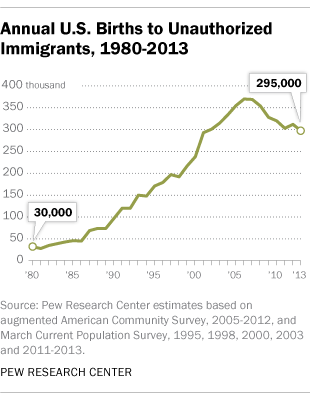
About 295,000 babies were born to unauthorized-immigrant parents in 2013, making up 8% of the 3.9 million U.S. births that year, according to a new, preliminary Pew Research Center estimate based on the latest available federal government data. This was a decline from a peak of 370,000 in 2007.

Annual U.S. Births to Unauthorized Immigrants, 1980-2013Births to unauthorized-immigrant parents rose sharply from 1980 to the mid-2000s, but dipped since then, echoing overall population trends for unauthorized immigrants. In 2007, an estimated 9% of all U.S. babies were born to unauthorized-immigrant parents, meaning that at least one parent was an unauthorized immigrant.

The 14th Amendment to the U.S. Constitution, adopted in 1868, grants an automatic right of citizenship to anyone born in the United States. But in recent years, some politicians have called for repeal of birthright citizenship, including Republican presidential candidate Donald Trump, who says that so-called anchor babies are a magnet for illegal immigration.

A Pew Research survey in February 2011 found that a majority of Americans (57%) opposed changing the Constitution to end birthright citizenship, while 39% favored such a change. That same survey found that most Americans (87%) said they were aware of the constitutional guarantee of birthright citizenship.

Number and Share of U.S. Births to Unauthorized Immigrants, 1980-2013There were an estimated 11.3 million unauthorized immigrants living in the U.S. in March 2013, according to a preliminary Pew Research estimate. They make up 4% of the population, but their share of births is higher because the immigrants include a higher share of women in their childbearing years and have higher birthrates than the U.S. population overall.

These estimates are based on data from the U.S. Census Bureau’s Current Population Survey and American Community Survey, using the widely accepted “residual methodology” employed by Pew Research for many years.

Most children of unauthorized immigrants in the U.S. are born here, and therefore are citizens. In 2012, there were 4.5 million U.S.-born children younger than 18 living with unauthorized-immigrant parents. There also were 775,000 children younger than 18 who were unauthorized immigrants themselves and lived with unauthorized-immigrant parents. These totals do not count U.S.-born children of unauthorized immigrants who do not live with their parents.

The nation’s unauthorized immigrants are more likely than in the past to be long-term residents of the U.S., and are increasingly likely to live with U.S.-born children. In 2012, there were 4 million unauthorized-immigrant adults who lived with their U.S.-born children, both minor and adult. They made up 38% of unauthorized immigrant adults. By comparison, in 2000, 2.1 million unauthorized-immigrant adults, or 30% of this group, lived with their U.S.-born children, minor and adult.

These new estimates, which include a 2008 estimate of 355,000 births to unauthorized-immigrant parents, differ slightly from a previous estimate for 2008 of 340,000 births to unauthorized parents, because they use different data sources and methodology.

Source: Number of babies born in U.S. to unauthorized immigrants declines | Pew Research Center

Chris Alexander on ‘barbaric cultural practices’: ‘It’s why we lost’ | CTV News

Without the ‘crocodile tears’ of Kellie Leitch, former Minister Alexander also disavows the ‘barbaric cultural practices’ tipline:

The Conservative proposal to set up a barbaric cultural practices tipline is one of the reasons the party lost the 2015 election, former immigration minister Chris Alexander says.

“I regret very much several issues that we blew up to a scale they should never have reached in the last campaign. It’s why we lost,” Alexander said in an interview with Evan Solomon, host of CTV’s Question Period.

“It was a terrible campaign. That announcement was the wrong one for that time.”

Alexander is now considering a run for the Conservative Party leadership. He says he’s finalizing the paperwork and will make a formal announcement in the coming weeks.

He’ll be facing off against Conservative MP Kellie Leitch, who appeared with Alexander last fall to promise the creation of the tipline, which was widely denounced and mocked on social media by people pointing out those in need of a tipline to report a crime could call 911. Leitch has distanced herself from the announcement, but says she stands by the message. She’s also since promoted the idea of a Canadian values test for immigrants, which other Conservative leadership candidates have roundly criticized.

Despite disavowing the tipline, Alexander – like Leitch – said the underlying value behind the announcement is important.

“I’m not going to back away from my commitment to women and girls who are facing the horror of forced marriage. It happens in Canada, it happens to 15 million girls and young women around the world every year, and young men as well,” Alexander said.

“I think Canadians get it. But we allowed ourselves to be portrayed in the last election as unwelcoming. That was a huge mistake.”

‘Not my policy’

While Conservative leadership candidate Michael Chong has been strongly critical of Leitch’s proposal to apply a values test to new Canadians, calling it dog-whistle politics, Alexander took a gentler approach.

“It’s certainly not my policy. It does make a lot of immigrants … nervous,” he said.

“It makes them feel unwelcome and it’s not workable in immigration terms. I can tell you that as someone who was very committed to defending Canadian values as minister of citizenship and immigration for two and a half years.”

Alexander also faced criticism as immigration minister over the slow pace of Syrian refugee approvals and lack of information made available under his leadership. The Conservatives pledged in January, 2015, to accept 10,000 Syrian refugees. When the haunting photo of Alan Kurdi, a toddler who drowned while fleeing and who drew an emotional reaction from Canadians in the middle of the election, Alexander says the Conservative campaign didn’t react quickly enough.

“I very much regret that after Alan Kurdi’s body was photographed on that beach, and we all mourned his loss and what was happening in the Mediterranean and across Europe, we didn’t respond as fast as we could have with a much stronger commitment to Syrian refugees,” Alexander said.

“I wanted us to respond quickly after that day. It took us two weeks. I think that was a mistake as well.”

Source: Chris Alexander on ‘barbaric cultural practices’: ‘It’s why we lost’ | CTV News

The Difference Between Racism and Colorism | TIME

Lori Tharp’s Same Family, Different Colors: Confronting Colorism in America’s Diverse Families makes the case to talk about colourism rather than racism and prejudice. Seems more semantics, as the substance is largely the same:

In the U.S., it has been repeatedly proven that skin tone plays a role in who gets ahead and who does not. Despite the fact that the word colorism doesn’t exist, researchers and scholars are now systematically tracking its existence. A 2006 University of Georgia study found that employers of any race prefer light-skinned black men to dark skinned men regardless of their qualifications. Sociologist Margaret Hunter writes in her book, Race, Gender and the Politics of Skin Tone that Mexican Americans with light skin “earn more money, complete more years of education, live in more integrated neighborhoods and have better mental health than do darker skinned …Mexican Americans.” In 2013, researchers Lance Hannon, Robert DeFina and Sarah Bruch found that black female students with dark skin were three times more likely to be suspended at school than their light-skinned African-American counterparts.

Suffice it to say, one’s health, wealth and opportunity for success in this country will be impacted by the color of one’s skin, sometimes irrespective of one’s racial background. Even darker-hued white people have different experiences than their lighter-hued Caucasian counterparts when it comes to access and resources. Colorism is so deeply ingrained in the fabric of this nation that we are all implicated and infected by its presence. And the sad thing is, for many people the lessons of color bias begin in the home.

In black families, Latino families, Asian-American families and obviously interracial ones, too, skin colors can vary in microscopic gradients or in obvious shades of difference. Luckily many parents are able to create a safe-space in the home where skin color differences only matter when it is time to buy sunscreen for the beach. But too often, the pervasiveness of a color hierarchy in the outside world seeps into the household and becomes part of the implicit and explicit teachings of parenting.

That is not to say that the solution to solving our color problem as a country lies in the home, but that is precisely where the conversation should begin. From day one, parents of every color should begin to celebrate color differences in the human spectrum instead of praising one over the other or even worse, pretending we’re all the same. Then, we could have a more public facing, cross-cultural dialogue about the more global problem of colorism and plot its necessary demise.

Source: The Difference Between Racism and Colorism | TIME

Members of dormant national security roundtable seeking answers [CCRS]

Always found the CCRS a useful forum during my time working on multiculturalism issues, where we would bring the “soft side” of counter-radicalization approaches to the table.

While it is normal for a new government to review the mandate and the membership, and whether or not it duplicates other consultative bodies (I think not), pleased that the Liberal government has signalled its intent to maintain the CCRS:

A group of Canadians who advise the federal government on national security issues are in the dark about the future of a 16-member roundtable they were appointed to.

Members of the Cross-Cultural Roundtable on Security are supposed to meet in-camera at least twice a year, yet the group hasn’t met since October 2014.

The roundtable was set up in 2005 to act as a sounding board for cabinet ministers and other high-ranking federal executives on how security matters and government policies affect different ethnic communities. Over the years, it has covered topics such as countering violent extremism, migration and cyber-security.

“I feel I’m in limbo,” said Farzana Hassan, a newspaper columnist and past-president of the Canadian Muslim Congress who was appointed to the roundtable in June 2015.

“It seemed like a very good fit and I jumped on the idea and I accepted the appointment, but I have not heard anything,” she told CBC News.

This past spring, Hassan and several other members contacted by CBC received a letter informing them that the government is re-thinking the roundtable’s activities and composition.

“I get the sense that they would want us to resign because we were appointed by the previous government and, you know, this government’s policies and outlines on certain issues is very different from the previous government,” said Hassan.

“I feel I can do more. I can share my ideas, but I have not been given the opportunity to do so,” she said.

Chair sees lack of communication

Myrna Lashley, a psychologist, was appointed to the roundtable in 2005 and has been the group’s chairperson since 2007. But after receiving the letter in March, Lashley suspects her involvement has come to an end.

“Effectively when you get that letter, you have been told ‘thank you,'” Lashley said.

In the meantime, Lashley is concerned the federal government is not communicating as effectively on national security issues with Canada’s ethnically diverse communities, such as Syrian refugees.

In the past, Lashley says the group met with and advised ministers of public safety and justice as well as senior executives from the RCMP, CSIS and Canada Border Services Agency on all sorts of issues that could or would affect an array of cultural groups.

“We could give them an idea of how different communities might react to something so that they could formulate it in a way that would be acceptable to all Canadians,” said Lashley.

Lashley points to the creation of the special advocate program, which provided independent, top-secret, security-cleared lawyers to represent people subject to a security certificate or immigration proceedings.

“We were the ones that said ‘let’s try a special advocate,’ that came from us,” Lashley said.

The Department of Public Safety refused CBC’s request for an interview. But in an email, a spokesperson said, “While the government is currently reviewing the membership of the table, it looks forward to resuming CCRS meetings in the near future.

Source: Members of dormant national security roundtable seeking answers – Politics – CBC News