Is Diversity on TV Really Getting Better? – The Daily Beast

More on diversity and minority representation in the entertainment industry:

And there is the hope—at the very least, a passionate desire—that the experience of a minority American has been universalized. The success of black-ish hints at that, as does the anecdotal experience of its cast. “I really love that we’ve brought family television back,” Ross said. “It’s a multigenerational comedy that makes people laugh and think all at the same time.”

Still, too, we may be far from fully realizing the idea of normalization—at least, to lend credence to Barris and Ross’s points, to the degree that “diversity” ceases to be a defining word in a conversation about one of TV’s best and most popular sitcoms.

A highlight, and perhaps the most incisive presence of the diversity panel, was actress Tichina Arnold, who, as she said, began acting at age 11 “during a time where there were glass ceilings everywhere.”

Mahoney, sitting next to her, laughed at the undersell: “Glass walls, glass floors, glass doors…”

But, now a star on Survivor’s Remorse, she’s been able to witness the progress and experience the immediacy of the change as it’s happening. And she has an interesting idea for what’s been behind the evolution.

“I thank God for social media,” she said. “I do. It could be a gift and a curse if not used correctly, but I think social media is one of the reasons why we’re all here on this stage, because social media has opened us up. It’s forced show business to listen, to pay attention to so many types of people and individuals out there.”

Mahoney is ready for the attention. And she’s ready to work for it.

“So there’s a line in the sand, and what my job is now is that I have to move that line in the sand,” she said. “And I have to walk in, and I have to confront people who are very comfortable in old, old ways of thinking.”

She paused.

“It’s exhausting,” she concluded. “It’s boring. But, as I often say, we’re built for it.”

Source: Is Diversity on TV Really Getting Better? – The Daily Beast
New gender-neutral Ontario health cards make it harder to get a passport

Inexcusable lack of communication and due diligence by the Ontario government. While I know that OHIP cards are not intended for identification purposes, the reality suggests otherwise.

Systems are linked and it is the responsibility of officials to make the necessary checks:

Ontario’s decision to issue gender-neutral health cards is making it more difficult for some of the province’s residents to get a passport, since the federal government wasn’t consulted on the switch.

….The province announced in June that it will start issuing health cards that no longer display information about a person’s gender on the front of the card.

Changes made to be fair and equitable, province says

Beginning in early 2017, drivers will also have the option on their licences to select X, instead of an M for male or F for female.

The province’s Liberal government said it is making the changes “to ensure the fair, ethical and equitable treatment of people with trans and non-binary gender identity.”

Bestard maintains this is a positive step for non-binary people, and one that she has absolutely no problem with. “I do understand the nuances of the LGBTQ community, and the challenges they face,” she said.

The issue, she says, is the headache that has been created by the two levels of government not working together.

“The lack of communication is quite surprising,” she said.

Immigration, Refugees and Citizenship Canada spokesperson Lindsay Wemp told CBC News that “IRCC was not consulted as part of this initiative from the government of Ontario.”

Christine Burke, spokesperson for Ontario’s Ministry of Government and Consumer Services, says ServiceOntario has been working with the federal government to address this situation.

“No consultations took place with the federal government prior to the change, as we were unaware that the photo health card was being used and accepted as an identity document by Passport Canada,” she said in an email.

Kwok Wong, spokesperson for the Ministry of Transportation of Ontario, told CBC News that the ability to just mark an X for gender on an Ontario licence complies with the International Civil Aviation Organization (ICAO) standards for machine-readable official travel documents.

“In various other countries, X is used in place of M or F when gender is not specified,” he said in an email.

“Ministry of Transportation officials discussed this proposal with the federal government counterparts including Passport Canada and Canada Border Service Agency.”

It appears that a licence marked with an X would not be able to be used to obtain a passport, as proof of gender is still one of the requirements.

Source: New gender-neutral Ontario health cards make it harder to get a passport – Hamilton – CBC News

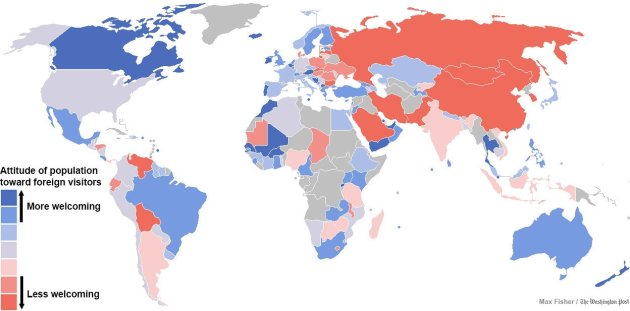
Neat map: Attitudes towards foreign visitors

Map attitudes foreign visitors

Latest Apple diversity report claims US pay equity, modest changes in gender and race

Latest numbers:

As of June, the company was 68 percent male and 32 percent female, Apple said on its website. That’s a shift of a single percentage point in favor of women.

In the U.S., the company was 56 percent white, 19 percent Asian, 12 percent Hispanic, 9 percent black, and 2 percent multiracial, another 1 percent being gathered into an “other” category. Notably the company actually increased the percentage of white employees 2 points, although Asian and Hispanic numbers were up 1 point apiece.

Less than 1 percent of American staff were undeclared, something Apple credits to “stronger internal processes and employees properly identifying themselves.” Most of the people who were previously undeclared turned out to be white, possibly explaining the above demographic shift.

On the pay equity front Apple claims that it has achieved total equity in the U.S. as of August, but is still working on the problem worldwide — this includes scrutinizing salaries, bonuses, and stock grants. There are no statistics on the company’s pay gaps elsewhere.

Like other tech companies Apple has sometimes come under criticism for being predominantly white and male in the U.S. In the past several years, though, the company has tried to adjust its hiring practices at all tiers. Its VP of Worldwide Human Resources, Denise Young Smith, is a black woman, and its retail head is former Burberry CEO Angela Ahrendts.

Source: Latest Apple diversity report claims US pay equity, modest changes in gender & race

Why Atlantic Canada risks losing its seat on the Supreme Court bench

David McLaughlin’s concerns on regional representation, where the comparative lack of diversity among Atlantic judges comes up against overall objectives for a more diverse Supreme Court):

The requirement that the Atlantic provinces have a guaranteed Supreme Court seat is a clear matter of convention, custom, practice, and tradition. How do we know? Because it has been the case since Canada existed. It is not an explicit legal obligation. A convention, with higher legal consequence, is not a custom, which may simply be a long-standing practice or tradition. A convention is not sacrosanct. Political actors can change it. That is how societies evolve.

Under the failed 1992 Charlottetown accord, the federal government would have been required to name judges from lists submitted by provinces and territories. This was a contemporary recognition of what might be termed the “regionalization” requirement of Supreme Court representation. It hewed closely to the original precepts of Confederation. The accord also called for formal consultation by provinces and territories with aboriginal peoples in the preparation of such lists.

Mr. Trudeau’s process inserts a more explicit “diversification” requirement for Supreme Court representation. The court should mirror Canadian society more visibly and directly as it pronounces on law that affects people.

This is all to the good. Except when it is not. This new process contemplates a clear tradeoff between historic convention and contemporary correctness. Since this convention is well known and established, there is no question that Mr. Trudeau is being deliberate, if not exactly forthright, about his intentions.

Justice Cromwell has not yet been replaced. Another judge from Atlantic Canada may yet be named. But this is no longer guaranteed. And that should exercise residents and governments in those four provinces.

Source: Why Atlantic Canada risks losing its seat on the Supreme Court bench – The Globe and Mail

And Konrad Yakabuski notes, I think correctly, that diversity is likely not to include much ideological or philosophical diversity (although I would not characterize it in the dark tones he does – really, seeing discrimination “lurking in every crevice of society”):

Canadians are lucky that, in Jody Wilson-Raybould, Mr. Trudeau has the most qualified Justice Minister in recent memory. As an aboriginal and former adviser to the B.C. Treaty Commission overseeing treaty negotiations between First Nations and the Crown, she is sensitive to the balancing act involved in governing and not prone to political pandering. She can be counted on to recommend judges of the highest calibre, regardless of their origins.

Just don’t expect Mr. Trudeau’s definition of diversity on the bench to include ideological or philosophical variety. The process he has put in place pretty much ensures the selection of liberal judges. Three of the advisory body’s seven members are Liberal appointees. Even if you might expect former Progressive Conservative prime minister Kim Campbell to argue for ideological diversity on the court, it’s an argument she’s likely to lose.

To be sure, the Liberal government has an interest in appointing judges that will uphold its laws, including its controversial legislation on assisted dying. But Mr. Trudeau has a greater political interest in naming judges that tick off his diversity boxes.

And with a majority of his advisory body’s members chosen directly by the legal profession – with the Canadian Bar Association, the Canadian Judicial Council, the Federation of Law Societies of Canada and the Canadian Council of Law Deans each getting to pick a member – the short list of potential top court judges Mr. Trudeau receives will reflect a liberal activist bent that sees discrimination lurking in every crevice of society.

 Diversity yes, but don’t expect big changes on Supreme Court 

Ahmadiyyas find place as Islam sect in census | The Indian Express

Significant:

The Ahmadiyyas, one of the most persecuted sects in the Muslim community, have finally managed find a place in India as a sect of Islam in the 2011 census. With a large section of Muslim clerics deeming the community to be heretics, successive governments in previous years had refrained from including them as a sect of Islam in the census report. This happened despite successive High Court judgments upholding their legal status as Muslims.

The community, which was recently lauded by Prime Minister Narendra Modi for its “religious tolerance and universal brotherhood”, has found its name included in the “Details of Sects/Religions clubbed under specific religious community” data released by the government last week. In earlier census reports, only Sunnis, Shias, Bohras and Agakhanis were identified as sects of Islam.

Conservative estimates of the community’s population in India, which originated in Qadiyan in Punjab, is pegged at 1 lakh. “It is a welcome move by the government,” said Mahmood Ahmed, former president of the Ahmadiyya Muslim Jamaat, Mumbai.

The sect’s origins lie in Qadian in Punjab. Mirza Ghulam Ahmad founded the movement in 1889. Rejecting orthodox Muslim beliefs, he preached that he was the promised messiah with the divinely inspired task of bringing God’s teaching into harmony with the present-day world. He said he was the messiah whose advent was awaited by Muslims, Christians and Jews alike, as well as the incarnation of Krishna.
Since its inception, the sect has been opposed by hardline Muslim clerics. This opposition culminated in a constitutional amendment in 1974 in Pakistan, declaring the Ahmadiyyas to be non-Muslims in the eyes of law. Soon after, there was widespread violence and persecution against the community in Pakistan.

Source: Ahmadiyyas find place as Islam sect in census | The Indian Express

Christian leaders from Middle East ask for Canada’s help

Will be interesting to see if this is picked up more widely:

A trio of Christian leaders from the Middle East are calling on Canada’s government to provide direct aid to Christians being persecuted in that region.

The three church leaders — one from war-torn Syria, one from Iraq and one from Lebanon — were in Toronto Wednesday as part of the Knights of Columbus’ annual Supreme Convention gathering.

All three spoke of the persecution of Christians in Middle Eastern hotspots by radical Muslim groups, such as the Islamic State (ISIS).

Archbishop Bashar Warda of Erbil, Iraq, says Canada — like the U.S. — has a “moral responsibility” to help.

“The Canadian people have a long tradition of helping and supporting the persecuted and marginalized people around the world,” said Warda, using Canada’s 1994 peacekeeping mission in Rwanda — albeit a doomed one — as an example. “Canadians were there. We’re not asking some extra efforts here. It is just the commitment of the Canadian people and the Canadian nation, that they would be always defending the marginalized and the (victimized) around the world. Here, there is a clear case … there are people being persecuted because of their faith, because of their way of life.”

The problem, says Warda, is that Canada’s government does not deal with church-affiliated organizations directly, but funnels aid money through various “institutions.”

“How much of this … (has reached) the Christian … refugees? … It is a very small amount,” he said.

Source: Christian leaders from Middle East ask for Canada’s help | Canada | News | Toron

Shaping the future of Canada’s immigration system

A number of opinions on the issues set out in the current immigration consultations (see earlier Collacott: Immigration ‘conversation” is public relations exerciseIRCC Discussion guide on immigration: What about citizenship?).

In addition to my comments below, views of Debbie Douglas (faster processing of family reunification), Harald Bauder (more funding for settlement, pathways from temporary to permanent residency), Jeff Reitz (greater efforts on employment) and the Conference Board (increased immigration levels, spread across the country):

Having inherited an immigration system plagued with backlogs and heavy-handed enforcement, the Liberal government says it’s keen to hear what you think needs to be done about Canada’s immigration future.

Since the beginning of the summer, Immigration Minister John McCallum and his parliamentary secretary, Arif Virani, have held more than two dozen roundtable meetings across Canada with settlement services organizations, businesses and community groups to get their thoughts.

Although the meetings are by invitation only — more are coming in August — the public can submit ideas by email to the minister. Since early July, more than 2,500 online submissions have been received. Submissions end Aug. 5.

“Immigration, Refugees and Citizenship Canada will be reviewing the feedback from Canadians to help guide decisions on how many people we will welcome in the coming years and the future of immigration in Canada,” said a department spokesperson.

While the final report won’t be ready till at least the fall, the Star interviewed a group of immigration experts to weigh in on the national dialogue by identifying gaps in the system and offering solutions.

Meaningful and accessible citizenship:

Andrew Griffith, a former director general at the immigration department, said Canada largely has its immigration policies and programs right, but an independent review by a royal commission would be helpful.

He said the consultation questions are biased towards economic class immigrants and miss out on important areas such as citizenship.

“Most immigrants choose to become citizens as part of their integration into Canadian society. If we believe in immigration integration, we should support political integration, in addition to economic, social and cultural,” said Griffith.

“The main instrument for doing so is citizenship, given that allows for full participation in the political process.”

Canada’s naturalization rate has been declining, from the peak of 93.3 per cent for immigrants who came before 1971, to just 36.7 per cent among those who arrived between 2006 and 2007.

Griffith said Ottawa must set targets for naturalization as a benchmark, to assess whether its policies strike the right balance in making citizenship accessible and meaningful.

Officials must also regularly review citizenship requirements to ensure that different ethnic groups and immigration classes (economic, family and refugees) have comparable outcomes. Reducing the hefty application fee from the current $530 would make citizenship more financially accessible.

Source: Shaping the future of Canada’s immigration system | Toronto Star

The Hill Times has the political reaction to the (trial balloon?) of differential immigration fees:

The federal government is seeking public feedback on letting some immigration applicants pay more for faster processing.

That idea is one of many put forward in an online consultation document the government is asking members of the public to fill out as it gears up for an overhaul of the immigration processing system.

The NDP’s immigration critic and a pair of Liberal and NDP MPs say bringing in a two-tiered Canadian immigration system is out of the question.

“I wouldn’t support it,” said NDP immigration critic Jenny Kwan (Vancouver East, B.C.). “By doing that, effectively you’re saying you can buy your way into the system and bypass everybody.”

“They’re absolutely creating a two-tiered system if that were to proceed,” she said.

However, Liberal MP Peter Fonseca (Mississauga East-Cooksville, Ont.) and a Toronto immigration lawyer say such a system could help to improve immigration processing.

The issue is one close to MPs’ hearts as much of their constituency work is tied up in helping constituents with immigration questions, including application processing.

Many MPs have two staffers in their riding offices and at least one attends to constituents’ immigration needs. The most common complaints of constituents about immigration issues are related to long delays in the processing times of applications for family reunification, refugees, spousal sponsorship, temporary foreign workers, visitor visas, and Canadian citizenship applications.

Immigration reform

The Devouring: It’s time to recognize Roma genocide

Gina Csanyi-Robah, Robert Eisenberg and Vahan Kololian on the Roma:

A slaughter that in many ways paralleled both the Armenian genocide perpetrated by the Ottoman Empire in 1915-16 as well as the Jewish Holocaust. August 2 is the official date designated by the worldwide Roma community to commemorate the Devouring. So why have so few people heard of it?

Unlike Jewish history and what has become the best recorded genocide of the modern era, the Devouring is still little known. While the history of the Roma genocide has been passed on orally through the generations, only recently has there been a movement to record this tragic history. Following the war the Roma community was so devastated it took 60 years to rebuild.

As a result, estimates of the number of Roma killed by the Nazis vary significantly, ranging between 250,000 and 1.5 million. Dr. Ian Hancock of the University of Texas, a world renowned expert on the Roma genocide suggests “… of the estimated 20,000 Romanies in Germany in 1939, fully three quarters had been murdered by 1945. Of the 11,200 in Austria, a half were murdered. Of the 50,000 in Poland, 35,000. In Croatia, Estonia, the Netherlands, Lithuania and Luxembourg, almost the entire Romani populations were eradicated.”

And there are many more in the field of genocide studies who have supported Dr. Hancock’s theory. Indeed, it is telling that the only country at this point that has recognized the Devouring as a legitimate genocide is Germany.

Like Eastern European Jews, they were designated as Untermenschen, unworthy of life. Along with the Jews, they were rounded up from their nomadic villages and thrown onto cattle cars destined for death camps. Indeed, it is said that Roma and Jews walked hand in hand into the gas chambers of Auschwitz.

The designation of genocide has always been emotionally charged. Motivated by both the Armenian genocide and the Holocaust, international legalist Raphael Lemkin coined the term to give specific meaning to the systemic and systematic murder of an entire people. Today, the United Nations genocide convention, which has universal acceptance, defines it as “acts committed with intent to destroy, in whole or in part, a national, ethnical, racial or religious group.”

If denoting genocide is emotionally charged, its political ramifications can be even greater. The Armenian community struggled long and hard to have Canada finally recognize their tragedy. Threatened economic and diplomatic repercussions from Turkey – which has steadfastly refused to accept the slaughter – were lodged with Canadian authorities when it discussed recognition in Parliament. Nonetheless in 2004, the Parliament of Canada began the process that was completed two years later by the Harper government with full recognition.

The Roma community in Canada, indeed worldwide, has neither the clout in government nor the institutional presence necessary to convince governments to recognize the Devouring. Sadly, global systemic discrimination was also a key factor for ignoring their history. Indeed, to this day the Roma, especially in Eastern Europe, remain persecuted targets of neo-Nazi and other extreme right-wing groups. However, time has certainly come for this recognition.

We lost Elie Wiesel last month, a Nobel laureate and a chronicler of the Holocaust. Mr. Wiesel once wisely noted: “Without memory, there is no culture. Without memory, there would be no civilization, no society, no future.”

Source: The Devouring: It’s time to recognize Roma genocide – The Globe and Mail

How a new appointment process ushers in Supreme Court transparency

Two separate commentaries on the new Supreme Court process and the diversity aspects, starting with Emmett Mcfarlane:

Moreover, statements that the committee will canvass across Canada to fill the new appointment has been met with criticism that the government is doing away with the convention of regionally-based appointments. The upcoming vacancy is historically Atlantic Canada’s seat on the Court. There is speculation that one reason the government would look to other parts of Canada for the next appointment is the desire to appoint an Indigenous or visible minority candidate to the bench. Not appointing someone from Atlantic Canada would not conflict with anything in the constitutional text, but it would be contrary to convention. While the courts tend not to enforce conventions, the government invites significant controversy if it chooses to abandon one here.

The regional issue aside, the lack of diversity on the Court is also a serious problem, at least from the perspective of the institution’s legitimacy. Lack of representativeness in a key governing institution like the Court runs contrary to the stated objectives of the Trudeau government (because it’s 2016, after all). Since the Court’s creation in 1875, every justice has been white. The language of the committee’s mandate is no doubt intended to rectify that. Whether it will, and whether the new process will succeed in bringing greater transparency to appointments and to the Court itself, remain to be seen.

Source: How a new appointment process ushers in Supreme Court transparency

Errol Mendes on the same point:

While the advisory panel has the mandate to consult widely (including with the Chief Justice of the Court, provincial representatives, and MPs and senators from all parties) it must go further in filling in what is missing – namely the lack of aboriginal and visible minority representation in the court while also achieving full gender parity on the bench.

Mr. Trudeau emphasized that the court must reflect our diverse society to bring different and valuable perspectives to the decision-making process. That is indeed what should be part of an appointment process based on merit. To achieve that, the advisory committee must perform extensive outreach activities, going into every part of our legal institutions to seek out the most competent and meritorious of such representatives of the missing diversity on the court.

Expectations of transparency and openness have been raised high by this new appointment process, but so has the expectations of a more diverse court. Because it is 2016.

 New advisory panel needs to dig deep for diversity on Canada’s top court