iPhone owners will have more than 100 new emoji to choose from when Apple launches its iOS 10 software this fall.
The new characters appeared in the developer preview of the software on Monday, and the Cupertino, Calif.-based company provided an early look at what’s to come in a press release. The update will introduce new, more inclusive characters as well as redesigned versions of already existing emoji. These will include female versions of sports-oriented emoji, such as the addition of a female swimmer, biker, surfer, weight lifter and basketball player.
Professional emoji like the detective and construction worker symbols will also be getting a female counterpart with the software update, and Apple has already proposed new characters to the Unicode Consortium based on occupations like astronaut, artist, firefighter, judge and pilot. It’s unclear when those latter symbols will be approved, however.
Apple
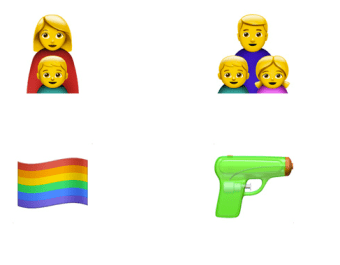
The new family-themed emoji coming in iOS 10 will include new symbols to more accurately represent different types of families, as shown below. A rainbow flag character will also be added to the roster.
Apple
The update is another sign that tech companies are pushing for more diverse emoji representations. A group of Google employees proposed a batch of new emoji in May that would include female scientists, doctors and farmers, among other professions. Last month, Facebook unveiled a set of gender diverse emojis for its Messenger platform as well.
Alex Nowrasteh of the Cato Institute makes the case for birthright citizenship (I would argue that integration is a more accurate term than assimilation):
The U.S. rule of birthright citizenship offers a stark contrast to policies pursued in Germany and Japan, where the children of immigrants are either denied citizenship or face a much harder path toward obtaining it.
The German guest-worker program of the 1950s through the 1970s admitted large numbers of Turks, Tunisians, Portuguese, and others to work in their growing economy. Originally, the Germans had no intention of letting the workers and their families stay permanently, but many, especially the Turks, did stay. Their German-born children were not allowed to become citizens. The same was true in Japan, where the Korean minority, called zainichi, was barred from citizenship for generations despite being born in Japan.
In both countries, the results were tragic. The lack of birthright citizenship created a legal underclass of resentful and displaced young people who were officially discriminated against in the government-run education system and had tenuous allegiance to the country in which they were born. After four generations in Japan, ethnic Koreans still self-identify as foreign. In both countries, these noncitizen youths are more prone to crime and extreme political ideologies like Islamism or communism.
Their failure to naturalize the Turks contrasts with Germany’s Aussiedler system that “repatriated” ethnic Germans and their families living in the territory of the Soviet Union, immediately granting them citizenship by virtue of their blood connection to Germany. Aussliedler inflows peaked in the late 1980s and early 1990s, when approximately 2.2 million ancestral Germans were admitted and given citizenship. Germany partly rectified its system in 1999, extending citizenship to Turks and creating some legal categories that can gain citizenship through birthright.
Equality Breeds Contentment
Youths born to noncitizen immigrants in countries without birthright citizenship have little legal stake in the nations they were born in but also have no place to go. Many might gain citizenship through the ethnicity of their parents in Korea or Turkey, but with no connections to those nations, citizenship there is meaningless.
In the United States, by contrast, children of immigrants are legally on the same playing field as children born to American citizens. Both can serve in the military, purchase firearms, serve on juries, and be treated the same by the legal system. That is one reason why 89 percent of second-generation Hispanics and 96 percent of third-generation Hispanics have described themselves as American only. “Hispanic-American” or “Mexican-American” is still popular among some after several generations, just as “Italian-American” still survives, but these Americans do not view themselves as foreigners.
The likelihood of amending the Fourteenth Amendment’s citizenship clause is small, but that amendment should be defended because of how well it has aided immigrant assimilation in the United States. Remembering the Fourteenth Amendment as a correction to previous racist policies and court decisions is essential, but that history should not blind us to its pro-assimilation impact on the descendants of America’s immigrants.
While I understand the rationale to shut-down such places of hate, one can question whether shutting them down will simply drive them underground, where their activities may be harder to detect and contest:
“Fight against the #radicalization: since December 2015, twenty Muslim places of worship have been closed,” the Interior Ministry tweeted.
Of the country’s 2,500 mosques and prayer halls, approximately 120 of them have been suspected by French authorities of preaching radical Salafism, a fundamentalist interpretation of Sunni Islam, according to France 24.
“There is no place … in France for those who call for and incite hatred in prayer halls or in mosques … About 20 mosques have been closed, and there will be others,” Cazeneuve said.
The announcement came days after French Prime Minister Manuel Valls called for a temporary ban on foreign funding of French mosques. A Senate committee report on Islam in France published in July found that though the country’s mosques are primarily financed through individual donations, a significant portion of their funding also comes from overseas—specifically from Morocco, Algeria, and Saudi Arabia. The same report called banning foreign financing of mosques “absurd and impossible,” calling instead for more transparency.
Because of France’s 1905 law establishing the separation of church and state, or laïcité, the French government cannot finance religious institutions directly. Some experts say this rule has made many mosques reliant on foreign funding.
Cazeneuve also announced Monday that French authorities would be working with the French Muslim Council to launch a foundation to help finance mosques within France.
While I agree with the logic of consolidation and having one integrated government portal for Canadians (I worked on citizen service strategies in the early days of Service Canada), my experience with Canada.ca is mixed, as I find the information I am looking for, more as a researcher, harder to find than before.
And while the concerns raised by this article are valid, I would be curious to know if there are any public studies on the usability of the site for citizens.
A briefing note provided to former Treasury Board of Canada Secretariat president Tony Clement on Dec. 2, 2013, contains a document called Public Opinion Research plan, ongoing user feedback on new Canada.ca website. When obtained by the Citizen, the entire document had been redacted. Government redacts, or blanks out, portions of documents that may breach a person’s privacy rights or are considered to be too sensitive for public consumption.
By my count, of the seven members, four women, one indigenous person, no visible minorities. Will be interesting to see how this process works and the results it generates:
Members of the new advisory board nominated by the legal community include: Susan Ursel, a senior partner with a Toronto law firm who has been recognized for her support of the lesbian, gay, bisexual, transgendered and two-spirited (LGBTT) communities in Canada; Jeff Hirsch, president of the Federation of Law Societies of Canada and partner with a Winnpeg law firm; Richard Jamieson Scott, a former chief justice of the Manitoba Court of Appeal and counsel, arbitrator and mediator at a Winnipeg law firm, and Camille Cameron, dean of the Schulich School of Law at Dalhousie University and Chair of the Canadian Council of Law Deans.
The Prime Minister said opening up the process helps reassure Canadians “that all members of the Supreme Court are both fully qualified and fully accountable to those they serve” across the country.
“The appointment of a Supreme Court justice is one of the most important decisions a Prime Minister makes. It is time we made that decision together.”
All candidates must be functionally bilingual, the government says.
The three members of the advisory board appointed by the Trudeau government include: Ms. Campbell, who served as prime minister in 1993 when she led the Progressive Conservative Party, former Northwest Territories premier Stephen Kakfwi and Lili-Anna Peresa, president of Centraide of Greater Montreal. Centraide is the Quebec presence of United Way Canada.
The government will mandate the advisory board to support the goal of a gender-balanced Supreme Court that also reflects Canada’s diverse society. With Justice Cromwell’s departure, the bench is equally split between men and woman and so a new ninth judge will tilt the balance one way or another.
“A diverse bench brings different and valuable perspectives to the decision-making process, whether informed by gender, ethnicity, personal history, or the myriad other things that make us who we are,” Mr. Trudeau wrote.
When Derakhti speaks, the criticism — and unnerving threats — come from many quarters.
The most potent anti-Semitism in Sweden and Europe today comes from Muslim immigrant communities, where some have called Derakhti a traitor and told him he should fear for his life. Some ultra right-wing Swedes nurse their own brand of prejudice, rooted in historic European anti-Semitism. And on the left, many are staunchly anti-Israel and extend their disdain to Swedish Jews. Some Swedes say the liberals among them have failed to denounce anti-Semitism on the part of the country’s Muslim minority for fear of appearing Islamophobic.
This apathy and vitriol seems only to deepen Derakhti’s empathy. “I feel like I am a Jew,” he said.
But he comes off as a cool young Muslim.
Derakhti is a hip dresser, accessorized with earbuds, an earring and tattoos — including a prominent one in Arabic. He talks cool — in both English and Swedish — and quickly admits that, to his parents’ chagrin, he was no student. He and David fought off anti-Semites, but Derakhti also casually mentions how, in their teenage years, they had fun smoking pot, and generally driving the adults around them crazy.
Derakhti’s image can only help him convince more young people to summon the courage to confront bigotry, said Silberstein, a well-educated, middle-aged Jewish man who has been working on the issue far longer than Derakhti.
“I’m pretty used to speaking in public,” Silberstein said. “But when I went into a school with Siavosh, when I spoke they hardly listened. When he got up and spoke, that’s when they really started listening.”
Derakhti has lost count of the number of times he has taken a busload of Swedish teenagers to Auschwitz and other concentration camps. He thinks it’s close to 20. He has also toured them through Srebrenica, the site of the worst massacre in Europe since the Holocaust, where Bosnian Serbs in 1995 slaughtered more than 8,000 Muslim men and boys during the Bosnian War.
His Jewish friend David was not the only one to inspire the trips he now leads to concentration camps and killing fields. His parents — persecuted in their native Iran as members of the Azerbaijani minority — moved the family to Sweden, where Derakhti was born. His father took him to Bergen-Belsen when he was 13, and Auschwitz when he was 15, to show him where hatred can lead.
“My father told me that if you’re in a minority, you always have to stand up for a friend,” Derakhti said.
Growing up in Malmo, a city with a reputation for intolerance in a country known for just the opposite, Derakhti saw its tiny Jewish minority — including its Chabad rabbi — attacked by members of the city’s much larger Muslim community. Many Malmo Jews fear wearing a yarmulke or other symbol of Jewishness. In the capital, Stockholm, Jews feel safer, but still wonder about their future in Sweden, particularly when Israel is at war, as it was during the summer of 2014 against Hamas in Gaza.
One day when Penny Collenette was director of appointments for Prime Minister Jean Chrétien, her executive assistant slunk into her office clutching a list. “You’re not going to like this,” she said. Collenette looked at it: 18 people recommended for an advisory group on a sensitive public policy issue. All of them were men.
Before the Liberal government was elected in 1993, they made a campaign promise to appoint more women. When they took office, Collenette asked to see the numbers: of about 3,000 people appointed by governor-in-council — deputy ministers, heads of agencies, Crown corporations, ambassadors, judges, returning officers and commission members — women made up between 26 and 29 per cent. Over the first year or so, Collenette kept an eye on that number like it was a stock ticker. With each list of proposed names, the proportion of women nudged upward, bit by bit.
She knew what this list of 18 men was going to do to the progress they’d made. She had a good relationship with the minister in question — even years later, she won’t say which one — so she called him up to say his department needed to do better. He whined a little, but three weeks later produced a new list: nearly half were women, and a few were Indigenous women, too. By the time Collenette left in 1997, the proportion of women in those posts had reached 39 per cent. “In a way, I suppose it was just naïveté,” she says. “We said we were going to do it, so I thought I guess we’d better do it. And of course, personally I wanted to.”
Two decades on, lagging progress — the ranks of women in top government positions is now lower than when Collenette left — has spurred a raft of highly visible attempts to rebalance the scales in Canadian politics and public service. The blunt, by-the-numbers approach of affirmative action is an imperfect and sometimes controversial way to move the ball forward, but — particularly in politics — it may be the only way to upend the entrenched systems that favour men and overlook women. “That we’re still so far behind on this one suggests there are still some really pernicious ideas about women in politics,” says Melanee Thomas, a professor of political science at the University of Calgary. A large and growing number of countries employ gender quotas in politics, and many have seen dramatic improvements in representation as a result. Canada is well behind, and the country’s ranking on gender equity has been slipping for years. The major roadblock is also where the clearest solution lies: with political parties and nominations. “If parties demanded that this would be different, it would be different,” Thomas says.
Publicis Groupe SA put the chairman of its Saatchi & Saatchi advertising agency on leave after he was quoted dismissing the debate on gender bias as “over.”
In a wide-ranging interview with Business Insider published Friday, Saatchi & Saatchi Executive Chairman Kevin Roberts said he doesn’t spend “any time” on gender issues at his agency, saying the issue is “way worse” in sectors such as financial services, where there are “problems left, right, and centre.”
“It is for the gravity of these statements that Kevin Roberts has been asked to take a leave of absence from Publicis Groupe effective immediately,” Publicis Chief Executive Officer Maurice Lévy said Saturday in a statement. “It will ultimately be the Publicis Groupe Supervisory Board’s duty to further evaluate his standing.”
Roberts’s remarks don’t uphold the no-tolerance policy toward behaviour or commentary in the “spirit of Publicis Groupe and its celebration of difference,” according to the statement. “Promoting gender equality starts at the top, and the Groupe will not tolerate anyone speaking for our organization who does not value the importance of inclusion,” Publicis said in the statement, which also was released internally to employees.
Publicis is a multinational advertising and public relations firm based in Paris. It has owned Saatchi & Saatchi since 2000.
Roberts, 66, didn’t respond to an email sent to his work address. Prior to becoming chairman, Roberts served as CEO Worldwide of Saatchi & Saatchi from 1997 until 2014. A citizen of New Zealand, he was born in the north of England, according to his biography on Saatchi & Saatchi’s website.
Roberts’ views “are not mine, and nor are they the position of the agency,” Robert Senior, worldwide CEO of Saatchi & Saatchi, said in a statement. He said he was proud that 65 per cent of the agency’s staff was female, including women in senior leadership roles across the business.
Levy, who is 74 years old, added: “Diversity & inclusion are business imperatives on which Publicis Groupe will not negotiate. While fostering a work environment that is inclusive of all talent is a collective responsibility, it is leadership’s job to nurture the career aspirations and goals of all our talent.”
You may object that moral considerations should limit our opposition to nonbelief. Don’t people have a human right to follow their conscience and worship as they think they should? Here we reach a crux for those who adhere to a revealed religion. They can either accept ordinary human standards of morality as a limit on how they interpret divine teachings, or they can insist on total fidelity to what they see as God’s revelation, even when it contradicts ordinary human standards. Those who follow the second view insist that divine truth utterly exceeds human understanding, which is in no position to judge it. God reveals things to us precisely because they are truths we would never arrive at by our natural lights. When the omniscient God has spoken, we can only obey.
For those holding this view, no secular considerations, not even appeals to conventional morality or to practical common sense, can overturn a religious conviction that false beliefs are intolerable. Christianity itself has a long history of such intolerance, including persecution of Jews, crusades against Muslims, and the Thirty Years’ War, in which religious and nationalist rivalries combined to devastate Central Europe. This devastation initiated a move toward tolerance among nations that came to see the folly of trying to impose their religions on foreigners. But intolerance of internal dissidents — Catholics, Jews, rival Protestant sects — continued even into the 19th century. (It’s worth noting that in this period the Muslim Ottoman Empire was in many ways more tolerant than most Christian countries.) But Christians eventually embraced tolerance through a long and complex historical process.
Critiques of Christian revelation by Enlightenment thinkers like Voltaire, Rousseau and Hume raised serious questions that made non-Christian religions — and eventually even rejections of religion — intellectually respectable. Social and economic changes — including capitalist economies, technological innovations, and democratic political movements — undermined the social structures that had sustained traditional religion.
The eventual result was a widespread attitude of religious toleration in Europe and the United States. This attitude represented ethical progress, but it implied that religious truth was not so important that its denial was intolerable. Religious beliefs and practices came to be regarded as only expressions of personal convictions, not to be endorsed or enforced by state authority. This in effect subordinated the value of religious faith to the value of peace in a secular society. Today, almost all Christians are reconciled to this revision, and many would even claim that it better reflects the true meaning of their religion.
The same is not true of Muslims. A minority of Muslim nations have a high level of religious toleration; for example Albania, Kosovo, Senegal and Sierra Leone. But a majority — including Saudi Arabia, Iran, Pakistan, Iraq and Malaysia — maintain strong restrictions on non-Muslim (and in some cases certain “heretical” Muslim) beliefs and practices. Although many Muslims think God’s will requires tolerance of false religious views, many do not.
A Pew Research Center poll in 2013 found that in Iraq, Malaysia, Pakistan and other nations in which Islam is officially favored, a large majority of Muslims think some form of Islamic law should be the law of the land. The poll also found that 76 percent of such Muslims in South Asia and 56 percent in the Middle East and North Africa favored executing Muslims who gave up their religion, and that in 10 Muslim counties at least 40 percent favored applying Islamic law to non-Muslims. This shows that, for many Muslims, the revealed truths of Islam are not only a matter of personal conviction but must also have a central place in the public sphere of a well-ordered society.
Does this mean that Islam is evil? No, but it does mean that it has not yet tamed, to the extent that Christianity has, the danger implicit in any religion that claims to be God’s own truth. To put it bluntly, Islam as a whole has not made the concessions to secular values that Christianity has. As President Obama recently said, “Some currents of Islam have not gone through a reformation that would help people adapt their religious doctrines to modernity.” This adaptation will be long and difficult and require many intellectual and socio-economic changes, some produced by outside forces, others arising from the increasing power of Islamic teachings on tolerance and love. But until such a transformation is achieved, it will be misleading to say that intolerance and violence are “a pure betrayal” of Islam.
There is no central religious authority or overwhelming consensus that excludes such Muslims from Islam. Intolerance need not lead to violence against nonbelievers; but, as we have seen, the logic of revelation readily moves in that direction unless interpretations of sacred texts are subject to nonreligious constraints. Islamic thinkers like Ibn-Sina accepted such constraints, and during the Middle Ages Muslims were often far more tolerant than Christians. But the path of modern tolerance has proved more difficult for Islam than for Christianity, and many Muslims still do not accept the ethical constraints that require religious tolerance, and a significant minority see violence against unbelievers as a divinely ordained duty. We may find it hard to believe that religious beliefs could motivate murders and insist that extreme violence is always due to mental instability or political fanaticism. But the logic (and the history) of religions tells against this view.
Learn something every day, not aware of this history:
President Tsai Ing-wen of Taiwan offered a formal apology on Monday to aboriginal peoples for centuries of “pain and mistreatment,” and she promised to take concrete steps to rectify a history of injustice.
In a ceremony at the presidential office in Taipei attended by aboriginal community leaders, she said that although Taiwan had made efforts to end discrimination against hundreds of thousands of indigenous people, a formal apology was now necessary.
“Unless we deny that we are a country of justice, we must face up to this history,” Ms. Tsai said. “We must tell the truth. And then, most importantly, the government must genuinely reflect on this past.”
Taiwan has 540,000 residents who are members of aboriginal groups, or about 2 percent of the population of 23 million. The Council of Indigenous Peoples officially recognizes 16 groups with three — the Amis, Atayal and Paiwan — making up 70 percent of the total indigenous population.
Taiwan’s earliest known residents are believed to have come to the island 6,000 years ago or earlier from Southeast Asia and are part of the Austronesian peoples who range from Madagascar to Polynesia. When Han settlers from mainland China began arriving in the 17th century, indigenous peoples, particularly those on Taiwan’s western plains, faced assimilation, loss of land and outright violence.
Today, indigenous groups face high levels of unemployment, low wages and less access to education and other services.
“Another group of people arrived on these shores, and in the course of history, took everything from the first inhabitants who, on the land they have known most intimately, became displaced, foreign, non-mainstream and marginalized,” Ms. Tsai said.
Capen Nganaen, 80, a representative of the Yami, said he was happy to receive the government’s apology.
“Taiwan has had many presidents during its history, but never before has one been willing to offer an apology to the indigenous peoples,” he said during the ceremony.



 Multicultural Meanderings