Why kicking me out of the country is bad for Canada’s economy

One personal account of the impact of Express Entry by an international student, Murad Hemmed:

As of June 16, 2017, I will no longer be welcome in Canada. On that date, my Post-Graduate Work Permit expires, and I have to leave the country. There’s no telling when—if—I’ll be able to return.

I arrived in Toronto on September 12, 2010. As a precocious (read: full of himself) teenager, I thought I was headed for the Ivy League. Then reality set in: I couldn’t afford a U.S. education. Luckily, the self-styled “Harvard of the North” accepted me, so to the University of Toronto I came. It helped that I had an aunt in the city who generously agreed to put me up for the duration of my degree. (A decision I’m sure I gave her cause to regret, with my tendency to return home in the wee hours and my litre-a-week ice cream habit.) Once here, though, Toronto quickly became home. I have a job, an apartment and relationships here. Bombay, the city of my birth, is a place I haven’t called home in years. India, the country of my citizenship, holds no special place in my heart.

Until quite recently, it would have been relatively simple for me to stay. But changes to Canada’s immigration policies that took effect last year have made the path to becoming a permanent resident much more difficult for international students. It’s a sucker punch for the thousands of young people who have bought into Canada’s “nation of immigrants” tag line, who hope that their personal and financial commitment to this country will be recognized and rewarded. It makes little sense to court bright foreign talent to enrol in Canada’s universities, educate them and allow them to integrate, only to uproot them and send them away. But this isn’t just a sob story; it’s an economic issue.

The problem was caused by trying to solve another one. In January 2015, the previous Conservative government implemented a new permanent residency system, called Express Entry, to speed up processing times and prioritize economic immigration. Businesses would be able to hire foreigners with special, in-demand skills without replacing Canadian workers. As part of the overhaul, the government also took a separate program commonly used by international students to gain residency and lumped it in with the Express Entry process. Now, applicants like me are up against everyone else who wants to immigrate to this country.

I’m currently putting together an application for permanent residency. I’m collecting documents, consulting lawyers and comparing notes with friends who are doing the same. Come June, I’ll create a profile for myself in Citizenship and Immigration Canada’s online Express Entry database. Then I’ll wait to be chosen, either by Ontario or in one of the monthly draws from the Express Entry pool. Under the current system, my qualifications and skills are converted into points—the more I have, the better my chances. I score the maximum for being young and for my excellent English. My degree earns me a few more, but there are no extra points for earning it in Canada. Add it all up, and I have fewer than 450 points, the lowest the bar for entry has ever dropped. I’d get an extra 600 points if I qualified for a Labour Market Impact Assessment (LMIA), a document showing my employer can’t find a Canadian to do my job. That’s a requirement engineers and software developers can often meet; journalists, not so much.

Look: Canada can probably do without me, personally. But I’m not the only young person facing this predicament, and losing potentially thousands of international students each year isn’t good for the country or its companies. According to the Canadian Bureau for International Education, 51% of international students plan to apply for permanent residency. We’re Canadian-educated, so our degrees and qualifications need no translation. We’re culturally integrated and linguistically compatible. We’ve paid hundreds of thousands into the public purse in the form of frankly ridiculous international tuition fees, and we have acclimatized to Canadian winters. We know that coffee is spelled “Tim Hortons” and that poutine is a superfood.

Consider the country’s demographics, too. “Canada has a shortage of talented 20-somethings in all areas,” says Mike Moffatt, an assistant professor in the Business, Economics and Public Policy group at Ivey Business School at Western University. “We need people who are going to be working for the next 30 to 40 years, paying into CPP [and] creating economic growth to allow the baby boomers to have the full pensions they’re expecting.” The demographics issue is particularly acute in mid-size cities like London and Windsor, Ont., which have trouble retaining young people and desperately need 20- and 30-somethings to start families and lift the local economy.

We’re also incredibly valuable to our employers. Vancouver tech startup Mobify has hired a number of international students. Some don’t meet the LMIA requirements because they work in non-technical fields. “But they’re highly valuable to us, because they’re already here and they have that knowledge and skill base,” says Tanya Kensington, the company’s senior director of people and culture. The spouse of one Mobify employee recently had to go back to school to allow the couple to stay in the country.

Ontario has its own program for international students with job offers, which allows applicants to potentially skip the LMIA requirement. But Toronto lawyer Stephen Green says employer approvals aren’t being processed fast enough. “If you go to the website, they say you get an answer in 90 days,” he says. “You don’t! So [they’re] giving out misinformation, and suddenly everyone’s freaking out. And we’re losing amazing people.” In any case, the allocation for that scheme fills out rapidly—Ontario stopped accepting most classes of applications on May 9 this year.

The new federal Liberal government seems to be aware of the issue. On March 14, Minister of Immigration, Refugees and Citizenship John McCallum signalled that making it easier for international students to gain residency would be part of a broader review of the Express Entry system. “I believe international students are among the most fertile source of new immigrants for Canada,” he told reporters, saying he wanted federal-provincial talks on the matter. Ideally—from my own selfish perspective—that would mean a quota or a program specifically for international students. The government could also follow the advice of the Canadian Chamber of Commerce, which recently recommended that applicants be awarded points for earning a Canadian post-secondary degree. Whatever form the changes take, the immigration lawyers I’ve spoken to—both as a journalist and as a client looking at my options—have suggested they are likely to come within a year.

In the meantime, it’s possible that I could obtain permanent residency under the current system, if the bar falls low enough. But for now, I’m filling out my forms, resigned to the fact that I may well have to book a plane ticket to Mumbai in the coming months. One-way.

Source: Why kicking me out of the country is bad for Canada’s economy

L.G.B.T. People Are More Likely to Be Targets of Hate Crimes Than Any Other Minority Group – The New York Times

L_G_B_T__People_Are_More_Likely_to_Be_Targets_of_Hate_Crimes_Than_Any_Other_Minority_Group_-_The_New_York_TimesIn Canada (2013), 51 percent of hate crimes were motivated by race or ethnicity, 28 percent by religion , and 16 percent by sexual orientation.

So while the focus of this article is correct following Orlando, the data is presented in a manner that over-emphasizes the storyline – racial and ethnicity hate crimes are 59 percent, religious 19 percent and sexual orientation 19 percent:

FBI hate crimes

Even before the shooting rampage at a gay nightclub in Orlando, Fla., lesbian, gay, bisexual and transgender people were already the most likely targets of hate crimes in America, according to an analysis of data collected by the Federal Bureau of Investigation.

L.G.B.T. people are twice as likely to be targeted as African-Americans, and the rate of hate crimes against them has surpassed that of crimes against Jews.

Politicians have been divided on how to define the Orlando tragedy. President Obama called it both “an act of terror and and an act of hate.” But some Republican officials have refused to acknowledge that it could be considered a hate crime.

Senator Mitch McConnell of Kentucky, the majority leader, has omitted any mention of gays when talking about the massacre, and Representative Pete Sessions of Texas has said the site of the shooting was not a gay club.

According to a CBS News poll released on Wednesday, however, most Americans call the attack both a hate crime and terrorism. And the nightclub, Pulse, on its Twitter account, billed itself as “Orlando’s premier gay ultra lounge, nightclub and bar.”

As the Country Becomes More Accepting, Some Become More Radical

Nearly a fifth of the 5,462 so-called single-bias hate crimes reported to the F.B.I. in 2014 were because of the target’s sexual orientation, or, in some cases, their perceived orientation.

Ironically, part of the reason for violence against L.G.B.T. people might have to do with a more accepting attitude toward gays and lesbians in recent decades, say people who study hate crimes.

As the majority of society becomes more tolerant of L.G.B.T. people, some of those who are opposed to them become more radical, said Mark Potok, a senior fellow at the Southern Poverty Law Center.

The flip side of marriage equality is that people who strongly oppose it find the shifting culture extremely disturbing, said Gregory M. Herek, a psychology professor at the University of California, Davis, who is an expert on anti-gay violence.

“They may feel that the way they see the world is threatened, which motivates them to strike out in some way, and for some people, that way could be in violent attacks,” Mr. Herek said.

Source: L.G.B.T. People Are More Likely to Be Targets of Hate Crimes Than Any Other Minority Group – The New York Times

Are Immigrants Prone to Crime and Terrorism? – The Atlantic

The evidence and linkages between crime and social exclusion:

But in terms of both crime and terrorism, immigrants are not the problem Trump says they are.

Study after study after study bears out mostly the last part of his remarks: Immigrants largely commit crimes at a lower rate than the local-born population. Those numbers are true even of the children of immigrants. Writing in the Oxford Handbook of Crime and Criminal Justice, Sandra M. Bucerius, an associate professor at the University of Alberta, noted:

“Second-generation immigrants typically have higher crime rates than first-generation immigrants. In the US context, however, most second-generation immigrants continue to enjoy lower crime rates than the native-born population. In stark contrast, research findings in European countries indicate that some second-generation immigrant groups have crime rates that drastically exceed those of the native-born population.”

I asked Bucerius about immigrants and crime (not terrorism), and she told me that though most studies do not differentiate among different immigrant groups, researchers do know there are some “immigrant groups in every Western country that we have data on that [are] more criminally involved than the average.”

“We also know,” she said, “that those groups always experience social, economic and/or political exclusion higher than the average. This does not imply that all immigrants who are socially excluded become criminals. Yet, exclusion and discrimination seem to be a risk factor.”

Bucerius points out that that while studies point broadly toward lower crime rates among immigrants and their children, these studies do not—and often cannot—speak to differences across different ethnic or religious groups. For instance, she says, there are no studies that compare crime rates among Muslims, Jews, and Christians.

“What we can say is that—in some European countries— like Germany, the Netherlands, Belgium, or France, we see a disproportionate number of second-generation immigrants involved in crime who are likely Muslim,” she said. “However, for these groups in particular, we need to take the very problematic history of guest-worker integration into account, and consider the highly problematic relationship between France and Algeria [and] forced secularism.”

Bucerius spent five years studying predominantly Muslim Turkish, Moroccan, and Albanian drug dealers in Germany, and the resulting book—Unwanted: Muslim Immigrants, Dignity and Drug Dealingexamines how different policies and exclusion practices cause and foster alienation among immigrants communities. For instance, she points out, most second-generation immigrants born in German in the 1970s, ’80s, ’90s are not German citizens.

“They were born and raised in a country that they could never become citizens of, and constantly live with the fear of deportation,” she said.

Source: Are Immigrants Prone to Crime and Terrorism? – The Atlantic

Toronto campaign against Islamophobia an insult: Fatah

OCASI IslamophobiaTarek Fatah over-reacts to the above poster which to my eyes, as a white guy, makes the point regarding prejudice and bias.

Traditionally, virtually all ethnic groups have faced these kinds of attitudes from many ‘old stock’ Canadians, with Canadian Muslims, as the most recent group, along with terrorism events, being the latest ones.

The same poster could have been made many years ago with an ‘old stock’ Canadian and a Ukrainian Canadian, changing the location to somewhere in the Prairies.

None of this to say that Canada’s success in integrating new Canadians from so many parts of the world reflects the efforts of so many ‘old stock’ Canadians, working alongside new Canadians, to achieve this.

In a press release on Tuesday, OCASI revealed, “The City of Toronto and OCASI are launching a Toronto public education campaign to address xenophobia, Islamophobia, and anti-immigrant sentiments.”

It quoted Councillor Joe Cressy of Trinity-Spadina saying “OCASI has an extensive history of working with refugees and understand the barriers they face to integration. We appreciate their insights.”

One of the first outcomes of OCASI’s “insights” was a poster that shows a white man confronting a black Muslim woman in hijab, telling her: “Go back to where you come from,” to which the black hijabi woman replies, “Where, North York?”

In one sweep the City of Toronto depicted every white man as a racist bigot and perpetuated the victimhood of Muslims, a goal of all Islamists worldwide who hate the West.

The question to Cressy is this: If you had to show a white male, then why didn’t you put your own face on the poster? Why leave it to an actor?

Or perhaps OCASI could have asked Mayor John Tory to do the honours of being the white racist male?

I am no denier of white privilege in our society and have taken on four white friends in a debate on this subject, so before the allegation of me being Uncle Tom is thrown my way (which I am sure it will), let me state the following: This is the most offensive poster designed by the City of Toronto in years.

Its intention seems to be to cover up the crimes of Islamists and distract Canadians from seeing the real threat to our society — Islamofacism, not so-called Islamophobia.

My son-in-law is white, so are the husbands of three of my nieces. My first boss in Canada was white and my editors at the Sun are white men. This poster is a slap in the face of Tory and all the decent, white males who have stood up for equal rights over the last century.

Bring it down, John Tory, because you are a good man.

Source: Toronto campaign against Islamophobia an insult | Fatah | Columnists | Opinion |

The big problem with calling it ‘radical Islam’: McWhorter – CNN.com

Great piece by John McWhorter of Columbia on the semantics of what to call and not to call, terrorism and extremism carried out by Muslims:
Still, the right claims the two are ignoring the fact that a disproportionate number of men who perpetrate acts such as Mateen’s are Muslims infuriated at the West.
They assert further that as long as we say “radical Islam” rather than “Islam” alone, we are suitably specifying that we don’t hate Muslims. But that isn’t how it would appear to Muslims themselves, and — if we break the language down to its structure and meaning — they’re right.
In a sentence such as “We must eradicate radical Islam,” the object of the verb eradicate is technically “radical Islam,” yes, but the core object, the heart of the expression “radical Islam,” is “Islam.” Radical Islam is a kind of Islam. The object of the eradication in the sentence is “Islam,” modified — not redefined into something else — by “radical.”
That truth affects how one processes such a sentence. The adjective can come off as a kind of decoration — it feels parenthetical, even when talking about something innocuous. Take the sentence, “I’m thinking about one of those juicy steaks.” We process the speaker mainly as thinking about steak, not steaks with the particular quality of being juicy.
We must take heed of such qualities of language, especially when the object in question is already loaded with pungent associations. Perhaps if Islam were something most of us had little reason to think about, then qualifying its name with an adjective could qualify as neutral expression. “Restorationist Zoroastrianism” — OK, maybe.
But this is the real world. Let’s face it: These days, most of us need reminding that Islam is a religion of peace. Human beings generalize; we harbor associations. In such a climate, it’s particularly easy to interpret “radical Islam” as a summation of Islam in general. It’s how many of us might guiltily hear it, and how many Muslims would process it. Certainly Islamist terrorists would: Of all the qualities one might attribute to them, subtlety of interpretation is not one of them.
Suppose someone decided to battle “radical Christianity”? Note that whatever justifications that person offered along the lines of “We don’t mean all Christians,” they’d sound a little thin. Note also that in modern American English, “radical” can mean not only “extreme,” but also, by extension, “genuine.” After all, the “radical” Islamist considers himself to be the “true” Muslim just as the “radical” feminist might consider herself more devoted to her cause than someone who would shirk that label. Meanwhile, with the pop-culture exclamation “Rad!” thrown into the mix, there’s an even finer line between its connotation “Amazing!” and the implication “That’s the way it should be!”
There actually is room for terminological compromise here. “Radical Islam” is an unhelpful term because it sounds too much like “Islam” and has been used so much that it practically sounds like “Islam” alone at this point. However, one could get the point across with something like “violent Islam” as some have tried. “Violent Islam” actually sounds like a subset of Islam rather than the thing itself, and “violent” has no alternate connotation of “authentic,” as “radical” does.
It’s important to stress, however, that semantics — used one way or another — will not change any terrorists’ minds. Omar Mateen did not shoot up the Pulse because people said “radical Islam” instead of “Islam.” Accounts of ordinary, seemingly secular Muslims mysteriously but implacably deciding to leave comfortable existences in Western Europe to join ISIS in Syria likewise make it plain that word choice will not win or lose this battle for us.
Rather, we must maintain the cognitive equipoise that refuses to revile members of a worldwide religion because of the actions of a small band of amoral true believers. In doing so, we are embodying a more enlightened worldview than ISIS and its sympathizers.
We must resist overgeneralization — a tendency hardwired into human nature — not because we think it would have restrained an Omar Mateen, but because it makes us better human beings, and possible models for future ones. Virtue, Aristotle called it. And not in the sense of stalwartly refusing to call someone a dirty name a la Dudley Do-Right, but in the sense of cultivating personal excellence simply because, in the end, it’s a perfect foundation for an existence, especially if as many people do it together as possible.
So, the indignant right-wing columnists who yearn for America to express a more direct, religiously inflected contempt for terrorists are missing the strength in what they misread as a sign of weakness. In saying we are battling “terrorists” rather than “radical Islam,” we reveal ourselves as better than the barbarians who wish to harm us.
The alternative that the right would prefer would be a nyah-nyah contest, what we might euphemistically call a competition in the distance one can cover via the act of urination. Make no mistake: I detest what people like Mateen do — the mere thought of that man this week, for example, nauseates me. Neither Sykes-Picot, nor American support for Israel, nor brown skin, nor any other historical or present-day factor justifies actions like his. But that’s why we must do better than they do, including in how we use language. I’m glad that many of us are.
And I, for one, am not against using language that allows us to refer to the painfully obvious fact that so many of these attacks stem from a perversion of the doctrine of a particular religion. Those who feel that the mere observation of this reality constitutes racism or incivility carry their own burden of justification here.
However, I highly suspect that the people who despise the President and Hillary Clinton for not saying “radical Islam” wouldn’t be quite satisfied with “violent Islam.” Why? Because it doesn’t sound like an insult, and that would reveal, again, what these detractors are really seeking — to win a competition, not to solve a problem. Like I said, we can — and must — do better than that.

Source: The big problem with calling it ‘radical Islam’ – CNN.com

Making a mass murderer — the meaning of Orlando: Jebara

Good commentary by Imam Jebara of the Cordova Centre:

When I heard of the massacre in Orlando and learned something about the background of the gunman, I knew — before hearing any details — what the story was about. The young man evidently was struggling with a conflicted sense of identity. He was, apparently, gay himself. He felt ashamed of who he was and struggled to reconcile the conflicting — yet undiscussed — duplicity inherent in the ultraconservative religious culture of his family’s native Afghanistan.

His religious or political views may have had nothing to do with the tragedy; the professed vehement homophobia of his family’s culture most certainly did. When the father claimed that he was shocked by his son’s appalling act of violence, it was apparent to me that he — like too many other parents — had ignored how his son’s self-hatred had been the catalyst for his so-called “radicalization”.

It’s important to separate Islam, the faith, from the tribal systems that tend to be intertwined with it — tribal systems which consider their particular culture and habits to be indistinguishable from Islam itself. (It’s really not much different from the case of Americans affiliated with the Ku Klux Klan who consider their world-view and ideology as vital parts of their ‘Christian’ identity.)

I have witnessed several cases of young men coming from the same background as Mateen who had homosexual inclinations — young men who came from families that publically supported extremist groups, spewed anti-Western rhetoric online, in public and in the community, and supported extremist interpretations of Islam that embrace the execution of homosexuals, rampant misogyny and other self-destructive and violent forms of behaviour.

These families espoused these views because of the tensions created by the clash between their native cultures and their adopted one. Luckily for those young men, they learned to reconcile their religious identity with a candid assessment of their cultural identity, helping them divert themselves from the sort of mental and psychological breakdown that might have led them to violence.

Many cultural factors influence how we behave — and religion is interpreted as reflection of the culture in which it is observed, not the other way around. Most known extremists and terrorists are anything but spiritual and devout individuals. They tend to be broken people — empty shells with weak personalities and low self-esteem, carrying emotional baggage from childhood, from growing up in unbalanced families.

So what’s the solution? Rather than supporting generalizations against all Muslims, we should treat the various manifestations of violent extremism as we would any other mental health problem or crime. Steps should be taken to train and equip parents to recognize signs of mental illness, as well as the subtleties of unstable behaviour patterns, and to take the proper measures to have their child’s condition diagnosed and treated.

Fearmongering and victimization are counterproductive — they amount to sticking our heads in the sand regarding the effect of cultural pressures and alienation. Recognizing the influences of the various cultures from which we come can circumvent the development of more fringe psychotics and prevent future acts of heinous violence.

Source: Making a mass murderer — the meaning of Orlando

Memo to the Oscars from the Tonys — this is what diversity looks like

Stark contrast with Hollywood:

This is not to say that Broadway has solved racism. In fact many of this year’s most-lauded actors say there’s more work to be done. Speaking with the Hollywood Reporter, Leslie Odom Jr., who won for his role as Aaron Burr in Hamilton, has said the lack of complex roles for black actors is so acute he plans on focusing on his music career following Hamilton. Looking into 2017, few expect the range of plays and musicals for the year ahead to rival this season. The real question is what comes out of the seeds that Hamilton is sowing — perhaps a new generation of actors and writers inspired to tell their own stories.

645679121JN00223_2016_Tony_

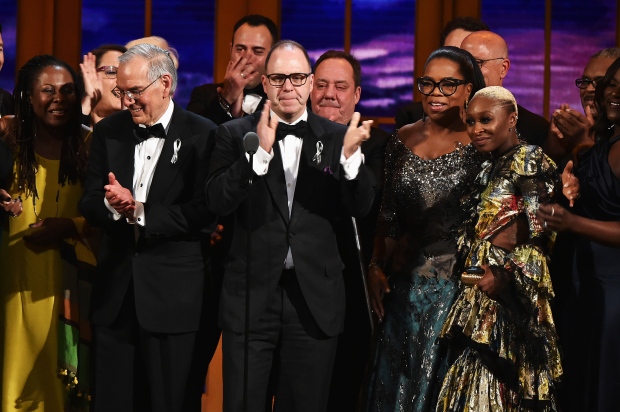
The cast of The Colour Purple accepts the award for Best Revival of a Musical onstage. (Getty Images for Tony Awards Productions)

Meanwhile, when it comes to diversity, the hip-hop history lesson is just the beginning. From Spring Awakening, where actors perform American Sign Language, to the Latin rhythms of the Gloria Estefan-inspired On Your Feet, Broadway is breaking boundaries and wooing new audiences. While Hollywood is busy arguing about who should direct the inevitable Hamilton movie, executives should be taking notes. Instead of playing it safe with familiar faces and bland remakes, shake things up. As Kevin Costner once said: “Build it and they will come.”

Source: Memo to the Oscars from the Tonys — this is what diversity looks like – Arts & Entertainment – CBC News

Apple’s WWDC 2016 onstage lineup was more diverse than it has ever been – Recode

Changing the public image:

Like virtually all of Silicon Valley, Apple is both extremely white and extremely male in its upper ranks. And for many years, it has been mostly white men onstage at Apple keynote events.

Last year, that began to change. And at today’s Worldwide Developers Conference, it changed some more.

Of the 10 people onstage at WWDC today, there were six men and four women, including one African-American woman. According to 2015 figures on Apple’s website, the company has a 70/30 gender split, and is 54 percent white, 18 percent Asian, 11 percent Hispanic and 8 percent black. At last year’s WWDC, there were two women onstage for the event.

The women onstage were Apple Music’s Bozoma Saint John, Apple Watch software exec Stacey Lysik, software engineering VP Cheryl Thomas and iOS software exec Bethany Bongiorno. Imran Chaudhri, on the Apple design team, was the one nonwhite guy. (Apple iTunes executive Eddy Cue — a regular presenter at Apple events, including today’s — is Cuban American.)

ICYMI: After Orlando, time to recognize that anti-gay bigotry is not religious freedom: Neil Macdonald

Good commentary by Macdonald:

A perfect example is Proposition 8, the California ballot initiative whose purpose was to block the advance of same-sex marriage, on the grounds that it would somehow harm or invalidate heterosexual marriage, and would result in schoolchildren being taught that gay sex is normal and acceptable.

Prop 8 proponents included the Roman Catholic Church, the Knights of Columbus, the California Catholic Conference of bishops, the Church of Jesus Christ of Latter Day Saints (the Mormons), the Union of Orthodox Jewish Organizations of America and assorted evangelical Christian groups. Together, they poured a fortune into the campaign. The Mormons alone provided $20 million.

They won, then immediately lost when the initiative was vacated by secular courts.

Since then, organized religions have continued their anti-gay activities, often going to court to ensure their right to discriminate against gays in hospitals and schools and other religiously affiliated institutions.

Yes, it is true that Pope Francis has softened his church’s line on homosexuality. But his tolerance is only remarkable in contrast to his hardline predecessor, and church doctrine remains unchanged.

It is also true that the Reform and to an extent the Conservative streams of Judaism have moderated their tone where gays are concerned.

Not so Islam. That religion remains largely hostile to gays, and anti-gay sentiment is woven into the laws of many Muslim countries.

Sheikh Farrokh Sekaleshfar, a British-born physician and imam, has spoken at public venues in the United States, softly and diffidently asserting that as a matter of compassion, homosexuals should be put to death.

There are many, many other sheikhs like Farrokh Sekaleshfar.

And while evangelical Christians don’t seek the death penalty for homosexuality, many do want it punished. In 2004, Dr. Richard Land, the Oxford-educated former president of the Ethics and Religious Liberty Commission of the Southern Baptist Convention, told me on camera he thought gay sex should be outlawed.

In any event, this much is singularly true: the worst mass murder in American history was directed at one group, and it was done by some one who had sworn allegiance to a fundamentalist religious group.

If casual misogyny and sexist humour helped create Marc Lépine, then organized religion must reflect on helping shape a culture that will this week have led to 50 funerals in Florida. It’s not just the extremists who want to deprive gays of human rights.

People of faith might ask themselves this: even if they’ve never so much as lifted a hand to a gay person, have they smiled at a homophobic joke? Or overlooked mistreatment? Or nodded during a anti-gay sermon?

And if so, wouldn’t this be a good time to speak up?

Britons ‘as French as Edith Piaf’ apply for citizenship over Brexit worries | Reuters

Not large numbers but interesting as people hedge their bets:

Twenty-nine year-old Briton Colette Taylor-Jones rushed to become French before the referendum that will decide whether Britain stays in the European Union or not.

“I decided to change my nationality when the whole ‘Brexit’ story started,” the book publisher told Reuters at the end of a ceremony organised by authorities for naturalized citizens.

Worried she might find herself an alien in the country she calls home, Taylor-Jones, who grew up in Nice, filled in the forms to become French when Britain’s Conservative Party promised to hold a referendum on EU membership if it won 2015 parliamentary elections.

Under EU rules, her British passport has so far guaranteed her the same rights to live and work in France as her French neighbours and she did not want to have to ask for a residency permit in case of Brexit, she said.

The latest polls ahead of the June 23 referendum show Britons are almost evenly split over whether to stay or go.

Some 279 Britons became French in 2014, the latest year for which data is available, with the numbers fluctuating between 205 and 354 per year in the five previous years, French Interior Ministry data shows.

Officials said they cannot provide data on how many have applied for a passport.

Twenty-eight year-old Jack McNeill, who has been living in France for six years, says he considers it home too. The prospect of having to ask for a residency permit or not being able to move freely around Europe if Britain left the EU pushed him to apply for a French passport.

McNeill, who is from Edinburgh and works at an international organization based in Paris, is now going through the paperwork and filling in the forms required for his citizenship request.

“What it means to be French is to adhere to the values of the country. ‘Liberté, égalité, fraternité’,” he said, referring to the French motto of freedom, equality and solidarity.

“That’s what it means and you can be from any ethnicity or your first language could be any other language but if you believe in these values and the importance of them, and the importance of preserving them and so on, then you are as French as anyone else, as Edith Piaf,” he said – while acknowledging he might not quite share the late singer’s musical skills.

Both Britain and France allow their nationals to hold dual citizenship and McNeill, speaking in a pub that sells fish and chips in the heart of Paris, said he still feels British too.

The French foreign ministry estimates that about 400,000 Britons live in France. There is no official data because they are not obliged to register.

Source: Britons ‘as French as Edith Piaf’ apply for citizenship over Brexit worries | Reuters