Not an easy political debate to have in the current mass migrant context:
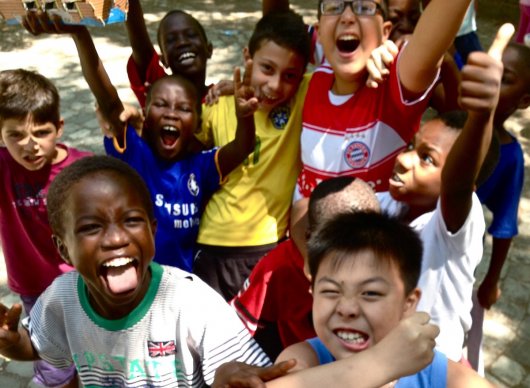
Fred Kuwornu, an Italian-Ghanaian director, has been waiting for years for this moment. In 2011, he made a documentary called 18 IUS SOLI. Screened at film festivals across the world, including Venice, it called for Italian citizenship to be made available to people born in Italy to foreign parents.
Now it’s more than cinema; the Italian Senate is debating this very possibility.
That’s if politics and the migrant crisis don’t get in the way.
Hundreds of thousands of people born in Italy to non-Italian parents could soon be eligible for citizenship if changes to the country’s nationality laws are passed.(www.ilprimatonazionale.it)
“The issue is very complex. I believe that today it is not possible to be just a citizen of the country your parents are from or where you were born,” Kuwornu tells Equal Times.
Currently, Italian citizenship is largely based on jus sanguinis which relates to having Italian ancestry.
According to the current law, No.91 of 1992, children born in Italy to non-Italian parents must apply for Italian nationality between their 18th and 19th birthdays. They can only apply if they have lived in Italy continuously for their whole life. Even in a country notorious for its lengthy bureaucratic practices, the process is particularly long and complicated.
The new ‘tempered’ law would base citizenship on the principle of jus soli (or the right to citizenship based on one’s place of birth) or on cultural participation (at least five years of education after the age of 12 in Italy) – jus culturae.
In accordance with jus soli, children born in Italy to non-EU citizens (one of whom has to have a resident’s permit) will be eligible for Italian citizenship.
A November 2015 report from the Ministry of Public Education revealed that there are more than 805,000 young people of school age born in Italy to foreign parents, although it is not clear whether all of these students would be eligible for citizenship under the new rules.
“The tempered jus soli seemed to be the best compromise. I do, however, hope that this law will be approved quickly,” says Kuwornu, whose documentary promoted legislative change through community screenings, discussions and cultural initiatives.
It may yet be some time before the law is passed, however. The Chamber of Deputies approved it on 13 October 2015 with 310 votes in favour, 66 votes against and 83 abstentions, but it still awaits a vote in the Senate, where lawmakers held a hearing on the subject on 30 March 2016.
Anti-immigrant sentiment
What complicates the process are elections – for the mayor of Rome on 5 June and other administrative balloting – amidst a certain amount of hostility towards the new law.
Against the backdrop of the migrant crisis, populist politicians across Europe have helped to stir anti-immigrant sentiment. In Italy, the Lega Nord (Northern League) has drawn thousands of protesters in their demonstrations against immigration.
Supporters fear that failure to passed the jus soli law now could add years of second-class citizenship for many second-generation immigrant youth.
The new law has also been criticised by pro-immigration groups that see it as less-inclusive compared to the ambitious 2011 campaign ‘I’m Italy too’ (L’ Italia sono Anch’ io), supported by many Italian associations.
An alternative positive example, albeit small-scale:
The news from Israel is often bad: attacks on Jews by young Palestinians and reprisals by Israeli forces. Expanding settlements in the West Bank. Escalating fear and hostility. Plummeting prospects for peace.
But a group of dedicated educators is working to bring the two sides together — not at the bargaining table, but in the school room.
“We’re giving hope where leaders have failed,” says Mohamad Marzouk, director of the community department for the bilingual and bicultural Hand in Hand schools.
“Fear and mistrust develops over years when people are separated,” he says. “A kindergarten child goes to an Arabic or Hebrew school and never experiences the existence of children on the other side. This ignorance of the other creates mistrust and fear.”
Marzouk and Rebecca Bardach, Hand in Hand’s director of resource development and strategy, are in Toronto on a speaking tour.
“Hand in Hand is my Iron Dome against hatred,” says Bardach, referring to Israel’s missile defence system. “I can’t change what is happening politically, or the minds of people who hate each other. But I believe we can overcome that sense of helplessness with understanding.”
Hand in Hand, boasting some 1,320 Jewish and Arab Israeli students, and a lengthy waiting list, was founded in 1998 with one school in Jerusalem. It has now expanded to six, from Jaffa to the Galilee. Arab Israelis make up 20 per cent of Israel’s 8.5 million population and many identify as Palestinian Israelis.
The security wall between Israel and the Palestinian territories — Israel’s “separation barrier” — is physically and psychologically divisive, says Bardach. But the two separate language streams of the Israeli school system are a “huge contributing factor” to mutual misunderstanding between Jews and Arab Israelis.
“Children aren’t growing up learning about differences, what we have in common and building common ground,” she says. Parents must make a choice that cuts their children off from one or the other group.
Not so in Hand in Hand schools, where children are taught by Hebrew and Arabic-speaking teachers.
They partner with children who speak the other language, and study together. They also learn the missing links in mainstream curriculums — the other’s religion, culture, food, daily life and history. Elements that allow them to see their counterparts as fellow humans rather than enemies.
Outside the classroom they play together at sports, picnic together and celebrate each other’s holidays.
They and their parents have weathered nearly two decades of anger, violence, war and political outbursts in the world around them, including a 2014 firebombing of the Jerusalem school by Jewish extremists.
That brought even more support for Hand in Hand, from the media, thousands of demonstrators, Israel’s President Reuven Rivlin and Jerusalem Mayor Nir Barkat.
The traumatic event shook parents and children. But they were helped through it by the school’s tradition of unflinching dialogue on the events around them, however painful. It held true even in the past two years, when Jewish parents were afraid to drive on main roads for fear of being attacked, and Palestinian parents feared gangs of extremists who targeted Arabs for beatings.
The success of the Hand in Hand community has led to expansion, but on a shoestring. Its $9 million-a-year budget is financed by the Israeli government and private donations. Scholarships are available, but fees are $1,200 a year. “Not easy to afford” in Israel, Bardach admits.
One reason why Mr. Obama’s Taliban-termination received hardly more attention than his other acts on Monday is because people increasingly feel like it doesn’t. The Taliban appointed another leader, its third. Al-Qaeda has sprung back to life. Some have likened decapitation policies to Whac-a-Mole games: Bash a bad guy, and another one springs up.
Boss-offing is not a mysterious topic: In recent years, an entire science of decapitation analysis has sprung up.
The most influential number-crunching was conducted in 2009 by Jenna Jordan, a researcher at the University of Chicago (she is now at Georgia Tech). She analyzed 298 incidents of “leadership targeting” over six decades and looked at their impact on the organizations whose leaders were the recipients of these abrupt terminations.
Her results were far from encouraging. Her data showed that decapitation, on average, “does not increase the likelihood of organizational collapse beyond a baseline rate of collapse for groups over time.”
In fact, the extremist groups most likely to fall apart (that is, to stop being able to commit attacks and wage war) are actually those whose leaders have not been killed: Hitting the head honcho actually seems to help groups keep fighting longer – perhaps because it rather literally injects some fresh blood into the organization.
More recent analyses have questioned these findings. Certain groups have indeed self-imploded following the untimely demise of their figurehead: Peru’s Shining Path faded into irrelevance after its leader Abimael Guzman was captured; Italy’s Red Brigades did not outlast its founding leaders; the capture of Abdullah Ocalan disempowered Turkey’s Kurdistan Workers’ Party for a decade.
In a big-data study last year, Bryan Price of the U.S. Military Academy analyzed 207 terrorist groups from 1970 to 2008, but instead of looking at their effectiveness, he examined their longevity.
He found that taking out the executives “significantly increases the mortality rate of terrorist groups, even after controlling for other factors” – but it often takes longer than we’d like. Counterterrorism, he concluded, is a long game. He also found that the groups most likely to implode after things blow up in the head office are nationalists. Groups that see themselves as religious, he found, are more tolerant of bloodbaths at the top. Of 53 religious groups, only 19 have ended – 16 of them after their boss was wiped out. But of the 34 such terrorist groups still in existence (including al-Qaeda and the Islamic State), 20 have endured a decapitation strike.
There are other good reasons to knock off the kingpins: Inspiring morale in your troops, hurting jihadi recruitment by looking all-powerful, sowing moments of chaos that can be exploited. But there’s no reason to think they’ll make the fight any easier, or the world less bloody.

 Multicultural Meanderings