It Is Time To Redefine Canada’s Vertical Mosaic | Jack Jedwab
2016/06/25 Leave a comment
Interesting article by Jedwab on the ‘vertical mosaic,’ teasing with a brief discussion of cultural factors but not following up with any information about individual group disparities.
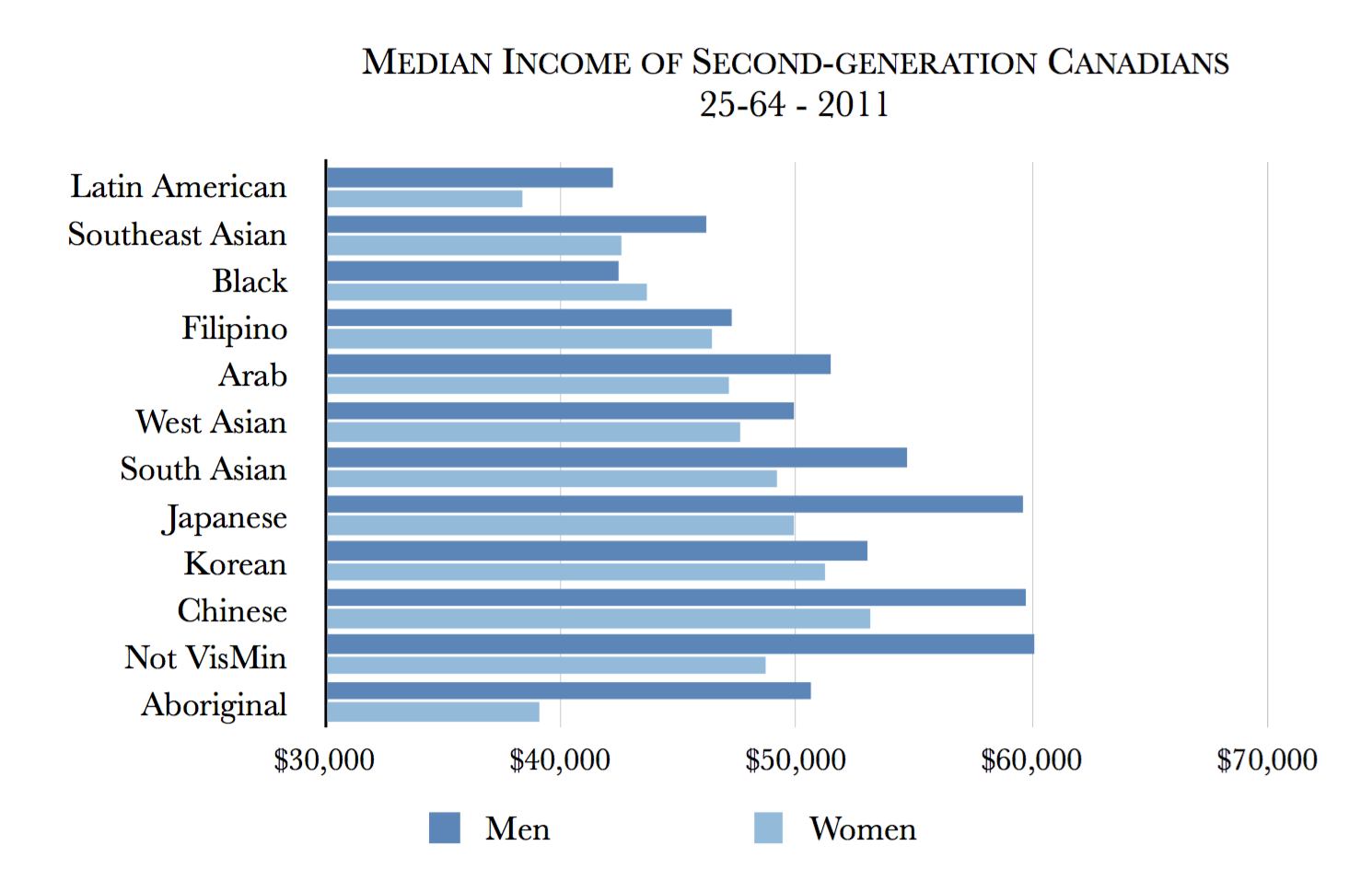
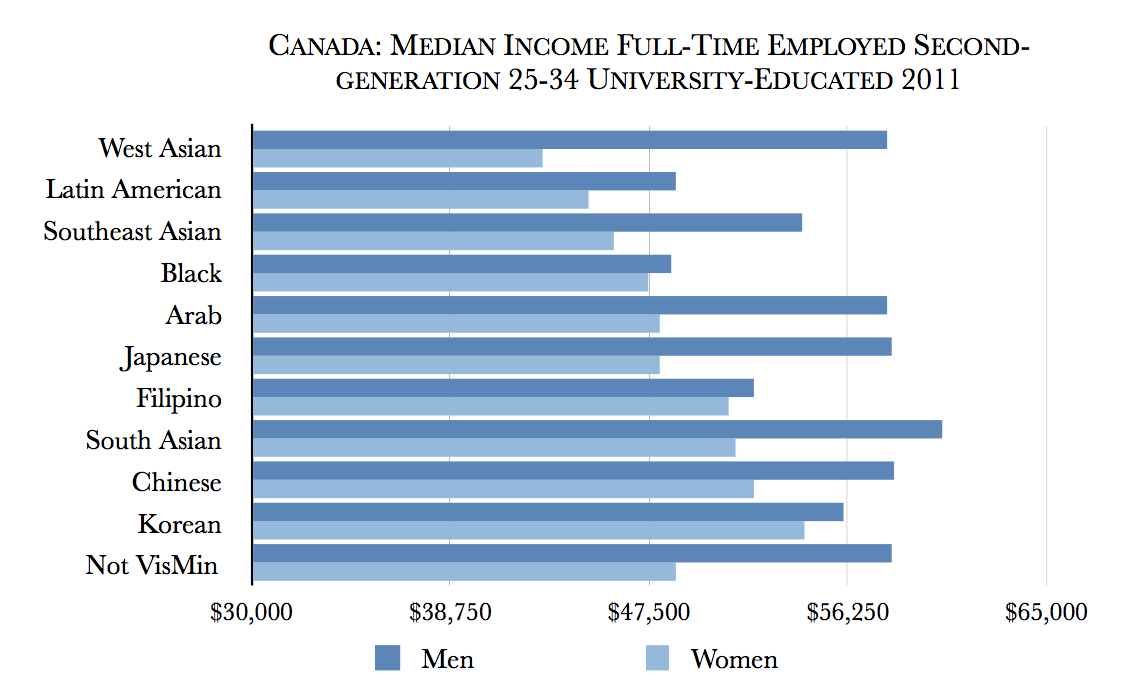
The two charts below, taken from INSERT, indicate the persistence of income differences in second-generation immigrants, both more generally and the university-educated young.
For all second-generation, the disparities with non-visible minorities and among different visible minorities groups are greater.
While for most groups, median incomes for the university-educated are broadly comparable to non-visible minorities, that is less the case for Latin American and Black Canadian men.
The redefinition of the ‘vertical mosaic’ needs to look more at both the overall and the group differences to assess the ongoing impact of external bias and discrimination along with any internal cultural factors and preferences that may also contribute to these disparities:
Porter made several significant observations about the economic inequality between people of British and French origins and “others” (what he called “minority ethnics”). Porter carefully documented the French population’s lower-income status and disagreed that their situation could be blamed entirely upon the British desire for economic dominance. He insisted that French-Canadian under-representation in the country’s economic elite was as much related to their values as it was to cultural discrimination.
A major part of the problem in French Canada was the dominance of the Catholic Church, which Porter felt reinforced cultural difference, encouraged separateness and diminished educational opportunity. Much has changed since the 1960s with the onset of Quebec’s Quiet Revolution and the ensuing rise to relative economic parity between French and English Canadians. Regrettably Porter said relatively little about the condition of indigenous peoples in Canada’s class structure, a persistent concern that 50 years later still badly needs national attention.
Porter was persuaded that persistent minority ethnic attachments were the principal obstacle to immigrant and minority economic advancement. This conviction was central to his ultimate objection to multiculturalism adopted by the Trudeau Liberal government in 1971. If the Canadian mosaic was vertical, Porter largely blamed it on the encouragement that multiculturalism offered to newcomers and their descendants to retain their ancestral identities. Most European origin post-war immigrants and their children would probably disagree with Porter’s assessment of multiculturalism as constituting such an obstacle.
Canada is now a much larger and more ethnically diverse country than the one Porter studied in 1965. The 1961 census reported that there were approximately 18.5 million Canadians compared with nearly 34 million in 2011.
Prior to the 1970s, immigrants from European countries accounted for over three-quarters of those coming to Canada. For many European origin groups, the story of their place in the vertical mosaic over the past fifty years ended up being one of noteworthy upward mobility. The groups that Porter saw as being locked into some lower status (Ukrainians, Italians, Poles, Finns and Czechs and Slovaks) have generally moved up the socio-economic ranks. The children of Southern and Eastern European immigrants who came to Canada in the late 1940s and 1950s are in retired age and, for the most part, they witnessed the erosion of the ethnically defined barriers to economic mobility.
Today, over three-quarters of immigrants to Canada hail from non-European countries and are defined as visible minorities. The growth in the visible minority population has seemingly changed the nature of the vertical mosaic and the portrait of inequality in Canada. The question that preoccupies researchers is whether the upward mobility experienced by most European origin groups can be replicated by non-European immigrants and their children. Several analysts are decidedly pessimistic about such prospects and argue that “race” has replaced ethnicity as the new dividing line within the Canadian mosaic.
But there are some important caveats to keep in mind when making observations about the economic dream of recent newcomers to Canada. Unlike the post-war immigrants that often came to the country with little formal education, most recent arrivals are a highly educated bunch. Data from Canada’s 2011 national household survey reveal that immigrants that arrived in Canada between 2001 and 2009 were twice as likely to have a university degree as a person born in Canada. Hence in most cases newcomer expectations for their own personal success is higher than was the case for the immigrants in the era Porter documented. While many newcomers want their children to do better than them, an increasing number will be satisfied if they do as well. That’s also a concern for many non-immigrants.
The contemporary version of the Canadian dream for many of us is perhaps more modest. It’s something akin to owning a home and staying out of debt (these two things may seem contradictory to many Canadians).
Recently, the earning power of many university degrees has stagnated. According to Statistics Canada’s 2012 Survey of Financial Security, student debt rose by 44.1 per cent from 1999 to 2012, or 24.4 per cent between 2005 and 2012. So too has the cost of owning a home in Canada. In the final quarter of 2015 Statistics Canada reported that the ratio of household credit-market debt to disposable income, the key measure of the debt load, rose to 165.4 per cent.
Sure interest rates are at record lows and there is fear that a slight rate hike will make the dream of personal debt reduction more elusive. The gap between the highest paid Canadians and others has widened in recent years. The wealthiest 20 per cent of Canadians hold 70 per cent of the country’s wealth.
Source: It Is Time To Redefine Canada’s Vertical Mosaic | Jack Jedwab
 About Andrew
 Multicultural Meanderings