Stephen Gordon: The damage the Tories did with the census won’t be easily undone

Stephen Gordon on the possible long-term damage to the Census:

The census is only useful if (approximately) everyone co-operates. The same goes for lots of other things: carpool lanes, anti-littering bylaws and jury duty, to name three. The nature of collective action problems is that it’s never in one’s individual rational interest to take part in the solution; it’s better to simply free ride off the efforts of others. This is why one of the core tasks of government is to enforce participation — and this means imposing penalties for not co-operating.

This is where social capital comes in — or social trust, or social cohesion, or whatever you want to call it. It’s not feasible to governments to micromanage their citizens and enforce their co-operation in their daily activities, even if they wanted to. To a very great extent, the smooth functioning of society relies not on government enforcement, but on people’s willingness to go along with the rules, so long as they believe that everyone else is obeying them as well. Everything depends on a willingness to trust strangers, and to reward their trust in you.

It’s worth dwelling on this point, because one of the most debilitating consequences of the Conservatives’ time in office has been the creation of a constituency for whom the census is now a highly-politicized symbol, instead of being a neutral instrument for good governance. While the government can force co-operation, this isn’t the same as restoring mutual trust.

You can’t expect people to take your concerns seriously if you won’t do the same for them. To the extent that their concerns are about privacy, the most promising way of restoring that lost trust is to demonstrate the extent to which concerns about privacy are taken seriously, and to show some flexibility on the details. For example, questions about religion have been dropped from this year’s census questionnaire.

Social capital is difficult to build, and easy to destroy. The former Conservative government demolished a big chunk of our social capital when it blew up the census, and it will take time and effort to restore it. Posting selfies with census forms can’t hurt, and just might help.

Source: Stephen Gordon: The damage the Tories did with the census won’t be easily undone | National Post
Justice system can’t wait for judicial appointments review, say judges

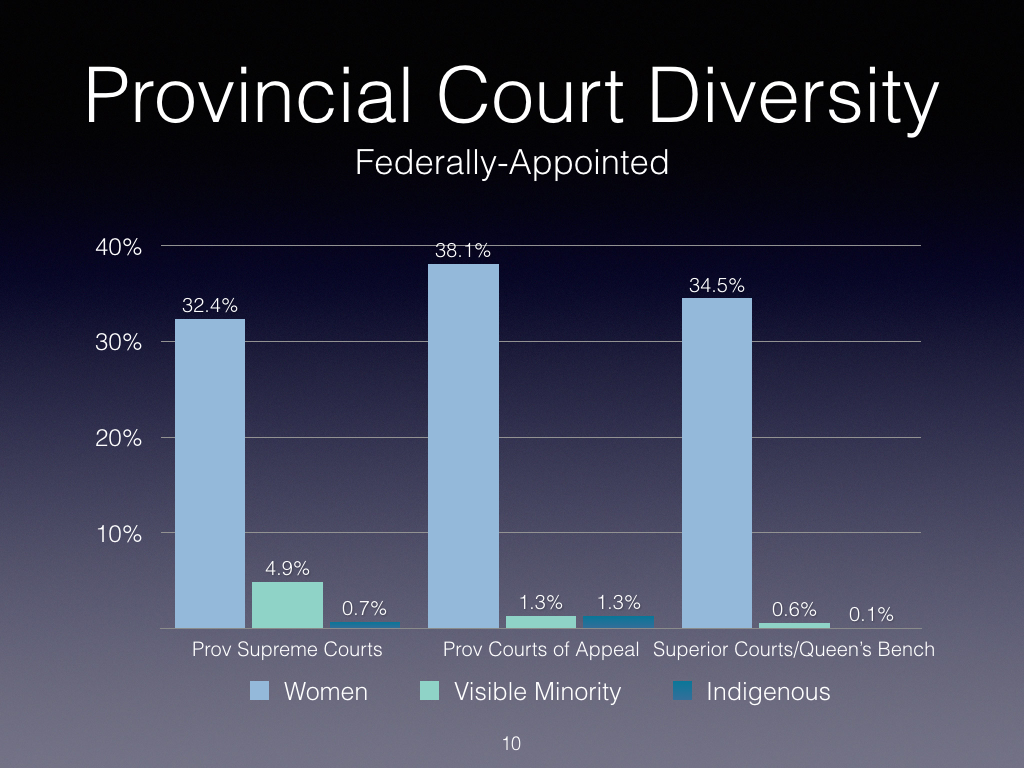
Judicial Diversity 2016 - DRAFT.010The fine balance of doing a review – generally a good idea to ensure comfort with the process and alignment with governmental priorities – and the operational requirements of filling positions (see my analysis of current judicial diversity Diversity among federal and provincial judges):

Since being appointed justice minister and attorney general six months ago, Jody Wilson-Raybould has not appointed a single judge. There are at least 46 vacant seats on the bench of federally-appointed superior courts, with British Columbia and Alberta each short 10 judges.

In addition, every judicial advisory committee from Toronto to Newfoundland and Labrador was disbanded last fall when their terms expired. Judicial advisory committees assess the qualifications and merits of those who apply to be a judge and recommend applicants to the minister.

“It would be much better to continue those committees until they’re replaced. That would be a fairly simple situation to an unacceptable hiatus,” Wittmann told CBC News.

Appointments to JACs and the bench are made by the minister in close collaboration and consultation with his or her judicial affairs adviser — a crucial role that has also not yet been filled.

“The minister is working to staff this position as soon as possible,” said Michael Davis, director of communications for Wilson-Raybould, in response to several inquiries by CBC News.

Lorne Sossin, dean of law at York University’s Osgoode Hall, calls that surprising and concerning.

“It’s not an emergency in the way a forest fire or a flood is, but it is building to that point that it’s creating really negative consequences on the ground,” said Sossin. “If you have those vacancies for so long a period of time, it’s again putting extra stress and strain on those who are in the system. It creates backlogs and access-to-justice concerns.”

Wilson-Raybould is, without a doubt, among the busiest cabinet ministers. Prime Minister Justin Trudeau gave her a lead role on several important and pressing files, such as legislation to permit physician-assisted dying, a federal inquiry into murdered and missing indigenous women and legalizing marijuana.

“So, there’s lots of different priorities but I don’t think those are any excuses to not have a timely set of benchmarks being met on something as critical as judicial appointments,” said Sossin.

Judicial appointments process under review

According to the minister’s office, the hold up is an overall review of the judicial appointments process.

“A review of the entire judicial appointments process is ongoing, based on principles of openness, transparency, merit, and diversity. The minister is committed to achieving a greater degree of diversity within the Canadian judiciary, so that it will come to truly reflect the face of Canada,” her office said in a statement.

Judicial advisory committees are also subject to that review. CBC News asked her office whether Wilson-Raybould is interested in tinkering with the makeup of the councils, as the previous government changed the rules to require each committee to have a representative with a background in policing.

“(The minister is) aware of the need to get the Judicial Advisory Committees up and running in a timely manner. However, it is important to ensure that this is done in a considered way, given the important role these committees play,” her office said.

‘What should happen is some appointments ought to be made by the executive branch of government. That’s their job.’-Alberta Court of Queen’s Bench Chief Justice Neil Wittmann

“I regret there is nothing we can add as processes are under review at the moment,” Davis added later, when asked for an update on the process so far, including the mandate, scope and timeline for completion.

But Chief Justice Wittmann isn’t so sure.

“I’m not aware of a review actually occurring. I’m aware of the minister’s position that she wants a review to occur,” he said.

Source: Justice system can’t wait for judicial appointments review, say judges – Politics – CBC News

Chinese real estate investors are reshaping the market

Good long-read in Maclean’s on the impact of Chinese investors and immigrants in the Vancouver, Toronto and other real estate markets. Most interesting point for me was that Chinese Canadians, equally affected by rising housing prices, are participating more in the debates:

Last November, the 38-year-old lawyer and former head of the B.C. Civil Liberties Association helped Andy Yan, acting director of SFU’s City Program, with his headline-grabbing study on home buying in Eby’s West Side riding. In addition to the incendiary data involving Chinese names, the study revealed that 36 per cent of owners on homes worth an average of $3.05 million listed their occupations as housewives or students with little or no income. Fully 18 per cent of the 172 homes purchased were not mortgaged by banks. That means on Vancouver’s West Side alone over a six-month period last year, roughly $100 million in cash came pouring into Canada, almost all of it from China. Yet the homeowners would in all likelihood pay little or no income tax. The total value of all homes sold in the study period topped a half-billion dollars.

Predictably, when Yan’s study was published, a chorus of voices, including former developer Bob Ransford, jumped to criticize Yan: “The danger is intolerance, racism, singling out certain groups of people saying they’re to blame for this,” said Ransford. But such labels have failed to muffle the debate, particularly as more and more Chinese-Canadian voices have begun calling out white developers and academics for making the claim. Fung, the software engineer, says he’s among those “deeply pissed off” by what he considers a slur: “The only people claiming racism are white Anglo-Saxon males—that’s it. These are the same guys trying to label Andy Yan—whose grandparents paid the head tax—a racist? It’s absurd.”

That sentiment is shared by Ian Young, the South China Morning Post’s Vancouver correspondent and author of the popular Hongcouver blog. Young, who is ethnically Chinese and was raised in Australia and Hong Kong, says the issue is one of money, not of race. “What defines those people in terms of their behaviour here in Vancouver, and in terms of their impact on affordability, is not their ‘Chineseness,’ it’s their ‘millionaireness,’ ” he says. “The idea that there is commonality to be found in the Chineseness—I find that kind of insulting. Why would you think that someone was better defined by the colour of their skin than the colour of their money?”

This is why Fung believes it is so vitally important for Chinese-Canadian voices to encourage a debate over the impact of foreign investment on the local market. “Chinese people have a tendency to be a little quiet, we tend to want to not create ripples—culturally it’s something we’re not comfortable with.”

Source: Chinese real estate investors are reshaping the market

Methods For Reforming Neo-Nazis Help Fight The Radicalization Of Muslims

More on Hayat-Germany and some of the similar counter-radicalization approaches:

Hayat-Germany grew out of a program called Exit-Deutschland, which targeted neo-Nazis and right-wing extremists, groups that German authorities have been working to deradicalize and fold back into Germany society for years. Berczk says the Hayat program is premised on the belief that the lessons from working with right-wing extremist programs can be applied to radical Islamists as well.

“There is a commonality between extremist ideologies,” she says. “But also if we are talking about sects and cults, there are certain things that all these groups have in common.”

That’s good news because it means authorities can mine their long experience with neo-Nazis and apply it to the relatively new problem they face with ISIS now. Of course, each case is different, which is what makes deradicalization complicated.

But in a general way, Hayat-Germany says the key component in these programs is family. Studies have shown that by strengthen family ties, parents and siblings end up providing the support young people were missing and subsequently sought and found in extremist groups.

Among other things, Hayat counsels the families to avoid confrontation when they are trying to convince relatives to come back from Syria. Recruiters in the jihadist camps tell new arrivals that conflict with their families is inevitable. They warn them that if they reach out to those they have left at home, they’ll be chastised and ordered to return.

The problem with their families, the recruiters say, is they just don’t understand ISIS followers and the depth of their faith. If families get angry — even if it comes from worry — this plays right into the recruiters’ hands.

That’s why Hayat tells parents not to demand a return, but instead to suggest their relatives leave Syria and settle in a third country, far away from the battlefield, and start a family and a new life. Once the young people are out from under ISIS’ spell, families have a better chance of convincing them eventually to come home. Strategies to make this happen come from counselors at Hayat.

Quintan Wiktorowicz, an academic who did field studies on radicalization in Jordan and the U.K., now runs Affinis Labs, which tries to use innovation and entrepreneurship to solve community problems like radicalization. He was responsible for engagement programs at the White House and developed counter-radicalization initiatives for the State Department. He says Hayat’s remedies — from hotlines people can call to engaging the families of radicalized youth in counseling sessions — are strategies that have been effective across ideologies.

“Although there are different pathways to radicalization and the ideologies vary across extremists groups, the underlying drivers are very similar,” he said.

The drivers usually come in three parts: an extreme level of frustration, a sense of powerlessness and exposure to an ideology that not only resonates emotionally, but also offers a solution to the frustration.

“The mechanics, whether you are a right-wing extremist or embracing ISIS, are very similar,” he says.

Source: Methods For Reforming Neo-Nazis Help Fight The Radicalization Of Muslims : Parallels : NPR

Canadian universities fail to meet diversity hiring targets

Another program likely to be examined in the context of  the diversity and inclusion agenda, as Minister Duncan has indicated:

The Canada Research Chairs program – one of the country’s premier tools to attract and retain top academic talent – has failed to meet its own targets for the hiring of women, visible minorities, people with disabilities and indigenous Canadians, and the federal program’s steering committee says it is urging universities to meet their equity goals.

In a letter sent to university presidents last month, the head of the committee said its members are concerned about the “very slow progress” that has been made on diversity among the 1,880 regular chairs.

“We are calling on you and your colleagues to sustain and intensify your efforts, in order to address, as soon as possible, the under-representation of individuals from the four designated groups within the program,” wrote Ted Hewitt, president of the Social Sciences and Humanities Research Council, one of three agencies with representatives on the committee.

Federal Science Minister Kirsty Duncan, who had a long career in academia before entering politics, says she ordered a review of the program and is taking the equity issue “enormously seriously.”

“I have spent the last 25 years of my life fighting so that young women wouldn’t face the same challenges I did,” she said.

Targets are set based on an estimate of how many people that belong to each group are in the pool of eligible academics. For women, the target was 30.6 per cent, but only 28.9 per cent of research chairs were female; the number of chairs who identified as being a member of a visible minority was 13.1 per cent, against a target of 15 per cent; indigenous scholars made up 0.95 per cent of the program, compared with a goal of 1 per cent; and persons with disabilities had only 0.59 per cent representation, although the target was 4 per cent.

Universities’ compliance varies widely across the country, and can differ slightly from year to year as scholars move among institutions. Of the top 15 research universities in Canada, most met two of four targets, with the University of British Columbia and Queen’s University meeting three. The University of Calgary and the University of Ottawa met none of their four targets.

Dalhousie and the University of Montreal could not provide figures upon request. All schools said the designations are self-reported and, for that reason, identification among the equity categories may not be complete.

Source: Canadian universities fail to meet diversity hiring targets – The Globe and Mail

Creation of ombud’s office urged to tackle immigration snafus

Not sure that adding another layer is necessarily the best approach compared to reviewing the overall processing system and making adjustments as necessary:

….These cases are problems critics say an ombudsman at the immigration department could easily fix, saving taxpayers money for reprocessing and potential litigation, and immigration applicants the agony of having their lives thrown into disarray.

“These are the majority of problems people have day-to-day that could be resolved if there is the will to cut through the red tape,” said Toronto immigration lawyer Raoul Boulakia.

“Immigration cases are expensive to litigate. In some cases, the court would not intervene and the process takes so long. Having an ombudsman’s office would be terrific.”

The idea of establishing a public complaints office at Immigration, Refugees and Citizenship Canada has been floating around for years but never got traction because of the lack of organized efforts among applicants and Ottawa’s short-sighted arrogance to cater to foreign nationals with no voting power.

However, with the new Liberal government’s emphasis on transparency and accountability, critics say an ombudsman could aptly look at these systemic challenges and find solutions.

While Immigration Minister John McCallum agreed that “obviously there is enormous room for improvement” for his department’s service delivery, he is noncommittal to the idea.

“That’s what a lot of my job is about. We are trying to reduce processing times and improve services. The idea of an ombudsman is an interesting idea, but it might be a little bit duplicating of what my office and I are trying to do, and it would add costs. Our objective is similar,” he told the Star.

“If having an ombudsman would assist that task, I would consider it … if it’s value-added. Right now, people can go to their MPs, the MPs might bring it to me and we work on it. We certainly spend a huge amount of time dealing with these problems and cases trying to get the best outcomes.”

The Public Service Alliance of Canada, the union that represents the 5,000 immigration department employees, said frontline services have suffered after 10 years of cuts — staffing was down by 5.3 per cent while workload increased — under the previous government. That led to minimum service and sometimes tainted decision-making, the union said.

“Our members are caught between a lack of resources and instructions. They are being told you have two minutes to respond to a phone call, basically. That’s not worthy of client service in our mind,” said Chris Aylward, national executive vice-president of the union.

“It is nice for the minister to say he’s all for increasing the service and service delivery, but in order to increase service delivery, you have to make sure the resources, tools and training are there.”

The union is all for the establishment of an impartial office if it serves both the clients and its members instead of creating an additional administrative burden and more work under existing resources, Aylward added.

Queen’s University professor Sharry Aiken, who specializes in migrant law and policy, said an ombudsman could best handle administrative issues that emerge in application processing as a result of “misunderstanding, poor representation and human error” that could easily be fixed.

Currently, members of parliament are overwhelmed by constituents’ requests for assistance on immigration files for relatives and friends looking for updates on applications, and immigration cases are inundating the court system and tribunals.

Aiken said the cost of setting up a well-equipped ombudsman’s office at the immigration department could easily be offset by the savings in resources in other jurisdictions and improved operational efficiency. Meanwhile, the courts and tribunals should still handle cases involving errors in law, she added.

“The office would need the authority and resources to deal with these cases and circumstances,” said Aiken, who co-chairs the Canadian Council for Refugees’ legal affairs team. She said the danger of setting up an ombud’s office without proper resources is it would get swamped and couldn’t investigate complaints in-depth.

Source: Creation of ombud’s office urged to tackle immigration snafus | Toronto Star

Not enough resources for Syrian refugees in Canada: poll

Encouraging high level of overall support despite funding concerns:

Canadians generally support the Liberal government’s response to the Syrian refugee crisis, but many think there are not enough resources in communities to support their resettlement, according to a new Nanos Research/Globe and Mail poll.

The poll of 1,000 Canadians found that 68 per cent support or somewhat support the government’s overall response to the Syrian refugee crisis, while 30 per cent oppose or somewhat oppose it. The government has resettled nearly 27,000 Syrian refugees since December of last year, with plans of welcoming thousands more throughout 2016.

“Canadians have given the Trudeau government a green light on this Syrian refugee crisis,” said pollster Nik Nanos. “The one thing that they are concerned about is whether we have the necessary resources to resettle these refugees in our communities.”

When asked if communities have all of the resources they need, such as housing, language training or social services, to resettle Syrian refugees, 61 per cent of Canadians disagreed or somewhat disagreed. On the other hand, 33 per cent agreed or somewhat agreed.

Chris Friesen, settlement services director of the Immigrant Services Society of B.C., said he was not surprised by Canadians’ concerns about the lack of settlement resources at the local level.

“Here in British Columbia for example, we’ve had over the past two years a 15-per-cent cut in the immigrant settlement and language program funding,” said Mr. Friesen. “The types of programs and supports we are seeing that are in short supply range from settlement-informed trauma support programs, a diversity of language programs, [and] additional children and youth programming.”

Mr. Friesen said there is a particular need for youth support, as close to 60 per cent of recently arrived Syrian refugees are under the age of 18. He said many Syrians also have medical issues – physical and mental, including post-traumatic stress disorder – stemming from their experiences during the conflict that require support.

Previous housing problems appear to be nearly solved. For instance, Mr. Friesen said his organization knows of about only six or seven Syrian refugee families still in hotels. During the height of the government’s efforts to resettle 25,000 Syrians before the end of February, Toronto, Ottawa and Vancouver asked the government to stop sending more refugees there for a few days as they struggled to house the large number of people who had already arrived. As of this week, 97 per cent of government-assisted Syrian refugees had moved into permanent housing, according to a government official.

The official said refugees are using the government services available to them. For instance, language assessments have been done for close to 80 per cent of Syrian resettlement clients over the age of 18, and 34 per cent of those assessed have begun language training.

Settlement funding will be increasing for all jurisdictions this year, the official also said. In addition to a base settlement fund of $588.6-million this fiscal year (outside of Quebec), the federal government has provided $38.6-million as a supplement to help deal with the arrival of the Syrian refugees and will kick in another $19.3-million through the budget, for a total of $646.5-million.

Source: Not enough resources for Syrian refugees in Canada: poll – The Globe and Mail

La situation démographique avive les enjeux de l’immigration au Québec

Good overview of Quebec demographics and the some of the challenges to its immigration policies:

Alors que le taux de fécondité poursuit son déclin et que le vieillissement de la population s’accentue au Québec, l’enjeu de l’accueil des immigrants est placé à l’avant-plan, suscitant des débats sur l’économie, l’identité, la culture et la langue dans la province.

L’Institut de la statistique du Québec (ISQ) a annoncé à la fin du mois dernier que l’indice synthétique de fécondité s’était établi à 1,6 enfant par femme en 2015 – une baisse de 1 % par rapport au niveau de 2014 -, marquant un recul pour la sixième année consécutive.

Bien que ce chiffre ne semble pas anormalement bas, la province doit aussi tenir compte du vieillissement de la population et du manque de main-d’oeuvre qualifiée.

Québec estime qu’environ 1,1 million de travailleurs auront pris leur retraite entre 2013 et 2022, et selon un document récemment publié par le ministère de l’Immigration, cette situation «souligne la nécessité de réaffirmer le rôle de l’immigration et de sa contribution au Québec».

Cependant, les immigrants ne sont pas répartis équitablement partout dans la province. Selon Statistique Canada, d’ici 2031, les minorités visibles représenteront 31 % de la population de Montréal, mais pas plus de 5 % ailleurs au Québec.

Le démographe de l’Université de Montréal Marc Termote se dit «très, très inquiet» des divisions culturelles et linguistiques entre la métropole et le reste des municipalités québécoises.

«C’est une cassure vraiment profonde entre Montréal et le reste du Québec», a-t-il constaté.

Il a cité l’exemple de Brossard, en banlieue sud de Montréal, qui abrite plus d’immigrants que Québec, la capitale et la deuxième ville la plus populeuse de la province.

M. Termote s’est par ailleurs désolé que tous les gouvernements répandent le «mythe» voulant que l’augmentation des niveaux d’immigration aide à combler le manque de main-d’oeuvre.

«Toutes les études montrent que l’impact économique de l’immigration est nul», a-t-il soutenu.

«Il y aura des pénuries, mais ce seront des pénuries très ponctuelles, dans des secteurs bien spécifiques. Et ce n’est pas en ajoutant 10 000 immigrants de plus qu’on va régler cette pénurie-là. (…) Ce n’est pas par une politique générale qu’on règle le problème», a-t-il ajouté.

Montréal a du mal à intégrer les immigrants qu’elle a déjà accueillis, alors que le taux de chômage pour les résidants nés à l’extérieur du pays se situe à 11 %, comparativement à sept pour cent pour ceux qui sont nés au Canada.

Par rapport aux autres provinces, le Québec contrôle davantage ses politiques d’immigration. La province sélectionne ses immigrants en fonction de la langue; 61,3 % des immigrants arrivés entre 2010 et 2014 étaient francophones.

Cette politique aide à préserver le caractère distinctif du Québec, mais elle crée également des tensions, selon M. Termote.

«Le bassin d’immigration francophone, ce n’est pas la France, la Belgique ou la Suisse francophone. Le bassin francophone, c’est essentiellement l’Afrique francophone – l’Afrique subsaharienne et le Maghreb -, ce qui a des implications (culturelles)», a-t-il indiqué.

Mais il y a aussi des conséquences politiques, a souligné Daniel Weinstock, directeur de l’Institut de recherche sur les politiques sociales et de santé de McGill.

Selon M. Weinstock, la province est témoin d’un «évidemment» de la position nationaliste modérée sur l’immigration et la diversité qui avait caractérisé les discours politiques dans la province, depuis les années 1960 et au temps de René Lévesque.

Il y a une forte division entre le gouvernement libéral, qui souhaite augmenter les niveaux d’immigration à 60 000 personnes par année et les sélectionner selon leur potentiel économique, et l’opposition, qui s’inquiète de leur intégration dans la province.

«Il y avait une sorte de consensus à l’idée que le Québec est une société immigrante, une société francophone et qu’être un citoyen québécois signifiait l’acceptation de ce contrat», a-t-il expliqué.

Ce discours change, dit-il, puisque désormais, certains Québécois veulent aller plus loin que de protéger la langue, ils veulent «protéger tous les aspects de la culture québécoise que certains immigrants, même s’ils parlent français, ne partagent pas».

Source: La situation démographique avive les enjeux de l’immigration au Québec | Giuseppe Valiante | National

Denouncing Queen invalidates citizenship oath

Some still think we are a British colony, unaware of the Statute of Westminster and the repatriation of the Constitution?

In hearing that Srabon Salim was able to send a letter not acknowledging the Queen minutes after the Oath of Citizenship is not Canadian. As such it breaks the contract between that person and Canada therefore rebuking their citizenship.

Whether people like it or not we are a British colony.

If you are able to make a promise when you know that you are going to dismiss the promise immediately after, is that not the same as lying under oath? If people were to do that in a court room would it not make all of our testimonies potentially false?

There is also another part of the Oath that says “I will faithfully observe the laws of Canada and fulfill my duties as a Canadian citizen.”

If people are able to break the oath would they not be able to then say they don’t recognize Canadian laws and follow their own laws or the laws of the country they came from.

If someone does not want to observe our Queen why would they choose to live here? It is of my opinion that as long as we are a British colony, and if someone says in an Oath; “be faithful and bear true allegiance to her Majesty” they should not be able to denounce it, or as said before the contract is broken and they are no longer a Citizen of Canada.

Source: Denouncing Queen invalidates citizenship oath

Giving a Name, and Dignity, to a Disability – The New York Times

Interesting account of the evolution of terms for those with intellectual disabilities:

OTHER organizations and state agencies have done the same, most of them joining the medical and scientific communities in adopting the term now in favor: intellectual disability.

Dr. Wehmeyer said the change made an important break from the connotations of past terminology. “It’s the first term that doesn’t refer to the condition as a defective mental process — slow, weak, feeble,” he said. “Intellectual disability conveys that it is not a problem within a person, but a lack of fit between that person’s capacities and the demands of the environment in which the person is functioning.”

But even Dr. Wehmeyer did not immediately care for the term (“I would have gone with cognitive disability,” he said). And not everyone embraces what is called people-first language — as in “people with intellectual disability.” Advocates in the blind and deaf communities, for example, argue that such constructions are unnecessarily defensive and hinting of shame.

The question now is whether “intellectual disability” will remain the preference, or, like its predecessors, devolve into a derogatory taunt. The answer seems to hinge on society’s ability to shed its prejudices and move past that stigmatizing sense of otherness.

One of the men I wrote about, Keith Brown, lived for many years in Texas institutions before working for more than three decades in that turkey-processing plant in Iowa. His job was to “pull crop” — that is, to yank out part of the digestive systems of dead birds swinging past on shackles.

When he and the other men were finally removed from their squalid schoolhouse dormitory in 2009, after repeated failures of government officials to heed warnings, Mr. Brown was found to have suffered significant physical and emotional consequences, including post-traumatic stress.

Today he is the sole resident of an apartment in Arkansas. He is a commuter, a palette-jack operator, a pet owner, a Dr Pepper drinker, a brother, an uncle. He is many things, he says, “but I am not retarded.”

Source: Giving a Name, and Dignity, to a Disability – The New York Times