Citizenship and Immigration Canada finds passport lost for 13 years

Fortunately, a very rare occurrence, but why should it have taken so long, and why were previous MPs not able to ‘encourage’ officials to find it?

A woman whose passport was lost in the depths of a federal department for over a decade is finally on her way to becoming a permanent resident.

“It has cost us so much heartache,” said Janina Ibarra. “I haven’t seen my mother in 11 years and I have not been able to go back.”

Ibarra came to Canada 17 years ago from Sri Lanka, which was in the midst of a civil war at the time. She says she had hoped to stay as a refugee.

Before her refugee case was settled, Ibarra met and married a Canadian citizen, and he applied to sponsor her for permanent residency status.

As part of that process, 13 years ago Sri Lanka sent her passport to Citizenship and Immigration Canada — but it went missing, leaving her with no official residency status in Canada.

Ibarra says for the past two years she has been under a deportation order she was told could be enforced at any time, which would mean leaving behind her husband and their two children.

The situation put her and her family in a precarious position — emotionally and financially — leaving them to rely on their community for support.

“There were times we would have money thrown in our mail slot,” she said. “At the end of the day it really was the benevolence of our church and church friends.”

Note buried in file

After the federal election last fall, Ibarra decided to ask her new MP Harjit Sajjan for help.

She got the answer she was hoping within three weeks. Buried in a half-metre-tall file was a note that said the passport had been archived by the government at least five years ago, if not longer, and where to find it.

Ibarra’s sponsorship application is on track for the first time since 1999. She says she hopes to have her permanent residency by late summer.

In the meantime, she’s looking for answers from the federal government for the years of her life she feels were put on hold waiting for her paperwork to get processed.

Source: Citizenship and Immigration Canada finds passport lost for 13 years – British Columbia – CBC News

Overshadowed by Islam: minority religions in Switzerland – SWI

Would have been helpful to have numbers for the other religions but nevertheless interesting:

Whether the issue concerns school, the workplace or the public domain, Islam monopolises debates on religion and integration of foreigners in Switzerland. The Islamic headscarf, prayer halls in schools, the practice of Ramadan, and separate areas in cemeteries for Muslims are recurrent topics of discussion in Swiss politics and public opinion.

While the attention may be justified by the international context and by the number of Muslims in Switzerland – they now represent 5% of the population – experts say it would be a mistake to ignore the fact that the religious environment in Switzerland today is very diverse. In addition Catholic and Protestant majority faiths, there are Jews, Buddhists, Hindu, Sikhs and Orthodox Christians, to mention just a few.

“In the media they are often ignored. There is talk about them only when something happens,” notes Martin Baumann, professor of religious studies at the University of Lucerne. He gives the example of the Hindu community in his city. “They [came under] some scrutiny in 2012 when, for the first time in Switzerland, they got the authorisation to sprinkle the ashes of their dead in the river Reuss.”

For Alexandre Sadkowski, priest of St Catherine’s Orthodox parish in Geneva, it is to be expected that the media will focus on current issues – and thus on Muslims. “It was that way a few years ago with the issue of minarets and then refugees. If you do not hear talk of other religions, it is because they do not have problems of integration – or it is just not an interesting topic.”

Search for recognition

Baumann points out another aspect: “Many religions with emigrant communities here have a problem of organisation. They have no representatives who speak a [Swiss] national language well and can talk to the media. There is a lack of professionalism in relations with the outside world.”

But he also points out that some religious groups, like the evangelical churches, prefer not to be in the media. “They can be a bit critical in their attitude to journalists because they feel they are not understood. I think some of them are just happy to be left in peace.”

Lack of focus on minority religions is common not just in the media, but also in the political and administrative spheres, Baumann says. “Some religious communities would like closer collaboration with the offices in charge of integration. The major discussion about official recognition of one’s religion in Switzerland is taking place not only among Muslims, but also members of other religions.”

Such recognition, which is a matter for the cantons, is quite important, explains Sadkowski. “It would give us a chance to be consulted and be in on decisions. We Orthodox do not have a lot of requests, but when we do have one, like building a church, we don’t get much of a hearing.”

Source: Overshadowed by Islam: minority religions in Switzerland – SWI swissinfo.ch

Is Canada A Nation Of Immigrants? | Jack Jedwab

Jack and I have a disagreement here, with significant policy implications.

The issue is not, in a labelling sense, of creating multiple classes of Canadians. We are now back in the world of “a Canadian is a Canadian is a Canadian,” whether born here, born abroad or children of immigrants.

In contrast to earlier waves of mainly white and Christian immigrants, with many similar integration challenges, today’s immigrants are largely visible and religious minorities.

Without looking a the different experiences between first and subsequent generations of immigrants, we overlook the very real differences in outcomes for different groups of the second-generation compared to non-visible minority Canadians (or “old-stock” Canadians).

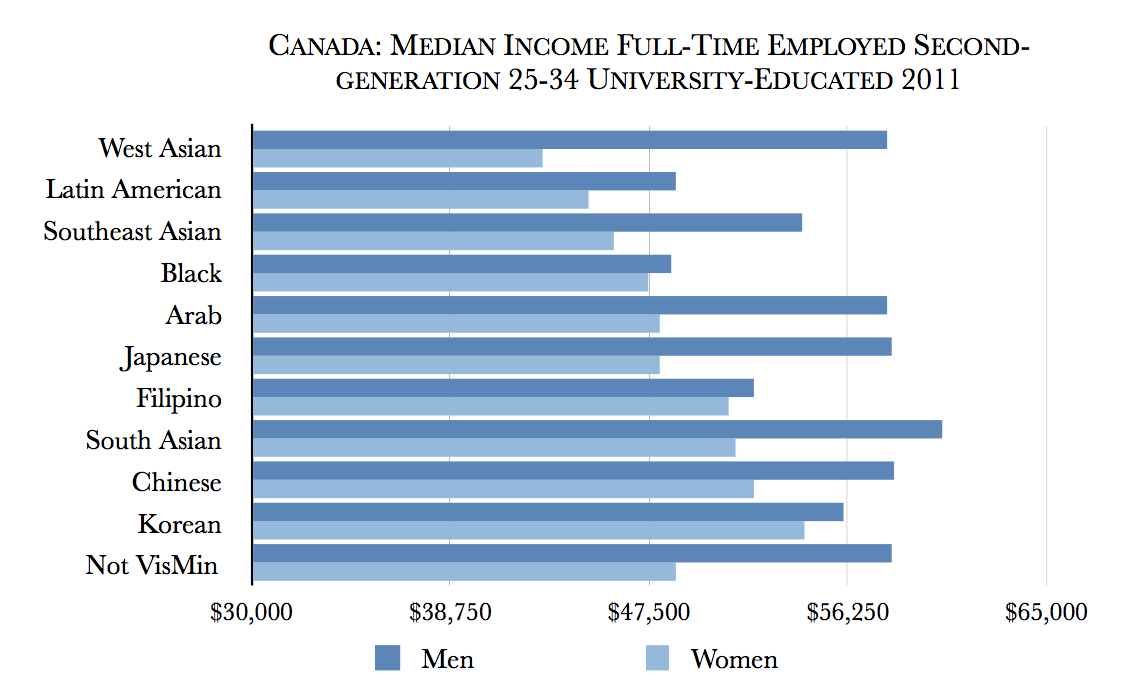
2G_University_Educated_25-34In some cases (i.e., percentage university-educated), the second-generation does significantly better than non-visible minority Canadians. And those that find employment have comparable median salaries.

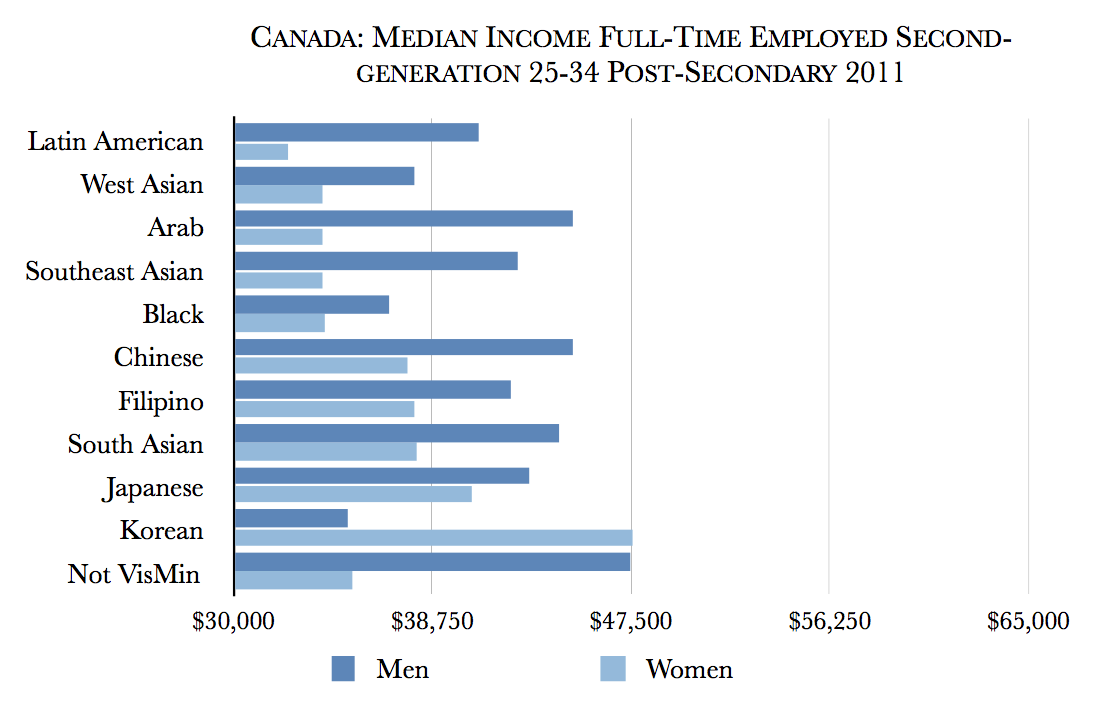
However, the second generation has higher unemployment rates than non-visible minority Canadians. Those that are not university educated have lower median incomes, as shown in the chart below:

2G_Non-Univ_Educated_25-34This is not to mentioned the well-documented instances of discrimination in hiring, police carding and other areas that show significant differences between visible minorities and others.

So while as a ‘value statement,’ one may prefer to refer second-generation immigrants as non-immigrants, this effectively masks some of the ongoing integration challenges that some elements face.

And while I fully agree with Jack that comparisons with Europe are often inappropriate given our differences in history, geography and identities, we do, like other ‘new world’ countries, view ourselves as countries of immigrants, unlike Europe. And this, with the exception of the USA, both reflects and influences how we deal with integration.

Measuring and contrasting the outcomes of both first and second generation outcomes provides useful international and internal benchmarks allow us to identify ongoing integration challenges with a view to overcoming them. Not making the distinction obscures them:

But there a significant segment of the Canadian-born population that sometimes wrongly gets labeled as immigrants. I refer specifically to persons born in Canada of foreign-born parents (a group to which I belong). Much social science literature in Europe refers to these children of immigrants as “second generation immigrants”. To many North American observers the term must seem like an oxymoron. It nonetheless gets employed by a number of Canadian scholars.

There are statistical breakdowns in the census of Canada on the basis of generational status. Immigrants are generally designated as the first generation, their children as second generation and there is a category for third generation or more. It’s inaccurate to refer to second generation Canadians as something other than non-immigrants with whom they are grouped in the census question on immigrant status.

The confusion that is created by designating them as “second generation immigrants” is sometimes influenced by European analysis with the practice in several EU countries of not automatically conferring citizenship on persons born in the country. For example, children born in France of foreign-born parents do not become citizens until reaching the age of the majority. Switzerland does not automatically extend citizenship to a child that is born in the country. Rather, a person is automatically Swiss if at least one of the child’s parents is Swiss.

Relatively few Canadian scholars that use the term second generation immigrants necessarily think of such individuals as immigrants. Rather most simply echo terminology that is used in some of the Canadian literature on immigration and citizenship and/or seek to engage with European policy-makers or scholars by employing a common vocabulary. But the Canadian-European comparisons can be problematic and regrettably they sometimes don’t make for good scholarly work.

Is Canada a nation of immigrants? It is certainly a nation with many immigrants who have played a critical role in the process of nation-building. But it is simply too limiting a concept when “the nation of immigrants” conveys the idea that immigration is the country’s principal defining characteristic.

Source: Is Canada A Nation Of Immigrants? | Jack Jedwab

I’ll be ‘proud’ when Canada achieves justice for all: Denise Balkissoon

A needed broader perspective on the justice system than provided by Ghomeshi defence lawyer Marie Henein:

I don’t expect defence lawyers to be nice, and so I didn’t have any beef with Marie Henein until this week. Then she said that our legal system is one “we should all be proud of,” and now I’m compelled to reply: Don’t be absurd.

It’s one thing to state, as Jian Ghomeshi’s ferociously successful lawyer also did in her CBC Television interview, that justice was “absolutely” served when her client was acquitted. That proclamation refers to a single case – specific circumstances of evidence and reasonable doubt, one set of police officers and Crown attorneys, one particular judge.

But to say, as she did, that the Canadian justice system is impartial “each and every single day,” well that’s simply wrong. Training and intellect might help Ms. Henein skillfully navigate the system, but that doesn’t mean the system itself is admirable.

After Mr. Ghomeshi’s acquittal on multiple charges of assault and sexual assault, an unhappy group marched north from the courthouse to the Toronto Police Service headquarters on College Street. There, it merged with Black Lives Matter Toronto, justice advocates who have been sleeping outside the police HQ for almost two weeks now. Native Child and Family Services of Toronto is right next door, and indigenous demonstrators were soon in the mix as well.

Emotions were extremely high and the number of criticisms levelled at the Canadian justice system was overwhelming. Many of them were also valid, and reflective of my own personal list.

For example: A quarter of federal prisoners are aboriginal, even though just 4 per cent of the population is indigenous. Black Torontonians (and non-white Canadians across the country) are much more likely to be “carded,” meaning stopped randomly by police and asked to submit personal information despite not being accused of a specific crime.

Justice is expensive and the more impoverished you are, the less likely you are to receive it. The Legal Aid cutoff for a single person in Ontario is $14,000 a year, or about half of working full-time for minimum wage; Ms. Henein’s fee is rumoured to be up to $1,000 an hour. Lawyers who work with low-wage clients talk about the scourge of “pleading out” – when innocent defendants make deals, acquiring criminal records because they lack the resources for endless, unpredictable court dates.

If Ms. Henein truly considers herself a feminist, as has been endlessly discussed, a recent Criminal Lawyers’ Association report must surely upset her: Female lawyers are dropping out in droves, in part because of sexist treatment by police, court staff and judges. There are many ways that the law disappoints Canadian women – please also do not forget the hundreds of native women and girls whose disappearances and murders have been virtually ignored for decades.

To say, as Ms. Henein did, that justice in Canada is “very, very good,” is to consider all of these problems acceptable. It’s an attempt to write off dissenters as a motley crew with aimless complaints, when in reality many legal critics have clear, concrete suggestions for change.

For example, Black Lives Matter Toronto wants transparency around police violence toward civilians; this includes tracking the race of those killed by police and an inquiry into the death of Andrew Loku, a mentally ill father of five shot in his hallway last year.

One wish of many indigenous lawyers is increased application of the Supreme Court’s 1999 Gladue decision: When sentencing indigenous offenders, the focus is meant to be on rehabilitation, not punishment, with true consideration of the impact of residential schools and other historical inequities.

And advocates for sexual assault survivors have a number of ideas worth considering, such as greater use of the civil system versus the criminal courts, and increasing complainants’ access to legal support and information.

The list of proposed solutions is as long as the list of problems, and that’s good. A growing, evolving justice system is something we should all want, and I think we do. A 2014 Angus Reid Survey found that only about 60 per cent of Canadians said they trusted the police, while a mere 40 per cent said they had confidence in the criminal courts.

Victorious defence lawyers might be proud of our justice system, but the rest of the country has doubts that are more than reasonable. I guess winning is a heady drug, and intoxicants do tend to interfere with one’s sense of reality.
Source: I’ll be ‘proud’ when Canada achieves justice for all – The Globe and Mail

Rights groups call for oversight of Canada border agency

Another due process pressure point on the Government:

Civil society groups proposed a model Thursday for independent oversight of the Canada Border Services Agency, following the deaths of two immigration detainees in March.

Recent revelations that the CBSA had fully implemented just one of the 19 recommendations from a coroner’s inquest examining the 2013 death of Lucia Vega Jimenez at the Vancouver airport are another indication that the border agency is in need of oversight, said Josh Paterson of the B.C. Civil Liberties Association.

The CBSA is the only law enforcement agency in Canada that has no independent oversight body, noted Canadian Association of Refugee Lawyers president Mitch Goldberg, even though officers generally have more power and less training than police.

An oversight body for the CBSA would need to be independent of political influence and have legal power to both investigate and monitor CBSA activities, said Canadian Council for Refugees president Loly Rico. The council has proposed a model for a CBSA oversight body, recommending that it have the ability to receive and review complaints from citizens and non-citizens about their interactions with the CBSA, compel CBSA to share information, and make recommendations to the Public Safety Minister.

Canada has been criticized by three United Nations agencies in the last four years over its treatment of immigration detainees, said Alex Neve, secretary-general of Amnesty International Canada. Some of the practices criticized by the United Nations included the practice of keeping children in detention, the lack of a limit under Canadian law on the amount of time an individual can be detained, and the country’s extensive use of immigration detention, when it should be a last resort, Neve said.

“That is a very strong signal that Canada’s immigration detention system is broken,” he said, adding that it is “unconscionable” that there is no independent oversight of CBSA.

Source: Rights groups call for oversight of Canada border agency

Trudeau government asks for ideas on open government

Where do I begin?:

The Liberal government is asking Canadians for their ideas on making government more open.

Treasury Board President Scott Brison announced the national consultation today.

Brison says the transparency bus has left the station.

The minister says he believes that an open government is a more effective government.

Beginning today, people can go to open.canada.ca to offer their views on what should be in the next federal strategy on open government.

Officials will also hold in-person discussions across the country and the resulting plan is to be released this summer.

 Some initial thoughts on my short list:
  • The hardest issue of all: changing the culture and enforcing a default obligation of openness;
  • Provide information in electronic formats that allow manipulation for analytical purposes. The previous government only released public opinion research data tables in pdf format, rather than in spreadsheets. More recently, PCO was unable (or unwilling) to export its database of GiC appointments in spreadsheet format, requiring me to recreate this already public information;
  • Expanded data sets, issued regularly in a timely fashion. My initial list, starting with citizenship:
    • in addition to top 10 (consider top 25)  countries of birth, have complete table or one mapped to IRCC operational regions (top 10 only covers about 50 percent of new citizens)
    • naturalization rate after 6 years of permanent residency, broken down country of birth mapped to IRCC operational regions
    • naturalization rate after 6 years of permanent residency by immigration category, gender and province
    • citizenship test pass (language and knowledge) results by country of birth mapped to IRC operational regions
    For passports, numbers related to:
    • top 25 countries of birth (all)
    • top 25 countries of birth (foreign-born)
    • number of passports issued abroad mapped to IRC operational region (to give sense of Canadian expatriates)
    • breakdown by country of birth of passports issued abroad

    Appointments: regular employment equity type reporting for all GiC appointments.

Source: Trudeau government asks for ideas on open government – Macleans.ca

Liberals push Access to Information overhaul back to 2018

I am more forgiving of the Government than some of the critics. Better to take some time to get it right, given the policy and operational considerations, but in the meantime, Canadians need to hold the Government to account, provide input to the open.canada.ca consultation site, and continue to provide examples of where the system is not working (my experience under the previous government can be found in my  ATIP Delay Log):

The Liberal government is pushing their pledged overhaul of the outdated Access to Information system to 2018, Treasury Board President Scott Brison revealed Thursday.

The government will still move within a year to make some smaller changes to the 33-year old system, which allows Canadians to obtain government information for a $5 fee.

But the larger reforms to address well-documented problems such as delays and aggressively applied secrecy provisions will have to wait two years.

“This act hasn’t been updated since 1983. Getting it right is really important,” Brison told reporters Thursday.

“We feel we can move forward with some specific changes over the next several months . . . but that doesn’t obviate the need to do a deeper consultation in 2018, which will look at other areas of improvement.”

Once a world-leading law, the Access to Information Act has been allowed to decay under successive Liberal and Conservative governments. It has not been substantially updated since the early 1980s, when most government business was conducted on paper.

The situation reached a point where, in 2015, Information Commissioner Suzanne Legault was forced to call the system a “shield against transparency.”

In their election platform, the Liberals pledged to make government information “open by default” — the principle being Canadians ultimately own their government’s work, and should be able to access it unless their government has a compelling reason to keep it secret.

The government also promised to eliminate the sometimes exorbitant fees departments charge for searching for and photocopying documents to release.

While those changes will have to wait, Brison’s department is moving forward on other commitments: applying the system to ministers’ offices, including the Prime Minister’s Office, administrative bodies in Parliament and federal courts, as well as giving Legault’s office the ability to issue binding orders for departments to release documents.

Treasury Board is expected to unveil legislation incorporating those changes, and potentially others from a parliamentary committee and public consultations, either in 2016 or 2017.

Fred Vallance-Jones, a journalism professor at the University of King’s College in Halifax, said the government appears to be moving in the right direction. But he questioned why more dramatic changes need to wait.

“I don’t think there’s any lack of advice that’s been given to the federal government over the last number of years about what is wrong with how the act is working,” Vallance-Jones, who leads Newspapers Canada’s annual Freedom of Information Audit, said Thursday.

“Those kinds of things have been on the table for quite a long time.”

Source: Liberals push Access to Information overhaul back to 2018 | Toronto Star

International-student work program needs overhaul, report says

Great example of some of the in-depth research and analysis that IRCC/CIC do, and the importance this work can and should have in ongoing policy development and program design.

However, highly disturbing that the release of such research took a nine-month battle between the Globe and IRCC/CIC. It is one thing to apply ATIP liberally with respect to advice to a Minister (decision or information memo), quite another to research. Questionable ethics for all involved, and hopefully the current Government will deliver on its commitment to greater openness:

A program that allows international students to work in Canada after graduation is creating a low-wage work force, encouraging low-quality postsecondary programs, and needs to be redesigned, says an internal report from Citizenship and Immigration Canada.

Under the Post-Graduation Work Permit Program international students with degrees from Canadian colleges and universities can work here for up to three years after their programs end. Between 50 per cent and 60 per cent of eligible international students applied for a work permit, the report says, with more than 70,000 people holding permits in 2014.

The program is designed to make Canadian postsecondary institutions an attractive destination and to give international students work experience, making it easier to apply for permanent residence.

But the 35-page report found that the majority of those employed through a work permit are in low-skilled jobs in the service sector, and have median earnings that are less than half of other recent university and college graduates.

“Facilitating this large pool of temporary labour, largely in low-paid positions, may be in conflict with the objectives of the Putting Canadians First strategy,” the report states.

That strategy was initiated by the former Conservative government to prioritize employment for Canadians after abuses of the temporary-foreign-worker program came to light. The Post-Graduation Work Permit (PGWP) report was commissioned as part of a larger review of temporary-foreign-worker policies.

The Globe and Mail obtained the report after a nine-month battle. The government initially refused the request. After an appeal to the Information Commissioner of Canada and discussions between the commissioner, Citizenship and Immigration Canada and the newspaper, the government provided a partly redacted version of the report.

Marked “secret,” the report reviews six years of the work-permit program, from 2008 to 2014. It raises many questions about how Canada attracts international students and how they transition to citizenship.

Its findings are likely to complicate the recently announced review of how the new Express Entry immigration system is treating international students who want to become permanent residents. Express Entry, introduced in January, 2015, does not award applicants any extra points for studying in Canada, as had been the case under a prior immigration program for international students. As a result, it has been heavily criticized for making it much harder for international students to become permanent residents.

Earlier this month, John McCallum, Minister of Citizenship and Immigration, said the government is launching a federal-provincial task force to look at how Express Entry can better serve this group.

“International students have been shortchanged by the Express Entry system,” he said at the time. “They are the cream of the crop in terms of potential future Canadians …”

The PGWP report, however, suggests that most international students’ investment in a Canadian education is not being rewarded by the labour market.

International students with a work permit had median earnings of $19,291 in 2010, compared with about $41,600 for 2013 domestic college graduates and $53,000 for Canadian university grads, according to the review.

Source: International-student work program needs overhaul, report says – The Globe and Mail

In defence of the Office of Religious Freedom: Solomon, de Souza

Nuanced opinion by Evan Solomon, supporting the concept of an Office for Religious Freedom:

We not only ought to be saving religious groups from persecution—that should be basic foreign policy—we need to have a deeper understanding of the impact religions have on societies if we have any hope of making a difference in these conflicts. It’s hard to forget the accounts from the famous Black Hawk Down incident in Somalia, where U.S. soldiers flying in choppers over Mogadishu hung their feet out open doors. No one told them showing the soles of their feet to the local population was a profound insult, further turning the population against them.

The Office of Religious Freedom was flawed, and never quite lived up to its billing, hobbled by its puny budgets and by the Harper government’s propensity to imbue everything with a partisan mission. But it barely got off the ground, and the core idea is sound. If Canada really is back—this government’s mantra—it had better make sure it takes religion seriously. There is no point in tripling the number of trainers in Iraq if we don’t deeply understand the belief system of the very soldiers we are trying to support, as well as the ones we are fighting.

Conflicts of the future will have twin threats: terror, and the danger of giving in to a xenophobic response. Winning both sides will mean being unafraid to talk about religion, and engaging with religious communities. Without an office to do that, how does this become a government priority?

Source: In defence of the Office of Religious Freedom

And less nuanced support by Father Raymond J. de Souza, the Chair of the former advisory committee:

That reading is rendered more plausible given that the foreign affairs department (now called Global Affairs) undertook no consultations with the ORF’s advisory committee, drawn from religious leaders from across the country. The non-partisan, volunteer group includes many who are in direct contact with persecuted communities around the globe. I am the chairman of the advisory committee, and the new minister’s office never consulted the committee, or its leaders. If there was a commitment to religious freedom, but through a different means, such consultation would have been an obvious starting point.

If the Liberals had a credible plan to advance religious freedom in a world of increasing religious persecution, surely it would have been announced. But since the election, the government refused even to announce its intention to close the ORF, even long after staff was told to look for positions elsewhere. Only last week, when the opposition moved a motion in the House of Commons, did the government declare its decision to close the ORF. Doing that on the day before the budget was released, before a two-week recess of the House, suggests a desire to bury this news. It does not appear that the government even thinks the decision a good one, or has an alternative plan. 

It is also short-sighted. Religious persecution and massacres are on the increase. Should the government decide to launch a particular program, likely more costly than the ORF, to promote, for example, legal rights in criminal justice systems abroad, or political rights in new democracies, or to encourage our authoritarian allies to respect minority rights, then it will be open to the charge that it simply chose not to put a priority on religious freedom.

This week, Dion outlined his foreign policy philosophy as one of “responsible conviction.” The idea is that one stands up for Canada’s convictions, but in a responsible manner, meaning that the objections of those who do not share our convictions have to be generously taken into account, whether it be Saudi Arabia or Russia or Iran. If the closing of the ORF is an example of “responsible conviction” in action, the message will be clearly understood in Riyadh, Moscow and Tehran. Of course, Canada stands foursquare behind religious freedom, but will not raise the matter if it proves awkward. 

Dion himself knows that is the case, as he stressed that “responsible” is not to be understood as an adjective that empties the noun of any meaning. Otherwise he would not have insisted that his new approach should not “be confused with moral relativism or the lack of strong convictions.” The need to emphasize that something is not what it appears to be is the customary way politicians confirm that it is precisely that.

Burying the Office of Religious Freedom

I think most critics of the Government’s decision have overly focussed on the question of the Office and the Ambassador per se rather than the sun-setting of the modest program funds for projects to help support religious freedom, where likely more impact will be felt.

McCallum reverses changes for intake of privately sponsored Syrian refugees

More flexible approach and response to criticism than the previous government:

Immigration Minister John McCallum is reversing changes to the private sponsorship of Syrian refugees program after a public outcry.

The Canadian Press has learned that the immigration department will now process all applications for Syrians received as of today with an eye towards getting a further 10,000 Syrians to Canada by the end of this year or early 2017.

Private groups were caught off guard after the government scaled back efforts to resettle Syrians once the Liberals achieved their goal of resettling 25,000 people by the end of last month.

In addition to cutting staff processing Syrian applications, the government decided to limit the number of cases it would accept this year.

The move prompted some sponsorship groups to question whether the Liberal government was truly committed to refugees and left many disappointed that it could take as long as a year to welcome Syrians to Canada.

In an interview with The Canadian Press, McCallum says the government is doing all it can to respond to a surge in demand that he called historic and unlikely to be repeated.

Source: McCallum reverses changes for intake of privately sponsored Syrian refugees – The Globe and Mail