#Citizenship Act C-6 Changes: Hearings Start April 12
2016/04/13 Leave a comment
The first Citizenship and Immigration Standing Committee hearing took place April 12. The Minister made a summary introduction to allow more time for questions (and given he was somewhat late).
The Minister did indicate in his responses to questions that while his focus was on implementing platform and mandate letter commitments, he made the general point that he was open to considering amendments in response to the NDP’s question regarding the lack of judicial hearings in cases of revocation for misrepresentation.
Government-side questions were a mix of softball (e.g., time for C-6 to be implemented) and those that likely reflected constituent concerns with respect to knowledge and language testing, along with some that probed the rationale for certain policy choices (e.g., 3 year minimum residency rather than 2). Some MPs were better at having internalized their questions, others stuck more closely to their written material.
Surprisingly, the proposed repeal of citizenship revocation for terror or treason received comparatively little attention from the Conservatives, with the Conservative immigration critic (Michelle Rempel) focussing on the elimination of language assessment for 55-64 year olds and the possible impact on the economy, leaving it to another Conservative to question the proposed repeal, mentioning the restoration of citizenship to the convicted terrorist Zakaria Amara, (“a terrorist is a terrorist is a terrorist”).
The Minister made his standard reply: all Canadians, whether sole or dual nationals, should be treated the same (“a Canadian is a Canadian is a Canadian”), and that the Canadian legal and penal systems were more appropriate ways to deal with terrorists.
My summary notes:
Language: No disagreement among all parties on the importance of language competency to integration and citizenship. The Conservatives focussed on the reduced age requirements to 18-54 from 14-64 and the possible impact that would have on labour market participation and outcomes. They suggested a better approach was more emphasis on language training.
The Conservatives also asked whether any economic analysis had been done on the impact of this change for 55-64 year olds and the answer was no, the Minister retorting that none was carried out when the Conservative government increased the requirement. The Minister also responded that the number of 55-64 year olds was 8 percent of the number of applicants (data provided to me by IRCC for earlier years shows a smaller number but they may have used 2014-15):
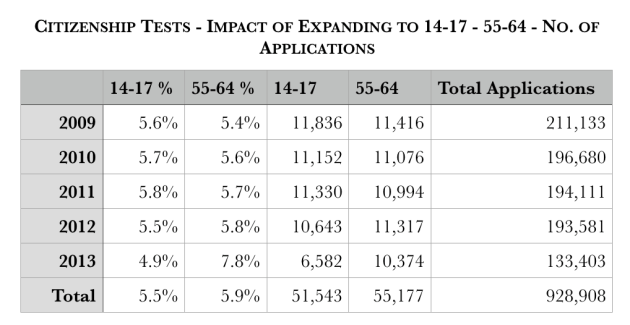 Surprisingly, the Conservatives spent some time on the younger cohort affected (14-17 year olds) despite the fact that they would have all (or virtually all) been in school for 3-5 years and thus be competent in English or French (I always suspected this was a ‘backdoor’ way to ensure civics education).
The NDP focused more on the level of resources for language training, citing examples of reduced funding and wait times. The response was to emphasize the current high levels of funding for language training and additional funding for Syrian refugees. They also asked a number of technical questions regarding the level of language required (CLB-4 – basic).
Some Liberals noted that some constituents worried about the citizenship test, particularly the 55-64 year olds and asked how many people are likely to apply without the test and these worried. Officials replied that it is difficult to isolate factors, there were a number of reasons, including some dual citizens may not want Canadian citizens, but referred to the historic 85 percent naturalization rate (recent rate is significantly lower).
Knowledge test: There were a number of questions regarding the knowledge test and what happened when an applicant failed. The Minister and officials noted that the first time pass rate was 87 percent. Those who failed could write the test a second time, boosting the overall pass rate to slightly above 90 percent. Those who failed a second time could have a hearing before a judge, leading to another few percent to the overall rate. Subsequently, officials noted that typically the time to retake the test is between 2-4 weeks.
The NDP also noted some of the difficult and ‘tricky’ wording of the knowledge questions. The Minister acknowledged the point and stated that the revised citizenship guide would be written in a manner to be more comprehensible to more people.
Citizenship guide: Liberal side asked questions of planned revising of citizenship guide and degree to which the Charter would be emphasized and questions regarding religious rights. Officials noted that much of the content of the guide is prescribed by regulations (history, society, rights and responsibilities).
Physical presence requirement: Raised by Liberal MPs for cases of those working overseas with families in Canada, the Minister reiterated that citizenship required physical presence, that we did not want ‘citizens of convenience’ acknowledging that there were some hardships but nevertheless maintaining the requirement.
Fees: The NDP raised the issue of the steep increase of fees in 2014/15: from $100 to $530. Minister responded by saying that neither the platform nor mandate letter referred to fees but that he did not preclude looking at fees in the future.
Revocation (misrepresentation): The NDP raised the removal of judicial review as noted by the CBA, leaving revocation at the discretion of the Minister. The Minister responded by stating that the Committee would hear from the CBA and that he was open to amendments in this area.
Processing times/Service standards: Liberal members raised the issue of processing times. The Minister gave credit to the previous government for a number of measures that have allowed IRCC to meet a processing time of 12 months (later officials indicated this was with respect to 80 percent of complete applications as of 1 April 2015 – incomplete ones are not counted).
International students pre-permanent residency credit: Minister reiterated measure to restore 50 percent credit for pre-permanent residency time for international students and also review possible improvements to Express Entry to make it easier for students, something that he intended to do that was not in his mandate letter. Some government members asked whether consideration would be given to more than 50 percent with the response being that 50 percent was deemed to be reasonable.
Refugee pre-permanent residency time: Chair asked whether consideration would be given to granting pre-permanent residency time to refugees or humanitarian cases. Officials noted that credit was only provided once refugees had been confirmed as protected persons and Minister added as general principle, government should not credit illegal time in Canada, only legal.
Lost Canadians: NDP raised that there were remaining cases and that the first generation limit remained an issue. IRCC officials explained the provisions of prior legislation (C-37 and C-24), that avenues were available for particular cases not addressed along with stateless persons.
Seizure of documents in cases of fraud. Conservatives asked for examples and officials indicated passports with entry and exit information. There were questions regarding the degree to which officials would have discretion with officials replying that this would be based on ‘reasonable grounds,’ with the details to be spelled out in regulations.
There was a long side discussion on the legitimate issue raised by the Conservatives regarding changes in the way that MP citizenship (and immigration) enquiries were going to be handled compared to the earlier direct channel of the Ministerial Enquiries group, leading to a Conservative motion, supported by the NDP, that officials brief the Committee prior to C-6 moving forward. Defeated on party lines although the request for a briefing (if not the timing, holding C-6 hearings in abeyance) appeared reasonable.
 About Andrew
 Multicultural Meanderings