Canada can do better on getting more women elected, 60th place in world right now
2016/04/12 1 Comment
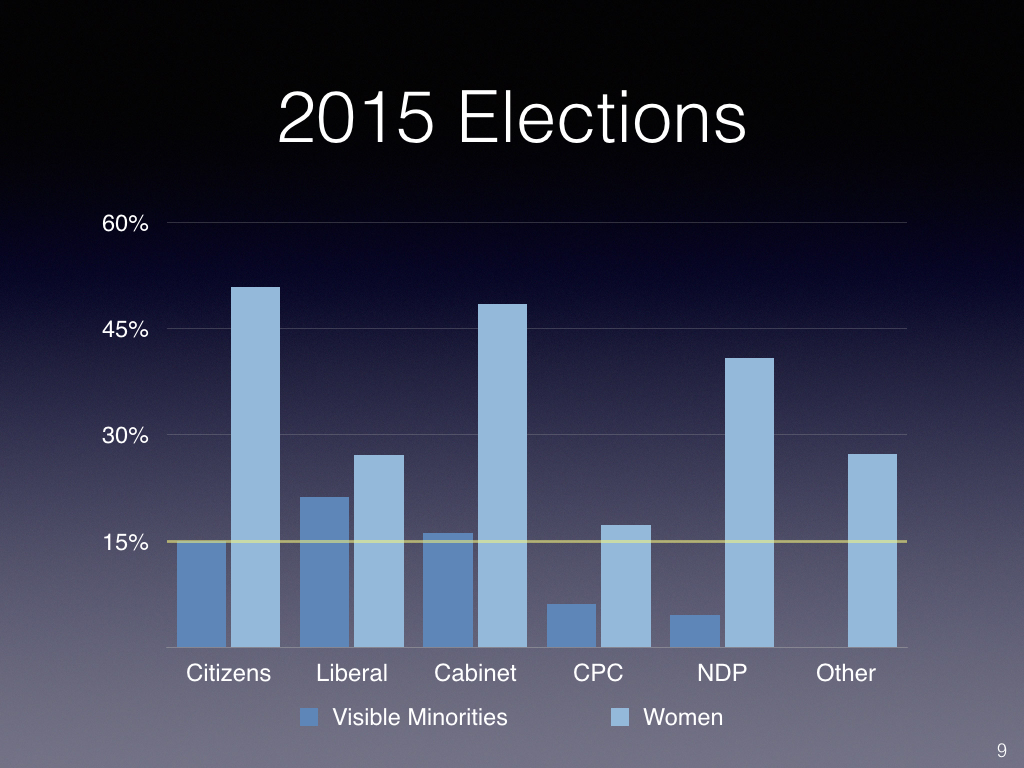 Nancy Peckford and Grace Lore of EqualVoice argue for a gender-based lens with respect to evaluating electoral reform proposals. Women who are now more under-represented than visible minorities, where all parties have made major and successful recruiting efforts:
But, it is crucial to understand that “proportional representation” is not one thing and neither is “women’s political representation.” Proportional representation systems vary widely in how individuals become candidates, how votes are cast, and how those votes are translated into seats. UBC political scientist Grace Lore, and EV’s senior researcher, has just finished a multi-country study of electoral systems in Europe and North America with a specific focus on their effect on women’s representation. The data from that research strongly reveals that while the number of women elected is an important indicator of success, so is the ability of these women to act to represent their constituents, including women.
In ‘closed list’ PR systems, parties determine a set list of pre-approved candidates and voters simply pick a party and, de facto, accept the list of candidates in the ordered that is proposed by the party. In ‘open list’ systems, voters have the opportunity to indicate preferences between candidates. In some countries that use open list proportional representation, voters can even indicate a preference for candidates from multiple parties. Like open list proportional systems, alternative vote systems give voters the chance to rank parties instead of just indicating their top choice.
These are not minor or mechanical details—they matter greatly to how one participates in the democratic process. The nuts and bolts of each system also shape the role of parties and the choices available to voters, including the possibilities for women’s political representation. Some features of electoral systems, whether based on proportional representation or not, lead to the election of a greater number of women, while potentially reducing women’s capacity to represent women’s and other interests once they are in office. Other features improve the power of individual women to have influence, but do not maximize the possibilities for the sheer number of women elected. Lore’s extensive research of electoral systems on two continents and 15 countries underscores that if women representatives are more beholden to a political party for their election (versus having a direct relationship with constituents), their lack of independence frequently prevents them from effectively advocating on behalf of other women.
In short, proportional representation is neither necessary nor sufficient to ensure women’s equal representation. Political culture matters significantly, i.e. voters and parties need to seek more women to appear on the ballot and create the conditions for their participation. More women also need to choose politics as the place to dedicate their time, energy, and skills. If we do not also tackle other systemic barriers, including inequality in access to political resources and the uncertainty of the nomination processes, we cannot count on this happening. These concerns can and should be part of the electoral reform discussion. Revisiting the rules around financing and timing of nomination races are two key areas where there is much room for improvement.
Canada can do better than its current 60th place in the global community for its representation of women. Open discussion around electoral reform provides us all—voters, parties, MPs, and organizations, with an opportunity to take action. Action, however, must be thoughtful and evidence based. A consideration of the impacts on women in politics should be incorporated at every stage of the process—from broad principals to basic mechanics.
Source: Canada can do better on getting more women elected, 60th place in world right now |
 About Andrew
 Multicultural Meanderings
Pingback: Canada can do better on getting more women elected, 60th place in world right now | Mark Geoffrey Kirshner