Where is the postracial society? Mark Kingwell

On identity politics and post-racialism:

Is the solution a “postracial” society, blind to colour and bogus judgments of difference? Would that it were so. Unfortunately, too many comfortable postracialists are self-appointed allies of struggle, who should remember that they don’t get to be not-white just because they have achieved personal tolerance. Demographics alone are an uncertain vehicle of change, and rainbow populations no guarantee of harmony and justice – sometimes quite the opposite.

The presumed liberal goal for diverse societies is universal equality, but identity politics seems compelled to tout essential differences. The best response to this long-standing philosophical double-bind isn’t what Mr. Rock suggested: more opportunity, especially in Hollywood’s tiny self-regarding gene pool. Opportunity is too often a rigged game, another frat mixer where you get stuck in the corner with the other squares.

Instead, we need to challenge the very idea that random differential traits – skin colour, physical beauty, penises – should generate outcomes unrelated to them, such as wealth, power and status. Racism is stupid as well as dangerous, a conceptual error frozen into intellectual sludge. The solution is not more identity but more imagination, including for differences we haven’t yet encountered.

Without that, the postracial society will remain a sci-fi dream, like crew rosters on Star Trek or the bar scenes in Star Wars. And even there – well, we like you, C-3PO, but you’re … not an organic.

Source: Where is the postracial society? – The Globe and Mail
Artist draws moon’s craters named after women to illustrate inequality

web-craters09nw6Lack of historical diversity – only 27 out of 1,600 (0.02 percent):

Last year, Montreal artist Bettina Forget was looking at an atlas of the moon when something suddenly struck her as odd.

She knew the moon’s surface is pockmarked with craters of varying size. These circular depressions are the lasting record of billions of years’ worth of interplanetary bombardment dating back to the formation of the solar system. But, in a way, they also record an artifact of science and culture that hits much closer to home – because, no matter where Ms. Forget looked, the craters were named after men.

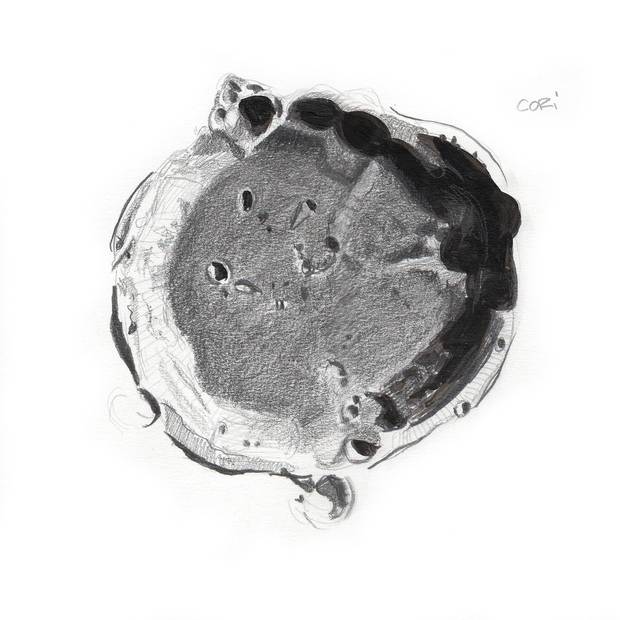
Soon, Ms. Forget found herself combing through the International Astronomical Union’s catalogue of lunar features. Of the more than 1,600 named craters on the moon, she discovered that a mere 27 honour famous women in science and space exploration.

That’s when she decided to draw all 27 by hand.

Source: Artist draws moon’s craters named after women to illustrate inequality – The Globe and Mail

Citizenship: 2015 Full-Year Data – Backlog largely eliminated

Citizenship - Conference Board April 2016.001My quick analysis of the 2015 operational data released a few days ago.

  • The increased funding of $44 million provided in Budget 2013 to address the backlog has clearly worked: 235,000 in 2015, slightly down from 263,000 in 2014, but significantly greater than earlier years when it dropped as low as 113,000;
  • The backlog has been reduced from a high of 396,000 in 2013 to 130,000 in 2015, a major achievement;
  • In election year 2015, significantly more citizenship ceremonies were held (3,300) compared to previous years averaged around 1,900, likely reflecting a conscious decision to do more ceremonies, smaller in numbers, in more places; and,
  • While the number of applications appears less (130,000) compared to 2014 (198,000), the data is often revised as any delayed or incomplete applications originally not entered into the system are backdated to the original date of the application (the 2014 data, originally showing 130,000 was revised only in the third quarter of 2015).
  • While it would be premature to declare a trend, logic suggests that the various changes made by the previous government, including the fee increase to $630, would result in a decline of applications.

As the proposed changes to residency and testing in Bill C-6 need to go through the parliamentary process, followed by coming-into-force provisions, these unlikely to be implemented much before 2017.

Statistics Canada: The contribution of immigration to the size and ethnocultural diversity of future cohorts of seniors

Projected_distribution_of_various_cohorts_at_age_65__by_place_of_birthNot surprising but interesting:

The aging of Canada’s population is currently related to the baby-boom cohort reaching their senior years. Subsequent cohorts will continue to sustain high populations of seniors because of declining mortality rates and higher immigration levels.

According to population projections, future cohorts of older Canadians could also be more ethnoculturally diverse, as a larger portion of them could be born outside of Canada.

Source: The Daily — Study: The contribution of immigration to the size and ethnocultural diversity of future cohorts of seniors

Liberals vow to review Canada’s poor record jailing Islamist fighters returning to country

Reasonable approach as part of the overall review under-way:

Canada’s poor record at jailing Islamist fighters returning from Syria and Iraq will be scrutinized as part of the government’s overhaul of the nation’s security apparatus.

The commitment Tuesday by Public Safety Minister Ralph Goodale, responsible for Canada’s chief spy agency and the RCMP, follows news that about 60 individuals in Canada are suspected to have returned from foreign battlefields and the ranks of the Islamic State, al-Qaida and other terrorist groups.

None have been charged, though Parliament in 2013 created four new criminal laws against leaving the country or attempting to leave to engage in terrorist activities. The Canadian Security Intelligence Service (CSIS) believes about 180 others from Canada are currently fighting with, or aiding, extremist movements overseas.

The numbers were revealed Monday by CSIS Director Michel Coulombe, testifying before the Senate’s committee on national security. The principal concern is that some of those who survive and return to Canada could use their combat skills to launch attacks here or become terrorist recruiters, fund-raisers and domestic organizers.

Goodale and RCMP Commissioner Bob Paulson, appearing before the Commons public safety committee Tuesday, said the paucity of foreign fighter prosecutions — there has been just one — reflects the high evidentiary standards in Canada’s criminal courts. (Five other men have been charged in absentia, but two have reportedly been killed fighting in Syria.)

Gathering incriminating intelligence in a far-flung combat zone, then turning it into evidence to satisfy guilt beyond a reasonable doubt is tough. What’s more, CSIS has no law enforcement powers and terrorism-related criminal charges are up to the RCMP.

“It’s a challenge to be able to get the evidence that’s required to prove our cases to our standards here in Canada,” Paulson told reporters. “We have been improving collecting that evidence, but it is fundamentally an evidence-collection issue.”

Increasingly, police and other authorities are using heavy surveillance, immigration law, detentions, peace bonds and disruption tactics to watch, remove, control and thwart the activities of those who have returned.

Both Goodale and Paulson flatly rejected the notion of lowering criminal law thresholds.

Instead, Goodale said the issue will be included in the government’s promised review of Canada’s national security framework.

“How do you make that important transition from intelligence information to prosecutorial evidence? All of that is part of what we will be examining,” he said.

Source: Liberals vow to review Canada’s poor record jailing Islamist fighters returning to country | National Post

25,000 Syrian refugees in four months: How did Canada do it?

Rob Vineberg’s good summary of the mechanics of the Syrian refugee intake, in The Interpreter of Australia’s Lowy Institute for International Policy.

His conclusion is noteworthy:

How did Canada manage to meet such an ambitious goal? Ironically, it was the ambitious goal itself that galvanised the Public Service and the Armed Forces to develop innovative approaches. A smaller goal would have resulted in ‘more of the same’ and disappointing results. As Minister McCallum said: ‘One definition of real change is you’re doing something you’ve never done before.’

Source: 25,000 Syrian refugees in four months: How did Canada do it?

Canadian woman will be on next series of bank notes, Trudeau announces

One has to admire the choreography of this announcement on International Women’s Day with other related elements: the PM’s op-ed in the Globe ( Gender equality is an opportunity, not a threat) and the announcement of DM changes, which included four women (one of whom is visible minority) and one man – because its 2016?:

The image of an iconic Canadian woman will appear on the next issue of bank notes, Prime Minister Trudeau announced today.

“A Canadian woman will be featured on the very first of the next series of bills expected in 2018,” Trudeau said.

“Today, on International Women’s Day, the Bank of Canada is taking the first step by launching public consultations to select an iconic Canadian woman to be featured on this new bill.”

The government and the Bank of Canada did not indicate which denomination would showcase the iconic female Canadian.

Finance Minister Bill Morneau, who stood alongside the prime minister with other members of the Liberal caucus and former Mississauga, Ont., mayor Hazel McCallion during the announcement, noted that it is “high time to change.”

“One of the very first things I had the honour of doing as the new finance minister was asking the governor of the Bank of Canada, Stephen Poloz, and his colleagues at the bank whether it’s in fact possible to put a woman on the bank note,” said Morneau.

The finance minister said he was told the central bank had been looking into the possibility for some time and was keen to support the initiative.

Source: Canadian woman will be on next series of bank notes, Trudeau announces – Politics – CBC News

Liberals shift immigration focus to family reunification, refugee resettlement

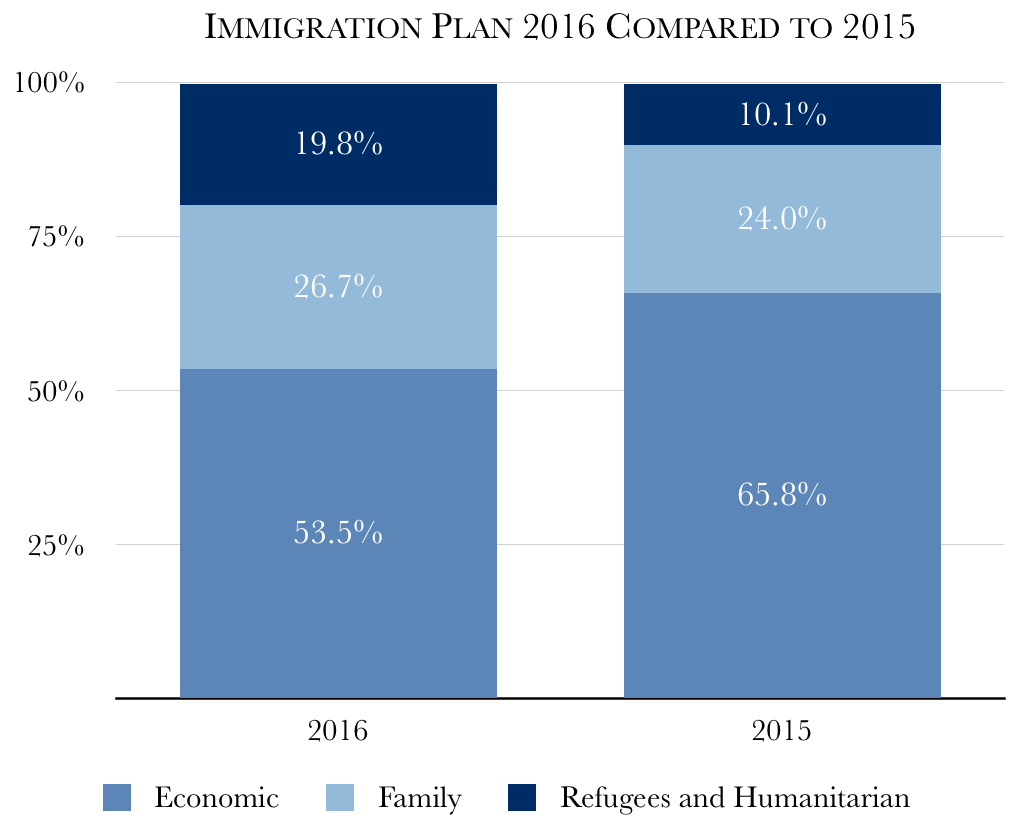
Immigration_Plan_2016One of the more comprehensive reports on the changes, but changes that some of my colleagues more expert in immigration characterize as ‘less change than meets the eye’:

Canada will seek to admit a record number of immigrants as the Liberal government shifts its focus on family reunification and the settlement of refugees, says Immigration, Refugees and Citizenship Minister John McCallum.

“This plan sends a message about the importance of family,” McCallum said in Brampton, Ont., on Tuesday.

“It outlines a significant shift in immigration policy towards reuniting more families, building our economy and upholding Canada’s humanitarian traditions to resettle refugees and offer protection to those in need.”

McCallum said Canada will admit between 280,000 and 305,000 new permanent residents in 2016, a record increase from the 260,000 to 285,000 newcomers the previous Conservative government had planned to welcome by the end of 2015.

The Liberal plan will see Canada admit:

  • 151,200 to 162,400 caregivers, provincial nominees, and other skilled workers under the economic stream.
  • 75,000 to 82,000  spouses, partners, children, parents and grandparents of Canadians under the family reunification plan.
  • 51,000 to 57,000 refugees, protected persons and others admitted for humanitarian reasons.​

The Liberal plan also includes admitting 18,000 privately sponsored refugees, “three times more than in earlier years,” McCallum said.

The government has resettled some 25,000 Syrians, a mix of government-assisted and privately sponsored refugees, in four months. The Liberals have also pledged to resettle another 10,000 government-assisted Syrian refugees by the end of 2016.

Reviewing sponsorship conditions

McCallum said the government will review some of the conditions imposed on Canadians looking to sponsor their children and spouses living overseas, making family reunification a priority.

“The government of Canada will make family reunification an important priority because when families are able to stay together, their integration to Canada and ability to work and grow their communities all improve,” McCallum said in a much-anticipated report tabled in Parliament on Tuesday.​

“We will work to restore the maximum age for dependants to 22 from 19 and re-examine the two-year conditional permanent residence provision for sponsored spouses.”

In its annual report to Parliament, the Liberal government is also pledging to:

  • Eliminate the $1,000 labour market impact assessment (LMIA) fee for families looking to hire caregivers for family members with physical and mental disabilities. An LMIA is a document employers must file to prove the need to hire a foreign worker over a Canadian one.
  • Review the express entry system launched in January 2015 “to provide more opportunities” for applicants who have Canadian siblings.
  • “Expand and monitor the use of biometrics” to verify the identity of all temporary and permanent residents  who need a visa or permit to enter Canada.

Fewer economic immigrants

Conservative immigration critic Michelle Rempel denounced the government’s decision to admit fewer economic immigrants.

“These cuts to economic immigration come at a time when our workforce is aging, our economy is slowing, and refugees are waiting for months to have long-term affordable housing,” Rempel said during question period,

She said the government’s changes to the caregivers program would “leave the most vulnerable Canadians without care.”

Source: Liberals shift immigration focus to family reunification, refugee resettlement – Politics – CBC News

Laura Track: Citizenship comes with the same rights and responsibilities, regardless of birthplace

Citizenship - Conference Board April 2016.001Laura Track of the British Columbia Civil Liberties Association supporting the Government’s planned repeal of the revocation for terror or treason provisions (the above chart has been revised with full-year data for 2015):

Critics point out that the government can still revoke someone’s citizenship on the basis that they lied or committed fraud in order to obtain it. How can that be a more serious offence than terrorism, some wonder? However, the two scenarios are fundamentally different. Citizenship obtained by fraud is a citizenship that should never have been granted. Revoking it is akin to correcting an error. Revoking citizenship from a Canadian based on a crime they committed after citizenship was legitimately obtained is a punitive response that amounts to the ancient punishment of exile. Such medieval practices have no place in a rights-respecting democracy.

It’s no secret who would have been targeted by the law: new Canadians of colour who arrived in Canada only one or two generations ago. This unequal treatment is why the BC Civil Liberties Association and Canadian Association of Refugee Lawyers challenged the law in court last summer, arguing that it is discriminatory and violates key constitutional rights. It is also poor security policy, and fundamentally wrong.

We applaud the government for taking the first steps towards bringing about the law’s demise. The reforms are not perfect, and still leave too much power in the hands of government bureaucrats to revoke citizenship in cases of fraud or misrepresentation, without the involvement of a judge. But it’s a step in the right direction — the direction of equal rights for all Canadians.

Source: Laura Track: Citizenship comes with the same rights and responsibilities, regardless of birthplace | National Post

Today’s feminist problem? Black women are still invisible: Anderson

More than an element of truth in this critique by Septembre Anderson:

A few weeks ago, I got a press release about the 100th anniversary of women getting the vote in Canada. The e-mail goes on about women’s suffrage and the commemoration of that fight for a few hundred words and then begins to catalogue when women got the right to vote throughout the country – women in Manitoba in 1916, those in Newfoundland in 1925 and so on and so on – and then, in brackets, near the end, “Unfortunately, the right to vote was withheld from indigenous women, as well as those of Asian and African descent, for years longer.”

Nowhere in the press release was there any mention of how anti-black many suffragettes were; how much of these women’s activism was about gaining the vote for white women only; and how championing eugenics for racialized women was also part of their politics. Heck, there wasn’t even a mention of when indigenous, Asian and African women got the vote in Canada.

And this is the problem with feminism as it exists today. Black women and other women of colour are continuously rendered invisible beneath the “women” banner. The default definition for women is white women – those with the most systemic power – and the issues of the most privileged of us take precedence over the trials and tribulations of the least privileged of us.

We saw this clearly during the Academy Awards. While white women used the hashtag #AskHerMore to bring awareness to and combat sexist reporting on the red carpet, women of colour were bringing attention to #OscarsSoWhite, created by movie critic April Reign, to protest the lack of racial diversity in Oscar nominees.

We saw this with the celebration of Justin Trudeau’s recent cabinet – that boasted gender parity “because it’s 2015” but not racial parity. We see this with continuing discussions about the gender pay gap – but there’s a greater disparity between race than gender.

While white women experience the repercussions of sexism, racism isn’t one of the barriers that they have to come up against. It’s actually one that benefits them. The unique issues that black women have to deal with are far too often overshadowed by the issues that white women deal with, leaving those of us with less institutional power to wait and hope for a trickle-down equity that history has shown us will never come.

Black women exist at the intersection of blackness and womanhood and, therefore, our feminism isn’t a single issue struggle. Our battle for equity and inclusion is with both misogyny and systemic anti-blackness, from within and without feminist circles. Feminism, as it is popularly practised, whitewashes the experience of racialized women and does not acknowledge the intersectionalities within womanhood. It does not acknowledge the distinctive ways different women experience sexism.

Through this myopic definition of womanhood, mainstream feminism is embroiled in elevating the women closest to the top rather than those struggling and suffering on the margins.

In Canada, black women and other women of colour find themselves missing not only from movements for gender diversity, but also from seats of power. Bank boards, newsrooms, hospital boards and executive positions are all spaces where white women see themselves better represented.

Source: Today’s feminist problem? Black women are still invisible – The Globe and Mail