Canada has more women in cabinet, but fewer sit on Commons committees

The Globe picks up on the same issues I raised earlier in Diversity on parliamentary committees: Does it matter? | My piece in The Hill Times with interesting commentary from a variety of parliamentarians, but only focuses on gender:

Diversity on committees is important; women believe they bring a different view to issues.

“It’s not that it’s a right or a wrong perspective. It’s just different,” said Pam Damoff, the newly elected Liberal MP for Oakville North-Burlington and the only woman on the public safety and national security committee. “It’s early going so far, but I do think it [female membership] gives a slightly different lens to look at things.”

There are 10 members on each committee – six Liberals, three Conservatives and one New Democrat. The numbers for each party are based on their representation in the House.

Mr. Trudeau’s promise to make committees more independent has also added to the dearth of female representation. There was criticism among opposition during the past government about having parliamentary secretaries, who are considered junior cabinet ministers, on their respective committees. The view was that the Harper government was using parliamentary secretaries to do the bidding of their minister, hijacking the committee’s independence.

Mr. Leslie said his government was “determined not to repeat that.”

And so, parliamentary secretaries are not on committees, giving Mr. Leslie even fewer female MPs to work with (the Prime Minister, cabinet ministers, opposition leaders, and the Speaker are also not appointed to committees).

“Do we need more women in caucus? Absolutely,” Mr. Leslie said.

And not just in the Liberal caucus, but in the entire Commons, where there are a total of 88 female MPs and 250 male MPs; women account for 26 per cent of the 338 seats.

The Conservatives elected 99 MPs – 17 are women. They are allowed to appoint three MPs to each committee. The third-party NDP has 44 MPs, 18 of whom are women. They are allowed one MP on each committee.

“We made a decision to put women on key committees,” Ms. Mathyssen said. Her party purposely put women on the foreign affairs committee and also on international trade, given that the massive trade deal, the Trans-Pacific Partnership, is one of the most important issues facing the Commons for the NDP.

Ms. Mathyssen suggested that women are more pragmatic and work harder than their male counterparts. “We go in prepared … We’ve always had to be very efficient in terms of time management because of all the things women do.”

For Ms. Damoff, being the only woman on the public safety committee was a surprise. She had asked to be on the infrastructure committee. “When I first got appointed, I thought, ‘Wow, I’m the only woman on here.’” she said. But she quickly realized she could play an important role.

“I do bring a different perspective,” she said. Recently, RCMP Commissioner Bob Paulson appeared before her committee on issues around sexual harassment in the police force. She asked him what he was doing to promote women into leadership roles.

“The only way you change the culture in any organization, whether it is business or politics … is to have women in leadership roles,” she said about why she asked that question. “Not that men may not have thought of it. But it was just a different perspective I was bringing to the issue.”

Government House Leader Dominic LeBlanc recognizes that there are too few women on committees, but says the Prime Minister made the commitment to put women in leadership roles in government. “One objective is to encourage more women to run for nominations and get elected to Parliament,” he said. “This would be a direct way to increase the number of women serving on committees of the House.”

Nancy Peckford of Equal Voice, the non-partisan organization advocating for more elected women, says it’s important to have gender parity in cabinet, but the trick now is not to be complacent and think that women have somehow won.

“What this points to is that you have a House that is only 26-per-cent women … so, really, it comes down to electing more women,” she said.

The print edition also has a neat graphical representation.

Source: Canada has more women in cabinet, but fewer sit on Commons committees – The Globe and Mail

Perception of politicization of the public service is a problem for Liberals | Ottawa Citizen

Not unexpected to hear this kind of criticism from the opposition, as well as the more-balance assessments from others:

The appointment of Matthew Mendelsohn, who helped write the Liberal election platform, as a senior-ranking bureaucrat is a “clear, unprecedented and blunt” politicization of Canada’s non-partisan public service, says former Conservative cabinet minister Jason Kenney.

Kenney said the previous Conservative government — which had a rocky and sometimes hostile relationship with the bureaucracy — would have been vilified if it “plunked” such a key election player into the top ranks of the Privy Council Office (PCO).

“The real shocker here is his appointment to a No. 2 position in the PCO, the summit of the entire public service,” said Kenney in an interview. “A fellow who worked as a partisan political Liberal on the election campaign … I don’t think there is any precedent for this.”

That perception has dogged the Liberals since Mendelsohn was appointed in December as a deputy secretary in the PCO to head a new “results and delivery” secretariat to ensure election promises are tracked and met.

Results and delivery are big priorities for the Liberals and the public service has a lousy track record at both. By all accounts, Mendelsohn is working hard to get buy-in from ministers, deputy ministers and departments on creating a “delivery culture” in government.

And there seems little debate Mendelsohn is qualified. He is an academic, founding director of the Mowat Centre, an Ontario think-tank, a former deputy minister of several provincial portfolios; an associate cabinet secretary in Ontario and a one-time public servant.

But his bona fides include a leave from the Mowat Centre to work on the Liberal platform and help pen Prime Minister Justin Trudeau’s mandate letters for ministers.

He is also part of the Dalton McGuinty-Kathleen Wynne brain trust that has joined the Trudeau government.

He worked with Queen’s Park veterans Katie Telford, now Trudeau’s chief of staff, and Gerald Butts, his principal secretary. (Mendelsohn’s wife, Kirsten Mercer, was Wynne’s justice policy adviser who moved to Ottawa to become chief of staff for Justice Minister Jody Wilson-Raybould but has since been replaced.)

“The closer you fly to the action the bigger the risk of being branded,” said David Zussman, who holds the Jarislowsky Chair in Public Sector Management at the University of Ottawa. He was recruited into PCO to help lead the Jean Chrétien government’s massive program review.

Zussman also cautions the government has to be careful about the perception that it is too Ontario-centric when staffing ministers’ offices.

“They need a national perspective in ministers’ offices and they have to be careful about that. They could all be meritorious appointments but if they all come from the same place they are not as valuable to ministers as people who come from across the country,” he said.

Ralph Heintzman, a research professor at University of Ottawa, was a harsh critic of the Tory government for politicizing the public service particularly for using government communications to promote party interests.

Heintzman, a key player in writing the public service’s ethics code, feels Mendelsohn’s appointment is within bounds. He was tapped as a policy expert for the platform but wasn’t a candidate or campaign worker.

But perception is reality in politics and Heintzman said Mendelsohn had “sufficient involvement” with the Liberals that the government will now have to be sensitive to all future appointments.

“The very fact the appointment created a perception, fair or not, creates a new situation for the Liberals in the future because it will have to be very sensitive about any future appointments from outside the public service to make sure those impressions aren’t reinforced,” said Heintzman.

That could pose a problem for a government that is anxious to renew the public service and bring in new talent and skills to fill many policy and operational gaps.

The public service has long been criticized for monastic and a “closed shop.” In fact, former PCO Clerk Janice Charette made recruitment, including bringing in mid-career and senior executives, one of her top three priorities.

Source: Perception of politicization of the public service is a problem for Liberals | Ottawa Citizen

From a different angle, Geoff Norquay, a former staffer to former PM Mulroney, argues for greater movement between the two spheres:

We learned this week that a significant number of public servants have been joining ministerial offices in the new Liberal government.

The knee-jerk reactions of some Conservative commentators were predictable enough: “It absolutely feeds into the perception that the civil service favours the Liberals, and that the public service is becoming more political,” said Michele Austin, a former chief of staff to two Harper government ministers.

I believe these reactions are wrong, for several reasons.

Canada has a non-partisan public service, but people have been crossing back and forth between the public service and political offices for many years. It used to be a normal process and it’s not necessarily a bad thing. Actually, it’s a good thing.

Until the Harper era, these movements were openly acknowledged and positively sanctioned, because people from ministers’ offices wishing to cross over to the public service were given a priority for hiring in the bureaucracy.

As part of his effort to close “revolving doors,” Stephen Harper put a stop to the priority system. That was a mistake. Once it has worked through its top priorities, I hope the new government considers bringing the priority system back.

Ministers’ offices are the nexus where the public service and politics meet. They are the place where political judgments are applied to bureaucratic recommendations, where political desires meet practical realities, and where executive decision-making confronts the art of practical execution.

Far too often, these two sides operate as non-communicating solitudes. When relationships between ministers’ offices and the public service become strained, it’s usually because they don’t understand each other’s motivations, priorities, imperatives and constraints.

Many of these tensions and frustrations can be made more manageable if public service recommendations to ministers are more politically sensitive, and if requests and instructions from the political level are tempered by respect for bureaucratic considerations.

open quote 761b1bCreativity comes from your ability to see the different and conflicting sides of complex issues, and apply what you’ve learned from one field to the challenges of another.
The odds of this happening are much better if at least some people making these calls, and negotiating the interface, have experience on both sides. That’s certainly been my experience through more than forty years of working in and around provincial and federal governments.

Trudeau’s blurring the line between ministries and the public service. Good for him.

Québec met en avant les avantages d’accueillir plus d’immigrants

Express Entry, the Quebec version:

La nouvelle politique de l’immigration, présentée lundi par la ministre de l’Immigration, de la Diversité et de l’Inclusion, Kathleen Weil, fait miroiter les avantages de hausser de 50 000 à 60 000 le nombre d’immigrants reçus annuellement au Québec.

« Selon les perspectives démographiques, à partir d’un niveau de 60000 personnes immigrantes admises annuellement, le Québec éviterait un recul de sa population en âge de travailler en dessous de son niveau de 2011 » alors qu’avec le maintien du seuil d’immigration actuel de 50000 nouveaux arrivants par année, « la taille de la population en âge de travailler connaîtrait un recul marqué entre 2016 et 2031, entraînant une rareté de main-d’oeuvre, particulièrement dans certaines régions et secteurs d’activité », peut-on lire dans le document de 61 pages décrivant la nouvelle politique d’immigration du Québec et accompagné d’une stratégie d’action 2016-2021. Dévoilé en mars 2015, le Plan économique du gouvernement Couillard prévoyait consacrer 42,5 millions de dollars en cinq ans à cette stratégie.

En février, lors de la consultation en commission parlementaire portant sur le projet de loi 77 qui refonde la Loi sur l’immigration adoptée en 1991, des participants, notamment l’économiste Pierre Fortin, mettaient en garde le gouvernement contre une hausse des seuils d’immigration qui pourrait s’avérer « destructive » pour la cohésion sociale, tout en ne présentant pas d’avantages économiques pour la population d’accueil. La politique d’immigration dévoilée lundi insiste plutôt sur le « rôle important[de l’immigration] pour accroître la prospérité du Québec ».

Distincte de la politique, la consultation sur les seuils d’immigration triennaux doit se tenir plus tard cette année.

Entre sélection et besoins

La nouvelle politique préconise de mettre en place « un système d’immigration novateur qui permettra une adéquation optimale entre la sélection et les besoins du marché du travail », a déclaré la ministre Kathleen Weil en conférence de presse à Montréal.

Le projet de loi 77 permet l’implantation de ce nouveau système reposant sur une déclaration d’intérêt de la part des candidats à l’immigration dite « économique », c’est-à-dire les candidats choisis par Québec. « Il mettra fin au principe du premier arrivé, premier servi », a souligné la ministre. Les délais imposés au candidat avant son arrivée au pays, variant de un à quatre ans à l’heure actuelle, passeront de trois à six mois, a promis Kathleen Weil.

Le gouvernement Couillard entend accentuer ses efforts pour recruter des immigrants parmi les étudiants étrangers et les travailleurs temporaires. Un peu moins du quart de ces étudiants et travailleurs décident de s’établir au Québec, une proportion que la ministre souhaite augmenter substantiellement. La moitié des étudiants étrangers souhaitent immigrer au Québec, a signalé la ministre, citant un sondage commandé par Montréal International.

Kathleen Weil a présenté la connaissance du français comme « la clef de voûte de la réussite de la participation économique et sociale des personnes immigrantes ». Le Québec sélectionne une majorité d’immigrants qui connaissent le français. Entre 1990 et 1994, ils étaient 35,1 % de l’ensemble des immigrants reçus contre 61,3 % entre 2010 et 2014, a-t-elle mentionné. L’immigration est « une contribution à la vitalité du français » au Québec. Les cours de français destinés aux immigrants seront mieux adaptés aux besoins particuliers des immigrants. Tout immigrant, quelle que soit sa date d’admission au Québec, aura droit à des cours à temps partiel.

Source: Québec met en avant les avantages d’accueillir plus d’immigrants | Le Devoir

My secret debate with Sam Harris: A revealing 4-hour dialogue on Islam, racism & free-speech hypocrisy – Salon.com

A very good long-read and effective take down of Sam Harris, a major figure in the anti-Muslim cottage industry, by Omer Aziz:

On that same podcast, Harris reflected with astonishment that I “didn’t even seem to be religious!” When I heard him say this, I burst out laughing. Unlike the charlatan Maajid Nawaz, I forthrightly admit that I am a skeptic and make no claims to being a “reformer”—such titles are for self-anointed prophets, not writers. Harris referred to me as a “young Muslim writer,” echoing his remarks during our debate where he referred to the same Middle Easterners he considers backward subhumans as “your fellow Muslims.” Imagine the grotesque stench of anti-Semitism if I called Sam Harris a “Jewish neuroscientist” or referred to Jewish terrorists in the West Bank as Harris’s “fellow Jews.” This is what white supremacy does: It reduces another person’s complex humanity to a two-dimensional stick-figure and allows the objectifier to remain so ignorant of how other people actually live that this ignorance becomes a privileged badge of honor rather than a mark of impoverishment. One should pity individuals like Harris, so blinded by arrogance that they live in a world removed from the struggles of every day people who they assume to be knaves and fools.

Harris ought to retire from the Islam industry altogether, or at least take a long vacation from spouting bile for a living. If this is too much to ask, he should at least have the integrity to admit that his attempted ambush on the “young Muslim writer” who “didn’t even seem to be religious” backfired and so he deprived his customers out of the truth.

For all of its shortcomings, this unpublished debate was not a waste of time. It illuminated one thing for certain: that Harris and his brigade of  reactionary pseudo-liberals are not at all interested in the questions they raise. It is about power for them, and maintaining a belief in their own superiority. No debate will rob Harris and his ilk of such a satisfying elixir, that they are civilized, while those people over there, in their ghettos and their mosques, they are barbaric, they are criminals, they are animals. Why escape Plato’s cave if you are the one holding the chains?

Source: My secret debate with Sam Harris: A revealing 4-hour dialogue on Islam, racism & free-speech hypocrisy – Salon.com

Nova Scotia celebrates 100th anniversary of all-black unit: ‘Fighting to fight’

Anthony Sherwood continues to tell needed stories:

Despite making an award-winning docudrama on Canada’s only all-black military unit in 2001, director Anthony Sherwood says he’s still amazed how little is known nationally about the No. 2 Construction Battalion.

Sherwood will present a special screening of his film Honour Before Glory, at the new Halifax Central Library on Tuesday as part of celebrations marking the 100th anniversary of the formation of the battalion in 1916.

“Nova Scotia is one of the provinces where the story has flourished and has been told several times,” said Sherwood. “But I’m amazed that there is still a lot of people who don’t know this story.”

The military unit formed during the First World War was the only predominantly African-Canadian battalion since Confederation. The segregated battalion allowed black men who had previously been turned away by recruiters to enlist in the military.

Sherwood said the unique story of the battalion is an important piece of Canadian history because it shows that there were black Canadians who served their country during the first great global conflict.

“I think that participation and that service should be recognized,” said Sherwood.

Sherwood, a Halifax native, said he came to be interested in the battalion through the diary of his great uncle, Reverend William White, who served as the unit’s chaplain. That diary became the basis for the film, which won a Gemini Award in 2002.

“I strongly believe he wanted somebody to read this (diary) and tell this story,” said Sherwood.

Source: Nova Scotia celebrates 100th anniversary of all-black unit: ‘Fighting to fight’ – Macleans.ca

Trudeau on Trump: Not ‘smug’, Mr. Kenney — just sensibly alarmed: Kheiriddin

Tasha Kheiriddin on Trudeau’s comments and Jason Kenney’s reaction:

Some criticized Trudeau’s remarks as ungracious. “Regrettably smug comment by PM Trudeau,” sniffed Jason Kenney on Twitter, “re our American friends, who help to defend Canada & our interests globally.” The American Spectator’s Aaron Goldstein called Justin Trudeau “smug and condescending just like Obama.”

But Trudeau wasn’t being smug. He was speaking truth to power, or power-in-waiting — at a time when many in the U.S. would do well to listen. Like his father, Trudeau pointed out something about Americans that Americans are seldom going to notice themselves — that they are all too often oblivious of the interests and experiences of the people with whom they share the planet. The elephant won’t crush the mouse out of malice — but he might do it out of ignorance.

In Trump’s case, the ignorance is wilful — even celebrated by those who profess it. Anti-elitism has combined with racism to fuel Trump’s rise. Malicious verbal — or physical — attacks are visited on those who disagree with him. The ends aren’t justifying the means this time, because the ends have nothing to do with protecting American values or interests. They’re all about Donald Trump — what he wants, the lies he’s willing to tell to get what he wants.

Trump’s campaign carries all the hallmarks of tyranny — towards other nations, towards the American people themselves. And it won’t help Americans defend themselves … or us.

Trudeau on Trump: Not ‘smug’, Mr. Kenney — just sensibly alarmed

Kelly McParland: McCallum’s plan to rewrite guide book is a historical stumble

Predictably, and legitimately, concern has been raised regarding the plans to revise Discover Canada, the citizenship test study guide.

When providing advice to the Conservative government on the guide in 2009, I argued for greater balance in their choice and treatment of elements, along with messaging, aiming to ensure a guide that would survive any possible change in government (while there was an advisory committee, it never met together to have a fullsome discussion and debate).

In terms of McParland’s particular concerns, while military history is important (and not just the previous peacekeeping focus), so is social history, which Discover Canada largely downplayed. It was a deliberate political choice to downplay the Liberal narrative in favour of a more Conservative one.

The wording of  ‘barbaric cultural practices’ was largely chosen to attract media attention (it worked!). Arguably, it also was a precursor to the Conservatives use of identity politics, seen in the Zero Tolerance for Barbaric Cultural Practices Act and the late unlamented proposed ‘snitch’ line announced by former Ministers Leith and Alexander.

The same points can be made more effectively in the context of the history of women’s equality rights and how ‘honour’ killings and the like are against the law.

While Discover Canada was a marked improvement compared to the ‘insufferable lightness’ of its predecessor, A Look at Canada, my hope that the Liberal government, in revising and renaming the guide, doesn’t make the same mistake. Hopefully, it will keep some of the stronger points in Discover Canada while ensuring a broader narrative, one that lives up to the diversity and inclusion commitment, and speaks to those with both conservative and ‘progressive’ values:

Canadians continue to celebrate the people and events of the time despite the Liberal government’s apparent perplexity. Re-enactments are held each summer. Streets, schools and universities have been named in commemoration of its key figures. Reminders of the war are dotted across regions that are among Canada’s most popular tourist areas.

Handout

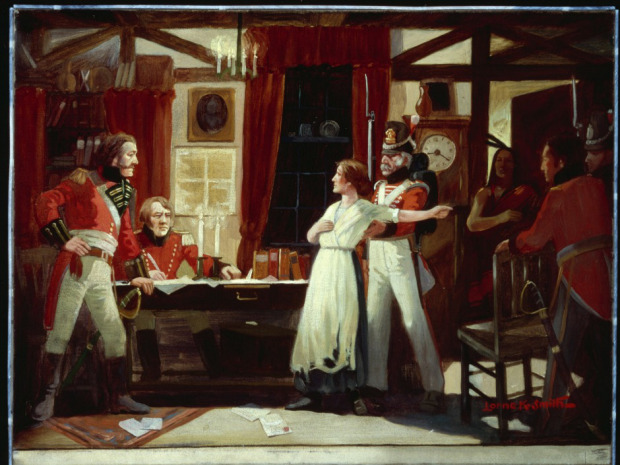
HandoutLaura Secord became one of Canada’s first heroes for warning of an impending American attack. featured in The War of 1812.

There is an unfortunate and dispiriting tendency in current culture to try and re-interpret the past. Oddly, it is deemed inappropriate to honour the events that made Canada a country and set the foundation for the culture we’ve become. We would prefer to condemn previous generations for lacking our own views, as if 19th century Canadians should somehow have shared the perspective of a future society they could never imagine.

The Liberals have shown an eagerness to roll back any initiative they view as too reflective of their Conservative predecessors. McCallum would do well to recognize that Canada’s history does not belong to any particular political party. He should be expanding efforts to acquaint Canadians with their history, not trying to erase it from guidebooks for the sake of a cheap political snub.

Source: Kelly McParland: McCallum’s plan to rewrite guide book is a historical stumble

Nine new MPs came to Canada as refugees or from current or past war zones |

Good profile of the backgrounds of this group of MPs:

Nine newly-elected MPs in the 42nd Parliament, which is considered the most diverse crop of MPs in Parliament’s history, came to Canada either as refugees or fled from war-torn countries.

Out of the nine, according to research conducted by John Chenier, former editor of <em>The Lobby Monitor</em> and now editor of ARC Publications, four came to Canada as refugees from war zones or suffered persecution and five immigrated to Canada from current and past troubled zones such as the Middle East or Pakistan.

The four MPs who came to Canada as refugees are: Liberals Arif Virani (Parkdale-High Park, Ont.) from Uganda; Gary Anandasangaree (Scarborough-Rouge Park, Ont.) from Sri Lanka; Maryam Monsef (Peterborough-Kawartha, Ont.) from Afghanistan and Ahmed Hussen (York South-Weston, Ont.) from Somalia.

The five first-generation immigrants from current and past danger zones include: Liberal MP Faycal El-Khoury (Laval-Les Iles, Que.) from Lebanon; Liberal MP Iqra Khalid (Mississauga-Erin Mills, Ont.) from Pakistan; Liberal MP Salma Zahid (Scarborough Centre, Ont.) from Pakistan; Liberal MP Eva Nassif (Vimy, Que.) from Lebanon, and Conservative MP Ziad Aboultaif (Edmonton Manning, Alta.) from Lebanon.

In total, there are 40 MPs from all parties who were born outside of Canada, according to Parliament of Canada website and research conducted by <em>The Hill Times</em>. Of these, 29 are Liberal, eight are Conservatives, two are NDP, and one from the Green Party.

Source: Nine new MPs came to Canada as refugees or from current or past war zones |

Time to rewrite Citizenship Act, ‘Lost Canadians’ advocate says

Don Chapman continues his crusade for the few remaining cases of ‘Lost Canadians.’

It appears that the main focus of his efforts is more with respect to posthumous recognition of Canadian citizenship and their descendants. There do not appear to be any hard numbers showing this is a significant issue (at least that I have seen) although there are a few anecdotes that he cites:

When it comes to immigration law, Prime Minister Justin Trudeau likes to say, “A Canadian is a Canadian is a Canadian” — but one advocate says it’s actually not that simple.

The Liberal government should be taking more steps to help law-abiding people whose road to citizenship is blocked by the existing law, said Don Chapman, a longtime champion for so-called “lost Canadians.”

It’s time for the Citizenship Act to be scrapped and rewritten, Chapman said — and he believes the upcoming 150th anniversary of Confederation is the perfect time.

For instance, a baby born to a Canadian woman outside the country’s borders would not have been deemed Canadian if the mother was married to a man of a different nationality, but would be if the mother was unmarried.

In 1977, an updated law created new issues. It established the concept of dual citizenship, but did not restore Canadian citizenship for those who lost theirs when they switched under the earlier law.

The consequences of these two pieces of legislation were people who became known as “lost Canadians” — mostly those who believed themselves to be citizens, but by law were not.

The act has been amended several times. There are now 18 definitions of what makes a person a Canadian citizen with more than a dozen caveats, linked to everything from what year they were born to whether their parents were Canadian diplomats or soldiers.

Still, Chapman said he hears from people nearly every day who have suddenly learned they aren’t citizens, or can’t get the decades-old birth certificates of their now-deceased parents to prove that they are. They end up in endless battles with the government or before the courts, and need a citizenship ombudsman who could help, speeding up the system at the same time.

And yet the first thing the Liberals did with the Citizenship Act was to restore the status of a convicted terrorist, Chapman said.

They did it with Bill C-6, introduced last month to revoke a provision of the existing law that allowed dual citizens to be stripped of their Canadian citizenship if convicted of terrorism or other crimes against the country.

A government spokesman said changes to the Citizenship Act in 2009 and 2015 restored or granted citizenship to the “vast majority” of lost Canadians.

And there are ways to address cases that weren’t covered, Immigration Department spokesperson Nancy Caron said in an email.

“The minister has the authority to grant citizenship on a discretionary basis to alleviate cases of special and unusual hardship,” Caron said. “Those cases are assessed on a case-by-case basis.”

Source: Time to rewrite Citizenship Act, ‘Lost Canadians’ advocate says | CTV News

Vision Vancouver pushes gender parity motion

One aspect of diversity but as the DiverseCityonBoard initiative makes clear, this challenge goes beyond gender given the increased (and increasing) ethnic diversity in our larger cities:

All City of Vancouver advisory committees could soon be required to have 50-per-cent female representation.

To mark International Women’s Day on Tuesday, Vision Vancouver Coun. Andrea Reimer plans to introduce a motion that would create a formal policy ensuring that at least half of all committee members are women.

Mayor Gregor Robertson indicated he’ll be supporting the motion, and hopes it will pass unanimously.

Reimer’s motion also calls for a review of how the city funds subsidized housing and social policy grants to make sure that women and girls are getting an equal share of services.

“While we often think of Vancouver as a progressive city, there’s more we could be doing to remove barriers to women and ensure that we are providing an equitable delivery of services,” Robertson said in a press release. “We continue to see women underrepresented in public life and in 2016 there’s no reason that should be acceptable.”

But unanimous support may not be possible. NPA Coun. Melissa De Genova said she has yet to decide which way she’ll vote on the motion, but she does have concerns about the 50-per-cent standard.

“We all would like to see more women become involved in our city and in our community, but I think perhaps we don’t agree on how we should get there,” she said.

Source: Vision Vancouver pushes gender parity motion