Express entry, foreign worker reforms attract ‘fewer’ skilled workers: chamber report
2016/01/16 Leave a comment
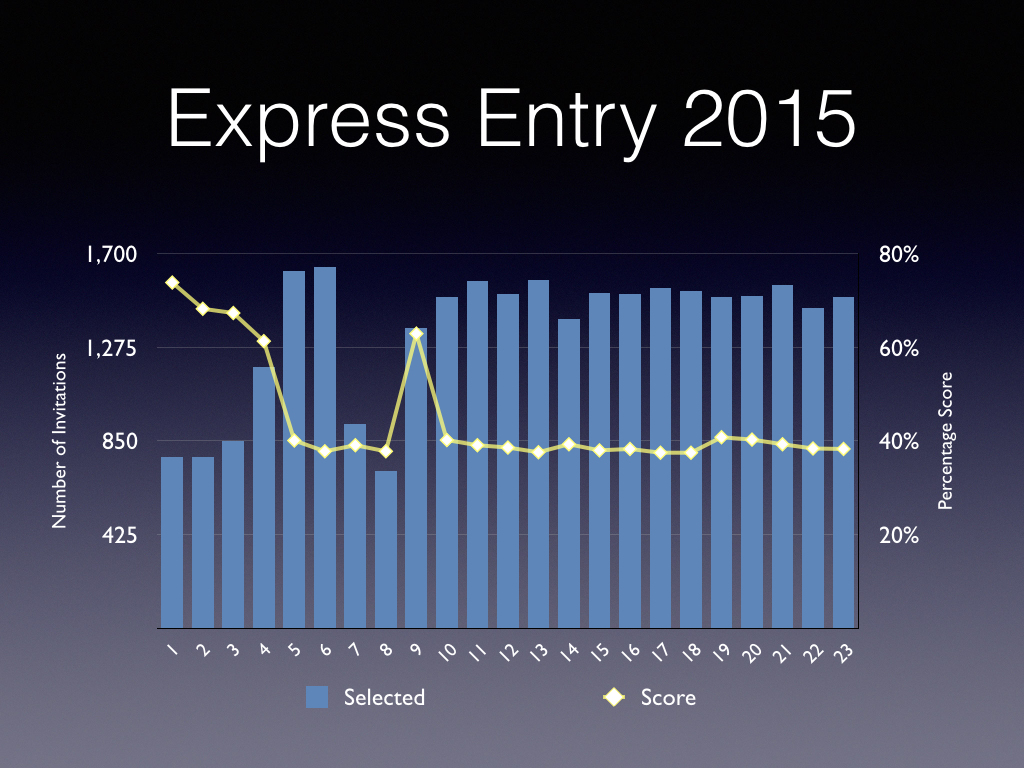 Another item on Minister McCallum’s to do (or at least consider) list, passage below on Express Entry (the above chart shows the 23 rounds in 2015, and how the program has settled at around 1,500 invitations per draw, with a minimum score of about 40 percent of the total possible 1,200 points):
“The concept of attracting ‘the best and the brightest’ is missing in action,” says the new report, “as the competitive model of Express Entry is currently undermined by the protectionist policy embodied in the labour market impact assessment tool.”
As CBC reported in September, businesses say the labour market impact assessment (LMIA) — a new requirement borrowed from the newly reformed Temporary Foreign Worker Program — is the biggest flaw with Express Entry.
Under Canada’s new immigration system, highly-skilled foreign workers not only have to line up a job before applying to come to Canada but their job offer has to be backed by what the government calls a positive LMIA. That assessment is a document all employers now need to hire a foreign worker over a Canadian one.
The chamber calls the introduction of this new requirement a “misstep” that has made it “extremely challenging” for businesses to attract highly-skilled workers such as video game developers, top-flight researchers and workers in the trades.
Chamber calls for ‘sober, thoughtful review’
The 32-page report titled “Immigration for a Competitive Canada: Why Highly Skilled International Talent Is at Risk” lays out what Canadian businesses see as “missteps” with the immigration changes and offers 20 recommendations.
The recommendations include:
-
Removing the new requirement of a labour market impact assessment from the Express Entry system.
-
Tweak the points system under Express Entry to benefit high skilled workers applying under the International Mobility Program.
-
Reduce processing times for study permits and visas.
 About Andrew
 Multicultural Meanderings