Douglas Todd: Racism, a word to use with care

Perspective from former British Columbia Premier and federal cabinet minister Dosanjh:

Suffering is difficult to compare — and the fact such global acts of racism are more enormous than what has happened in B.C. or Canada does not lessen the pain for those who have been discriminated against here.

Nevertheless, when former B.C. premier Ujjal Dosanjh first came to Canada almost 50 years ago, he was among the many newcomers who found the West Coast a “fair and inclusive” place compared to where he had been.

After growing up in the Punjab region of South Asia and later moving to Britain, Dosanjh was relieved to come to B.C. and get away from the exceptional “colour consciousness” and harsh caste system he had experienced in India.

The budding young lawyer was also pleased to leave behind the marauding “skin heads and teddy boys” of England, where maverick politician Enoch Powell had just made his infamous 1968 “rivers of blood” speech about unchecked immigration.

B.C.’s record in regards to racism is “not great historically,” says Dosanjh, who served in the federal Liberal cabinet following years as a provincial NDP cabinet minister and premier.

Still, Dosanjh believes it’s wise to put past incidents of B.C. racism into perspective.

“We have learned in B.C. And we’ve been moving forward, including on the First Nations file. To not acknowledge the distance we have come is to do an injustice to Canada,” he says.

Dosanjh remains painfully aware of the ruthless bigotry promulgated elsewhere today, and not only by ISIS. He knows hundreds of millions of India’s lower castes are still discriminated against as “unclean” and that China continues to brutally target Muslim ethnic minorities.

The term racism is often abused in Canada, Dosanjh believes. Last week he gained national attention, and applause, for challenging how Ontario Liberal Premier Kathleen Wynne tossed out the epithet.

When Wynne suggested people criticizing the federal government’s promise to rapidly bring 25,000 Syrian refugees to Canada were masking “racism and xenophobia,” Dosanjh said Wynne had “in one fell swoop” insulted not only him but the 67 per cent of Canadians who disagreed with the government.

Dosanjh believes Wynne was trying to silence Prime Minister Justin Trudeau’s critics by lobbing the often-misused word (which the Oxford Dictionary helpfully defines as “prejudice, discrimination, or antagonism directed against someone of a different race based on the belief that one’s own race is superior”).

Similarly, people of many ethnicities have charged Vancouver Mayor Gregor Robertson and the city’s housing developers with manipulating the racist label to shut down protests about the way international investors are fuelling Metro Vancouver’s astronomical housing prices.

In ethics, the principal of proportionality is key. In just-war theory, the response to an act of aggression should be proportional to the initial violence. In the courts, the punishment should fit the crime.

Is it possible that many charges about B.C.’s history of racism are disproportionate?

For his part, Dosanjh said he “doesn’t recognize” the portraits of a horrifyingly racist B.C. often painted by academics and activists.

“Some experts become vested in continuing to say what they’re saying even when things have changed. They focus on one thing to the exclusion of all else. It’s like a new religion; after it starts, it ossifies.”

Does it create unnecessary division to allege that racial intolerance has been worse that it actually has been?

It’s crucial to remain on guard and denounce racism whenever it arises. But, in the name of proportionality and building community, it’s also important not to exaggerate it.

Source: Douglas Todd: Racism, a word to use with care

Can’t Put Down Your Device? That’s by Design – The New York Times

Next time you can’t stop yourself looking at your various social media feeds and other apps, consider how companies are engineering such stickiness:

Tech companies tend to present these feedback loops as consumer conveniences. A new Intel TV ad, for instance, shows a young girl in the back of a car growing sad because the laptop on which she was watching a singalong video suddenly runs out of power. The company’s new battery-preserving processor, though, ultimately saves the day, “so you never have to stop watching.” T-Mobile has just introduced BingeOn, a feature that offers subscribers on certain plans unlimited high-speed access to popular streaming video channels.

An image from “Network Effect.”

There’s even an industry term for the experts who continually test and tweak apps and sites to better hook consumers, keep them coming back and persuade them to stay longer: growth hackers.

“How do you drive habitual use of a product?” said Sean Ellis, the chief executive of GrowthHackers.com, a software company specializing in online growth techniques. “It’s not just about getting new people. It’s about retaining the people you already have and, ultimately, getting them to bring in more people.”

As an example, Mr. Ellis described how he recently started using a free meditation app, called Calm, which has a calendar feature that gently nudges subscribers to use the service more. Every time he finishes a session, the app “shows me I’m doing one every three to four days,” Mr. Ellis said. “But it’s clear to me that I should be doing one every day, based on the graphic.”

Yet technologists like Tristan Harris, a design ethicist who is also a product philosopher at Google, warn that growth hacking, taken to its extreme, can encourage sites and apps to escalate their use of persuasive design techniques with potentially unintended consequences for consumers. He compares online engagement maximization efforts to the so-called bliss-point techniques some food companies have developed to hook consumers on a stew of fat, salt and sugar.

“The ‘I don’t have enough willpower’ conversation misses the fact that there are 1,000 people on the other side of the screen whose job is to break down the self-regulation that you have,” said Mr. Harris, who emphasized that he was speaking only for himself and not for Google.

Mr. Harris is also the co-director of an effort called Time Well Spent, which encourages tech companies to provide more choices for users who would like to limit session-prolonging techniques like autoplaying one video or song after another. He said he envisioned alternative app designs that might measure success not in followers, connections, endorsements or likes accumulated, but in meaningful relationships developed or desired jobs offered.

“Right now, many company leaders and designers would like to do these things differently, but the incentives aren’t aligned to do this,” Mr. Harris said.

Certainly, it may be difficult for efforts like Time Well Spent and art projects like “Network Effect” to sway companies that find themselves in increasingly heated competition for online users’ attention.

Source: Can’t Put Down Your Device? That’s by Design – The New York Times

Immigrants in Parliament, including cabinet ministers and just announced parliamentary secretaries | Canadian Immigrant

For those interested, and impatiently awaiting the updated Parliamentary MP listing with birthplace and birthdate info, Diana Manole went through google and other tools to piece together this list: 41 foreign-born MPs, 35 of which are visible minority.

Source: Immigrants in Parliament, including cabinet ministers and just announced parliamentary secretaries | Canadian Immigrant

Hollande’s plans to strip dual nationals of citizenship stirs the Left – France

Healthy debate to have:

French government plans to toughen security laws in the wake of the Paris attacks, which include stripping dual nationals of their citizenship, have come under fierce scrutiny from members within its own ranks. Lille mayor and former labour minister Martine Aubry has called into question the moral basis of the move.

“I’m not sure stripping dual nationals of their citizenship is absolutely necessary,” Martine Aubry told French TV channel BFM on Thursday.

The French government has introduced a raft of security measures since the Paris attacks on 13 November. The police has carried out over 2000 raids on suspects with terrorist links as part of new emergency state laws. Today President François Hollande wants the state to have even more sweeping powers, such as being able to strip dual nationals of their citizenship if they’re involved in terrorist offences.

The prospect has sent alarm bells ringing within his Socialist party, concerned that the Left is jerking dangerously towards the Right.

“Should we treat dual nationals born in France differently? Should we be suspicious of anyone whose parents come from abroad?” Aubry continued.

In essence, the former Labour minister is criticizing what she considers to be a knee-jerk reaction on the part of the president “to give the allusion that he’s going far enough.”

Her comments come three days before regional elections, in which the Far-right Front National is slated to win.

The Paris attacks have reshaped the context. The focus is now less on social issues–although unemployment is higher than ever according to fresh statistics published on Thursday-and now more concentrated on security. A growing number of candidates are opting for stringent security measures in their manifestos to compete with Marine Le Pen.

“It’s out of the question to let the Front National win,” Aubry added, pledging her “full” support to François Hollande in regional elections, of which the first round kicks off this Sunday.

The fact remains however, that she still has doubts on whether his security face-lift suits him.

Source: Hollande’s plans to strip dual nationals of citizenship stirs the Left – France – RFI

Refusal to grant British citizenship to extremist’s family ruled unlawful

Over-reach, not authorized by legislation (apart from the substance):

An unprecedented decision by the home secretary, Theresa May, to refuse British citizenship to the wife and children of a supporter of Osama bin Laden in order to deter other potential extremists has been ruled unlawful by the high court.

Mr Justice Ouseley quashed the refusal of British citizenship to the wife and two adult children of the Islamist extremist, who is a refused asylum seeker but cannot be deported to Egypt for fear he will be tortured.

The judge said May had acted unlawfully because parliament had not expressly provided that British citizenship could be refused to deter others from engaging in extremism in the future.

The Egyptian family, who have been in Britain since 1994, cannot be named and were referred to in court as HY, MM, GY and TY. The father has been described by the Home Office as an Islamist extremist and is listed by the United Nations as associated with al-Qaida through Egyptian Islamic Jihad.

The mother, aged 51, is bedridden and mainly lives with her husband, while their children, who are in their 20s, have left home and are following professional careers and have their own families. All were given indefinite leave to remain in Britain in May 2009.

The family’s barrister, Michael Fordham QC , told a hearing in October that the wife and children were “blameless individuals whose good character is unimpeachable” and were being blamed for the “sins of their father”, who was no longer regarded as a threat by the security services.

The judge said they were each regarded as being able to truthfully take the citizenship oath and pledge of allegiance in good faith. The Home Office said there were “no lurking doubts” or reasons to suspect they were in any way involved in extremism.

…Robin Tam QC, for the home secretary, said British citizenship was a privilege and not a right, and it was not irrational to deny it as a deterrent to individuals connected by blood or marriage to those who had engaged in extremist activities.

Ouseley did not agree. He said there was “real unfairness in refusing naturalisation to someone who qualified in all other respects, in order to provide a general deterrent to others, over whom the applicants had no control”.

The judge said that if parliament had ever intended the home secretary to use such a discretionary power, it would have expressly provided for it. He said the effect of her approach, which he said was unprecedented, was to force applicants to choose between family and British citizenship in order to deter others from extremist activities.

Source: Refusal to grant British citizenship to extremist’s family ruled unlawful | UK news | The Guardian

Contracts trump culture — Iranian woman doesn’t have to return dowry after leaving marriage: Ontario court

Rule of law prevails, appropriately without accommodation:

Reliance on cultural norms is no substitute for explicit contract language when giving a gift or transferring property, Ontario’s top court ruled Wednesday.

The decision comes in the case of a young Iranian couple in Ottawa whose marriage fell apart after the bride received a dowry — also known as a mahr — from the groom’s family.

“A wide variety of cultures and their norms and traditions form an integral part of the Canadian mosaic,” the Appeal Court ruled.

“They cannot simply be imported into a transaction involving the transfer of real property by reference to a concept such as ‘dowry,’ which forms a part of a particular culture or tradition.”

A wide variety of cultures and their norms and traditions form an integral part of the Canadian mosaic

Ahmad (Reza) Abdollahpour and Shakiba Sadat Banifatemi married in Ottawa in March 2012. According to Iranian custom, his family gave the bride a dowry that included a 50 per cent stake in a house they owned. They transferred the ownership by way of a deed of gift.

After they separated in December 2013, Abdollahpour and his family wanted the property back. Banifatemi refused and the Abdollahpours sued.

The groom’s family argued the transfer was part of the dowry and that Iranian culture and tradition dictated that Banifatemi would have to return the gift if she left the marriage.

A year ago, Ontario Superior Court Justice Robert Smith sided with the former bride, prompting the former groom and family to appeal. They argued Smith was wrong to find the gift was given unconditionally.

In upholding the ruling, the Appeal Court noted the two families had negotiated the property transfer before the marriage — after receiving independent legal advice — — and that the lawyer for the groom’s family described the transfer as a “wedding gift to both kids.” In addition, the deed of gift, which was formally registered, stated that the groom’s family was transferring “irrevocably” the property to the bride.

As such, the Ontario Court of Appeal concluded, everything pointed to an intention by both sides that the transfer was both irrevocable and unconditional, and that there was no indication of any expectation of a return if the marriage broke down.

It simply isn’t good enough, the Appeal Court concluded, to insist after the fact that cultural expectations formed part of an agreement unless explicitly noted, or that merely listing a gift as part of a dowry is sufficient to create an implied set of conditions related to traditional norms.

Source: Contracts trump culture — Iranian woman doesn’t have to return dowry after leaving marriage: Ontario court

Expats may have Harper Tory restrictions on voting dropped, Liberals say

To be watched – I think the current 5 year rule is appropriate (it was instituted in 1993 and the social contract reasoning of the Court decision makes sense). Moreover, not clear how many expats would in fact vote (see earlier Reframing the debate over expat voting: Russell and Sevi, Globe editorial for the numbers):

The new Liberal government wants more Canadians to vote in elections and won’t be reviving measures proposed by the former Conservative regime that critics said would have the effect of suppressing voting, the Prime Minister’s Office said Wednesday.

At the same time, a spokesman for the PMO said the government had made no decision on an existing law currently subject of a court battle that effectively disenfranchises expats abroad for more than five years.

“We will be able to clarify our intent in the coming months,” Olivier Duchesneau, deputy communications director in the Prime Minister’s Office, said in an email.

“But we believe that more Canadians should have the ability to vote, not the opposite.”

Two expat Canadians in the United States launched a constitutional challenge to rules in the Canada Elections Act that bar them from voting from abroad. They were initially successful in Ontario Superior Court in 2014, but the province’s Court of Appeal sided with the Conservative government in July.

The two are now waiting to see if the Supreme Court of Canada will take up their case. In the interim, they have called on Prime Minister Justin Trudeau to withdraw the government’s defence of the legislation if the top court does agree to a hearing.

The PMO said no decision has been made on the litigation or the existing legislation, but made it clear the Citizens Voting Act or Bill C-50 proposed by the former government would stay dead.

Among other things, it tightened ID and registration requirements for voters living abroad. The Conservatives argued it was aimed at preventing fraud, but critics said it would make it harder for expats to vote.

The bill, introduced last December by then-democratic reform minister Pierre Poilievre in response to the initial court decision, passed second reading in May and was being debated in committee. The legislation died on the order paper when the election was called.

“The government is committed to scrapping the Citizens Voting Act,” Duchesneau said.

Source: Expats may have Harper Tory restrictions on voting dropped, Liberals say

Don’t want to pledge allegiance to the Queen? Seek comfort elsewhere: Macleans editorial

More commentary on the recanting of the reference to the Monarchy in the citizenship oath:

It would be easier to be annoyed with Bar-Natan’s hypocrisy if he was less effusive in his praise for his new homeland. “I’m definitely proud to be a Canadian,” he told the Canadian Press after the ceremony. “It’s a wonderful country, a truly wonderful country, with one small iota that I disagree with.” That said, Canada is not an à la carte proposition in which new citizens should be encouraged to sign up for the bits they like and ignore the rest. Anyone who finds the totality of Canadian democracy repulsive is welcome to seek comfort elsewhere. Perhaps in time Bar-Natan will come to realize the bothersome oath to Queen Elizabeth the Second that irks him is actually an essential component of Canada’s remarkable tradition of freedom, tolerance and diversity.

When Britain took control of Quebec following the 1759 Conquest, Canada’s “citizens”—the 70,000 or so habitants who suddenly found themselves British subjects—were initially required to take an anti-Catholic “Test Act” oath to vote or hold public office. Concern for the rights of his French-speaking, Catholic citizenry led Quebec governor Guy Carleton to replace this offensive religious obligation in 1774 with a uniquely Canadian compromise: a secular oath pledging allegiance instead to the Crown. This early expression of Canadian constitutionalism allowed the Canadiens to participate fully in society and guaranteed their freedom of religion.

Today’s oath is a direct descendant of Carleton’s innovation. It is a deliberate effort to mould an inclusive society out of diverse parts—and the very reason Bar-Natan can become a Canadian while at the same time expressing dissent, however sanctimoniously. We should be celebrating this remarkable history of toleration, not disavowing it.

Source: Don’t want to pledge allegiance to the Queen? Seek comfort elsewhere

Canadian Encyclopedia: 30 immigrant groups to Canada

Good list and background information (click on the story to see timeline and links):

To celebrate its 30th anniversary, The Canadian Encyclopedia created 30 lists of 30 things that make us proud to be Canadian, from famous people and historic events, to iconic foods and influential artists. Read more of their lists here.

The various waves of migration to Canada over the course of its history have made the country what it is — a mosaic of peoples of diverse backgrounds. In 2011, Canada’s foreign-born population was approximately 6.8 million people, or 20.6 per cent of the total population — the highest proportion among G8countries.

Canada’s checkered history of immigration has included instances of outright discrimination (see Komagata MaruChinese Head TaxMS St. Louis) as well as genuine humanitarian heroics; Canada is the only nation to receive the United Nations Refugee Agency’s Nansen Award, in recognition of its efforts to resettle 60,000 Vietnamese refugees.

Source: Canadian Encyclopedia: 30 migrant groups to Canada – Macleans.ca

ICYMI: Ex-immigration minister Atkey urges Canada to double intake of Syrian refugees

A historical reminder and it appears the Government is listening:

As Canada braces for the arrival of 25,000 Syrian refugees, the man who served as immigration minister during the Vietnamese boat people crisis says Ottawa should be doing much more.

Ron Atkey believes the 25,000 Syrians Ottawa is promising to re-settle initially is a “noble objective” but he wants Canada to up the ante.

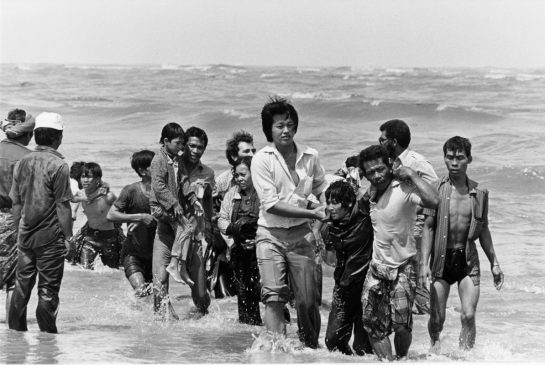
“If Canada can do another 25,000 — that would make a significant contribution in line with Canada’s contribution with the Vietnamese boat people in 1979 to 1980. It will demonstrate to the Americans that they have to do more. We’ll shame them into it, similarly the Australians,” says Atkey, who was immigration minister in the Joe Clark government in 1979 when 50,000 Vietnamese refugees were granted asylum in Canada. By the end of 1980, that number had risen to 60,000.

Canada admitted 60,000 Vietnamese refugees in 1979 and 1980.

Canada admitted 60,000 Vietnamese refugees in 1979 and 1980.

“For us to take a dramatic position on the world stage is important. We won a medal from the United Nations High Commission for Human Rights. We gained a lot of prestige as a humanitarian country. I think that’s consistent with Canadian tradition.”

Atkey, who is also a lawyer, professor and national security expert, is chair of Humanity Wins, a group of prominent Canadians who came together earlier this year to advocate for re-settlement of Syrian refugees to Canada.

Source: Ex-immigration minister urges Canada to double intake of Syrian refugees | Toronto Star