Q&A: Master of None’s Aziz Ansari on ‘ethnic’ casting, Netflix & making revolutionary TV

On my ‘to watch’ list:

Launched on Netflix two weeks ago, Master of None has already been become one of the most talked-about shows of the year. It’s been hailed as the show that aging Millennials have been waiting for, the show that put an end to the last acceptable ethnic cliché, a show that subverts masculinity, and a food-stuffed triumph; it’s the new Louie, the new Sex and the City. Aziz Ansari, the co-creator, co-writer and co-director of this mult-headed Hydra of amazingness,spoke to Sarmishta Subramanian about how he and his co-creator, Alan Yang, did it.

Reviews of your show have been ecstatic. People have really responded to it. Why do you think that is?

It’s making a narrative of our comedic viewpoint. Master of None is really me and Alan’s perspective, and I guess it resonated with a lot of people.

For me, as an Indian, it was like watching Indians on television for the first time. It was a revelation. Have you heard that from other people? 

That was a point of the show. Me being Indian and him being Taiwanese, we could finally do an episode like “Parents” [which tells the backstory of the parents of Ansari’s character, and stars the actor’s parents] or “Indians on TV.” We were in a place that was so creatively friendly like Netflix; we also had the experience to tell a story like that, to get it right. What other show would have the impetus to do an “Indians on TV” episode? None, really.

It’s partly the specificity of it that’s ground-breaking. You never really see a Bengali or a Malayali or someone from Tamilnadu; it’s just “Indians.”

Yeah, that’s what I love. There are little things I’ve seen so many people respond to, such as my dad saying poda or ayyo or talking about pappadums, these little cultural things you haven’t really seen. Usually, it’s not an Indian person running the show, so there’s no one with that background to draw from.

Were you frustrated as a viewer by the generic way Indians are usually represented?

Yeah, that montage at the beginning of “Indians on TV” sums it up. But it’s not just Indian people—it’s everybody. The point with Master of None is: Everyone is an interesting, compelling person who goes beyond their ethnic background, their accent. We’re all three-dimensional characters.

A lot of times, characters of certain ethnicities are reduced to these two-dimensional, cardboard, stereotype roles, where their traits are very generic, and specifics of their ethnicities are painted with very broad strokes. It’s very insulting, and people don’t really get it right often. It’s pretty incredible that Ashton Kutcher did that brownface thing and didn’t get more flak for it. It’s pretty insane.

A big thematic point of Master of None is that there aren’t easy answers to these things and there don’t need to be. It’s more about having a conversation about it. A lot of the episodes were written with us in the writers’ room having long discussions about race or sexism or old people.

It’s not just a mix of races. In very subtle ways, the show also crosses age and class and sexual-orientation boundaries, but never in an over-the-top way. 

That’s one of the advantages of structuring the show the way we did, as opposed to a four-piece ensemble every week. The show is really about: What’s [Ansari’s character] Dev going to find himself doing this week? And which characters can we bring in to help that story? Sometimes it’s that this episode is called “Old People,” and let’s just have him hanging out with Rachel’s grandma the whole episode and you don’t see the other friends. You probably couldn’t do that on a normal show, because they’d say you’ve got to have all the friends still there. It gets annoying, because, in real life—and people have responded to this—you don’t have lunch with the same four people every day; you don’t see the same four people every weekend. People weave in and out of your life.

The casting for the show is almost—almost—over-the-top diverse. Two Indians is too many? How about an Indian guy, a Taiwanese guy, a black lesbian—

[Laughs] It wasn’t done in this way of a United Colors of Benetton ad. It was done in a very genuine way. The Brian character is based on Alan, the co-creator of the show, so he’s a proxy for him. Denise—we had an open call for that character. We told our casting person, Alison Jones, “Let’s meet with interesting people.” I read with so many women, and Lena [Waithe] was the funniest, and it just so happened she was an African-American lesbian woman, so we totally adapted the character to her. And Wareheim—Eric Wareheim—who plays Arnold, he is a good friend of mine in real life and he’s really funny.

Source: Q&A: Aziz Ansari on ‘ethnic’ casting, Netflix & making revolutionary TV

Liberals will find key to undoing Harper’s agenda in his infamous ‘firewall’ letter | Ottawa Citizen

A good in-depth and must read piece by Andrew Potter on how the ‘firewall’ letter was implemented from Ottawa, and the tactics behind implementation of the ideology:

Data: It wasn’t privacy, as Tony Clement said, or freedom, as Max Bernier argued, that was the real rationale for killing the mandatory long-form census. It was to throw a whole lot of noise into the demographic signal that the census had been giving for decades. That is also why Statistics Canada as a whole was gutted over the course of the Harper years. Without accurate data, social planners are flying blind.

Expertise: No government in living memory has been as hostile to experts and to evidence as the Harper government. But as Laval economist Stephen Gordon recently argued, it wasn’t all forms of expertise and evidence that gave the Tories hives – plenty of their economic initiatives were rooted in the best available evidence. What the Tories were allergic to was expertise that steered the evidence in directions they didn’t want to go – “committing sociology,” in Harper’s wonderful turn of phrase. That is why scientists were muzzled, policy shops were shuttered and bureaucrats were ignored.

Money: Here is the meat in the sandwich. When it comes to social planning, the ultimate source of Ottawa’s power is the spending power. And this is where Harper had his greatest success. By the end of his tenure as prime minister, Ottawa’s spending, as a share of GDP, had fallen to levels not seen since the middle of the 20th century. And the spending that does remain is overwhelmingly devoted to either just keeping the lights on or takes the form of transfers to the provinces and individuals.

Harper’s policy genius here was the two-point cut in the GST, which currently costs the federal treasury about $12 billion a year. Harper’s political genius was the creation of an all-party and pan-Canadian consensus around the virtues of a balanced budget at that historically low-level of federal spending.

No data, no experts and no money. Starve the beast, but make it blind and deaf at the same time. This is Harper’s “Ottawa Firewall” in a nutshell.

‘Flat-tire federalism’

As long as Harper was in power, this firewall against centralized social planning was bound to be highly effective. The question is, what remains of this agenda with a Liberal majority in power in Ottawa?

The long-form mandatory census is back, just under the wire. Another missed census in 2016 would have gummed up the data for generations, but as it stands, it looks like the 2011 asterisk will remain just that.

The scientists have already been unmuzzled. The public servants have been asked for their advice. The policy shops are staffing up and stocking the shelves and will be open for business soon.

But what about the money? This is where things get tricky for the Liberals. Their commitment to running three relatively small deficits to build infrastructure and kick-start growth caught everyone in the chattering classes off guard, and turned out to be a political winner.

But the promise was to return to balance by the last year of their mandate. That is, they accepted the basic premise of balanced budgets at more or less current levels of federal revenues (their tax plan calls for additional revenues of just $3 billion). This isn’t nearly enough, and there is not enough economic good weather in the offing for Ottawa to grow its way to good times.

An Ottawa with lots of data and lots of policy ambitions but no money is going to be pretty ineffectual.  At some point, the Liberals are going to have to tackle the revenue problem. Without money, without the fiscal capacity to get things done, all the data and expertise and policy advice is just squiggles on a page and vibrations of air molecules.

A federal government that is nicer, less controlling, more transparent but still broke is not one that has much capacity to bother the provinces with socialist schemes. And if that’s where things remain, then Harper’s long-term victory will be cemented, regardless of who is in power.

Source: Liberals will find key to undoing Harper’s agenda in his infamous ‘firewall’ letter | Ottawa Citizen

How the crazies and the pundits give IS exactly what it wants: Tabatha Southey

Great piece by Southey, and take down of those who should know better (David Frum) and those who don’t (Ezra Levant), although she is being unfair to Premier Wall:

Also working overtime for IS’s PR machine this week was former speechwriter for President George W. Bush and current senior editor at The Atlantic, David Frum. Despite the fact it appears that none of the people involved in the Paris massacre were Syrian refugees (statistically, refugees are among the groups least likely to commit acts of terror), Mr. Frum tweeted: “We must accept these peace-loving refugees from ISIS or else they will get very angry and try to kill us.”

What was the thought process there, Mr. Frum? “Good morning, I helped to provide justification for the Iraq war but I still don’t have quite enough blood on my hands, so I’d like to take a moment to characterize an entire nation of people as terrorists, thereby helping to ensure that the most vulnerable among them will suffer”?

Were you simply constrained by Twitter’s character limit there, Mr. Frum? Basic human decency and professionalism were clearly not issues for you.

Mr. Frum’s tweet may literally be the worst joke ever made, and it would be even if it didn’t spread just the kind of disinformation that actual IS murderers labour to disseminate.

What he should know, or admit to knowing, is that IS is not overly keen on Syrians escaping Syria. The optics are bad.

If you’re trying to position yourself globally as a utopian caliphate, Muslims running away from you as fast as they possibly can at grave risk to their lives is seriously bad press.

Muslims fleeing, not embracing you as an even marginally better alternative to the government that won’t stop bombing them, does not look good, and IS is acutely aware of this; no one wants would-be Syrian refugees kept in Syria more than does IS.

David Frum, among others, appears happy to help them out. David Frum: Unpaid Intern of The Islamic State of Iraq and Syria.

There’s method to IS’s macabre dramaturgy. They want to be depicted as the authentic Muslims, as some evil mystical empire with whom the West is at war, and volunteers queue up to help them.

In reality, IS’s progeny is recruited more at the malls than at the mosques and, in both their youthful demographic and their disaffection distorted into a kind of grotesque idealism, the recruits can seem more like murderous groupies than anything else.

In mentality and, to a certain extent, military capability, IS is more massive Manson family than major martial force.

Their lifeblood is the gratuitous message amplification so many proffer.

Big IS shout-out to Saskatchewan Premier Brad Wall, as well, for helping to stigmatize Syrian refugees and for suggesting that the appropriate response to terrorist intimidation tactics is to drop everything and be intimidated.

That’s exactly what his calls for additional security screening of Syrian refugees on top of the measures already in place do – measures that Michel Coulombe, director of the Canadian Security Intelligence Service, this week called “robust … and appropriate.”

The grassroots efforts on IS’s behalf should not be overlooked this week, either; every vile, racist tweet sent is like a bake sale held on IS’s behalf; and, speaking of sales, Sun TV detritus YouTube channel, Rebel TV, is offering black-and-white, very much IS-on-brand “Fuck ISIS” hats, T-shirts and coffee mugs.

This Christmas, Rebel TV wants you to say it with massacre merch.

Former Sun TV personality Ezra Levant high-tailed it to Paris this week to whine that its citizens continue, in the aftermath of last week’s horror, to be philosophical and resolutely secular, and to drink wine in the cafés. Why must they be so French?

Mr. Levant, disappointed rage-tourist and unofficial ambassador for the IS agenda, did not seem to like the fact that the attacks did not bring Paris to its knees. He is perturbed by your joie de vivre, France, by your determination to not let terrorists change you into a vicious, angry, funhouse mirror of your attackers.

President François Hollande announced the country will accept 30,000 refugees as planned.

Vive la France, and, terrorism dilettantes, go find meaningful employment.

Source: How the crazies and the pundits give IS exactly what it wants – The Globe and Mail

Saunders: Avert extremism before it starts by building better neighbourhoods

Good in-depth piece by Doug Saunders on the lessons learned from an international study on integration, directed by Manjula Luthria of the World Bank, and how they may avoid future faultiness in Canadian multiculturalism and integration:

The first set of barriers is physical, involving housing, neighbourhoods and transportation.

It’s important to allow immigrants and refugees, after their initial settlement, to join clusters of other people from the same background, in places where they can help each other out. A strong body of research has shown that integration happens faster and more effectively when immigrants settle in common districts. Isolation tends to breed alienation (and, in English-speaking countries, extremism tends to emerge from isolated individuals in non-immigrant neighbourhoods; “ethnic” districts are less prone to extremism)..

The second group of barriers are institutional: those that prevent immigrants from having their credentials recognized, their health care and social crises addressed, and that stand in the way of their children getting the education and assistance they need.

Absolutely crucial here are schools: Too many school systems have built-in incentives for children – especially male offspring of immigrants – to drop out early. While Canadian cities have considerable experience with educating classes of mixed experience (and we know these mixes are good educationally, for both newcomers and established Canadian students), many school boards today are providing only one teacher per class. A larger class size with multiple teachers and teaching assistants offering several levels of education is a recipe for inclusion….

Third are economic barriers. Key here is small business. Previous immigrant groups have succeeded in Canada and other Western countries because they’ve been able to set up shop, in an ad hoc way, without many bureaucratic or legal barriers. This is tougher today: It is increasingly difficult for immigrants to find low-cost spaces on streets with pedestrian traffic, in which they can start a business; they often live in areas where there are few such spaces at all. When they do get a space, they discover that licensing, regulatory and hygiene requirements often impose impossible costs on a small-scale business: The need to install, say, a $40,000 ventilation system has scuppered many a promising immigrant food enterprise….

Fourth are citizenship and inclusion barriers, both legal (the ability to become a citizen) and de facto (the ability to participate in the community and have access to the resources of the government with or without citizenship). There is probably nothing more threatening to integration than having a large population living in your city on a more or less permanent basis without a pathway to full, legal citizenship…

Germany learned this the hard way, when two million Turks went 40 years without access to citizenship, and became an isolated, lost generation who couldn’t invest in their communities or futures. (In recent years, German Turks have become citizens in greater numbers, and now are becoming a success story.) The United States is still learning this with its 12 million long-term residents, many of them born in the U.S. These people are “illegal,” and thus lack the privileges of citizenship, including full education access. The result: an enormous lost opportunity.

Ambitious immigrants, if they don’t know they’ll become citizens, won’t invest in their communities, start legal businesses, put their kids in higher education or enter the financial or political system: They’ll be stranded. Whether we call them “illegal aliens” or “temporary foreign workers,” we’re risking failed integration – not just for them but for the wider community around them – if we put up barriers to citizenship, inclusion, voting and economic participation.

….

The most successful and non-controversial refugee groups are those that are transformed, as quickly as possible, into regular “economic” immigrants: If they’re included quickly in the employment, education and housing systems of the established immigrant community, they will be more likely to stabilize their lives, give up their temporary mindset and become valuable members of their communities.

If we fear for the futures of our newly settled refugees – or worry that the 300,000 immigrants who settle in our cities every year won’t live the Canadian dream of the previous millions – then we need to step back and look at what has worked. We need to follow the dotted line that leads from a faraway country, through a low-cost neighbourhood somewhere, into the centre of our economies and lives. And we need to see where that line may be interrupted, and restore its path. Integration is something that happens, naturally, if we provide the right footholds.

Source: Saunders: Avert extremism before it starts by building better neighbourhoods – The Globe and Mail

Le problème de cette majorité francophone | Le Devoir

More on Quebec debates and how Premier Couillard is addressing them:

L’accueil par le Québec de réfugiés syriens a inspiré à Philippe Couillard des réflexions sur l’intolérance des peuples, intolérance sur les braises de laquelle il accuse le Parti québécois et la Coalition avenir Québec d’avoir soufflé. Des commentateurs y ont vu un dérapage partisan. Or, il n’a fait que révéler le fond de sa pensée.​

Dans son discours d’ouverture du conseil général du Parti libéral du Québec il y a une semaine, Philippe Couillard a lancé : « Non à la xénophobie et au racisme, non à la fermeture et l’exclusion, oui à l’accueil, oui à la citoyenneté partagée. » Le sujet : l’accueil des réfugiés syriens et une bannière déployée à Québec pour s’y opposer.

Le lendemain, dans son discours de clôture, le chef libéral s’enhardissait en parlant de l’intégration des nouveaux arrivants : il a dénoncé la proposition du PQ — en fait, de Jean-François Lisée — d’imposer un délai d’un an à un nouveau citoyen canadien avant qu’il obtienne le droit de vote au Québec, question d’empêcher Ottawa de tricher. Quant à la CAQ, Philippe Couillard lui reprochait cette idée aussi singulière qu’inapplicable d’imposer aux immigrants un examen de français et de « valeurs » trois ans après leur arrivée : un échec mènerait à l’expulsion.

Le PLQ se présente comme le parti « de l’inclusion », comme l’a dit son chef, « celui d’une citoyenneté ouverte et partagée ». Le corollaire, c’est que le PQ et la CAQ ne le seraient pas. Dimanche dernier, le président de la Commission-Jeunesse du parti, Nicolas Perrino, a bien résumé dans son discours cette nouvelle posture des libéraux. « Les Québécois de tous les horizons savent que notre parti est le seul qui refusera toujours de céder aux fantasmes populistes d’un autre temps. Ils savent que notre parti se méfiera toujours de ceux qui prétendent promouvoir l’affirmation identitaire de la majorité en brimant les droits fondamentaux des minorités. Ils savent que notre parti défendra toujours les libertés individuelles et notre culture sans jamais verser dans l’intolérance et l’exclusion. »

Dans la conférence de presse de clôture du conseil général, Philippe Couillard a développé sa pensée. Tant le PQ que la CAQ « ont un lourd passif » en matière d’accueil des immigrants. « Parfois, et même parfois involontairement, en adoptant certaines politiques qui semblent faciles, qui semblent répondre à ce qu’on croit être le souhait de la population, on pose des gestes qui attisent les braises de ces démons qu’on a chez nous comme partout ailleurs », a-t-il fait observer. Devant l’intolérance, « j’ai toujours eu cette inquiétude », devant ces « démons », présents dans toutes les sociétés démocratiques, « dont la peur de l’Autre, dont la tentation facile du rejet de l’étranger, dont la xénophobie ».

À l’Assemblée nationale mardi, le chef de la CAQ, François Legault, a bien tenté d’obtenir de lui une rétractation. En vain. Jamais, jamais il ne se rétractera parce que c’est précisément ce qu’il pense, confirme-t-on dans son entourage. Ce ne sont pas là des exagérations partisanes servant à chauffer des militants qui se délectent des attaques du chef à l’endroit des adversaires politiques.

Aux yeux de Philippe Couillard, l’hypocrisie du PQ était manifeste durant ce qu’il appelle « cet épisode très regrettable de la charte des valeurs ». En prônant une neutralité religieuse qui s’incarne dans les employés de l’État, le PQ a sciemment exacerbé les sentiments xénophobes du peuple et il a divisé les Québécois.

Deux conceptions

Le débat sur cette charte, appuyée par une nette majorité de francophones à l’époque, ne confrontait pas deux conceptions légitimes du vivre-ensemble — entre les visions d’un Guy Rocher et d’un Charles Taylor, par exemple. Pour les détracteurs de la laïcité de l’État comme Philippe Couillard, le débat opposait les défenseurs des droits et libertés à une majorité pusillanime qui gonfle les muscles en brimant les minorités ; les Lumières de l’interculturalisme, l’ouverture à l’Autre étaient confrontées à l’ignorance nauséabonde d’une plèbe un brin raciste et obtuse.

À l’instar de Bouchard-Taylor, Philippe Couillard a toujours soutenu qu’il n’y avait pas eu de crise des accommodements raisonnables. Il a affirmé que la pratique était aujourd’hui bien balisée et que la charte péquiste ne réglait que des « problèmes imaginaires ». Ce qui ne va pas, c’est la majorité francophone. Il faut définir une « nouvelle identité québécoise », avait-il fait valoir alors qu’il était candidat à la chefferie du PLQ.

Source: Le problème de cette majorité francophone | Le Devoir

Douglas Todd: Immigration fraud on a grand scale

Douglas Todd on the recent immigration fraud trial and verdict (while fraud and misrepresentation need to be countered, the overall number in percentage terms is small – see earlier “Protecting Canadian Citizenship” – Citizenship Fraud Update – Numbers Still Small):

[Judge] Harris could not find another Canadian immigration scam that matched “the scale of that perpetrated by Mr. Wang,” a former insurance agent and father of two who previously had no criminal record.

In determining Wang’s sentence, the judge took into account the punishments meted out in a range of earlier migration scams.

One case involved a man who imported 6,000 fake Alberta drivers’ licences. Another Ontario man filed 150 tax returns falsely claiming his clients lived in Canada, so they could obtain child-tax credits.

A woman in another case counselled au pairs on more than 100 occasions to lie to work in Canada. A B.C. woman was convicted of 16 counts of “arranging sham marriages between Chinese nationals and Canadians.” An Ontario duo arranged impostors to take English-proficiency tests for would-be immigrants with no ability in the language.

But how could Wang have pulled off a covert scheme involving more than 1,000 illicit would-be immigrants for eight years?

Barry Cartwright, senior lecturer in Simon Fraser University’s criminology department, said immigration fraud is “hard to catch. It’s expensive. It’s time consuming. And it’s resource-consuming.”

Even though Cartwright is not aware of a criminal case as extensive as Wang’s, the immigration specialist said he knows of larger questionable schemes involving loopholes in the immigration policies of Ottawa and Quebec, especially those to do with investor-class immigrants.

While Cartwright doesn’t want to take away from the value of Canada welcoming what he estimated to be the “nine out of 10” immigrants who end up contributing to the country, he said it’s difficult for officials to carefully screen applicants when “you’re bringing in almost 300,000 immigrants a year, or 25,000 refugees in two months.”

At his sentencing hearing, Wang’s lawyer argued his client’s punishment should be lenient since there was no “breach of trust.” The lawyer said the people who enlisted Wang’s services did so with “their eyes wide open.”

The judge, however, countered that Wang did not mastermind “victimless” crimes. The innocent children of his clients, he noted, could now be deported.

The judge also suggested the country’s entire immigration and taxation systems were victims of Wang’s elaborate cheating.

Wang’s subterfuge, Harris said, undermines whatever confidence Canadians have in the immigration process and is keenly relevant to “today’s age of international terrorism” and people smuggling.

In weighing Wang’s contributions to mass tax avoidance, Harris quoted Supreme Court Justice Peter Cory, who maintained the vast majority of Canadians who pay income tax by way of payroll deduction have little or no opportunity for evasion.

“Those who do evade the payment of income tax not only cheat the state of what is owing to it, but inevitably increase the burden placed upon the honest taxpayers. It is ironic that those who evade payment of taxes think nothing of availing themselves of the innumerable services which the state provides by means of taxes collected from others.”

In further justifying Wang’s seven-year sentence, Harris quoted B.C. Appeal Court Justice Sunni Stromberg-Stein, who said those who facilitate illegal migrants into Canada put an “astronomical cost” on the Canadian taxpayer, “fuel racial prejudice and racial tension” and “adversely impact all aspects of Canadian society.”

Even though Wang pleaded guilty, he has launched an appeal of his jail sentence.

Source: Douglas Todd: Immigration fraud on a grand scale

Regional differences in the educational outcomes of young immigrants

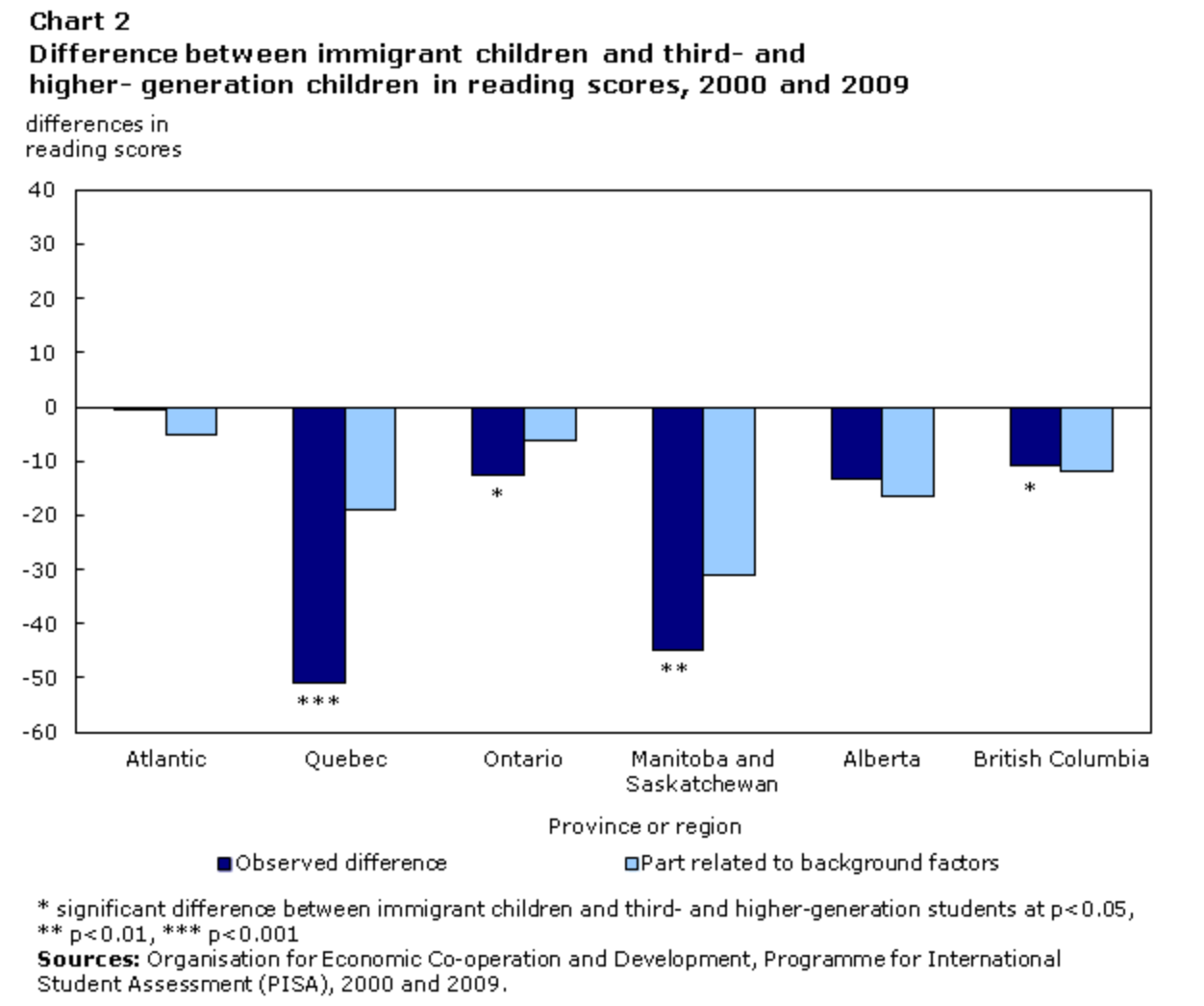
Immigrant Math Scores by RegionInteresting study comparing the educational outcomes of immigrant children and third-generation or more Canadians. The findings regarding Quebec are particularly worrisome, given implications for longer-term integration:


This article examines regional differences in the math and reading skills of immigrant children aged 15 based on data from the Programme for International Student Assessment (PISA). It also examines regional differences in high-school and university completion rates among young immigrants who came to Canada before the age of 15 using National Household Survey (NHS) data. Throughout the article, comparisons are made with the children of the Canadian-born (third- or higher-generation Canadians).

  • In Canada, the average PISA math score of immigrant students aged 15 was similar to the score of third- or higher-generation students. The average PISA reading score of immigrant children was slightly lower than the score of third- or higher-generation children.
  • In almost all regions, immigrant students had lower PISA reading scores than third- or higher-generation students. With respect to PISA math scores, immigrant students performed better than third- or higher-generation students in the Atlantic provinces and British Colombia, but performed less well in Quebec and in Manitoba and Saskatchewan.
  • Young immigrants aged 20 to 24 were more likely to have a high school diploma than their third- or higher-generation counterparts (93% versus 87%). Young immigrants aged 25 to 29 were also more likely to have a university degree (40%, compared with 26% of third- or higher-generation individuals in this age group).
  • Manitoba and Saskatchewan (29%) and Quebec (32%) had the lowest proportions of immigrants aged 25 to 29 with a university degree. In contrast, British Columbia (44%) and Ontario (41%) had the highest proportions.
  • Regional differences in the source countries of immigrants explained, in part, why some regions had higher university completion rates than others.

Immigrant Reading Scores by RegionSource: Regional differences in the educational outcomes of young immigrants

Trudeau’s Liberals more in line with Canadians’ fundamental values: Ekos Poll

Not surprising, as most polling during the election showed Conservative over-reach was off-side general Canadian values:

Graves said his polling found that after 10 years in power, Stephen Harper’s Conservatives were facing “growing tension” between what they stood for and the basic values espoused by Canadians.

“I really believe that the election shifted from being an important election about the economy to a historic election about values.”

His conclusion is supported by another poll EKOS conducted Oct. 8-12. Canadians were asked to identify the “most important factor” that would determine their vote.

Forty-seven per cent said it would be the choice that best reflects their values; 33 per cent said it would be a party platform or ideas; 10 per cent said it would be the party leader; and eight per cent said it would be the local candidate.

Canadians were asked about the “choices” that best describe their “vision” of Canada. Sixty four per cent cited humanitarianism and development versus 23 per cent who opted for defence.

Sixty-three per cent favoured active federal government, while 23 per cent supported “minimal government.”

And 57 per cent favoured “reason and evidence” over the 24 per cent who stood by “moral certainty.”

“I think people got fed up,” Graves said of voters.

“They were really resentful to not only this indifference, but hostility, to science and to reason. It was a very strident anti-intellectualism and it didn’t fit well. It’s not where Canadians were.”

Source: Trudeau’s Liberals more in line with Canadians’ fundamental values: Poll | Ottawa Citizen

Québec s’attaque à la radicalisation: Loi 59

The evolution of Loi 59 – refreshing to see a government open to amendments for proposed legislation:

La ministre de la Justice, Stéphanie Vallée, a dévoilé des dizaines d’amendements — tenant sur plus de 40 pages — à son projet de loi anti-discours de haine afin de l’inscrire formellement dans la « lutte contre la radicalisation ».

« Le discours haineux, c’est un discours qui peut s’inscrire dans un processus de radicalisation, malheureusement », a-t-elle souligné dans un bref entretien avec Le Devoir près d’une semaine après les attentats de Paris.

D’ailleurs, le libellé de la version amendée du projet de loi, soumise aux élus de la Commission des institutions jeudi, a été inchangé depuis les attaques dans la Ville Lumière, a-t-on assuré au Devoir.

Le projet de loi 59 prohibera les discours haineux et les discours incitant à la violence tenus ou diffusés publiquement, mais également les « enseignements » du même registre, visant un groupe de personnes identifié à l’article 10 de la Charte des droits et libertés de la personne — femmes, homosexuels, minorités visibles, groupes religieux, etc. —, a annoncé Mme Vallée jeudi.

Suivant les recommandations des juristes de l’État, l’élue libérale s’était abstenue de définir le concept de « discours haineux » dans la version originale du projet de loi, ce qui lui avait valu de nombreuses critiques. Elle a remédié à cette lacune. « Aux yeux d’une personne raisonnable, [le discours haineux] est d’une virulence ou d’un extrême tel qu’il est susceptible d’exposer ce groupe à la marginalisation ou au rejet, à la détestation, au dénigrement ou à l’aversion, notamment pour que ce groupe soit perçu comme étant illégitime, dangereux ou ignoble », peut-on lire dans la nouvelle mouture du document.

D’autre part, Mme Vallée a ajouté une disposition au projet de loi permettant aux cégeps de résilier un contrat d’utilisation d’un local si le locataire a un « comportement qui peut raisonnablement faire craindre pour la sécurité physique ou psychologique des étudiants ainsi que celle des personnes qui sont présentes dans le collège »« C’est une mesure [dictée par le] gros bons sens », a-t-elle fait valoir, près d’un an après le départ de jeunes fréquentant les classes du prédicateur Adil Charkaoui au Collège Maisonneuve pour aller grossir les rangs de groupes djihadistes.

Par ailleurs, Mme Vallée a retiré l’obligation faite à la Commission des droits de la personne et des droits de la jeunesse (CDPDJ) de tenir à jour une « liste noire » ou « liste de la honte » recensant les personnes épinglées pour discours haineux ou incitant à la violence dans le projet de loi.

Elle a également enlevé la peine minimale de 1000 dollars à laquelle celles-ci s’exposaient. La ministre laissera le loisir au Tribunal d’« imposer une ou plusieurs mesures de redressement » comme une « lettre d’excuses »« Il peut arriver qu’un discours haineux soit tenu par une personne dans une situation de vulnérabilité extrême [ou] un jeune, un mineur », a précisé Mme Vallée au Devoir.

Source: Québec s’attaque à la radicalisation | Le Devoir

The two faces of the Syrian crisis: a toddler and a tech titan, earlier fears of Vietnamese refugees

Anne Kingston, on the different images we have of refugees and how that reflects on us:

That a dead toddler and a tech titan have become the faces of one of the world’s worst refugee crises is telling. Where the Daily Mail and their ilk rely on dehumanizing refugees, those who are sympathetic have wound up making them unrealistically ultra-human. Most refugees, no matter where from, are not adorable small children. And odds are low that they or their progeny will revolutionize technology, create neat products people the world over clamour to buy, or contribute billions to the economy. They usually end up working jobs beneath their training and education. Some end up driving taxis, which is what Steve Job’s biological father did.

We search for unifying image to make sense, to rally around. But which images resonate with us says a great deal. One of the emblematic images from the Paris attack was the “Paris for Peace” symbol, the spontaneous illustration by a French artist. The other is a haunting photograph  by Associated Press photographer Jerome Delay of a body lying on the sidewalk outside the Bataclan Theater covered by a blanket, illuminated by lamplight. It is also a powerful tribute to humanity. All that is known about this unnamed person is that only hours earlier he or she was enjoying life in a jubilant crowd listening to music, before, in a  flash becoming a victim of  life’s circumstance. All we know that he or she was human, which in the end is all that should matter.

Source: The two faces of the Syrian crisis: a toddler and a tech titan – Macleans.ca

And Martin Patriquin reminds of the parallel worries that existed with Vietnamese refugees:

Of course, no system is perfect. Nothing is. All we can do is rely on historical precedent. Despite widespread concerns, neither increased criminality or a communist insurgency accompanied those 60,000 Vietnamese refugees. Today, Canada’s Vietnamese population stands at about 220,000—less than a third of the National Citizens’ Coalition’s dire prediction. Among them are politicians, writers, artists and Olympians. If this is anyone’s nightmare, it’s Chairman Mao’s.

Syria undoubtedly poses a security risk. Yet it takes a particularly blinkered sort of logic to come to the conclusion that its people are terrorists in waiting. Again, a bit of history: Canada has accepted roughly 2.5 million refugees and immigrants over the last 10 years alone, according to Statistics Canada data. The country’s Muslim population has doubled every one of the last three decades. And yet the two Islamist terrorist attacks, including that on the Parliament buildings last year, were perpetuated by born-and-bred Canadian converts to that religion.

No, Syrians are running because they are desperate. According to the Syrian Network for Human Rights data, close to 200,000, including 20,000 children, have been killed since 2015—the vast majority by the Syrian regime. If it isn’t the regime they are fleeing, it’s the hundreds of armed groups that constitute the rebellion against it. Time only means more bloodshed. Right now is the worst time to be thinking the worst of Syria’s myriad victims.

The fault with fearing refugees