Loewen: Support for Conservatives’ niqab ban is deep and wide, even among immigrants
2015/10/13 Leave a comment
Analysis by Peter Loewen
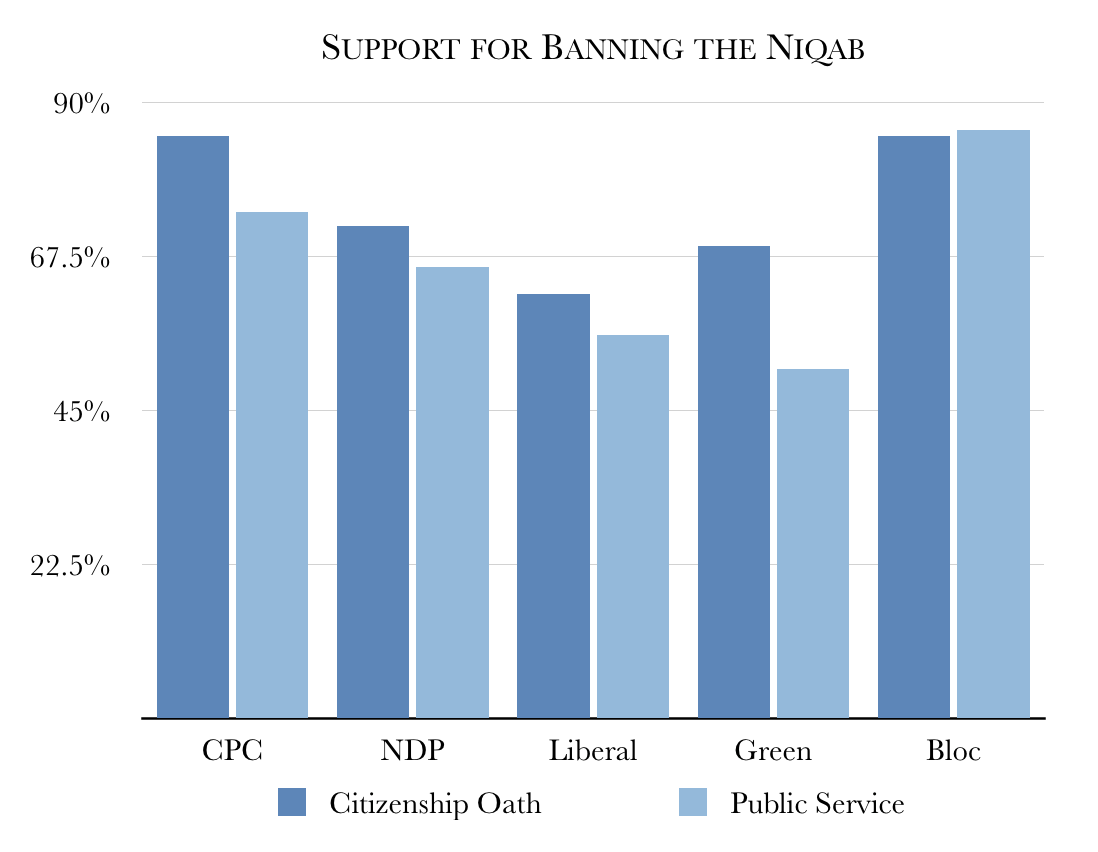
Interesting analysis by Daniel Robinson and Peter Loewen on the changing voting patterns of immigrant voters and the niqab, providing more analysis than in Doug Saunders synopsis (How Tories win immigrant votes using anti-immigrant messages). The chart above compares party supporter views:
On the citizenship oath measure, 72 per cent of Canadians agree. Just 14 per cent disagree. (Another 14 per cent either don’t know or are ambivalent.) This opinion is not isolated to “old stock” Canadians. Among those citizens born outside the country, 70 per cent agree with forcing women to reveal their faces.
… It is a similar story when we ask whether the public service should ban niqabs. Sixty-four per cent of people we surveyed support such a ban. Just 19 per cent oppose it. Support is undiminished among immigrants, where two-thirds (66 per cent) would support a ban and just 16 per cent would not. …
Some have noted that the niqab is an effective issue, not only because it garners wide support but also because it is largely irrelevant to voters. It is, at best, a useful distraction. But this misses something important about voters: they often take their cues from politicians about what is important. By the time we surveyed voters, the niqab had been a point of discussion for more than two weeks. When we asked our respondents how important the issue is to them, 78 per cent indicated that the niqab in citizenship ceremonies is a somewhat or very important issue. We got the same results when we asked about a niqab ban in the public service.
We now have a situation in which opinion-leaders – newspaper columnists, pundits, commentators – almost uniformly insist that a policy is both wrong and unimportant while voters disagree on both accounts.
Our data tell a broader story about multiculturalism and Tory support. Political scientists – especially André Blais and Richard Johnston – have long noted that the 20th century dominance of the Liberal party was attributable to outsized support among Catholics and visible minorities, perhaps especially immigrants (to the extent that those categories overlap). Consequently, the Tories have spent considerable effort courting various groups of immigrants to their party.
Data from both the 2011 Canadian Election Study and Ipsos-Reid’s massive 2011 exit survey suggest that the Tories may have finally closed this “immigrant gap” in the last election. Our data suggest that they have now not only closed the gap, but have created a significant advantage of their own among immigrant Canadians.
To test this, we calculated the odds of Canadians voting Conservative that controls for a respondent’s age, income, education and gender, province of residence and, importantly, religion.
The results, which draw on massive sample sizes, show that a native-born citizen has a 27 per cent likelihood of voting Conservative. The likelihood for an immigrant Canadian voting Conservative is 34 per cent.
Because we controlled for religious affiliation, we can also estimate these effects. Compared to the non-religious, Jews and non-Orthodox Christians have a greater likelihood of voting for the Conservative party. But among Muslim Canadians, there is a clear aversion to the Conservative Party of Canada.
The niqab has become a campaign issue in this election, and perhaps the issue. The are several reasons for this, but public opinion research points to one of the more important ones: given the consistent, widespread support across the political spectrum for the Conservatives’ stated position, the Tories can only stand to gain from the issue playing prominently in the public discourse.
 About Andrew
 Multicultural Meanderings