Memorial Univ prof refuses to wear device for hearing disabled student, cites religious reasons

Hard to believe. And should her religion (unspecified) or religious beliefs not allow her to wear a transmitter, this has to be balanced against the right of the student to hear her lectures, which in my mind should prevail:

In 1996, CBC News reported that MUN sided with a student who filed a similar complaint against Panjabi for refusing to wear one based on religious reasons.

Panjabi was also reprimanded in 1985 for a similar complaint.

While in each of those cases Memorial University sided with the students, so far the Sears family has been given no clear solution.

Sears’s father, Bill Sears, told CBC Radio he is not satisfied with what he has heard from both MUN and the university’s centre for disabilities.

“All we know is that it’s going through the channels in there, but we have had no feedback,” he said.

“The Blundon Centre said they would work with the professor if William really wanted to stay in class, to come up with compromise — but to me, the compromise is that she wears the FM system. I don’t get the idea of her refusing.”

Bill Sears said he has been in touch with the Canadian Hard of Hearing Association and the Newfoundland and Labrador Human Rights Commission, which are both looking into the matter.

He said knowing what his son has had to go through in his life with regards to his hearing problems, only to face this now in what is supposed to be a place of higher learning, is deeply disturbing.

“To see him denied education is an absolute travesty. At university, to run into this situation — it blows my mind,” he said.

“I’d love to see where it is written that you can’t wear a microphone because of religion.”

Given that Panjabi appears to be a repeat offender, perhaps stronger disciplinary action is needed.

The Conservatives’ veiled pitch for the anti-Muslim vote: Delacourt

Delacourt has it right, both in terms of substance and politics:

What we have here is a textbook case of saying one thing and doing another in politics. The ‘saying’ part is for all the wrong reasons — the ‘doing’ part is for the right ones.

I suspect the Conservative government realized several years ago that it was legally impossible to ban veiled voting. Two attempts were made between 2007 and 2011. Both quietly died on the order paper.

Here’s why: It would amount to singling out certain members of the population for restricted rights. We do allow people to vote in Canada without showing their face at the ballot box — through proxies, or mail-in special ballots. How do you write a law that says some people don’t need to show their faces, but others do?

Moreover, a special law to prohibit the niqab would stomp all over Canadians’ rights to religious expression. That’s probably why the Justice Department lawyer felt he had to point out the non-mandatory aspect of the legislation in Federal Court.

Rather than explain this to Canadians, though, the Conservatives took the path of blustering about niqabs and sending dog-whistle signals to people uncomfortable or fearful about Muslims. Bad statesmanship. Easy politics, though.

We saw that earlier this year, as well, when the Conservatives sent out a fundraising email asking supporters to sign up if they agreed that it was “offensive” to wear a niqab or a hijab at citizenship ceremonies. The email left little doubt that the Conservatives were whipping up these sentiments for reasons of purest electoral politics.

The note was signed by Immigration Minister Chris Alexander and stirred up some controversy with his interchangeable use of ‘niqab’ and ‘hijab’; one is generally associated with full-face coverings, while the other, the hijab, is commonly used to describe a head covering.

To make things even more confusing, not all Conservatives have been using the word “offensive” when it comes to garments of religious expression. Kenney, for instance, said on Twitter in 2013: “A child is no less Canadian because she or he wears a kippa, turban, cross, or hijab to school.” Kenney sent out that missive in the midst of the Quebec debate over the wearing of religious symbols in public.

There’s still a month left in this election and it’s entirely possible that one of the eleventh-hour Conservative campaign promises will revolve around banning veiled voting — again. It would fit well with this week’s bluster on citizenship ceremonies.

This time we might ask them: Why did the last two attempts quietly die? Are they serious this time, or is this just another attempt to whip up some good old-fashioned intolerance?

What’s really being veiled here by all this talk about the niqab?

Source: The Conservatives’ veiled pitch for the anti-Muslim vote

Flight and Freedom: Refugee Stories

Flight and Freedom, the book of refugee stories by Ratna Omidvar and Dana Wagner, is now out.

I read a proof copy and find their book to be a timely and well-needed counterpart to much of the rhetoric around refugees through its highlighting the remarkable personal stories of thirty refugees who have, and continue, to contribute to Canada. These stories make a compelling case for a more generous approach, reminding us of the potential cost of more restrictive approaches, particularly germane in the context of today’s Syrian refugee crisis:

What does escape look like up close? Why do people choose Canada? And once they land in a safe country, what happens next?

In Flight and Freedom, Ratna Omidvar and Dana Wagner draw on 30 astonishing interviews with refugees to Canada to document their extraordinary journeys of flight, and to transform a misunderstood group into familiar, human stories.

Each of the 30 stories documents an escape that is sometimes harrowing and always remarkable. The narrative then turns to contemporary lives and careers, and the impact of refugees-turned-Canadians in the communities they call home, from Halifax to Vancouver.

Stories focus on Canadians who arrived as refugees from notable conflicts around the world, from the War of 1812 to the ongoing War in Afghanistan. Beyond conflict zones, other stories profile people from persecuted groups like gay men and women. At the time of escape, some refugees were children, others were parents, and others got out alone. Notwithstanding the diverse events of a story, the single overriding imperative for all characters can be summed up in one sentence: “We have to run.”

Closing the book is a question: Would they get in to Canada today? Peter Showler, lawyer and former chairperson of the federal Immigration and Refugee Board, answers the hypothetical question by analyzing how the cases would be handled under Canada’s new refugee system.

Source: About the Book – Flight and Freedom

ICYMI: Whose Neighborhood Is It? – The New York Times

Tom Edsall on some of the integration challenges in the US and the progress that has been made:

These suburban Detroit communities provide a case study in what has come to be called the “tipping point,” the point at which whites begin to leave a residential locale en masse as African-Americans or other minorities move in.

This phenomenon puzzled Thomas Schelling, a professor emeritus of economics at Harvard and a Nobel Laureate, who was struck by the lack of stable integrated communities. In 1971, he began work on a mathematical theory to explain the prevalence of racial segregation in a paper titled “Dynamic Models of Segregation,” published in the Journal of Mathematical Sociology.

Schelling’s famous thesis has been carefully summarized by Junfu Zhang, an economist at Clark University. Zhang writes:

Schelling’s most striking finding is that moderate preferences for same-color neighbors at the individual level can be amplified into complete residential segregation at the macro level. For example, if every agent requires at least half of her neighbors to be of the same color―a preference far from extreme―the final outcome, after a series of moves, is almost always complete segregation.
In other words, residential segregation can emerge even if initial preferences are very slight.

According to Schelling, Zhang writes,

“in an all-white neighborhood, some residents may be willing to tolerate a maximum of 5 percent black neighbors; others may tolerate 10 percent, 20 percent, and so on.

The ones with the lowest tolerance level will move out if the proportion of black residents exceeds 5 percent. If only blacks move in to fill the vacancies after the whites move out, then the proportion of blacks in the neighborhood may reach a level high enough to trigger the move-out of the next group of whites who are only slightly more tolerant than the early movers. This process may continue and eventually result in an all-black neighborhood.

Similarly, an all-black neighborhood may be tipped into an all-white neighborhood, and a mixed-race neighborhood can be tipped into a highly segregated one, depending on the tolerance.”

In the years since 1971, scholars have followed up on the Schelling argument with empirical studies.

Residential and public school integration remain an immense challenge. Affordable housing, one piece of the integrative process, got a boost from a favorable Supreme Court decision in June, Texas Department of Housing, that further empowers plaintiffs in housing discrimination cases. A second boost came from new HUD regulations issued in July requiring local governments “to take significant actions to overcome historic patterns of segregation, achieve truly balanced and integrated living patterns, promote fair housing choice, and foster inclusive communities.”

Government action has often been resisted but, over time, it has pulled millions of blacks into the mainstream of American life. From 1940 to 2014, the percentage of African-Americans ages 25 to 29 with high school degrees rose from 6.9 percent to 91.9 percent. Over the same period, the percentage of blacks with college degrees grew from 1.4 percent to 22.4 percent. From 1963 (a year before enactment of the Civil Rights Act of 1964) to 2015, the percentage of blacks employed in management, professional and related occupations more than tripled, from 8.7 percent to 29.5 percent.

Although progress toward racial and ethnic integration has been sporadic – frequently one step forward, two steps back – credible progress has been made over the last 75 years. We have not come to the end of the story, but there are grounds for optimism.
Source: Whose Neighborhood Is It? – The New York Times

Missing the Point of Charlie Hebdo. Again. – The Daily Beast on satire

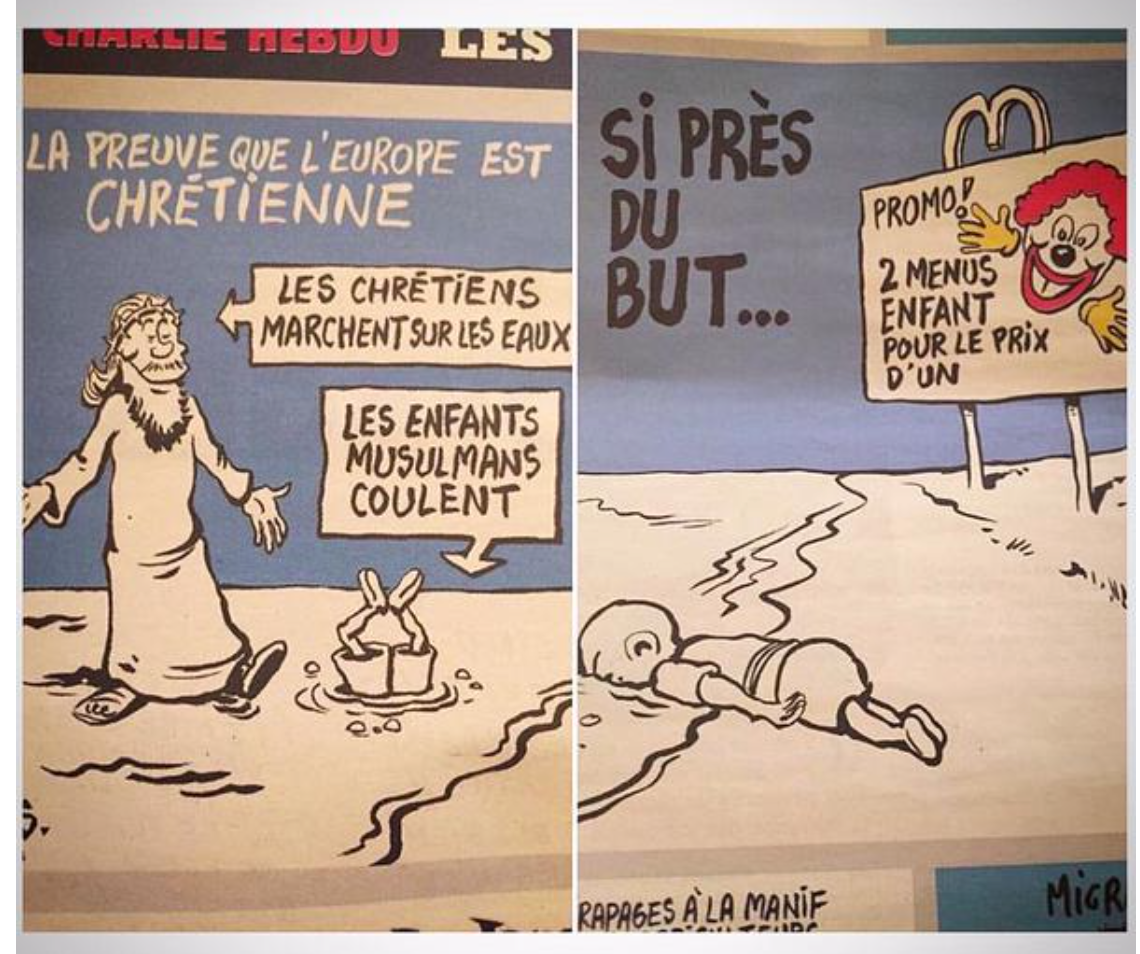
Charlie_Hebdo_RefugeesGreat point on once again how many critics of Charlie Hebdo don’t get satire (the offending cartoon above):

Satire is, by definition, offensive. It is meant to make us feel uncomfortable. It is meant to make us scratch or heads, think, do a double-take and then think again. It is supposed to take our prejudices, turn them upside down, reapply them, and make us think we’re seeing something we’re not, until we stop to question ourselves.

Yes taste is always in the eye of the beholder. But that’s the whole point of goodsatire. It is not meant to be to our tastes. It is meant to challenge our tastes. Having our fundamental assumptions about life challenged is never a comfortable thing. Bringing this back to the subject at hand, far from insulting him, these cartoons about Aylan are a damning indictment on the anti-refugee sentiment that has spread across Europe. The McDonald’s image is a searing critique of our heartless European consumerism, in the face of one of the worst human tragedies of our times. In particular, this image plays on the notion that while we moan there are not enough resources to cope with the influx of refugees, we simultaneously offer two for one McDonald’s Happy Meals to our own children. The image about Christians walking on water while Muslims drown is — so — critiquing what the magazine views as hypocritical European Christian “love” and truly bigoted claims, such as Hungarian Prime Minister Viktor Orban’s, that Europe is a “Christian” civilization.

Hebdo is no more racist a magazine than that bastion of liberal media The New Yorker was when it depicted Obama dressed as a Muslim, fist-bumping his angry black-revolutionary wife Michelle.

Not to our taste? Okay. Make us cringe? Fair enough. Don’t like them? Fine. But whatever we do, let us not misrepresent these images. Juxtaposing images of a dead child next to offers of cheap food “meal deals” is not mocking little Aylan, it is mocking us. It is mocking us for what we miss every single day, hidden in plain sight, and we do not see it because this is how desensitized we have become to human suffering. No, those besieged, brave satirists at Hebdo are not mocking Aylan. They are mocking newspaper covers like this from the UK right-wing tabloid The Daily Mail in which an image of Aylan was — in a national newspaper —  placed below an actual food deal. And how many of us noticed that on the day this Daily Mail cover went to print?

Poe’s law refers to a standard by which satire can be judged to be too good, where parodies of extreme views are so well performed that they are indistinguishable from the real thing. Yes, if those courageous disturbers of our conscience at Charlie Hebdo — those who survived the massacre that is —- are guilty of anything, it is that they are too good at their job.

Source: Missing the Point of Charlie Hebdo. Again. – The Daily Beast

Court clears way for Zunera Ishaq to become a Canadian citizen with her face covered by a niqab

Weird legal strategy, suggesting this was a wedge-issue all along (substantively, I agree with the Government that the wearing of a niqab at a citizenship ceremony is inappropriate):

The Harper government’s rule banning face coverings at such ceremonies was earlier found unlawful by the Federal Court.

Justice Department lawyer Peter Southey argued unsuccessfully that the lower court justice made errors in his original decision to overturn the ban.

Appeal Justice Mary Gleason said the court had no reason to interfere with the earlier ruling.
The ban on face coverings sparked a bitter debate in the House of Commons when it was first announced.

At Tuesday’s half-day hearing in Ottawa, a Justice Department lawyer told court that the government never meant to make it mandatory for women to remove their face coverings for citizenship ceremonies — a position that left both the judge and Ishaq’s lawyers scratching their heads.

The admission appeared to be a climb down from the Conservative government’s past position on the issue.

The controversial edict was a regulation that had no actual force in law, Justice Department lawyer Peter Southey told a Federal Court of Appeal hearing.

“It indicates a desire in the strongest possible language,” Southey said — an argument that appeared to come as a surprise to Justice Johanne Trudel.

“I cannot see how this is not mandatory,” Trudel said during the hearing.

Southey later told the court that the immigration minister was conceding that he “could not impose a mandatory rule in a guideline” for the purposes of this appeal.

Lorne Waldman, the lawyer for the woman at the centre of the case, dismissed Southey’s argument, saying everyone from former immigration minister Jason Kenney , his successor Chris Alexander and even Prime Minister Stephen Harper have said in public they see it as a mandatory policy.

Reading from internal government emails, Waldman told court there was not “one iota of discretion” within the policy.

“Everything says mandatory, no discretion — that’s the facts of the case.”

The controversial case focuses on whether a Muslim woman should be required to remove her face covering to take the oath of citizenship.

Outside court, Ishaq questioned the federal government’s new line.

“If it’s not mandatory I would simply say, why they are fighting for it? Just let me go,” she said.
“I can’t even make sense of the statement — what the lawyer said about it that it’s not mandatory. If it’s not mandatory, so why that all this fuss is for?”

 The Government has announced that it plans an appeal to the Supreme Court and we will see whether it maintains the same (baffling) legal arguments or comes up with stronger ones. Or whether this is simply an electoral ploy.

Mr. Harper, think big on the refugee crisis: Former Ministers and Deputy Ministers

Reprinted in entirety (see article for impressive list of signatories):

Bravo that Conservative Leader Stephen Harper is now preparing a new plan for Canada’s response to what has emerged as the worst refugee crisis in Europe and the Middle East since the end of the Second World War. Perhaps he has heard the many voices across Canada – provincial premiers, mayors of municipalities, faith leaders, non-profit organizations and ordinary citizens – wanting to act but stymied by the reality that the key lever for further progress is within the hands of the federal government.

As former federal ministers and deputy ministers, appreciative of what it takes to translate political announcements into realities, we urge Mr. Harper to think big and not let the exigencies of the election campaign diminish the call to action. There is nothing in the caretaker convention, followed during election campaigns, to stop government from responding to a crisis – particularly when there is all-party support.

Mr. Harper can turn to his professional public servants with their past successful history of managing Bosnian, Ugandan, Kosovo, and Indochinese mass movement of refugees. He can ask them to determine Canada`s maximum capacity for absorption of individuals now streaming into Lebanon, Turkey, Jordan and Europe. Under the Public Policy provisions of the Immigration and Refugee Protection Act, the government can launch a significant new humanitarian Syrian refugee resettlement program. Its goal should be to increase the overall Canadian commitment to numbers of refugees and significantly simplify administrative burdens for both private sponsors and immigration officials.

Mr. Harper can ask officials in the Departments of Finance, Treasury Board, Citizenship and Immigration, Defence and Foreign Affairs to ascertain the financial and human resources required and set those aside. The public record of the contributions of the previous waves of past refugee settlement programs demonstrate the long-term returns to Canada from what may, in the short term, look like significant costs. The government can engage with provincial governments, who are also committing resources, to maximize the effectiveness of all efforts. It is short term investments which will be critical to the success of the program: there will be ample payback for an adequate number of visa and security officers in the field for refugee selection, for professionals to expedite medical clearances and security assessments, and for transportation costs and staging areas in Canada when the refugees arrive. Pending full program implementation, the government can ensure ”all hands on deck” in fast-tracking existing applications, particularly those with family connections in Canada.

We appreciate that the world has changed. We share concerns about the protection of the security of Canadians in the post-Sept. 11 world – but security cannot be an excuse for inertia. In addition to providing adequate screening personnel in the field, security risks can be mitigated by a focus on women at risk, families with children, and families with Canadian connections. Canada can also now benefit from positive changes since earlier humanitarian programs. Social media and other information technologies now exist that were not dreamt of 30 years ago to enable rapid information sharing and decision-making – whether in identifying security risks or refugee resettlement. In contrast to the 1970s, there is a substantially increased cross-Canada network of highly experienced and motivated municipal, provincial and non-profit newcomer settlement agencies ready to act and be proactive partners.

Nor should Canada’s commitment to continuing the fight against Islamic State stop humanitarian initiatives. Public policy often has multiple objectives and there is no reason the two cannot proceed on parallel tracks. We understand that the challenge seems daunting when one considers there are now more than four million refugees. Perhaps in this context, a quote from Mother Teresa is appropriate: “I alone cannot change the world, but I can cast a stone across the waters to create many ripples.” Will Mr. Harper lead Canada in throwing that stone?

Source: Mr. Harper, think big on the refugee crisis – The Globe and Mail

Growing up Muslim: an individual story, a universal tale – Zarqa Nawaz

Gender equality, Islam and Canada:

I was always secure in the feeling that Canada was home and I was Canadian. That security gave me time to look into the practices of my community with a critical lens. When the National Film Board approached me to make a documentary, I chose to focus on patriarchy and the social exclusion of women in mosques. In 2005, Me and the Mosque was released. For me, Islam was never the problem – it was men and how they interpreted faith to their own advantage. I wondered what would happen to a mosque if it were run by an imam that came from a culture committed to gender equity, such as Canada. That was the question I explored in Little Mosque on the Prairie.

At first, the show wasn’t received well by the Muslim community. It was considered offensive and insulting to Islam. I was a pariah for a long time and I still bump into people who say I’ve given a bad impression of Muslims.

But I’ve seen those attitudes change toward me. The community no longer sees me as someone who is mocking the faith, but as someone who genuinely loves Islam but wants a critical dialogue about some of the cultural practices that have seeped in over the centuries. I am considered one of the few Muslims in the world who have successfully bridged the worlds of faith and comedy. But I would never have been able to do this had I lived anywhere else in the world.

In Pakistan, I would have been killed by now; in Europe, I would have been too broken by xenophobia and rejection to even try; the Islamophobic, post-Sept. 11, 2001, world of the United States would have stopped me cold. It was only Canada, where I truly felt I belonged and was cherished as a Muslim, where I could safely poke fun at both my Muslim and non-Muslim worlds.

My faith is different from that of my parents; we are forged by our environments and circumstances, which are radically different. And my children are different from me still. But we are all Canadian and have changed Canada, and Canada has changed us, all for the better.

Opinion: Let’s welcome refugees generously, but abandon multiculturalism: Julius Grey

I don’t think Grey understands multiculturalism in Canada – it is not deep, based on collective or group rights, but shallow, based on individual rights and within the overall constitutional and legal framework and that provides accommodation within that context, precisely as he describes his ideal:

This means that generosity and hospitality are not only morally right, but are also the prudent and most advantageous attitudes to take. Certainly, the flow must be regulated so that the health and education systems of home countries are not overwhelmed and the immigrants are integrated smoothly and fairly. Planning is needed at an international level to distribute the new arrivals and to determine the rate of movement. However, the building of walls and the use of military force will cause suffering and achieve nothing.

When Anglo-Saxons, Celts, Viking and Norman French created the English and Gauls, Latins and Germanic Franks created the French, the results were permanent and irrevocable because the constituent groups were fused. Those who fear multiculturalism are not entirely wrong. A better model, especially with vast movements like the present one, is complete integration and inter-marriage with a new culture evolving that contains contributions from all. If groups merely coexist side by side, sooner or later a crisis develops and is exploited by demagogues to breed hate.

When the coming great migration occurs — and the current crisis is only the tip of the iceberg — it will be necessary for the host state to become totally neutral on religious questions, but also to provide a single system of schools, hospitals and social services for all. Individual accommodation that encourages attendance at public institutions is a positive thing, but collective or institutional accommodation is not.

Further, the host countries should adopt laws similar to Quebec’s in order to maintain a common language for all, while encouraging knowledge of other languages. The abandonment of multiculturalism will assuage fears that lead people to support anti-immigrant parties and will create a solidarity around social issues that is often absent in divided societies. It will also encourage individual autonomy and freedom, since everyone will have a different shade of skin colour and an individual family history, free from dogma and from pressure to live in any particular way or to marry any prescribed type of person.

Freedom and social justice both depend on our ability to create a society which has, on the one hand, citizens of myriad origins and, on the other, no barriers between them.

Source: Opinion: Let’s welcome refugees generously, but abandon multiculturalism | Montreal Gazette

Eight steps to get more Syrian refugees into Canada: Adelman, Alboim, Molloy and Cappe

Best and most comprehensive advice I have seen so far from Howard Adelman, Naomi Alboim, Mike Molloy and Mel Cappe:

1. The government should authorize the admission of Syrian refugees under a special program without the need for individual determination by the United Nations High Commissioner for Refugees (UNHCR) or another state. This has been done for other major refugee movements in the past. This one step would expedite the selection of refugees and reduce the paperwork burden for sponsor groups.

2. The actual number and time frame will have to be negotiated or determined by the government when elected in October, but the method for speeding up the process must be introduced as soon as possible. We believe that it is not unrealistic to call for 25,000 government-assisted and 25,000 privately sponsored Syrian refugees to be admitted each year for the next two years.

3. The vast majority of Syrian refugees should be resettled to Canada from four target countries: Turkey, Lebanon, Jordan and Egypt . This will relieve the pressure on these countries of first asylum and will reduce the desperation that is compelling people to risk their lives to get to Europe.

4. First priority should be given to displaced Syrian families with children in the four target countries. These would include families with significant Canadian connections, which would include relatives of Canadian citizens or of permanent residents. The fundamental rule (applied during the Indochinese movement) would be that extended family groups that have fled or taken refuge together would be processed and travel to Canada together. Families would not be broken up.

5. In addition to those with significant Canadian connections, the new program should target (but would not be restricted to) cases referred by the UNHCR.

6. Canadian visa offices in the field should be reinforced significantly and instructed to accelerate the selection rate for refugees referred by the UNHCR or with Canadian connections so that they can be referred to both the large umbrella sponsor groups (sponsorship-agreement holders) and local sponsor groups (groups of five) in large numbers expeditiously.

7. An increased number of government-assisted refugees should be selected from the pool of refugees referred by the UNHCR or other reputable agencies and should be destined to communities with reinforced agencies providing immigrant and refugee services. Humanitarian considerations should be paramount and provision should be made for hardship cases and those most in need.

8. Early outreach to employers will be essential; the temporary foreign worker program for low-skilled workers should be severely curtailed, freeing up jobs for incoming refugees.

Now is the time for all political parties to demonstrate to Canadians that they can work together to address a crisis of enormous proportions and to reclaim our leadership role on the world stage that reflects our values as a caring and compassionate society. We have the experience and expertise. We did it before and we can do it again. All we need now is the political will.