Brazil’s colour bind: How one of the world’s most diverse countries is just starting to talk about race
2015/08/04 Leave a comment
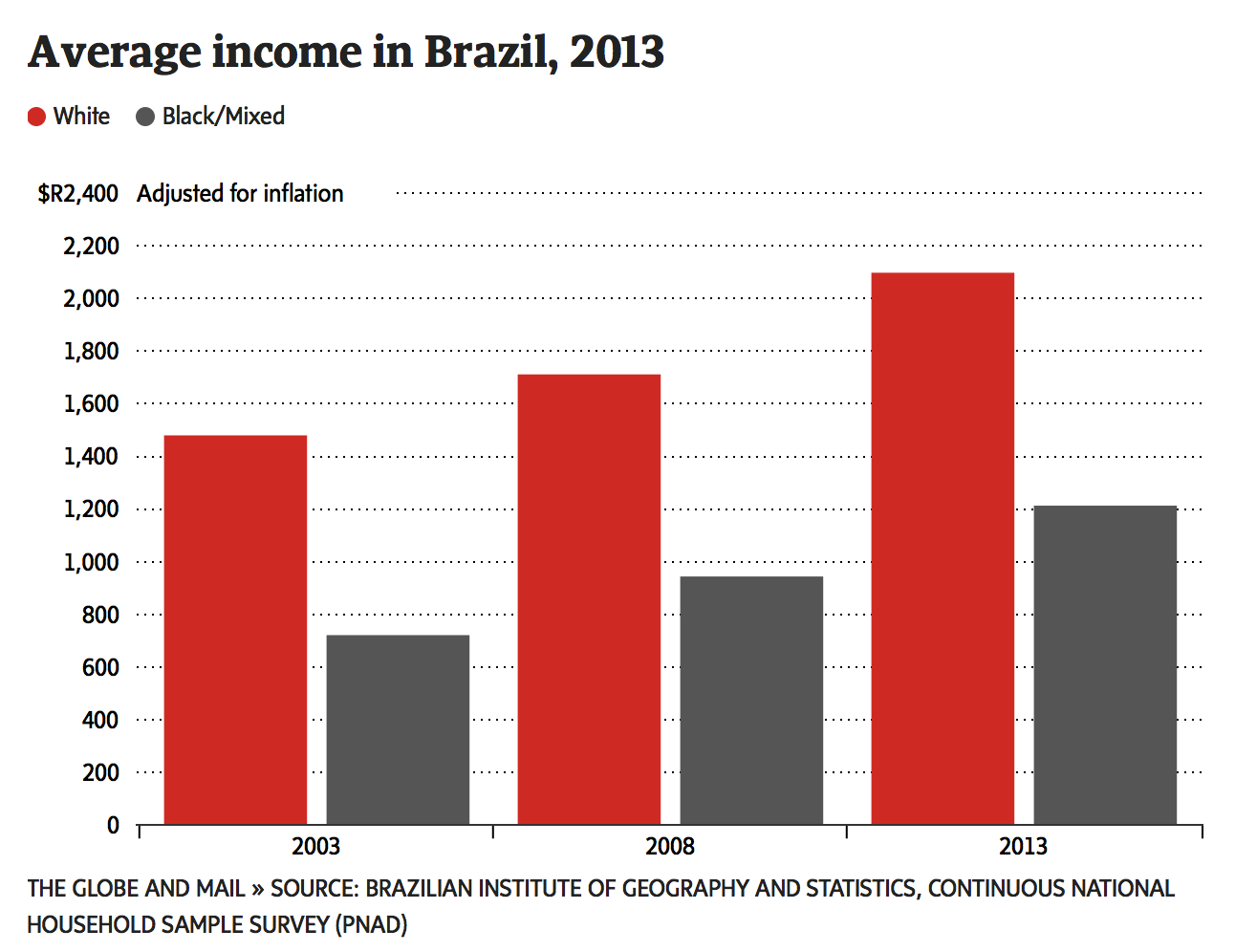 Good, in-depth profile of Brazil by Stephanie Nolen, its history of slavery, its national myth of colour blindness, racial inequality and efforts to acknowledge and address these legacy issues:
Even as the former slave owners set about diluting the country’s blackness, they also went to work on their cover story. In the Brazilian creation myth – the country’s version of Canada’s “cultural mosaic” or the U.S. “melting pot” – the country is a democracia racial, a racial democracy. This official story was built on the idea that from the day slavery ended, Brazilians of all colours were equal. After all, there was no segregation, no apartheid, no Jim Crow. Glossing over the massive disparities between the former owners and the newly freed slaves – who had no education, land or assets – the Brazilian elite, almost entirely white, declared the country uniquely equal and, in effect, postracial.
“It was ‘invisibilization,’” says Marcelo Paixão, who is black and a professor of economics at the Federal University of Rio de Janeiro. “The discourse was that we don’t have race in Brazil, so you don’t have race problems in Brazil, and you don’t need to discuss the inequality.”
The first census after the end of slavery, in 1890, asked not about race, but about colour: Citizens were asked if they were white, brown, black, yellow or caboclo – a Portuguese word for those with some indigenous ancestry, more commonly known here as being vermelha, or red. Over the next years, racial identity was steadily replaced with considerations of colour. In 1976, the national statistics institute, seeking to hone the precision of the census, surveyed thousands of Brazilians about what word they themselves used – and came back with a list of 136. They included terms such as amarela-queimada (burnt yellow), canela (cinnamon) and morena-bem-chegada: very nearly morena, a word for brown.
On some level, it was a progressive ideology, notes Prof. Paixão – it allowed for nuance instead of clear-cut indicators of racial purity. It also resulted in a more genuinely mixed culture, although that mixture is the outcome, in part, of appropriation. Cornerstones of black culture – such as samba music and the martial art capoeira, practised in secret by slaves – have been thoroughly co-opted into Brazilian identity.
But within that culture, and that society, there was an ineluctable hierarchy of what were to be considered racial traits. The dominant idea, propagated by whites, and eventually accepted by many black and mixed-race people as well, he explains, was that the “white” part of the mix brought a European rationality, while Africans brought happiness and creativity, a positive outlook – he ticks off adjectives and rolls his eyes. The more white that one was, the more of the “valuable” characteristics one had. To be whiter was to have a better chance of getting a job, and of earning more in that job. To be whiter, in other words, was to have it easier. Brazil became what is sometimes called here a “pigmentocracy.” (Prof. Paixão is among the fewer than five per cent of faculty members at the Federal University who are black.)
 About Andrew
 Multicultural Meanderings