Back to the beginning: the Conservatives burst a hiring bubble of their own making
2015/08/01 Leave a comment
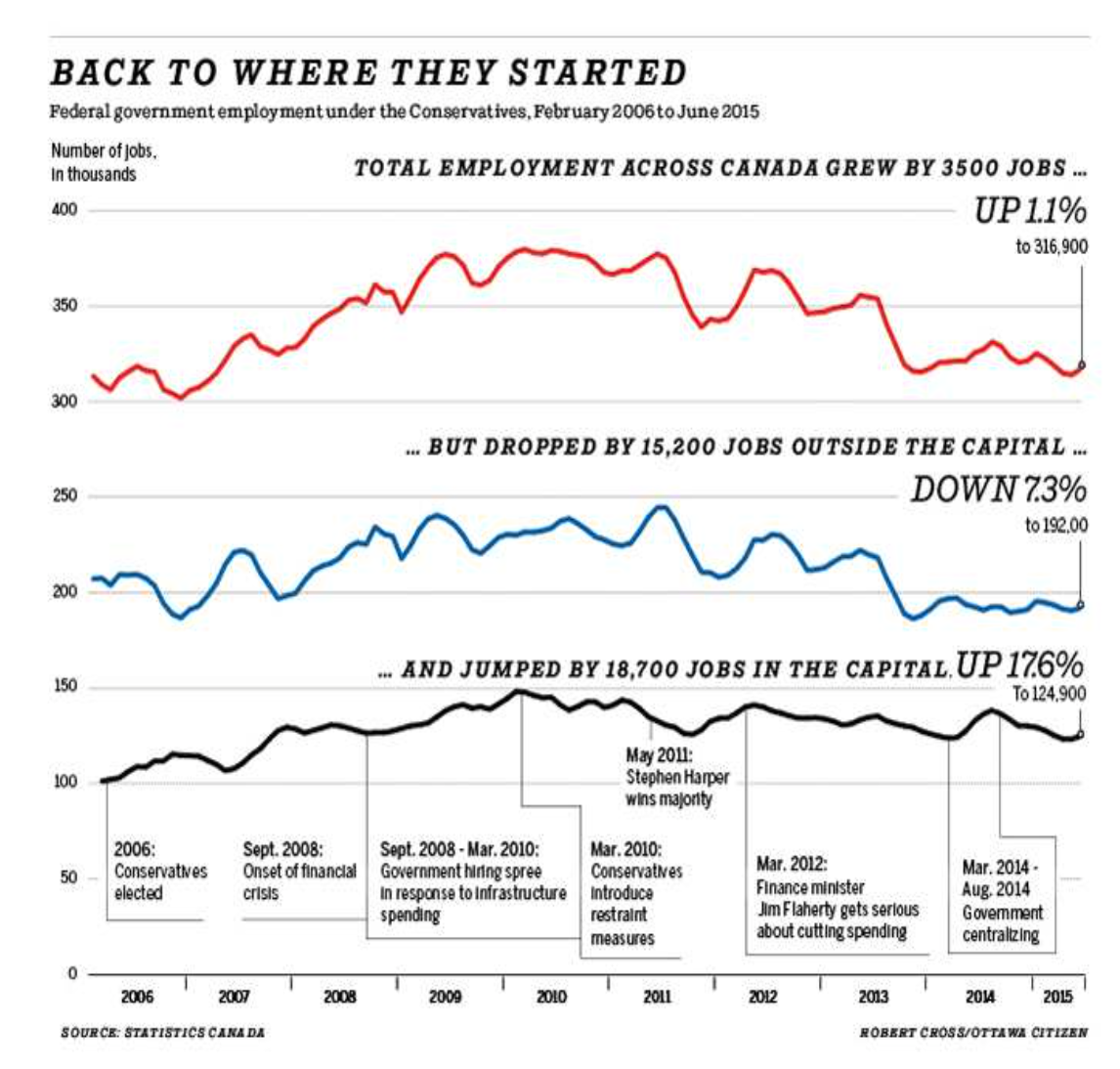 Good analysis by James Bagnall on public service employee number swings. Most interesting figure for me was shift from the regions to Ottawa/Gatineau (from 33.9 to 39.4 percent), reflecting in part that the decisions are made in the capital, not the regions, and likely disproportionate cuts to service delivery. The controversy over the closing of Veterans Affairs example being the most public example, with cuts to CIC’s regional network being partly responsible for the dramatic decline in the number of new citizens in 2012 and 2013 :
The initial rapid rise in the size of the federal workforce was a response to the onset of the 2008 financial crisis. The thinking was that if the private sector stopped spending, government had to pick up the slack to prevent economic collapse.
When it became apparent a couple of years later that the world hadn’t ended, the Conservatives reasserted a party imperative: the budget must balance. The late finance minister Jim Flaherty began signalling restraint in 2010, then accelerated things with his March 2012 budget. An important catalyst was the introduction of executive bonus programs that rewarded managers who trimmed their budgets.
Huge swings in government employment aren’t unique to Conservatives. The Liberals under prime minister Jean Chrétien implemented equally drastic cuts in percentage terms during the mid- to late-1990s. Chrétien and his finance minister, Paul Martin, had little choice. Interest payments on the federal government’s debt consumed 31 per cent of total revenues and were growing.
Even after adding more than $150 billion to taxpayers’ debt burden, the Conservatives budget is still much healthier. Last year, debt interest represented little more than 10 per cent of revenues, thanks in large part to substantially lower interest rates than were faced by Chrétien.
An unexpected result of the Conservative government’s recent retrenchment has been a sharp rise in the percentage of public sector employees based in the National Capital Region. According to data compiled by Statistics Canada, 39.4 per cent of the federal government’s workforce in June lived in Ottawa or Gatineau – compared to just 33.9 per cent when the Conservatives were sworn in almost nine-and-a-half years ago.
Indeed, had it not been for this centralization, the economy of the National Capital Region might have dipped perilously close to recession. Another way to look at it: From early 2006 to mid-2015, the Conservatives added 18,700 government jobs in Ottawa and Gatineau – and took away 15,200 from the rest of the country. Among the federal departments disproportionately hurt by the job losses were Veterans Affairs, Agriculture, Defence, Employment and Environment – organizations with a strong presence nationally.
Whoever wins the federal election will find much within the government’s workforce in need of repair – and many employees who would like to see an end to the wild swings of the past 20 years.
Back to the beginning: the Conservatives burst a hiring bubble of their own making | Ottawa Citizen.
 About Andrew
 Multicultural Meanderings