How Ontario travelled back in time as Canada moved forward: Cohn

Martin Regg Cohn on Ontario’s provincial flag and how it was a counter-reaction to the new Canadian flag 50 years ago:

While our flag looks and feels old, it is actually younger than the bold and modern Maple Leaf design of 1965. And was very much a reaction to the convulsive national flag debate led by then-prime minister Lester B. Pearson.

A former career diplomat, Pearson understood from his foreign travels that Canada’s emerging national identity demanded a flag that bespoke more than its colonial heritage. Yet in Parliament, Progressive Conservative opposition leader John Diefenbaker raged against the Maple Leaf as a betrayal of our British antecedents.

Tapping into that vein of resentment, Robarts’s PC government embraced the remnants of the discarded Union Jack design — and made it Ontario’s own ensign.

Until 1965, our national flag had featured a miniature Union Jack in the upper left quadrant and our coat of arms to the right — lumping Canada with other former British colonies boasting nearly indistinguishable and interchangeable flags. When Ottawa discarded that template, Ontario adopted it.

While retaining the Union Jack image, Robarts substituted Ontario’s Shield of Arms where the Canadian symbol had once been. The legislature quickly adopted the premier’s suggestion, though one dissenting MPP dubbed it a “revenge flag.”

And very much a reactionary response.

Parliament had chosen a flag for the future that captured the national spirit in early 1965. The Legislature had reacted, three months later, by travelling back in time to conjure up a flag of the past inspired more by tit for tat than tradition.

As Canada renounced the Union Jack, Ontario revivified its British roots, ever mindful of its official motto: “Loyal she began, loyal she remains.”

Do we dare display disloyalty to that design today? Is it time to revisit our faux flag?

It’s not a historical keepsake but a political quickie dreamed up by Robarts in the mid-1960s — just as another false idol, the Gardiner Expressway, was being completed. Should we be stuck with such symbols of short-sightedness for all time?

In Ontario, times change. But it takes time to build up momentum.

The British monarchy is in malaise — out of date and out of place in Canada, but difficult to dislodge. Just as our old Union Jack ensign could be confused for the British flag, so too Canadian postage stamps showing the Queen as our head of state are an anachronism (my airmail letters to British friends look like domestic mail to them).

But when I covered Australia’s ill-fated referendum on ridding itself of the monarchy in 1999, I watched voters quarrel over what would replace the Queen. The lesson is that you first need to marshal public opinion toward a durable consensus.

While many Ontarians clamour for an end to funding of separate schools, public opinion is still deeply split on ending constitutional protection for Catholic education. Until there is a consensus, there is no point launching a battle that will inflame religious passions, divide the province and end in stalemate.

As Ontario becomes less Loyalist and more modernist, demographic shifts will drive democratic change. In time.

How Ontario travelled back in time as Canada moved forward: Cohn | Toronto Star.
It’s not a small world after all: Pico Iyer

Pico Iyer on the enduring human differences:

Of course, the gulfs and divisions that remain aren’t entirely a terrible thing. When people say the world is growing homogeneous, losing its savour and individuality, I wonder if they’ve been to Yemen or Ethiopia recently. If someone tells you that we’re all blending into a Disneyland whole, singing “It’s a small, small world,” take them across town to where Haitians and Somalis are struggling to get by. Covering six Olympic Games in 14 years reminded me that the family of man is about as united and harmonious as many another family, even when on its best behaviour.

In Isfahan, Iran, not long ago I found the stores filled with pirated copies of Walter Isaacson’s biography of Steve Jobs, and last year in North Korea I saw a local crane forward to ask two visiting workers from Apple how Tim Cook’s management style differed from that of his celebrated predecessor. In the mausoleum where Kim Il-sung and Kim Jong-il lie, embalmed, we saw the sleek MacBook that the latter was said to have been using when he was reportedly felled by a heart attack on a train (our two Appleites confirmed that this was the perfect model to have in 2011, when he died). It’s wonderful that we can share more and more, and enjoy the tastes of foreign cultures in our hometowns and online.

But pity the politician who assumes that will really bring him any closer to Beijing or Tehran. The only way we’ll survive the global neighbourhood is by assuming we know nothing and recalling that a “Yes” in Tokyo – or Mexico City – conveys what we would mean by a “No.” I love the way that we can experience Jamaica, Pakistan, Haiti, Vietnam in our classrooms and cities; I shudder at the notion that to see them is to think we understand them or can easily be one with them.

Some people worry that soon all of us will be speaking English; my deeper fear is that, even if we are, we’ll still be largely incomprehensible to one another.

It’s not a small world after all – The Globe and Mail.

Why Reconciliation for Aboriginal Peoples Should Matter to New Canadians – New Canadian Media

Ranjit Bhaskar commentary on the TRC recommendations regarding new Canadians:

The broader hope is if Canadians have more knowledge of indigenous history, they will have a better understanding of the current policy disputes between governments and Aboriginal Peoples over natural resources, education and child welfare.

Of significant importance for new Canadians is the last two of the TRC’s 94 Calls to Action. The penultimate recommendation, “call[s] upon the federal government to revise the information kit for newcomers to Canada and its citizenship test to reflect a more inclusive history of the diverse Aboriginal [P]eoples of Canada, including information about the Treaties and the history of residential schools.”

Perhaps it is time for new Canadians themselves to insist on being better informed of an inconvenient truth to better appreciate the travails of indigenous people – essential because we cannot cherry-pick the history we inherit.

The last recommendation urges Ottawa to replace the current Oath of Citizenship with one in which new citizens swear to faithfully observe the laws of Canada, “including Treaties with Indigenous Peoples.”

A timely reminder of not just building a nation-to-nation relationship between Aboriginal Peoples and the Crown that respects the promises of historical treaties, but also for resetting relationships between the First Nations and the “latest nations.”

The two recommendations are a call to remember the injustices inflicted on one of the founding peoples of Canada now that we are slowly, but surely, coming to know about the other history. The part of our collective past not taught in schools, not part of the citizenship test and not part of the “Welcome to Canada” package.

Time to remember the more than 6,000 aboriginal children who never returned to their homes after being sent to residential schools by the Canadian government.

And perhaps it is time for new Canadians themselves to insist on being better informed of an inconvenient truth to better appreciate the travails of indigenous people – essential because we cannot cherry-pick the history we inherit.

…. Far too many Canadians, including many peoples of colour and First Nations themselves, are unaware of the Canadian history of colonization of the indigenous peoples and the exclusion of communities of colour. Instead, we need to invest in our collective understanding and put a halt to an enforced mass ignorance to change the way we look at each other, talk to each other and talk about each other.

Dialogue can hopefully foster positive relationships among indigenous peoples and newcomers to help bring about justice and equality for all. Reconciliation for indigenous people is an important first step towards that goal.

Why Reconciliation for Aboriginal Peoples Should Matter to New Canadians – New Canadian Media.

Know the truth, make amends – Erna Paris

Erna Paris on the need to face our history of residential schools and ‘cultural genocide,’ with some interesting contrasts with other countries who have (e.g., Germany, France), or have not (e.g., Japan, USA) faced up to their past:

A new challenge for Canadians will be to acknowledge the endemic disconnect between our myths and our reality. We view ourselves as a tolerant society that values diversity, but what the Truth and Reconciliation Commission has made clear is that we could believe this only because we excluded native peoples from the picture.

One key to reconciliation will be the rejection of all forms of coercive assimilation. For example, the Quebec Charter of Values, with its discriminatory rules about religious dress codes, was a throwback to attitudes that have historically produced ideas of lesser peoples.

The TRC has shown us where that leads.

The past can never be overcome. It can only be managed. With accountability on the part of lawmakers. With memorials to the victims. And with a major effort to pursue justice – however difficult that may be.

Know the truth, make amends – The Globe and Mail.

Wesley Wark: Information gap about Zehaf-Bibeau threatens security

Wesley Wark’s trenchant criticism of the narrowness of Canadian inquiries into the Zehaf-Bibeau and Couture-Rouleau attacks, which focus only on the security dimensions rather than also including the process of radicalization issues:

There is nothing in the forensic analysis of the Zehaf-Bibeau attack that can bear the burden of such a sweeping statement, but it smacks of politics and of an ill-considered willingness to add to public anxiety about Canada’s counter-terrorism capabilities.

The RCMP’s own, separate, after-action review was deliberately limited, by whose decision is not clear, to “the protective actions taken by the RCMP in response to the incident;” it explicitly precluded any examination of the national security context, existing threat levels at the time of the attacks, or any “pre-incident” information about the shooter.

This leaves Canadians with a worrying chasm of information about Zehaf-Bibeau’s development as a jihad-inspired terrorist, and any reflection of what, if anything, could have been done to prevent the attack plot. It may well be that confusion lingers about whether Zehaf-Bibeau even deserves the tag of “terrorist.” This became a highly politicized issue immediately following the attacks, with the prime minister’s immediate labeling of Zehaf-Bibeau as a terrorist.

An even greater chasm exists with regard to the other, and largely forgotten, terrorist attack of October 2014, in which Martin Couture-Rouleau ran down and killed Warrant Officer Patrice Vincent. Where is the inquiry into that attack and the subsequent death of Couture-Rouleau in a confrontation with the Quebec Sûreté? Unlike Zehaf-Bibeau, Couture-Rouleau had been under investigation by the RCMP, had his passport seized and had been prevented from travelling abroad. The RCMP had intervened directly with him and, as they confessed shortly after his attack, had come to a conclusion that he had changed his ways and did not pose an imminent threat. Later media leaks changed the channel on the story to one of an inability of the RCMP to acquire a peace bond against him, a leak that came suspiciously close to the government’s tabling of Bill C-51, the new anti-terrorism act, which included lowered thresholds for the issuance of peace bonds.

As a recent meeting of the Senate Liberal “Open Caucus” heard from several witnesses, including me, Canada suffers from an endemic problem of overweening secrecy that chokes off public debate. That problem has raised its head once more in the failure to constitute a proper public study of the attacks of October 2014. We need only look at how the Australians responded to their Sydney terror siege in December 2014, with an Australian government review issued in February 2015 and an on-going coroner’s inquiry that is expected to extend into 2016, to know that the balance between secrecy and public knowledge is out of kilter here.

Wesley Wark: Information gap about Zehaf-Bibeau threatens security | Ottawa Citizen.

Tory bill raises too many barriers for expat Canadian voters: Globe editorial

Unfortunately, all too characteristic of the Government in making it harder to vote (as in the case of Elections Act revisions), even if  maintaining the 5 year rule makes sense:

Last year, an Ontario Superior Court judge struck down a rule that barred citizens living abroad for more than five years from voting in federal elections. The government has rightly appealed that decision, while also introducing legislation that will enshrine expats’ voting rights, but with a twist. Expats will get to vote – it will just be really, really hard.

So hard, in fact, that many of the 2.8 million expats around the globe may well not bother. Others will try but won’t be able to meet the onerous new requirements in Bill C-50.

Under the bill, currently in committee after second reading, Elections Canada will eliminate the international register of electors, the long-established list of expat Canadians eligible to vote federally. In future, expats will have to re-register for each election, and can only do so after the writ is dropped.

That means an overseas Canadian would have about 36 days, the minimum length of an election campaign, to write to Elections Canada to request a ballot, wait while officials examine the extensive paperwork the bill requires, receive a ballot in the mail, make their mark, and then return the ballot by mail.

Critics say many long-time expats won’t be able to produce the new documentation required, which includes proof of the voter’s last Canadian address provided by a Canadian company or government office. The alternative is to find someone in the voter’s last riding who will vouch that the person in question once lived there – a time-consuming process.

The Harper government says the goal of the new rules is to prevent voter fraud, the same canard that it used to justify the Fair Elections Act. There are widespread concerns that as many as 400,000 eligible voters will be unable to cast a ballot in the fall election because of the Fair Elections Act. If Bill C-50 is adopted before Parliament is dissolved, the franchise of thousands of expats could also be compromised.

We are not convinced that the right to vote extends to Canadian who have chosen to live outside the country for decades, or even a lifetime. The government was right to appeal, and we hope a higher court will side with it. But in the interim, that lower court’s decision has to be respected. The bill should not be recognizing a right with one hand, while effectively taking it away with the other.

Tory bill raises too many barriers for expat Canadian voters – The Globe and Mail.

Flophouse American Diaspora Reading List

Victoria Ferauge’s updated American diaspora and expatriate reading list:

“Sometimes we feel we straddle two cultures; at other times, that we fall between two stools.”

Salman Rushdie, Imaginary Homelands: Essays and Criticism 1981-1991

Time for an update of the Flophouse American Diaspora Reading List – the best books and articles I’ve read recently about American people and communities abroad.  New books are in green.  As always, please feel free to add to the list.

This list has three sections:  Upcoming titles – Books that have not been published yet but that I plan on reading; General books/articles – the larger view.  Some talk about specific issues (like citizenship), others are studies, portraits or serious research about Americans abroad;  Expat autobiographies – Accounts of Americans in different countries.  These are not books that tell a potential American migrant how to live abroad.   These are personal accounts that talk about what happens to American identity when it gets transplanted somewhere else for a year or two, or for a lifetime.

The Franco-American Flophouse: Flophouse American Diaspora Reading List.

TRC Recommendation for a Residential Schools Monument

Jen Gerson of the National Post makes a constructive suggestion: situate the Monument for Residential School Victims in the location planned for the Monument for Victims of Communism.

Hard to argue with the logic. Will be interesting to see if anyone picks up on it:

The report calls on provincial and federal governments to install highly visible monuments in Ottawa and each provincial capital. The logistics of this are, inevitably, going to be fraught. However, in the grander scheme of things, at least one monument seems appropriate. In the meantime, there’s still space between the Supreme Court of Canada and the National Library in Ottawa. Catch it before it’s used to commemorate the victims of a political ideology that has never been enacted in this country.

Five of the best recommendations from the Truth & Reconciliation Commission, and five that will be problematic

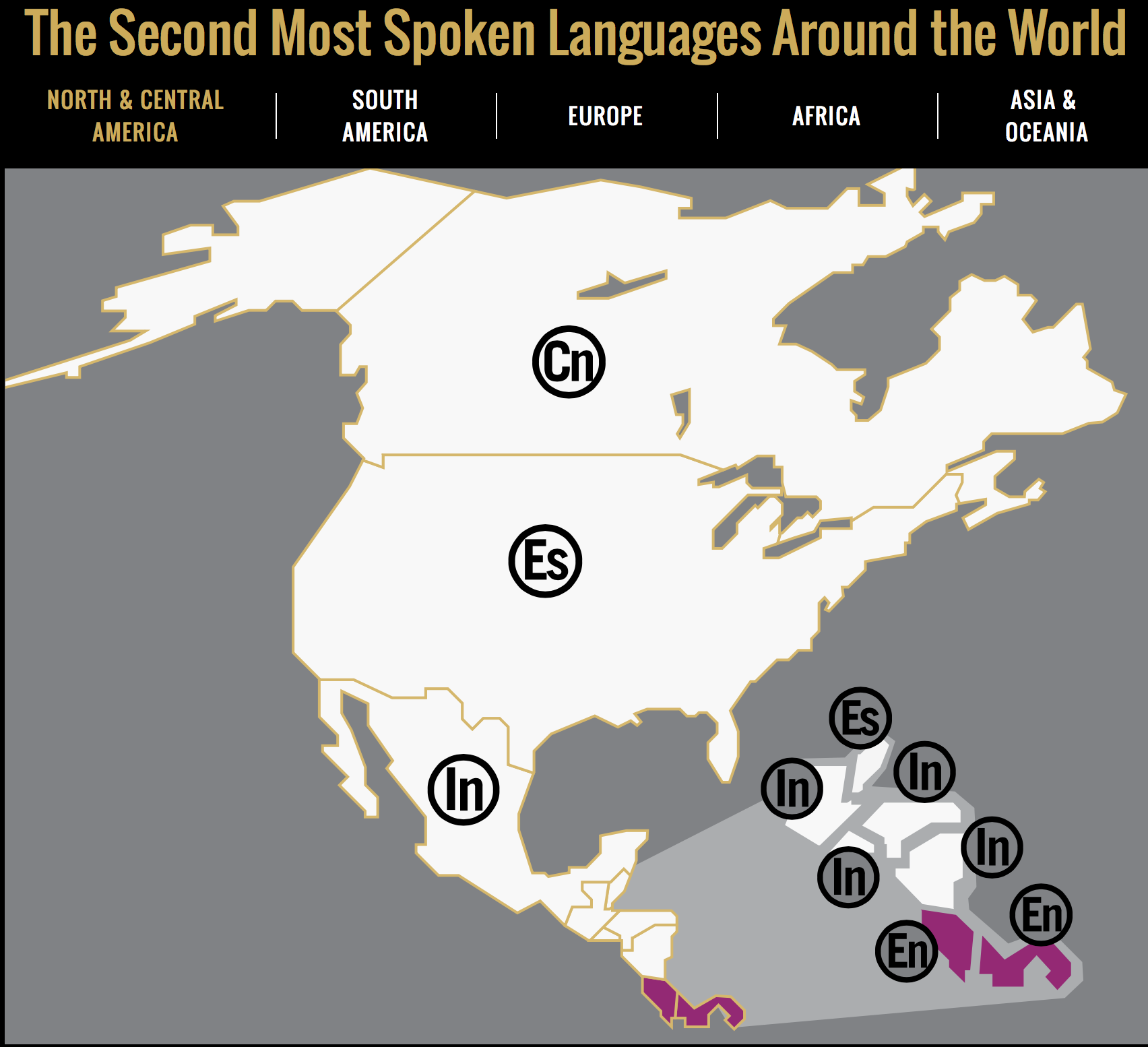
The Second Most Spoken Languages Around the World | Olivet Nazarene University

The_Second_Most_Spoken_Languages_Around_the_World___Olivet_Nazarene_UniversityPeriodically, I get these messages regarding some new interactive way of displaying data. This one is a nice web page that provides information on main second languages for most countries. Worth checking out if you like this kind of thing.

The Second Most Spoken Languages Around the World | Olivet Nazarene University.

Multiculturalism doesn’t work in Hungary, says Orban

More from Hungarian Prime Minister Orban. Never knew coexistence was a bad thing:

“Multiculturalism means the coexistence of Islam, Asian religions and Christianity. We will do everything to spare Hungary from that,” he said in an interview with daily Napi Gazdasag.

“We welcome non-Christian investors, artists, scientists, but we don’t want to mix on a mass scale.”

Orban, whose governing Fidesz party is losing ground in the polls to the far-right, anti-immigrant Jobbik party, has clashed with European counterparts over his isolationist views.

At the European Parliament in mid-May, he criticized as “bordering on insanity” EU proposals for migrant quotas drafted in response to thousands of deaths among asylum-seekers trying to reach Europe across the Mediterranean in increasing numbers.

On Wednesday he called Jobbik dangerous for Hungary “because they offer a constant temptation, an intellectual capitulation to the simplest solutions”, saying his government would strike a conciliatory tone towards voters.

Multiculturalism doesn’t work in Hungary, says Orban – Yahoo News.