Ottawa doit soutenir l’immigration anglophone au Québec, recommande le commissaire Fraser

Logical. Just as the federal government has to promote immigration to francophone communities outside Quebec to ensure their long-term sustainability, the same approach should apply in Quebec.

However, given that Quebec is responsible for immigrant selection, this is more of a wish. And the reality of Quebec being a minority within an anglophone (and hispanophone) North America makes it unlikely that any Quebec government will take this idea up:

Dans son rapport annuel rendu public jeudi matin, le commissaire Fraser consacre deux de ses trois recommandations à la communauté québécoise anglophone, qu’il décrit comme ayant des difficultés et comme n’étant « pas toujours perçue à sa juste valeur».

Le commissaire a entre autres recommandé au ministère fédéral de l’Immigration d’« établir clairement les mesures qu’il entend prendre pour favoriser la vitalité des communautés anglophones du Québec par l’entremise de l’immigration ».

« Les difficultés que connaissent les communautés anglophones du Québec en matière d’immigration sont similaires à celles que doivent surmonter les communautés francophones du pays, a-t-il noté. En effet, certaines ont de la difficulté à attirer un nombre suffisant d’immigrants anglophones pour pallier leur faible taux de natalité et l’exode des jeunes, et pour revitaliser leurs institutions à long terme. »

M. Fraser a précisé en point de presse qu’il respecte la compétence du Québec de sélectionner ses propres immigrants et que ses recommandations ne visent pas à plaider directement en faveur d’une hausse de l’immigration anglophone au Québec.

Mais « je pense que votre intérêt à ce sujet va soulever une discussion intéressante », a-t-il ajouté, se disant aussi conscient de la nature sensible du dossier linguistique dans la province.

Le Bloc québécois n’a pas tardé à réagir. « Le rapport du commissaire aux langues officielles est déplorable. Il propose de renforcer l’immigration anglophone alors que c’est le français qui est menacé au Québec », a dénoncé le chef du Bloc, Mario Beaulieu.

Ottawa doit soutenir l’immigration anglophone au Québec, recommande le commissaire Fraser | Hugo de Grandpré | National.

Islam in UK: Losing my religion | The Economist

Interesting trend even if the numbers are small as well as observation that many British Muslims have become more religious as a response to feeling that their faith is under attack:

Former Muslims’ reluctance to admit to their lack of faith rarely stems from a fear of violence, as in countries such as Sudan where laws make apostasy punishable by death. Rather the worry in Britain is about the social stigma, moral condemnation and ostracism that follows, says Simon Cottee of the University of Kent, who has written a book on the subject.

Many do not divulge their unbelief to their families, let alone the wider community. At events organised by the CEMB, some come straight from the mosque. Women say they continue to wear their veil at home to conceal their change of heart. Those who are openly godless often use the language of gay rights, talking about “coming out” to those close to them.

Despite such difficulties, the internet is making life easier. Muslims questioning their faith can talk to others online. The CEMB’s forum has over 4,000 users, says Marayam Namazie, the group’s founder. In the past would-be atheists had to sneak off to libraries to explore their doubts. Doing so online is easier and more discreet. Nonetheless the CEMB also offers guidance on concealing such activities, advising those with doubts to erase e-mails and search histories and to use a computer to which others do not have access.

Ibrahim Mogra, an imam in Leicester, says that he has heard of only a handful of cases of Muslims who have openly renounced their religion over the past 30 years. More common, he says, are those who abandon many of the practices of Islam—regular prayers, the dietary laws and dress codes, for example—but still identify as Muslims. This group, which is culturally but less spiritually committed to Islam, is getting larger, suggests Mr Mogra. Growing up in secular Britain leads people, especially the young, to drift away. But many grow out of their doubts, he reckons, and return, especially when they have children.

Religious leaders certainly try to draw them back into the fold. Sermons on Friday, when more backsliders may appear, are an opportunity to boost their faith. Ramadan is a chance to recharge the spiritual batteries of people who will only return again 11 months later for a top-up, says Mr Mogra. But a culture in which youngsters could express their uncertainties openly and discuss them with scholars would be good, he argues. “If, after that, they still have doubts, that’s up to them.”

The difficulty for Muslims with misgivings, at least in revealing them, is the politicisation of Islam. Many British Muslims have become more overtly religious as they perceive their faith to be under attack. Islam has become a greater part of their identity. That makes it harder for doubters to come out—and leaves them in a quandary. Some interviewed by Mr Cottee were wary of putting their testimonies online, anxious to avoid giving ammunition to those who would vilify Islam. Until Muslims feel more at ease in Britain and Britons more relaxed about Islam, the number coming out will be small.

Islam: Losing my religion | The Economist.

A Record Number of Americans Are Renouncing Their Citizenship

Expat-ExpressWhile the numbers are small, the trend is clear:

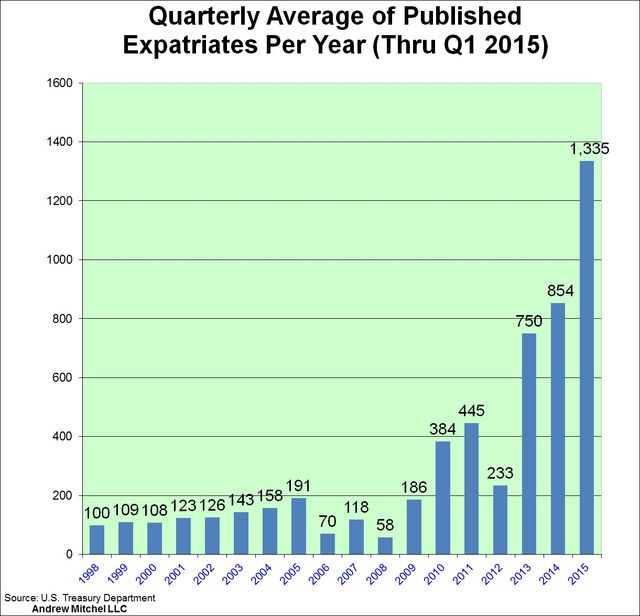
People giving up their nationality at U.S. embassies rose to 1,062 in the fourth quarter from 776 in the year-earlier period, according to Federal Register data. That’s the highest quarterly total since the second quarter of 2013, according to Bloomberg News calculations based on records starting in 1998.

The annual total reached 3,415 in 2014, from 3,000 in the year-earlier period, according to Federal Register data. The five highest totals have been recorded since the U.S. Congress passed the 2010 law.

There are an estimated 6 million U.S. citizens living abroad. More than 10,000 Americans living overseas have given up their passports over the past five years.

A Record Number of Americans Are Renouncing Their Citizenship – Bloomberg Business.

New Un-American Record: Renouncing U.S. Citizenship

Art Spiegelman: Je Suis Charlie—But I’m Not Pamela Geller

Cartoonist Art Spiegelman on the differences between Charlie Hebdo and Pamela Geller. One of the best:

I think that’s when my brain short-circuited. Because superficially, it seems like, well, the same thing is happening in Texas. But it’s not. It’s the anti-matter, Bizarro World, flipside, mirror-logic version of what Charlie Hebdo is about.

The American Freedom Defense Initiative is racist organization. It’s exactly the nightmare version that the writers who were protesting the PEN award thought Charlie was. But Charlie is an anti-racist, political magazine that does not have an agenda that consists of wanting to bait or trouble Muslims.

Pam Geller’s organization is intentionally trying to start war of culture with Islam by saying that all Muslims are terrorists under the surface, and we’re going to prove it. Do the group members deserve free speech protection? Of course. But they’re hiding behind that banner with things that have very little to do with free speech and a lot to do with race hate.

Je suis Charlie, mais je ne suis pas Pam Geller. She and her dim-witted, ugly organization deserve the protection of the free speech mantle that they wrap themselves in. But would I ever give them a courage award? Hardly. Would I ever want to be in the same room with them? No. Do I wish they would stop? Yes.

The PEN writers who protested the event were projecting similar motives and attitudes onto Charlie Hebdo. Dismissing it as French arrogance is quite arrogant. Dismissing it as crude and vulgar is something that makes me suspicious of how cartoons are viewed by the writers who didn’t have enough respect for these images to understand them on their own.

…. I’m stuck having to agree with my bête noir friend Pam Geller that it would be better going forward for newspapers and magazines to take on the responsibility for showing these images. When the Danish Muhammad cartoons appeared in 2006, and when the Mohammad cartoons from Charlie Hebdo appeared, newspapers should have shown these images and talked about them. Many dismissed them as banal and treated them as, “Nothing to see here, move along.”

If it were taken as a matter of course for newspapers and magazines to show these images, they could be normalized, so the many Muslims not offended to the point of grabbing a machine gun could understand that this is how our culture functions with images and issues. It would create a better-informed population dealing with whatever comes next. It would also be useful to have other voices on newspaper and magazine staffs.

What’s the mistake in not publishing images that could be deemed offensive?

There’s no stopping it. What would it be based on? Would it be based on when someone takes up arms against the image? Would it be based on when someone thinks it’s offensive? God knows where the line would be drawn. It can’t be drawn that way. There is an incredible efficiency cartoons have, once you learn to read them, in clarifying the issues at hand, making them memorable.

There’s something basic about cartoons. They work they way the brain works. We think in small, iconic images. An infant can recognize a smiley face before it can recognize its mother’s smile. We think in little bursts of language. This is how cartoons are structured. They’re structured to talk to something deep inside our brains. A cartoon becomes a new kind of word that didn’t exist before.

It’s interesting how little respect they get. “Oh, anyone could draw that crude, vulgar scrawl,” said a number of critics of Charlie Hedbo. That’s not quite true. They’re not totally dismissible. If a writer had made some of the points that Charlie Hebdo had made, I don’t think the writers protesting PEN would have been so condescending and dismissive.

Art Spiegelman: Je Suis Charlie—But I’m Not Pamela Geller | TIME.

Canadian research study hits snag over lousy population data – The Globe and Mail

Good piece on some of the limitations of the National Household Survey, particularly at the Census Tract level.

Nice comment on the irony between more corporate big data, with all the related privacy implications, and less effective government big data (although linking the NHS to CRA income information will improve quality and is appropriate use of big data):

The project, produced with the financial backing of the Maytree Foundation, used 2010 to 2013 data from the Canadian Community Health Survey, a voluntary annual survey with a sample size of 65,000. The project didn’t use the last voluntary national household survey due to difficulties in comparability and in assessing data quality for smaller communities.

The researchers want to see the mandatory long-form census not only reinstated, but expanded to include more questions on wealth and health. They recommend more sharing of information between federal government departments and more tools, such as online searchable databases, to make data more accessible and useable.

The irony is that the lack of data on the public side comes as Big Data is giving private firms unprecedented access to rich details about customers’ lives.

“The trend in the private sector, for companies like Google and Uber, they’re making brilliant decisions, strategically, because they’re collecting more and more information, mining it and refining their services and products,” said Mr. Johal.

“And what we’re seeing in Canada is governments stepping away actively from getting that information – so that makes it really hard for us to make those smart decisions and invest in our future.”

Canadian research study hits snag over lousy population data – The Globe and Mail.

Message for Ontario’s sex ed naysayers: Ignorance is far from bliss

Commentary by Aparita Bhandari  on the need for sex education and a reminder of some of the culture behind opposition to sex-ed:

I was around seven years old when I was told I was impure. It was at a family get-together in India that involved a religious ceremony. My mother had her period at the time, and had been segregated to a cold, dark room. I had no idea what was wrong with her, only that I never wanted to have what she had. I was impure by association. I was told I needed to take a purifying bath if I wanted to sit with my cousins. Eager to please, I splashed cold water on my shivering body. But I couldn’t wash away the sense of shame.

As a teenager in New Delhi, I hated taking public transit. Men would press their erections into my backside or try to cop a feel as I squeezed my way off the bus. But I did not know how to talk about it to my mother or anyone else. What words could I use? So I kept quiet, and avoided using public transit.

But it’s hard to stay quiet now when many parents in Ontario are removing their children from classrooms to protest the revised sex ed curriculum introduced by Kathleen Wynne’s Liberal government. They cite cultural concerns and family values but, as far as I’m concerned, a culture of shame and silence is more dangerous. And given the possibility that many of these parents aren’t going to talk to their kids about sex, it’s even more important that their children receive sex education that’s well researched and takes into account the access young people have to sexual information (and misinformation) today and includes topics such as sexual consent.

Since I attended a public school in Australia from Grades 5 to 8, I happened to learn about menstruation, puberty and my developing body through a mixture of books, sex ed classes and educational films that I caught on TV. But I never learned about sex from an authorized source. Back in New Delhi, there were exactly two pages devoted to reproduction in my Grade 9 biology class, which our Science teacher more or less skipped over. The main take-away was that we should know how to draw anatomical diagrams of male and female sex organs for our annual school examination. Any practical education came from romance novels and whispered conversations with friends.

I never had “the talk” with my parents, but I was repeatedly told by the women in my family that I had to watch what I wore, how I acted. I was warned, “Rape bhi ho sakta hai (You can get raped).” Nobody even told me what rape was, although Bollywood movies at the time had frequent scenes that suggested men sexually assaulting women.

Message for Ontario’s sex ed naysayers: Ignorance is far from bliss – The Globe and Mail.

Top federal bureaucrat targets hiring, policymaking and mental health in her first report

Twenty-Second_Annual_Report_-_Report_-_Clerk_of_the_Privy_CouncilClerk Janice Charette on her three priorities for the public service in her first report to the Prime Minister on the public service:

In her report, Charette said she is “unequivocally and personally” committed to the Blueprint 2020 vision, unveiled by her predecessor, Wayne Wouters, as the road map for the public service in the digital age.

The public service is in the throes of a major transition and Blueprint has a strong appeal to young, tech-savvy public servants, as it is built around new technology and cutting red tape. It’s aimed at making the public service more networked, innovative, efficient, productive, better managed and tech-enabled.

A big complaint about it, however, is that it dodges some of the politically sensitive issues dogging Canada’s largest employer. These include: the lack of trust between bureaucrats and their political bosses; the public service’s diminished policymaking role and relevance; and what many call a “toxic” workplace that has one of the highest incidences of mental health claims in the country.

Charette’s three priorities could go a long way to address those perceived gaps.

The public service has faced an exodus of retiring baby boomers whom Charette said have to be replaced with recruits who bring new skills and fresh ideas to “manage in the modern world” dominated by technology and big data.

Charette said she isn’t setting hiring targets at this point, but departments must keep their human resource plans updated so they know which skills are needed for the future. With downsizing, departments have been preoccupied with shedding jobs.

The number of people leaving or retiring from the public service had been relatively stable over the years, until the 2012 budget cuts kicked in. Nearly 13,000 public servants retired or left in 2013-14, followed by another 12,283 the following year.

Charette said she isn’t looking to “grow” the public service, but new hiring hasn’t come close to replacing the record number of departures. About 4,300 permanent employees were hired last year and about 2,870 the year before. Rather than recruiting, departments are filling gaps with casual, term and student employees.

The recruitment and retention patterns are reflected in the experience levels of public servants. Today, 13 per cent of public servants have less than four years of experience compared to more than 17 per cent the previous year. The proportion with between five and 14 years’ experience, however, increased from 45 per cent to nearly 49 per cent.

The prime minister’s advisory committee on the public service sounded the alarm in a report last month, warning that departments averse to hiring could cause a “demographic hole” similar to the missing generation that dogged the public service for years when it stopped hiring in the 1990s. The report called for “top-down direction” from the clerk and deputy ministers.

“I think it is important for me to send a signal about where I see the priorities,” Charette told the Citizen. “Departments are making their own decisions right now about their HR priorities and I think it is important for me to signal that when I look at the public service as a whole, that this is one area where I think we have a public service-wide need.”

Here’s a quick look at what Charette said.

Recruitment:

Specialists in data analysis will be a key recruitment target.

The public service should also examine how it recruits. It typically relies on a major post-secondary campaign on campuses, as well as online recruitment  The public service also needs an infusion of mid-career and senior talent from the private sector.

Policy development:

The public service is no longer the only or even the primary source of policy advice for ministers. Politicians expect public servants to consult and collaborate with stakeholders and it’s up to public servants to quickly “synthesize” the various interests to come with advice in the public interest.

Public servants also have to strengthen the links between policy and service delivery.

“Who is responsible for integrating that information, synthesizing it and trying to weed through what is in the public interest as opposed to the interests of the person who may be advocating a position is the job of the public service. (That’s) evidence-based public policy,” she said.

Mental health:

Charette has “no tolerance” for the situation in which one in five public servants complained about harassment in the last public service survey.

She also worries about the rising incidence of mental health claims that approach half of all long-term disability claims. Public servants’ reliance on medications to combat mental illness is also on the rise.

Some good use of infographics to communicate range of activities and related data in contrast to the previous text-driven reports as well as tables on employment equity (still using the dated 2006 labour market availability, however, which paints an overly rosy view).
Top federal bureaucrat targets hiring, policymaking and mental health in her first report | Ottawa Citizen.

Harper government to make revoking of passports from suspected extremists quicker

Not surprising. Unlike revocation of citizenship, which applies different treatment to dual nationals compared to Canadian nationals only (the latter cannot have their citizenship revoked), applies equally to both:

As it struggles to stop Canadians from joining terrorist groups in Syria and Iraq, the government is introducing measures allowing officials to more quickly revoke passports from suspected extremists, the National Post has learned.

A senior government source said the policy expediting passport revocations on national security grounds would be announced Thursday by Public Safety Minister Steven Blaney and Citizenship and Immigration Minister Chris Alexander.

The change comes two weeks after Canadian Security Intelligence Service director Michel Coulombe told the Senate national security committee the number of Canadians who had left for Syria and Iraq had jumped 50% in the past few months.

To prevent them from leaving, police have been alerting officials to cancel the passports of “extremist travellers,” but the government source said the current procedure was too time-consuming and that authorities needed to be able to act more speedily.

“With the growing number of radicalized Canadians travelling abroad to fight with ISIL, this government will take action to ensure our national security agencies can swiftly and urgently revoke the passport of any threat to Canadians and our allies,” the source said.

Harper government to make revoking of passports from suspected extremists quicker

Charlie Hebdo Editor Seeks to Distance Newspaper From Anti-Islam Causes – NYTimes.com

The numbers tell the story (7 out of 500 or 1.4 percent):

“Out of 500 covers in the past 10 years, only seven were made about Islam,” he [Gérard Biard] said. “So it’s not our obsession. We’re dealing with politics, we’re dealing with other religions.”

Ms. Geller has called the attack in Garland, Tex., in which both assailants were killed, a defeat for “the enemies of freedom” that validated the art contest — which she said had been held in part to honor Charlie Hebdo.

Asked how the Charlie Hebdo attack may have influenced a right-wing surge in French politics, Mr. Biard criticized Ms. Le Pen for portraying herself and her supporters as defenders of free speech.

“Marine Le Pen has a political agenda,” he said. “Her goal is to be elected in two years, to become president. She’s doing what every political leader does. She’s used an event and tried to transform this event into something for her own purpose.”

“The thing is, Marine Le Pen is not credible on that issue, because she is an extreme-right politician,” Mr. Biard said. “She runs an extreme-right party, with religious extremists in there. So when she attacks Islam, she in fact attacks Arab people.”

By contrast, Mr. Biard said, “when we mock a religion, we don’t knock believers, we don’t mock people. We mock institutions. We mock ideas.”

Mr. Biard was in New York to receive an award on Tuesday for “freedom of expression courage” at a literary gala sponsored by PEN American Center, a prominent literary organization that defends writers around the world.

The choice of Charlie Hebdo to receive the award has incited angry contention within the organization. More than 200 of its approximately 4,000 members have signed a letter protesting what they called Charlie Hebdo’s violation of acceptable expression, asserting that the newspaper’s cartoons have promoted anti-Muslim bigotry.

Mr. Biard, who has been the editor in chief of Charlie Hebdo for the past 10 years, said that the PEN protesters were entitled to their opinion but that he rejected their criticism.

“We have always been anti-racist, and we fight against all discrimination,” he said.

Mr. Biard also said that the newspaper, which derives its revenue exclusively from subscriptions, had gone from fewer than 10,000 before the January assault to more than 250,000 today.

Charlie Hebdo Editor Seeks to Distance Newspaper From Anti-Islam Causes – NYTimes.com.

The moral problem with a Muhammad cartoon contest

Noah Feldman on the moral responsibility of Pamela Geller for the Texas shootings:

One goal of the provokers in Texas seems to have been sending a message to Muslims that their faith may be criticized with impunity. Pamela Geller, the organizer, said she chose the venue because Muslims had previously organized an event there. Geller also said that Muslims generally cannot be criticized in the U.S. because of political correctness, and that she wanted to counteract what she perceives as a new social norm.

The desire to condemn Islam by intentionally offending Muslims is morally unpleasant in itself. Insulting the Prophet to make a point is a bit like showing Nazi propaganda to prove that Jews can be subject to criticism: effective, but repulsive.

Yet as moral wrongdoing goes, giving offense isn’t at the top of the list. You shouldn’t do it, but when you do, you’re offensive — nothing more. Compared with intimidation, for example, offense is less wrongful. If offense were all that Geller intended, she’d deserve a stern lecture about civility, not deep condemnation.

By willfully trying to provoke violence, Geller was trying to create a situation in which innocent people could have been harmed or killed.

Geller also had a plausible moral rationale: to strike a blow for free speech itself, after January’s attacks in Paris at the offices of Charlie Hebdo. Perhaps, it could be argued, some offense is justified in light of the need to stand up against terrorism that is intended to repress speech.

But there was almost certainly another goal at work in the provocation, too. Geller clearly wanted to get a reaction from Muslims offended by the event’s intentionally offensive speech. The point of the offense was, in part, to generate a response.

Perhaps all Geller wanted was to provoke a counter demonstration that would have drawn attention to her efforts. But assuming for a moment that she didn’t want to provoke a violent attack, Geller could still be held morally responsible for the foreseeable consequences of her provocation.

There’s a moral theory, called the ‘doctrine of double effect’, that says you shouldn’t be blamed for foreseeable consequences that you don’t want. We sometimes rely on it, as in justifying collateral damage as a result of an otherwise morally correct use of force.

This moral doctrine of double effect has no place in evaluating a conscious provocation. Geller was trying to provoke a reaction. If the reaction was reasonably likely to be violent, she can’t hide behind the notion that she didn’t want anyone to get hurt.

Was a violent reaction foreseeable? I’d like the answer to be no. Plenty of insults against Muslims go unremarked, and certainly unavenged. Violent attacks like the one on Charlie Hebdo are extremely rare.

Fairness toward American Muslims would seem to require us to say that the violent reaction wasn’t reasonably likely to occur. We’d then have to absolve Geller on a ground she probably wouldn’t much like.

But that still leaves the question of Geller’s own subjective beliefs and intentions. It’s hard to escape the suspicion that part of her hoped to provoke a violent response.

After all, it’s part of Geller’s worldview to believe that Islam is a violent religion. The bus and subway ads she’s paid for depict Islam in terms of violent jihad. She paid for an armed security guard outside the event, suggesting she considered violence at least possible. What’s more, the value of the free speech she is trumpeting is relevant mostly because cartoons perceived as insulting the Prophet have been met with violence.

If — and I say if — Geller intended to provoke violence, she did something much worse than giving offense. By willfully trying to provoke violence, Geller was trying to create a situation in which innocent people could have been harmed or killed. As it was, a security guard at the event was injured. (By the way, the guard who shot and killed the attackers counts as a hero who saved lives, regardless of Geller’s motives.)

If Geller wanted violence to happen, her actions were morally culpable — even though she obviously didn’t commit it.

And while we’re on the topic of fear