Advising resistance to police’s carding efforts grows more tempting: James

Royson James on Toronto police carding and the recent court decision:

In awarding damages to a man stopped in Moss Park and beaten up by police after he refused to engage the officer, citing his right to walk about the street without police harassment, Superior Court Justice Frederick Myers wrote:

“One who is not being investigated for criminality is allowed to walk down the street on a cold night with his or her hands in the pockets and to tell the inquisitive police officers to get lost without being detained, searched, exposed to sub-zero temperatures, or assaulted.”

You think?

Judge Myers awarded the victim, Mutaz Elmardy, $27,000 in damages in the 2011 incident.

“That police officers shattered Mr. Elmardy’s feeling of the law strikes at the rule of law itself and requires condemnation by the court,” the judge wrote.

You, sir, are a credit to your profession.

The same cannot be said of our Mayor John Tory (open John Tory’s policard). Since his election, it seems like he has done everything to perpetuate this odious police practice — from manipulating the membership of the police board, to hiring a chief committed to carry on the controversial exercise.

Tory calls carding corrosive. He says the police board is reviewing it. Yet he wouldn’t demand basic police accountability: provide those carded with a receipt of the encounter and respectfully inform them of their right not to engage.

http://www.thestar.com/news/city_hall/2015/05/13/advising-resistance-to-polices-carding-efforts-grows-more-tempting-james.html

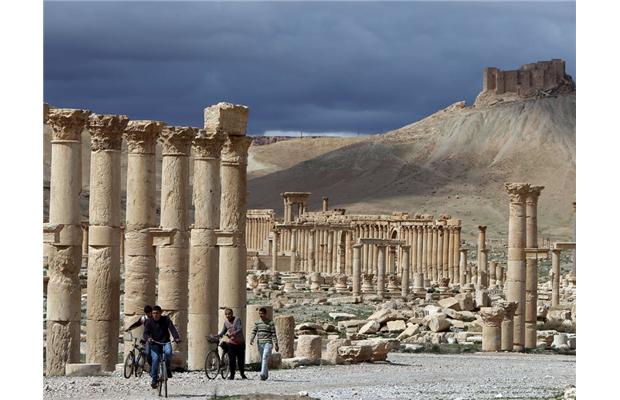
Syria warns 2,000-year-old city is in danger of being ISIL’s next cultural atrocity

PalmyraSad. Another one of the places I visited many years ago and is a world cultural and historical treasure:

A Syrian official called on the international community Thursday to protect the 2,000-year-old ruins of the ancient city of Palmyra, now threatened by the advance of the Islamic State of Iraq and the Levant. Fighting between ISIL and Syrian government forces has come within 2 km of the 2,000-year-old UNESCO World Heritage Site, which once attracted thousands of tourists to its towering Roman colonnades and temple to the god Baal. If Palmyra falls into ISIL’s hands,

Syria warns 2,000-year-old city is in danger of being ISIL’s next cultural atrocity.

How Chinese millionaires buy U.S. citizenship

US Business investor visa, another example of selling access. Expect that the numbers are smaller than State dept believes:

But what if you could buy your way to the front of the line? One visa allows investors willing to dish out half a million dollars a fast pass to a green card.

To qualify for the so-called EB-5 visa, an investor must inject $500,000 into a project or business that will create 10 new jobs in a high unemployment or rural area. The visa has become so popular among Chinese millionaires looking for a ticket to citizenship that for the first time since it was introduced 24 years ago, the government has run out of available slots… until October.

But since the EB-5 visa was created in 1990, some have seen it as selling citizenship to the highest bidder. Supporters of the visa argue it is a painless way to employ U.S. workers, stimulate the economy and create funding for American businesses. In fact, the program has generated $8.6 billion in investment and created more than 57,000 jobs since 1990, according to the State department.

Still, critics say the government needs to keep a closer eye on investors applying for the visa to ensure they have met the employment requirements adequately. Investments built in high-end neighborhoods that employ workers from poorer areas often fulfill the visa’s rural and low-income job quota. With vthe isa up for renewal this September, some are urging Congress to reconsider.

How Chinese millionaires buy U.S. citizenship.

Lebanon’s Sexist Citizenship Law Mothers, Babies

On the inability of Lebanese women to pass on their citizenship to their children if the father in non-Lebanese:

A study conducted by the American University of Beirut showed that the vast majority of Lebanese people surveyed supported Lebanese women’ passing on their citizenship to their Palestinian children and, to a slightly lesser degree, to their Palestinian husbands. Ultimately, as Abou Habib puts it, “The right of Lebanese women should not be a matter of political debate.”

Lebanon is not the only country to prohibit women from passing on their citizenship. It’s not even the only Arab country to do so. But unlike other Arab states, Lebanon considers itself a beacon of liberalism in the Middle East, the place where East meets West. Lebanon cannot claim to uphold Western values while continuing to deny women equal rights.

Countries far less liberal than Lebanon, such as the United Arab Emirates and Egypt, have made provisions to prevent statelessness. Children of Emirati women and foreign men, for example, can apply for citizenship after they reach the age of 18. Egypt, a country known for its culture of sexism, has granted women the full right to pass their citizenship on to their children.

I am proud to be Lebanese. So is my childhood friend. We identify as such. We want our children to be Lebanese, regardless of who their fathers are. Being Lebanese is being part of a community. It is being part of a people who have a zest for life, a kindness, a humor and a resilience. It is being part of my family. We want to be celebrated in Lebanon on Mother’s Day. But how can we keep ties to a country that creates so many hurdles for our children? How can we instill in them a sense of Lebanese pride if the country won’t acknowledge them as their own?

Lebanon’s Sexist Citizenship Law Mothers, Babies | Al Jazeera America.

Barbara Kay: Call barbarism what it is

Barbara Kay predictably misses the point on the use of the word barbaric. It was used in Discover Canada to provide the media quote rather than more neutral but equally strong language (e.g., against the law, not acceptible, will be severely punished). It also fits into the drift towards more dog whistle and identity politics by playing to the Conservative party base.

The risk of using such language is within communities themselves. The use of a label (even if correct) reduces the likelihood of the substantive message being heard. 

Moreover, one of Discover Canada‘s omissions was to put this statement in the overall context in the history of women’s rights in Canada, noting the evolution of what is considered acceptible (or non-barbaric) treatment of women. Such a strong narrative would have strengthened the Government’s arguments without the ‘bumper sticker’ label:

But not only are they wrong; they are not even popular amongst the silent majority of the cultural communities they are currying favour with. No politician in Canada is more familiar with what cultural communities want than Jason Kenney, who on March 12 rose in the House to speak, with regard to barbaric practices, words I believe most Canadians strongly approve:
“Yes, [barbaric] is a strong term. It is a judgmental term, but we do sometimes need to make judgments.” He continued, “I will be absolutely blunt. When I first came to government and started as minister of multiculturalism eight years ago, for political reasons I would have probably recoiled at the name of this bill. However, my enormous exposure to and close work with the huge diversity of our cultural and faith communities taught me something over the course of time. It taught me that the vast majority of new Canadians believe passionately that there are certain hallmarks of integration into this country that we must all respect, that there is a duty to integrate, and that there are certain practices that are rooted in custom or tradition that have no place in Canada….
“They said, ‘Please do not tolerate female genital mutilation, forced marriages or polygamy. Please stop this.’ … It was women who were victims of forced marriages, including here in Canada, who most strongly motivated the bill.”

http://news.nationalpost.com/full-comment/barbara-kay-call-barbarism-what-it-is

USA: Citizenship for Sale

On the US business immigration program. Similar issues as in the previous Canadian program:

Now let’s turn to the United States. Under the EB-5 visa program, foreigners can obtain a green card and then citizenship by making a small investment—$1 million, or $500,000 if it’s in an area with high unemployment—that will create or preserve 10 jobs for U.S. workers. Foreign investors can funnel their funds through “regional centers,” which are private organizations that finance commercial projects. These centers spare investors the trouble of figuring out for themselves whether an area suffers from high unemployment and whether a specific investment would generate the requisite 10 jobs.
The program is a mess. The government “is unable to demonstrate the benefits of foreign investment into the U.S. economy” under the program, in the words of the Inspector General of Homeland Security. Among other things, it’s almost impossible to figure out whether a specific investment generates jobs rather than reshuffles them from one place to another. There have also been examples of outright fraud and political cronyism. Part of the problem is a lack of documentation but the real problem is that the program is misconceived.
When we think about investment, the starting point is that investors don’t need citizenship or any other inducement to put money into a project when they will earn higher than the market rate of return. So given the risk and other opportunities, someone will invest $1 million or more in a mall complex or housing development if the expected return is, say, 10 or 15 percent. Many foreigners make such investments, and the vast majority of them make them not to obtain citizenship but to make money. In 2013, they ponied up $236 billion. Meanwhile, Americans invested another $2.5 trillion in the economy. At most $10 billion can be attributed to foreigners who seek visas, and probably a lot less.
The EB-5 program, then, just pumps up aggregate foreign investment in the United States by a few tenths of a percent per year. Given the size and liquidity of capital markets, the program has reduced the cost of capital by an infinitesimal amount, basically zero. A tiny reduction in the cost of capital might produce a tiny increase in the number of jobs, but most likely it will produce a tiny increase in profits for other investors or tiny reductions in price for consumers. It’s a bit like saying that you can immigrate to the United States if you buy a few cars from a domestic auto dealer at a price slightly higher than what the dealer is charging.

Fewer Americans Calling Themselves Christians, Survey Finds

Similar to Canadian numbers:

The share of Americans calling themselves Christians has dropped sharply in recent years, according to a new Pew Research Center survey — while the population of religiously unaffiliated adults has risen.
Though more Christians call America home than any other country, the percentage of American adults identifying as Christians has fallen from 78.4% in 2007 to about 70.6%. Meanwhile, over one in five (22.8%) say they are unaffiliated with any faith, a 6.7% percentage point jump since 2007.
Pew finds the Millennial generation is leading the decline in religious affiliation, though adults of all ages and across all demographic groups are steering away from Christianity. About 36% of Americans between 18 and 24 claim to be religiously unaffiliated, along with some 34% of Americans between 24 and 33.

http://time.com/3855277/american-christianity-poll-nones/

The New Progressive Agenda: A Return to Citizenship

Toni Morrison on the difference between citizens and taxpayers:

Remember when we used to be called “citizens”? There were levels of citizenship, certainly, but we were citizens nonetheless. “I am an American citizen” was our proud boast. Then, following World War II, the prosperous decades began, and we were called “consumers.” The American consumer wants; the American consumer needs — and consume we did. Items that were once luxuries became necessities, and, unlike our great-grandparents, we were ashamed to have only one pair of shoes or one Sunday dress. Being a consumer is not without pleasure or comfort. Yet now we are identified by a brand-new label, one that floods political speech, pundit themes, and media headlines: “taxpayer.” It seems that that definition is all we are.
The difference between understanding oneself as a citizen and understanding oneself as a taxpayer is not merely wide; it is antagonistic. A citizen thinks primarily about his or her community and is preoccupied with the safety of the neighborhood, the health of the elderly and disabled, the well-being of the young. A taxpayer thinks mostly about himself or herself, about who or what is taxing — that is to say “taking” — his hard-earned money to give to some undeserving body or some other distant, wasteful thing.
The Progressive Agenda seeks to return us to citizenship, the happily adult responsibility of being citizens to each other. It’s concerned with how to ensure a livable wage for all of us; how to improve schools in all our neighborhoods; how to protect working-class jobs and pensions from predators who rely on exploitation and selfish behavior; how to welcome the immigrant, the “huddled masses” we all (except for Native Americans and slaves) once were.

http://www.huffingtonpost.com/toni-morrison/the-new-progressive-agenda-a-return-to-citizenship_b_7265416.html

ATIP: “Effectively they are censoring that part of the past:” Michel Drapeau

Not acceptable. A Government that has strongly supported the Monument for Victims of Communism, where secrecy was the norm and rewriting the past common practice, is essentially behaving in a similar fashion.

Does their paranoia know no ends?

Prime Minister Stephen Harper’s government is setting a dangerous precedent by retroactively exempting all long gun registry data from Canada’s access to information and privacy acts, say some of the country’s foremost experts on access to information.

Michel Drapeau, who quite literally wrote the book on Canada’s access law, said the provision buried in the government’s budget implementation bill is “undemocratic,” “high handed” and marks the first time to his knowledge that a Canadian government has tried to make an exemption to the access laws retroactive.

“I think it’s wrong, it’s very, very wrong,” Drapeau said. “There is a concept in law that laws, normally, that’s 99.999 per cent, never have any retroactive action. The past is the past.”

The precedent the government is setting by making the exemption to the access to information act retroactive could be used to eliminate all trace of other files, Drapeau said.

“There’s no limit – anything they want. I guess they could pass a law on whatever activities that this particular government might have done or may have been involved in. It could be the Libyan mission or the ISIL mission.”

“This information doesn’t belong to this government – it belongs to us people.”

The problem, Drapeau points out, is the purpose of the access to information law is to allow citizens and researchers to search past government documents.

“We shouldn’t go out and purge records because we changed our mind or we don’t believe in what it is. I find that wrong and I find it is like robbing part of our collective and national memory and to what purpose.”

“It’s definitely a bad precedent and an example of excessive government secrecy and it’s a very dangerous step backwards.”

“Effectively what they’ve done is they are censoring that part of the past,” he added.

ATIP: “Effectively they are censoring that part of the past:” Michel Drapeau

A forgotten history: tracing the ties between B.C.’s First Nations and Chinese workers

A fascinating piece on the early history of Chinese in Canada:

Before the railway, before British Columbia joined Confederation, many Chinese were already here. They were farming, mining and logging. They arrived by the hundreds starting in 1858 at the start of the gold rush, and Henry Yu, a professor of history at the University of B.C., says some arrived almost 200 years ago on what is now Vancouver Island. To succeed and survive, the Chinese forged relationships with the province’s First Nations who also faced extreme discrimination by the white colonists.

“The Chinese dealt in reciprocal ways with First Nations. They didn’t take, they asked. They brought gifts, they shared foods. They did relationship-building,” said Prof. Yu, who is now helping the provincial government on a project that will see a string of Chinese historic sites in the province officially preserved and recognized.

An estimated 15,000 Chinese men worked on the railway in B.C. in the 1880s. They were paid half the wages of the white workers, got no medical care and were typically assigned the most dangerous jobs. Once the work was complete, the European settlers sought to drive the Chinese workers out of the province with a race-based Head Tax. The Chinese were regarded as the temporary foreign workers of their time – with the last spike in place, they were no longer wanted here.

“There is a long history that has been distorted, deliberately suppressed, or erased,” said Prof. Yu.

The most concrete remnants of that history are found on the banks of the Fraser River. There, the Chinese built elaborate gold-mining operations among the First Nations communities. Sometimes, the men stayed and married into those communities.

Bill Chu, founder of the Canadians For Reconciliation Society, and Bill Paul, a member of the Lytton First Nation, look over the remains of a metal band used on wooden steam trunk on the banks of the Fraser River. (John Lehmann/The Globe and Mail)

The Sto:lo people have their place names that mark this shared history. “Sxwóxwiymelh” is a place where a large number of Chinese railway workers died of the flu. They call the rolling hills opposite the mouth of the Coquihalla River “Lexwpopeleqwith’aim” – it means “always screech owls” but the word took on a dual meaning as a reference to the ghosts of Chinese workers who are said to haunt the area where many were killed during a blasting accident.

Mr. Chu is an accidental, amateur historian of British Columbia, drawn into the stories of the early Chinese railway workers and gold miners through his activism on behalf of Canada’s First Nations. He came to Canada from Hong Kong in 1974. As a newcomer, he knew nothing about the role of the Chinese in building this province.

“We are not all ‘new Canadians’ – we are as old as this province,” Mr. Chu said. Travelling up and down the Fraser Canyon, Mr. Chu has gathered stories of the Chinese railway workers kept by Sto:lo elders and others. He has visited many of the gold-mining operations that are still evident. “We are learning the history of this country from the mouths of its indigenous people,” he noted.
A forgotten history: tracing the ties between B.C.’s First Nations and Chinese workers – The Globe and Mail.