Cohen: Time to move beyond the myth of Vimy

Andrew Cohen on Vimy, with help from Jack Granatstein:

“For the first time, Canadians soldiers fought as one unit, under the command of Canadian officers and employing tactics developed by Canadians,” according to an article in the National Post in 2013. “And we won, trouncing the Germans where our allies had failed and congratulating ourselves ever since.”

As J.L. Granatstein argues, that view “is almost completely wrong. Almost. All that it gets right is that Canadians have congratulated themselves ever since.”

Granatstein, the highly decorated military historian who chaired the advisory board of the Vimy Foundation until 2014, is not belittling the foundation or Canada’s role in the Allied offensive that spring. Nor am I.

But, as he points out in his provocative new book, The Greatest Victory: Canada’s One Hundred Days, 1918, we have come to believe a more comforting mythology. His persuasive point is that our decisive impact came in the last three months of the war, that those were our greatest battles.

At Vimy, Granatstein writes, the Canadian Corps was not commanded by a Canadian but by British Lieutenant General Sir Julian Byng. The planners were not Canadians, as widely thought, but Britons. Seven of nine of the Heavy Artillery Groups that put Canadians on Vimy Ridge were from the Royal Artillery. And the supplies, weapons and ammunition were largely from Britain, he says.

While thousands of the soldiers at Vimy were born in Canada, most were recent British immigrants to Canada. (Indeed, we had no citizenship then.)

Most important – and hardest for us to accept – is that Vimy changed little. Yes, we took the ridge with courage, daring and innovation, a magnificent victory. But the Germans retreated a few miles east into new trenches, suffering a “tactical” more than a strategic defeat.

“Vimy regrettably did not win the war or even substantially change its course,” concludes Granatstein.

Yet that is not what Canadians know about Vimy. More likely, they hear that it “began our evolution from dominion to independent nation.” Or, more breathlessly, it marked “the birth of a nation.”

It helped that the battle opened under gun metal skies on Easter Sunday, fostering a poetic sense of resurrection. That some 10,300 were killed or wounded, that they fought through snow and sleet, that it was our greatest victory in the war up to then – all contributed to a national mythology.

But the birth of a nation? Lord, we had been here for 300 years, and organized as a country since 1867. To say that we fell from the heavens in 1917 denies centuries of achievement and sacrifice. That we began to emerge in the world afterward because we went to the Versailles Conference is an empty boast; in reality, we had little international influence until the Second World War.

All this may be useful to those who crave a comforting narrative. A century ago, as an adolescent people, we needed one.

Today we should remember Vimy. But we should also ask what we were doing there, and in the slaughterhouse of the Great War itself, and what the war did to us. That’s what a mature, self-confident people does.

Vimy is a myth. It’s time to move beyond it.

Cohen: Time to move beyond the myth of Vimy | Ottawa Citizen.
Slow start for Express Entry but new immigration system to pick up – Minister

Still early days so we should see the ramp up Alexander refers to:

Mr. Alexander said he doesn’t expect the new system to significantly alter the mix of Canada’s immigration source countries. India, China and the Philippines remain the largest sources for applications.

“We still see strong interest and immigration flows from Asia … but we also see some new markets responding to the prospects of a faster system,” Mr. Alexander said. “I know in France there’s a lot of interest in Canadian immigration and a lot of interest in Express Entry.”

In one round of selections, the top countries of residence were Canada (foreign applicants who are already in the country), the United States, India and England, according to Citizenship and Immigration Canada (CIC).

… “That is truly remarkable,” Mr. Alexander said. Under the old system, would-be immigrants could wait up to eight years to have their applications assessed, since it was run on a first-come, first-served basis. Now, the top candidates go to the front of the line right away, he said.

It’s a competitive system, but fair, he added.

Slow start for Express Entry but new immigration system to pick up – The Globe and Mail.

This is Edward Snowden’s Advice to John Oliver for an Unhackable Password

We all struggle with passwords, finding the balance between convenient and security (I use 1Password but Snowden’s approach is likely as if not more effective and free):

Edward Snowden has bad news for you: Your computer password is probably terrible.

In a web extension of his Sunday interview with John Oliver on Last Week Tonight, Snowden laid out the bad news: “For somebody who has a very common 8-character password, it can literally take less than a second for a computer to go through possibilities and pull that password out.”

Less than one second.

“My password is five characters,” Oliver said. “That’s not a joke. That’s bad, right?”

Snowden agreed it is really bad.

So what should people do for their passwords? While Oliver’s suggestion of “limpbiscuit4eva” was a flop, Snowden had some helpful advice: Forget about passwords and go with “passphrases,” or phrases that are long, unique, and thus easy to remember. Like “margaretthatcheris110%SEXY”.

A computer would never get it, and you’d never forget it.

And if you don’t like the Margaret Thatcher version, you can always pick a name closer to your values and ideology, or outside the political realm.

This is Edward Snowden’s Advice to John Oliver for an Unhackable Password

Hopes high for Modi’s arrival in the Lower Mainland

Likely correct assessment of how Modi’s visit will be received but nevertheless will be interesting given the large Sikh population in the Vancouver area:

While protests are promised, many in B.C.’s Indo-Canadian community appear to be enthusiastically looking forward to only the third official visit of an Indian prime minister to Canada.

And it doesn’t seem to matter that Prime Minister Narendra Modi, who will be accompanied by Prime Minister Stephen Harper at April 16 events in the Lower Mainland, is the controversial leader of a Hindu nationalist party coming to a region where Sikhs dominate the Canadian diaspora.

The son of a tea vendor in a society with limited social mobility, Modi’s political rise, his anti-corruption stance, and his economic record as chief minister of Gujarat state from 2002-14 have impressed Indians around the world.

That has some analysts suggesting India holds enormous potential for Canadian exporters, including those in the LNG sector. “He has an image of a person who is able to do things and make decisions,” said Kwantlen Polytechnic University political scientist Shinder Purewal. “And people like the fact that personally he’s not corrupt. Not even his enemies can accuse him of taking a cup of tea.”

One of his B.C. hosts, Khalsa Diwan Society president Sohan Singh Deo, brushed aside suggestions B.C.’s history as a breeding ground for Sikh separatism during the turbulent 1980s might cool Modi’s West Coast reception.

The relationship between India’s dominant Hindu majority and the tiny Sikh minority hit a tragic low point in 1984 when then-prime minister Indira Gandhi was assassinated by her Sikh bodyguards in retaliation for the Indian army’s assault on armed Sikh separatists in the Golden Temple in Amritsar. Her assassination led to deadly pogroms involving Hindu mobs targeting Sikhs, and was followed by the Air India bombings orchestrated by B.C.-based Sikh terrorists in 1985 that left 331 dead.

“It means nothing,” Deo, who will greet Modi and Harper at the Ross Street Temple on April 16, told The Vancouver Sun. “The whole community — Hindus, Sikhs — they’re all excited to welcome (Modi) with open hearts.”

And Modi, if the hopes of many are realized, will return the warmth by announcing that foreign visitors from Canada will be able to apply online for travel visas and obtain them at the airport upon arrival in India.

Ujjal Dosanjh, who as a former premier and federal cabinet minister has been the most successful South Asian politician in Canadian history, said the 1984-85 “aberration” can’t erase long-standing goodwill between Sikhs and Hindus in Canada. “I think that the sense of connection Indians have with India makes almost everyone, even the critics, have a sense of pride.”

Canadian Government, of course, views visit on both substantive and diaspora politics grounds.

Hopes high for Modi’s arrival in the Lower Mainland.

Terry Glavin focusses on the Komagata Maru, historical recognition and the broader historical context:

Compounding the awkwardness of just who should be apologizing here, and to whom, and for what, is that the story India tells itself about the Komagata Maru has undergone some significant revision as well. It was not long ago that the 1914 voyage was widely regarded in India as something of an embarrassment, an ill-conceived operation put up by Sikh militants and other Indian radicals who were rather too rash in their patriotism.

The since-revised Indian version, which formally acknowledges the voyagers of 1914 as heroes, is closer to the mark than the contemporary Canadian telling of the Komagata Maru story. It’s not just because Canadians tend to leave out all the revolutionary and counter-revolutionary intrigue, the spies, the provocateurs and double-agents, the terror and counter-terror of the time. Most conspicuously absent in the Canadian version of the Komagata Maru tragedy are the villains of that ethno-religious foreign constituency that was most fervently determined to insinuate its belligerent chauvinisms into Canadian affairs at the time. I refer of course to the British.

For all the racist hysteria animating Canadians in 1914 (in the preceding year, roughly 500,000 immigrants had arrived in Canada, a number not exceeded in any year since) the larger drama that determined the pivotal events in the story of the Komagata Maru arose from the brutal, global reach of the British Empire. Its Canadian champions and shadowy agents were already busy manipulating Canadian immigration law and its enforcement in cunning anticipation of the Komagata Maru long before the ship’s arrival in Burrard Inlet.

It was a time when the British Empire was acutely vulnerable to insurrections among its subject populations. Only weeks after the Komagata Maru was barred from docking in Vancouver, the First World War broke out. To the Indian patriots behind the Komagata Maru expedition, the voyage was a win-win proposition.

… Modi’s problem is that the Punjab Assembly resolution was accompanied by a motion demanding that he apologize to the Punjab Assembly, on behalf of the Government of India, for its bloody 1984 Operation Bluestar campaign in Punjab which so brutally rooted out Khalistani Sikh separatists from Amritsar’s Golden Temple.

Should Canada then turn around and demand that the Punjab Assembly apologize to us for the 1985 murder of 329 people, mostly Canadians, in the bombing of Air India Flight 182? That operation was orchestrated by the Khalistani Sikh terrorist leader Talwinder Singh Parmar, whose Babbar Khalsa organization enjoyed refuge in the Golden Temple prior to Operation Bluestar.

History does not lend itself to being abused and apologized for, especially not at the same time. The endearing Canadian custom of sanitizing history and putting it to innocently uplifting and inclusive purposes, too, is bound to go sideways sooner or later.

Having been involved in the Community Historical Recognition program and some of the community outreach with the Indo-Canadian and other communities (as well as attending the PM’s community picnic apology), it is the recognition part, and the greater awareness that it engenders, more than apologies, that is more important.

But I agree that if a government wishes to issue an apology, the only place for it is in Parliament, not at community events as PM Harper did with Indo-Canadians, or former PM Mulroney did with Italian Canadians.

Terry Glavin: Narendra Modi is coming to Canada. Things might get awkward

Erin Anderssen: Religious beliefs do not make it okay to shame and inconvenience other travellers

A reminder that fundamentalism and extremism is not unique to any one religion:

According to The New York Times, there has been an increasing number of cases of Orthodox Jewish men refusing to sit next women during flights, and solving the problem by standing in the aisle until a flight attendant asks the woman to move (to the back of the plane, perhaps?) or finds them a more acceptable spot. For ultra-conservative Orthodox Jewish men, making physical contact with a woman other than their wife is prohibited. Their concern is realistic, given how cramped airline seating is these days.

Switching seats is arguably a minor inconvenience in the big picture, but this is only the latest angle on a recurring debate – how far do we go, both personally and as a society, to accommodate religious freedom in public spaces? Let’s say a fundamentalist Christian got on a plane and refused to sit next to an LGBT couple on their honeymoon – would this be okay? The airlines, on the perpetual hunt for more coin, could always offer passengers a “suitable seatmate surcharge” – choose the sex, gender, weight and race of your preference.

In the New York Times piece, one female passenger agreed to move – just to get the flight going when the man wouldn’t take the window seat beside her. In another example, a man delayed a flight for 15 to 20 minutes because he refused to accept the spot he’d been assigned. The situation has become so common, the Israel Religious Action Center has started a campaign urging women not to give up their seats. Anat Hoffman, the group’s executive director told The New York Times, “I have 100 stories.”

After observing an incident on a flight between New York and Israel, documentary filmmaker Jeremy Newberger told the Times, “I grew up conservative, and I’m sympathetic to Orthodox Jews. But this Hasid came on, looking very uncomfortable, and wouldn’t even talk to the woman, and there was five to eight minutes of ‘What’s going to happen?’ before the woman acquiesced and said, ‘I’ll move.’ It felt like he was being a yutz.”

Erin Anderssen: Religious beliefs do not make it okay to shame and inconvenience other travellers – The Globe and Mail.

B’nai Brith campaigns to stop Queen’s Park Al-Quds rally

Interesting to see C-51 being invoked in this way:

B’nai Brith Canada thinks that getting an early start and the introduction of Bill C-51 might give it a real shot this year at persuading the Ontario Legislative Assembly to prohibit an Al-Quds Day anti-Israel rally from taking place at Queen’s Park this summer.

In association with a number of partner organizations, B’nai Brith launched its first “Stop Al-Quds Day” online petition March 25, and by April 1, it had collected more than 1,200 signatures.

Critics of the annual rallies say they promote hatred and anti-Semitism and that a protest calling for Israel’s destruction should not be allowed at Queen’s Park.

Jewish groups have tried unsuccessfully to have the events banned in the past, and they’ve brought comments made there to the attention of police, who also monitor the events, but no hate charges have been laid.

B’nai Brith communications officer Sam Eskenasi said that since 2009, his group has lobbied Ontario’s three provincial political parties to push the Legislative Assembly to refuse a public permit to Al-Quds Day protesters.

He cited the federal government’s recently proposed anti-terror law, Bill C-51, as a reason B’nai Brith’s online campaign could gain traction with the legislature.

“We’re trying to get our voices heard early this year, because in the past, the [Jewish] community only heard about the rally in the news or in a press release just before it happened,” he told The CJN.

The online petition is addressed to David Joseph Levac, speaker of the Legislative Assembly, who is in charge of the grounds where the rally usually takes place: “We the undersigned… demand that you no longer allow hateful rallies promoting propaganda contrary to Canadian values at the seat of government power.”

It continues: “With the increasing threat of home-grown radicalization, we cannot allow this anti-western rhetoric to continue unabated on the grounds of our legislature.”

International Al-Quds Day, typically celebrated after the fast month of Ramadan, was started in 1979 by Iranian leader Ayatollah Ruhollah Khomeini in solidarity with the Palestinians and in opposition to Zionism and the existence of Israel as a Jewish state.

Al-Quds Day rallies are held annually in cities across Canada and the United States. Last year’s rally at Queen’s Park was held July 26. Ramadan ends this year on July 17.

According to an International Al-Quds Day website, “International Day of al-Quds is an annual event supporting a just peace for Palestine, and opposing apartheid Israel’s control of Jerusalem.”

The website’s authors are not specifically identified, and the “About us” section says the Al-Quds Day events are “funded through many small, individual private donations within the U.S. and Canada.”

B’nai Brith CEO Michael Mostyn said that “as Canadians, we can no longer tolerate the grounds of our legislature being used for promoting Iranian government propaganda and supporting international terror as can be seen [at past years’ protests] by things such as the waving of Hezbollah flags.”

Partners of the “Stop Al-Quds Day” initiative include the groups One Free World International, Canadian Thinkers’ Forum, Christians United for Israel Canada, Hasbara York and Canadians for Israel’s Legal Rights.

B’nai Brith campaigns to stop Queen’s Park Al-Quds rally | The Canadian Jewish News.

‘Reclaiming Australia’ from Islam is really about reclaiming whiteness

Yassir Morsi commenting on “Reclaim Australia”:

Any contest over what is “obvious” about Islam or “real” about Islamism, or whether Muslims need “fixing”, however, misses the point. The Reclaim Australia rallies were never about Islam in the first place, but were a clash of different ideas about being Australian.

Racism is rarely about the reality of the other; the Reclaim protestors, without irony or self-reflection, were able to appropriate the Indigenous flag in their cry to reclaim Australia.

With the presence of swastika tattoos, and the general demography of the rally’s participants, it is obvious that race still remains central to our political culture in a constitutive sense; being “white” continues to play a formative role in how we construct what it means to be authentically Aussie.

For some, Aussie still simply means “white”, a sentiment that itself obscures the mostly forgotten English bigotry against the Irish, Australia’s first other.

These days the un-Australian is commonly a figure of colour, who is easily transmittable from one ethnic identity to another. The foreigner as a “form” always remains a thing to respond to, even as we openly acknowledge that, in Australia’s history, its content has always been interchangeable: Asian, African, Arab, Muslim – and yet, always Indigenous.

The foreigner is a piñata doll, the thing you beat so you can still feel you own a stick. It’s a thing to say “no” to, a thing whose integration is to be always measured against “our” standard and in doing so making that standard feel more real than it is.

In these cacophonies of “no” to foreignness, the foreigner is contradictory, fragmentary by its nature. Its truth is secondary to its function as a crude shorthand for the negating of difference and change.

No sensible adult could think Australia is becoming Islamic, and Reclaim Australia has little to do with halal, sharia, jihad or terrorism. These words are like traumas, a backdrop against which the repressed frustration of losing privilege plays out.

Yet despite official denunciation and celebration of diversity, racism as a concept in this country endures, adapting and readapting, chameleon-like to the changing social and political times. It does so because its aim, in part, is to address the sensitive needs of the dominant white nation’s sense of self.

‘Reclaiming Australia’ from Islam is really about reclaiming whiteness | Comment is free | The Guardian.

Toronto Police’s carding reform is built on a good foundation

Marcus Gee’s take on the reforms to carding practices:

Chief Blair said on Friday that he doesn’t want his officers just hanging around the station “waiting for a radio call to say some catastrophe’s happened” then going out to put yellow tape around the scene. Instead, he wants his officers to hit the streets to make contact with the public, build trust with the community and gather information that might help solve or prevent crimes. That is the essence of community policing, now in use by many police forces around the world.

The compromise struck by the board and the chief is an attempt to come up with a policy that would let police continue to have their interactions with the public but at the same time ensure that people they encounter don’t feel harassed or singled out because of their race.

To that end, police officers are to be explicitly prohibited from using “race, place of origin, age, colour, ethnic origin, gender identity or gender expression in deciding whether to initiate a community engagement” (unless such factors form part of “a specific suspect, victim or witness description.”) On top of that, they will be told to weigh the value of any engagement against an “individual’s right to be left alone” and to consider the issue of “psychological detention” – a person’s perception that he or she has no choice but to comply with police.

Chief Blair promises that the force will train officers in how to conduct engagements with the public respectfully and within the law; that it will report to the board regularly on the engagement policy; that it will refrain from imposing carding quotas on officers; and that it will take care not to gather or keep masses of irrelevant data.

None of this will be enough for many of the activists, human-rights organizations and community groups that have besieged the board over the carding issue. They don’t like the fact that officers will be able to initiate contact and gather information as long as there is a “valid public safety purpose,” a pretty broad authorization. They don’t like the fact that police will not be required to issue a receipt to those it contacts (instead, officers will have business cards they can hand out) or inform people whom they stop that they have the right to walk away. But the settlement announced on Friday is not a final policy, and its principles form a good foundation.

Toronto Police’s carding reform is built on a good foundation – The Globe and Mail.

Employment Equity in the Public Service of Canada 2013–14

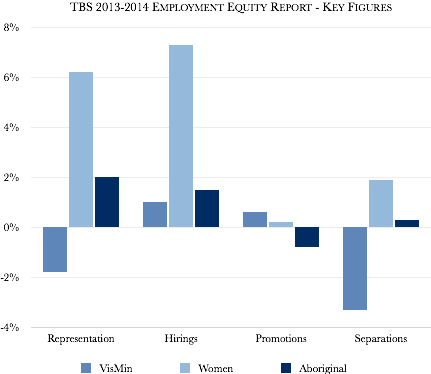
EE - TBS 2013-14 Summary Chart

Disappointing that TBS has not updated labour market availability (LMA) from 2006 (unlike Labour Canada for federally-regulated sectors – banking, communications, transport – has (17.8 percent visible minorities). However, while visible minorities remain under-represented, the hirings, promotions and separations data is relatively strong:

As at March 31, 2014, all four employment equity designated groups exceeded their workforce availability, as determined from 2006 Census data. Aboriginal peoples continued to increase their representation, from 5.0 per cent to 5.1 per cent; members of a visible minority group increased their representation from 12.6 per cent to 13.2 per cent; the representation of persons with disabilities decreased marginally from 5.8 per cent to 5.7 per cent; and women’s representation decreased slightly from 54.2 per cent to 54.1 per cent.

Within the executive cadre, representation rates continued to exceed workforce availability for three of the four designated groups. Women increased their representation from 46.0 per cent to 46.1 per cent; persons with disabilities increased their representation from 5.3 per cent to 5.4 per cent; and members of a visible minority group increased their representation from 8.2 per cent to 8.5 per cent. The representation of Aboriginal peoples remained stable at 3.7 per cent, below their workforce availability for executives.

For those interested, this table shows the overall trend over the past 5 years:

2009-10

2010-11

2011-12

2012-13

2013-14

Representation

10.7%

11.3%

12.1%

12.6%

13.2%

Hirings

11.3%

9.8%

10.7%

14.7%

16.0%

Promotions

12.1%

12.5%

13.5%

13.5%

13.8%

Separations

6.4%

7.1%

7.7%

8.9%

9.9%

Despite most of these years being under restraint and cutbacks, it is encouraging that representation, hirings and promotions continue to increase (separations may reflect cutbacks).

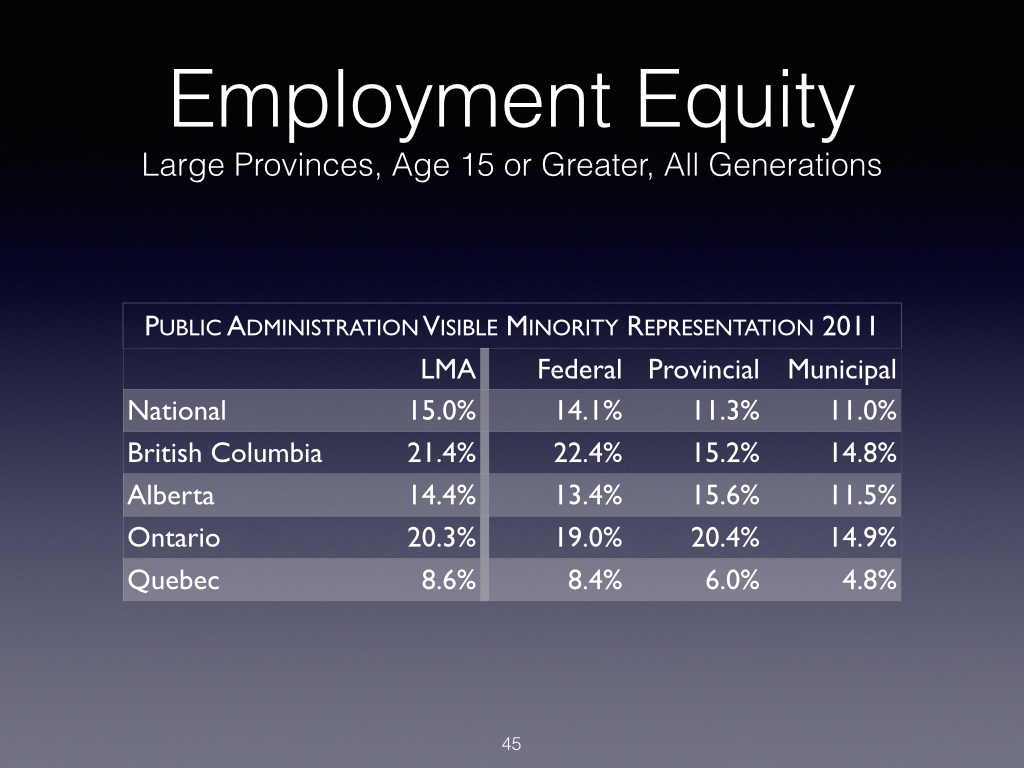
While TBS has not yet issued a revised LMA, a rough calculation would suggest the LMA has increased from 12.4 in 2006 to 15.0 percent in 2011.

This is based on the percentage of the population which is visible minority (19.1 percent) and adjusting for the percentage that are also Canadian citizens (78.3 percent).

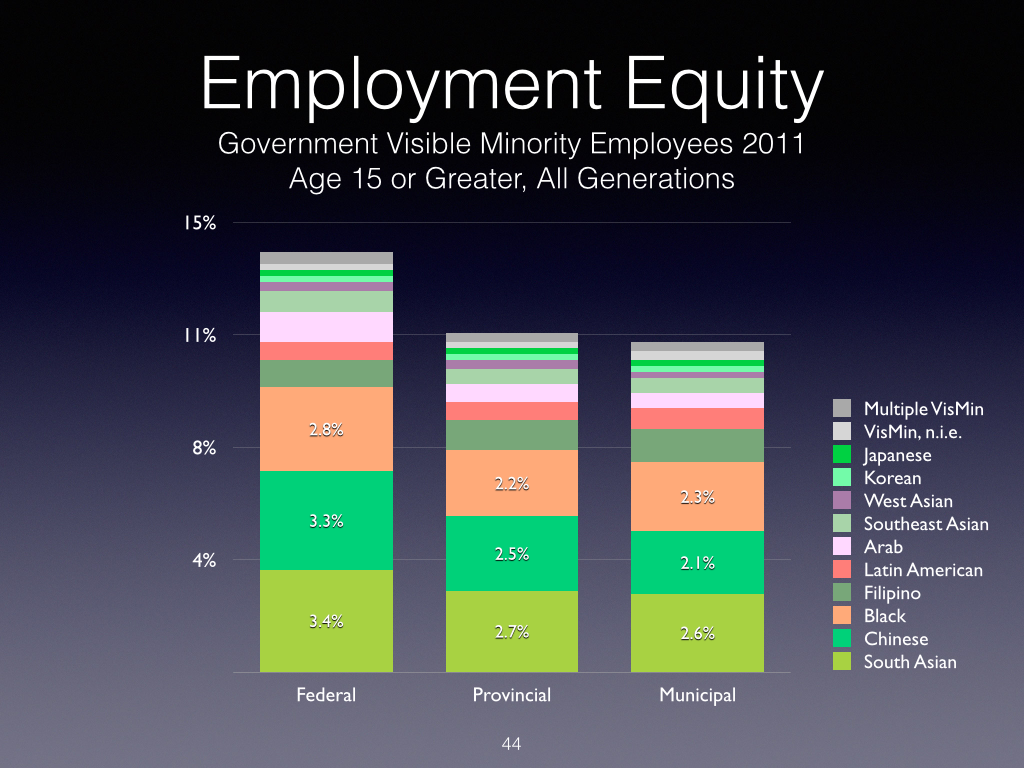
Another view of public service employment equity can be derived from the National Household Statistics on public sector employment, which covers all federal public institutions (less the Canadian Forces), not just the Schedule 1 departments covered in the TBS reports:


Multiculturalism in Canada-Evidence and Anecdote Deck - April 2015.044 Multiculturalism in Canada-Evidence and Anecdote Deck - April 2015.045

Employment Equity in the Public Service of Canada 2013–14.

French losing ground to English, immigrants in Ottawa

Not surprising given that most of Ottawa’s growth (and elsewhere in Canada) is driven by immigration, with immigrants largely integrating into the English language milieu:

The federal study, Portrait of Official Languages Groups in the Ottawa Area, is based on an analysis of Statistics Canada census data. It shows that the city’s overall population increased by more than 330,000 between 1981 and 2011.

Ottawa’s French-speaking community — defined as those whose mother tongue is French — grew by 26.1 per cent during that time span. But the English-speaking community enjoyed much more robust growth (45.9 per cent) as did the population of immigrants whose first language is neither English nor French (225.1 per cent).

What’s more, since immigrants tend to learn English after their arrival, the proportion of Ottawa residents who use English has gone up by 2.7 percentage points during the past three decades, while the proportion of those who use French has gone down by 3.2 percentage points.

Jacques de Courville Nicol, leader of a group dedicated to making Ottawa officially bilingual, said the study shows that the city is headed toward a unilingual future unless more is done to secure the place of the French language.

“Sadly, I think we’re on the road to becoming a unilingual capital, which is not a great signal to send to the rest of the country and the rest of the world,” he said.

De Courville Nicol said English and French must have equal status, rights and privileges within the City of Ottawa. Ottawa has a bilingualism policy that commits the city to offering services in both official languages, but it stops short of the kind of official bilingualism that governs federal institutions.

“I get discouraged when I see so little concern outside of Quebec for the French language and the French community,” De Courville Nicol said.

And while not mentioned in the study, Ottawa is growing much more than Gatineau, and attracting more immigrants as well, with greater diversity as a result:

Ottawa vs Gatineau.001

French losing ground to English, immigrants in Ottawa | Ottawa Citizen.