Citizenship rule changes ensnare Ontario family

A reminder that the variety of peoples’ lives and the desire for simple rules (limiting passing on citizenship to the first generation born abroad) can result in cases like this (most countries that have similar limits, if memory serves me correctly, have more flexibility than the Canadian approach):

At the root of their problems is the fact that Compton was born in Scotland, where his parents were living while in university. He was brought to Canada when he was five months old and lived in the country until his early 30s.

A teacher by profession, Compton then got a job at an international school and moved to Lima, where he met his Peruvian wife, Paola Moscoso Castillo de Compton.

His first son was born in Peru and automatically became a Canadian citizen. However, his second son, was born just months after the new rules came into effect. The changes mean Mateo, 5, is not a Canadian, even though his older brother Stephanoe, 8, is.

The new rules were part of legislation that solved the problems of thousands whose citizenship had been taken away by outdated legal provisions.’

However, at the same time the government said they were protecting the value of Canadian statehood by ensuring citizenship couldn’t be passed on from generation to generation of those living outside Canada.

The changes made Compton feel like a second-class Canadian. He didn’t even find out about the new rules until he tried to apply for a Canadian passport for his son in 2010 and was denied.

“This is an injustice,” he said. “This could happen to any Canadian.”

The situation has only worsened over time. After trying to deal with the matter from Peru, Compton returned to Ontario with his family in February last year.

He and his older son entered the country as Canadians, but Mateo, for whom he had to obtain a Peruvian passport, and Compton’s wife came in on visitor visas.

via Citizenship rule changes ensnare Ontario family – Toronto – CBC News.
The Iran deal is our best possible option. Let’s not spoil it: Heinbecker

Paul Heinbecker analyses the Iranian draft nuclear deal and concludes with the following sharp and pointed comment:

Finally, what can and should Ottawa do? Not much in Tehran, because with our embassy closed by the Harper government, we are blind, deaf, and dumb there. And as for Washington, we should just “zip it.” It would be an error in substance, and destructive of our wider interests, if we undermined the Obama administration vis-a-vis Iran, Israel or Congress. As regards Israel, we should not succumb to the temptation to play diaspora politics, even in an election year in Canada. We should, therefore, do nothing overtly to support Mr. Netanyahu, whose own election tactics destroyed whatever credibility he still had outside of Israel and the Republican side of Capitol Hill.

The Harper government has said little, but has announced a contribution of $3-million to support the IAEA’s efforts to monitor Iranian compliance. On an issue so fraught with dangers, such constructive circumspection is the beginning of wisdom. May it continue.

The Iran deal is our best possible option. Let’s not spoil it – The Globe and Mail.

A God? That’s complicated. Canadians hanging on to personal faith as organized religion declines: poll | National Post

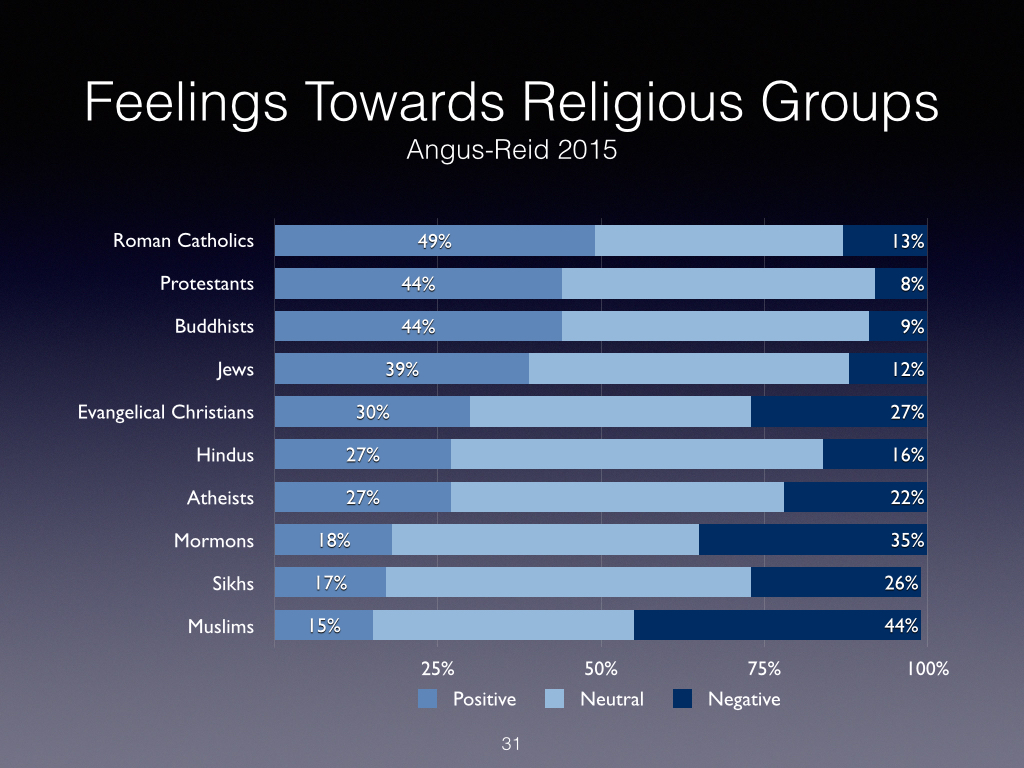
Angus Reid Religon Poll 2015 - Feelings Towards.001The National Post provides a very good infographic summarizing the findings of the recent Angus-Reid survey Religion and faith in Canada today: strong belief, ambivalence and rejection define our views which contains a wealth of information on attitudes and practices and worth reviewing.

Chart above highlights feelings towards different religions and is largely unsurprising.

The chart below provides a relatively rare view of immigration by religion between 2001-11, showing that while religious minorities are a significant share (36 percent), they are still less than Christian immigrants (42 percent). But the median age of religious minorities is younger than for Christians: 32 compared to 41.

Religious Immigration 2001-11.001

A God? That’s complicated. Canadians hanging on to personal faith as organized religion declines: poll | National Post.

Policy Arrogance or Innocent Bias: Review in Canadian Ethnic Studies

For those interested, Policy Arrogance or Innocent Bias: Resetting Citizenship and Multiculturalism continues to attract interest, most recently in this review by Nelson Wiseman of UofT in the most recent issue of Canadian Ethnic Studies.

Canadian Ethnic Studies Review 2015

Treating Saudi Arabian Jihadists With Art Therapy

Saudi Arabia’s deradicalization program using art therapy, with reasonably good results (only 20 percent failure rate). Kind of interesting to be using art in a place where it is generally frowned upon:

“They’re not so tough,” says Dr. Awad Al-Yami, a counselor here. “These are our kids, and anyway, they are members of our society, and they are hurting us. We feel obligated to help them.”

Al-Yami trained as an art therapist at the University of Pennsylvania. He pioneered an innovative program that’s unusual in Saudi’s ultra-conservative culture, where some clerics say that drawing is forbidden.

“I had a hard time convincing my people with art, let alone art therapy for jihadists,” he says.

But the program has delivered results.

“Actually, art creates balance for your psyche,” he says.

It is also a window on the psyche, he says. Drawing is a way for inmates to express emotions, anger and depression, when they first arrive at the center.

He keeps a gallery of paintings, which he analyzes like a detective. The black and white landscapes, which depict scenes from Afghanistan, mean an inmate is still living in the past.

After a few months of counseling, the paintings show more promise. Inmates use color and depict scenes from family life in Riyadh. Al-Yami says this is a sign that the inmate is coming to terms with coming home.

There is a striking number of inmates who draw pictures of castles with high walls. Those send a distinct message, according to Al-Yami.

“I’m not going to give you any information,” he says. “I’m behind the wall and you can’t get through. If I give you information, I am weak.”

He takes the failures hard. Some 20 percent of the inmates here go back to the fight. One spectacular failure went on to become an al-Qaida leader in Yemen.

Now, Al-Yami is preparing for a new wave of inmates: the ISIS generation. He knows they are more extreme than al-Qaida.

“We’ve got some in prison, waiting for their sentences to be over and they will be here,” he says.

Treating Saudi Arabian Jihadists With Art Therapy : Parallels : NPR.

Ottawa’s new Express Entry immigration system slow off the mark

Seems like normal process of introducing a new approach. We need to see full-year and likely two-year data to judge operational success (economic and social outcomes will take longer):

So far, slightly more than 6,850 prospective immigrants have been invited to apply for permanent residency under Express Entry. It will not be until 2017, two years after its launch, that a majority of immigrants are processed through the new system, Citizenship and Immigration Canada said. The shift to the new economic immigration system was announced in 2012 and has been in place since Jan. 1.

In its 2015 immigration levels plan, the Citizenship and Immigration ministry pledged to accept 260,000 to 285,000 new permanent residents, about two-thirds of them economic migrants. To meet that target, the government needs to admit about 22,500 immigrants a month, about 10 times the number that are admitted through Express Entry at present. Most new immigrants this year will have to be selected through the old system, which was criticized because it was slow and operated on first-come, first-served basis.

“CIC is in a period of transition with recent implementation of Express Entry that will span approximately two years,” said Johanne Nadeau, a Citizenship and Immigration Canada spokeswoman.

A majority of economic immigrants arriving in 2015 will be drawn from the pool of people who applied to enter Canada in the years before Express Entry was introduced, Ms. Nadeau said. It is not clear exactly how large a portion of overall immigration will come from Express Entry candidates, or whether the pace at which invitations are issued will increase.

CIC would not say whether it has annual targets or expectations for Express Entry admissions at this point. The number of new permanent residents coming through the program is expected to grow in 2016 to about half of all admissions. By 2017, most, if not all economic admissions should be through Express Entry, Ms. Nadeau said.

Ottawa’s new Express Entry immigration system slow off the mark – The Globe and Mail.

Let there be light, and access to information, in Ottawa – Globe Editorial

Cannot agree more, even if in my former life, reviewing ATIP requests was a chore:

When in doubt, disclose – that is one of the admirable messages delivered last week by Suzanne Legault, the Information Commissioner of Canada, in her report on how to modernize the federal government’s access-to-information system.

In fact, the principle in question is even broader. The presumption should be that any document made for a public, governmental purpose should be made public in the first place; that is, it should be posted on the Internet when it is created, and made available to a citizen seeking the information – unless there is some valid, solid reason not to do so. In other words, most public documents should be open “by default.” The burden of proof should be on the concealer.

The privacy of citizens will often be such a reason; secrecy in governmental activity is less often a solid ground.

The current ATI law is 30 years old, and has been amended in only minor ways since then. Governments and bureaucracies have little incentive to provide most information. This history demonstrates that both Liberals and Conservatives are to blame; we may well doubt that the NDP will be any better if they ever come to power in Ottawa.

All this should be, and could be, much easier in an age of electronic documents, when transmitting information is convenient and easy, and when metal filing cabinets are mostly obsolete. But that has not happened.

One recommendation in Ms. Legault would simplify life for everybody. The charging of fees for requests should end – New Brunswick has already done this in 2011.

The most fraught access-to-information question is cabinet confidences – that is, what is genuinely part of the deliberations of the cabinet, and what is being used as “a cloak” to conceal information. Ms. Legault is right that “purely factual and background information” should not treated as cabinet confidences, but “analyses of problems and policy options” may be another matter.

The fact, however, that cabinet confidence was invoked 3,136 times in 2013-2014 gives us pause. Ms. Legault’s recommendation that a few members of her office should be able to assess whether cabinet confidence is being used for its proper purpose is a good one – as is characteristic of this excellent report as a whole.

via Let there be light, and access to information, in Ottawa – The Globe and Mail.

The Holocaust’s long reach: Trauma is passed on to survivors’ children

Good long piece on the work of Helen Epstein (author of Children of the Holocaust: Conversations with Sons and Daughters of Survivors) and Vivian Rakoff of the ongoing inter-generational trauma faced by children of Holocaust survivors, and the commonality of that experience with other atrocities:

Trauma is trauma, whether it is besetting children of Holocaust survivors or children of families shattered by atom bombs, civil war, terrorism, domestic violence, sexual abuse, addiction, or even illness and disability. The stories keep emerging: in Heather Connell’s Small Voices, a film about the children of survivors of the Khmer Rouge killing fields; in Peter Balakian’s memoir Black Dog of Fate, written as the son of survivors of the Armenian genocide; in Michael Arlen’s Passage to Ararat, also about Armenia. (Memoirs by the children of Rwandan survivors are rarer: They’re just becoming adults.) The details of each oppression make it unique, but the effect of the trauma always follows the same path.

“I don’t feel possessive about my PTSD at all,” Ms. Epstein says. “I think it’s nearly universal.” To which Vivian Rakoff adds, “I think the transmission of trauma has to be admitted to. That when you do something terrible, it has effects. You can have psychic transmission of disorder in the same way you can have microbial transmission of disorder.”

Now we are learning that the horror can be passed along physically, and perhaps even genetically. Efforts are being made to interrupt that fateful flow: At Mount Sinai in New York, Dr. Yehuda has a theory that hydrocortisone might stymie the establishment of PTSD. There are also encouraging therapies and experimental programs, as Judith Shulevitz reported in The Atlantic, in which pregnant women at risk for PTSD receive counselling to help them through the thickets of child rearing.

Trauma and the atrocities that cause it are unavoidable. Parliament’s decision to expand Canada’s war against the Islamic State is, at least arguably, a legitimate and necessary evil. But the children of the soldiers and victims who fall on both sides in that war will feel its trauma regardless, in some place too dark to see. Then will come the hard part. Because once we notice trauma, and inquire after it, we are apologizing for it, and admitting to some sense of responsibility.

Maybe this is why we try so hard not to to notice other people’s pain, why we resist the idea that formative experiences are passed along in physical form as memory, conscious or collective or otherwise. We know we’re connected to one another in ways we can’t see or control, inconvenient as the fact often is. “Much of history is written in blood,” Helen Epstein writes in Children of the Holocaust, “and experiencing some degree of trauma seems to be a part of experiencing life. What that means to me is that it is not ‘other’ but, to various degrees, ‘us’ and that we need to learn to use that insight toward connection rather than separation.” Human pain turns out to be not very private after all.

Judith Herman, the Harvard psychiatrist who in 1993 wrote Trauma and Recovery: The Aftermath of Violence from Domestic Abuse to Political Terror, observed that “the study of psychological trauma has a curious history – one of episodic amnesia.” Why? Because “to study psychological trauma is to come face to face both with human vulnerability in the natural world and with the capacity for evil in human nature.”

We want to remember, and we want to forget. We are who we are. But sometimes we can’t bear to admit it.

The Holocaust’s long reach: Trauma is passed on to survivors’ children – The Globe and Mail.

Cosmo accused of racial bias in trends that ‘need to die’ list

Cosmo TrendsSomeone not thinking (unconscious bias at play):

Fashion magazines are always publishing their Do’s and Don’ts columns, but Cosmo’s latest — in which black models are used to illustrate trends that “need to die” but not showcased for any that are deemed trendy — is being given a major DON’T online.

The feature, appearing on Cosmopolitan.com, focused on fashion faux pas and was accused of being racist. It included 21 beauty trends that are dying and Cosmo-approved alternatives, but overwhelmingly the women of colour that are featured appear exclusively in the Don’t column. While the examples of Do’s are almost exclusively all white women.

The reaction was harsh and unforgiving.

Cosmo accused of racial bias in trends that ‘need to die’ list – Trending – CBC News.

The worst time for Jews to abandon Europe – Avraham Burg

Avraham Burg on European Jews:

In a generation in which we Israelis have forgotten how to be sensitive and empathetic to minorities, to those who are different, to the persecuted, and many American Jews are swallowed up in their comfort zones of white society and are abandoning their partnership with the “others,” in America, the “United States of Europe” is presenting a new model of identity – a union between those who are different, and the “other.” It’s a model no different from the American one which seeks to assimilate all into a monochromatic American democracy.

Further, Europe is the current meeting point between Islam and the West. Some of that encounter involves clashes, and some involves learning. The Christian continent is learning to make space for other, rich and varied identities. My friends, Ziya from Bangladesh, Shaida whose family is from Turkey and Rob from Jamaica, are impressive Europeans, and Europe is better off with them. Just like Shaul from Venice, Yoop from Amsterdam and Brian from London – there is no dissonance between their Jewish heritage and their European identity. The discourse between white, Christian Europe and those who are different is fascinating. More important is the dialogue between Western Europe and the Muslim forces in its midst.

The Muslim world and some of its members are embarking on a long journey toward the Western values of freedom, equality and brotherhood. The institutionalization of Western Islam in the heart of Europe – that which is absorbing values of democracy while remaining true to Muslim tradition – is where the strategic potential exists for bridging the gaps peacefully in the generations to come. It’s not happening in the Middle East or North America, but only in Europe. That is where the vanguard of humanity and humaneness is to be found. There has never been a worse time for Jews to abandon Europe.

The challenge facing the West and Europe is no longer military or economic, but rather an intellectual challenge of values. The philosopher Hans-George Gadamer said that he regards abundance of diversity as the most precious treasure which Europe managed to save from the conflagrations of the past, to offer to the world today.

“To live with Another, live as Another for Another, is the fundamental task of man – both on the highest and the lowest level …therein perhaps dwells that specific advantage of Europe, which could and had to learn the art of living with others,” Gadamer is quoted in Zygmunt Bauman’s book “Culture in a Liquid Modern World.”

A fight for the future of the West without the Jews of Europe would be almost tragic, and must be avoided at all costs.

The worst time for Jews to abandon Europe – Opinion – Israel News | Haaretz.