Trevor Phillips Says Multiculturalism Is ‘A Racket’ Ahead Of Channel 4 Race Documentary

Trevor Phillips on the dangers of excessive political correctness and the need for more open and frank discussion:

The perverse and unintended consequences of our drive to instil respect for diversity is that our political and media classes have become terrified of discussing racial or religious differences.

“Our desperation to avoid offence is itself beginning to stand in the way of progress. And all too often the losers are minority Britons.

“Preventing anyone from saying what’s on their minds won’t ever remove it from their hearts. People need to feel free to say what they want to without the fear of being accused of racism or bigotry.”

He listed ’10 true things’ it is taboo to say, including “Romanians are far more likely to be pickpockets” and “Jewish households are twice as wealthy as the rest”.

He cited the child sex abuse scandals in towns including Oxford, Rotherham and Rochdale and the murder in 2000 of eight-year-old Victoria Climbie as examples of institutions failing to act for fear of offending minority groups.

Phillips, a Labour London Assembly Member, also admitted he felt he bore some responsibility for the July 7 bombings in 2005 because, as then head of the CRE, he failed “to see what was coming”.

He said: “Because I had made it my business to spend part of each week in a community outside London, I already knew some groups were becoming so isolated that values and ideas which most people would find alien were tolerated and even encouraged.

“But we had said little about it and done even less. After 12 months at the CRE I had come to the conclusion that, while beautiful in theory, multiculturalism had become a racket in which self-style community leaders bargained for control over local authority funds that would prop up their own status and authority.

“Far from encouraging integration it had become in their interest to preserve the isolation of their ethnic groups. In some, practices such as female genital mutilation — a topic I’d made films about as a TV journalist — were regarded as the private domain of the community.

“In others, local politicians and community bosses had clearly struck a Faustian bargain: grants for votes.

“And I saw a looming danger that these communities were steadily shrinking in on themselves, trapping young people behind walls of tradition and deference to elders.

“Of course none of this was secret. But anyone who pointed the finger could expect to be denounced for not respecting diversity.”

Phillips criticised the public reaction to “pefectly reasonable” comments by Benedict Cumberbatch about the lack of roles for black actors in the UK.

He said Cumberbatch was making the “much-needed case for the employment of black actors in greater numbers”.

Trevor Phillips Says Multiculturalism Is ‘A Racket’ Ahead Of Channel 4 Race Documentary.

Immigrants Looking Beyond Big City Living – New Canadian Media – NCM

Saskatchewan_ImmigrationLet’s not exaggerate: the numbers are still small, both in Saskatchewan as a whole and the communities listed, but it is part of a trend, helped by the growth of provincial nomination programs, towards more dispersion of immigration across the country:

The research, based on the 2011 National Household Survey, revealed the top five non-metropolitan towns with the highest number of immigrants as a per cent of total population were all in Saskatchewan. Although the number of immigrants moving to rural areas are smaller, the impact on the local population is significant. For example, topping the list was the town of Englefeld, Saskatchewan, with a total population of 225 people, 80 of them being immigrants – about 35.6 per cent of the population.

“Over time, the labour markets in the larger centres become particularly saturated, so immigrants will perceive more opportunities in smaller jurisdictions and that will bring them outward.” – Dr. Michael Haan

Ontario still attracts the most in sheer numbers, but the prairie provinces rank higher per capita for several reasons says Dr. Michael Haan, the Canada research chair in population and social policy at the University of New Brunswick. He describes the recent trend to rural Canada as a natural progression of a country’s immigration movement.

“When a country initially welcomes immigrants, they tend to cluster in particular regions, here the largest cities received the most,” he explains. “Over time, the labour markets in the larger centres become particularly saturated, so immigrants will perceive more opportunities in smaller jurisdictions and that will bring them outward.”

Immigrants Looking Beyond Big City Living – New Canadian Media – NCM.

The Canadian High Commission, the revered historian and the dinner invite never sent

More of the sordid details behind the Government’s efforts to undermine the mandate of the Foundation for Canadian Studies in the UK. A long but interesting read, and consistent with earlier Government decisions to cut funding international for the Canadian studies abroad program (see Foreign Affairs Cuts Canadian Studies Abroad Program):

The foundation’s original mandate was “the advancement of the education of the public in the United Kingdom in matters relating to Canada,” primarily through the funding of Canadian Studies research chairs at several UK universities. Following the fracas, the foundation’s website was amended to say it is “now expanding this to consider research that is directed at issues that are of strategic importance to both Canada and the UK, such as energy, transport, communications, the sustainable use of natural resources, multiculturalism and the welfare of indigenous peoples.”

The squabble has seen Mr. Campbell accused of bullying and suggestions raised of interference by either the Prime Minister’s Office or the Department of Foreign Affairs and International Trade in Ottawa. Critics accuse the High Commission of wanting to use the foundation’s money – all of it raised via private donations – to carry out programs the High Commission can no longer afford to pay for after funding cuts by the federal government.

The Canadian High Commission, the revered historian and the dinner invite never sent – The Globe and Mail.

Bill C-51 hearings: Diane Ablonczy’s questions to Muslim group ‘McCarthyesque’

How does the Government seriously think that this ongoing line of unsubstantiated allegations helps increase cooperation with Canadian Muslim groups and Canadian Muslims in generally in helping reduce the risk of radicalization and violent extremism?

Just reinforcing previous examples of divisive language and the lack of a de-radicalization strategy on “soft” measures to reduce what are real risks:

During a question-and-answer session following National Council of Canadian Muslims executive director Ihsaan Gardee’s presentation to the House public safety committee on Bill C-51, Diane Ablonczy used her allotted time to “put on the record” what she described as “a continuing series of allegations” that the NCCM has ties to groups that have expressed support for “Islamic terrorist groups,” including Hamas.

“I think it is fair to give you an opportunity to address these troubling allegations,” Ablonczy said.

“In order to work together, there needs to be a satisfaction that, you know, this can’t be a half-hearted battle against terrorism. Where do you stand in light of these allegations?”

Gardee pushed back.

Ihsaan Gardee, the executive director of the National Council of Canadian Muslims, told Diane Ablonczy that her line of questioning Thursday was “entirely based on innuendo and misinformation.” (CBC News)

“First and foremost, I’ll say on the record that NCCM has condemned violent terrorism and extremism in all of its forms, regardless of who perpetrates it for whatever reason,” he told the committee.

“However, the premise of your question is false, and entirely based on innuendo and misinformation.”

Gardee pointed to the group’s history as an independent, non-profit, grassroots Canadian Muslim civil liberties organization with a “robust and public” track record.

“These are precisely the types of slanderous statements that have resulted in litigation that is ongoing,” he said, including a defamation lawsuit launched last year against the Prime Minister’s Office over “false statements” linking the group to Hamas made by now-former spokesman Jason MacDonald.

“The NCCM is confident that the courts will provide the necessary clarity on these points to ensure they are never repeated again,” he said. “The NCCM is not going to submit to a litmus test of loyalty used against Canadian Muslims and their institutions… which underlie such offensive questions.”

“McCarthyesque-type questions protected by parliamentary privilege are unbecoming of this committee,” he said, referring to a style of questioning used by U.S. Senator Joseph McCarthy in the 1950s, imputing guilt with little or no evidence to back it up.

In response, Ablonczy mused that Gardee seemed to have been prepared for her question — as, she said, she thought he might be — before switching topics to hear his thoughts on effective anti-radicalization initiatives.

Bill C-51 hearings: Diane Ablonczy’s questions to Muslim group ‘McCarthyesque’ – Politics – CBC News.

Justin Trudeau, Steven Blaney and Godwin’s law of Nazi analogies – From the author of Godwin’s Law

For those accusing Justin Trudeau and Minister Blaney of inappropriate Nazi and Hitler references, an interview with Mike Godwin, the coiner of Godwin’s law that whoever first invokes an (inappropriate) reference has lost the argument, to set the record straight:

Let’s start with Mr. Trudeau. Did you think what he said was appropriate? 

Yes I actually do I think that it’s served Canada well to remain aware that the singling out of people on the basis of their ethnic or religious background is not something that Canadians have totally been a stranger to. That in the run up to World War Two certainly Jews in Canada had that experience …. I think that Canada of this century is a better place and I think what Mr. Trudeau is saying is in line with what I think majority of Canadian values are today.

You are aware that some people did criticize him for that comparison perhaps unconsciously thinking of Godwin’s Law. 

I am aware of it and I think that the thing that I would say in defence of Mr. Trudeau is that he is not saying that anyone who is afraid of people of different cultures or people of different ethnic groups is inherently going to act like a Nazi or be like Hitler. I think what he’s saying is look, let’s be aware of history, we should remember our mistakes and not repeat them.

Let’s look at minister Blaney who seemed to draw a line between certain kinds of speech and the Holocaust. Do you think that that comparison was acceptable. 

…  I want to say, in defence of Mr. Blaney, that in fact bad ideas can lead to bad real world outcomes. That is certainly true and nobody can dispute that. But what free and open societies like Canada’s and like those of other developed nations really try to do is not attack the ideas by suppressing them.

For all the Canadian pundits, politicians and interest groups who condemned both, worth reading and reflecting upon, and appreciating the nuance in Trudeau’s remarks in contrast to the less sophisticated remarks of Blaney.

Justin Trudeau, Steven Blaney and Godwin’s law of Nazi analogies – Home | Day 6 | CBC Radio.

19th-century Toronto Irish immigrants a lesson in upward mobility

A good piece on the history of the Irish in Toronto, the original public fears, and how the Irish community eventually blended in, emerged from poverty, and was no longer was perceived as threat to the majority population:

So how did the Irish emerge from a climate of poverty, hostility and violence that too often defined their lives in Toronto? A range of factors contributed, of course, some hard to replicate in modern-day Toronto, but others more readily at hand.

It surely helped that the Irish spoke English, allowing them to sidestep the language barrier that would slow the integration of later generations of newcomers.

Physical mobility was another Irish advantage. Corktown and neighbourhoods like it may have served as landing pads for the new immigrants, but they rarely stayed in one place for long.

“By the 1890s, they’re everywhere,” said McGowan, himself descended from famine refugees. “If you went to an American city, there would be these long-standing Irish enclaves. You don’t have that here.” This geographic dispersal helped bring Catholics and Protestants into closer contact, driving mutual understanding and even encouraging intermarriage. “Cupid was probably more important than denomination at a certain point,” McGowan said.

At the same time, immigrants from other parts of the world began trickling into Toronto, loosening the Irish monopoly on the fears and resentments of the WASP majority.

“From the 1880s, Toronto started getting immigrants who were even more scary from the majority perspective,” said Allan Levine, author of Toronto: Biography of a City.

“Number one, Catholic Irish immigration peters out, so there are fewer paddies with cloth caps and accents in the downtown area,” said William Jenkins, a professor of North American Irish history at York University, and himself the proud owner of a lilting Irish accent. “People basically just forget about the Irish.”

In the meantime, the community was working doggedly to improve its lot. Mutual aid societies, church parishes, sports teams, card parties, and temperance leagues created a thick support net for Catholics trying to climb the social ladder or simply to avoid destitution.

“They created their own infrastructure,” said Levine. “They looked after themselves.”

19th-century Toronto Irish immigrants a lesson in upward mobility | Toronto Star.

Douglas Todd: Canada a blank slate, with no culture?

More on the ongoing (existential) debate on whether Canada has a unique culture. My favourite comments cited by Douglas Todd are below:

Eric Kaufmann, a Vancouver-raised political scientist at the University of London, said while there is no single Canadian identity, “as long as each resident of the country identifies with Canada in some way, the whole remains united.”

Somewhat like John Ralston Saul, Kaufmann emphasizes the “Métis,” or “mixed,” nature of Canadian culture — that many residents are a blend of such things as Anglo-American, Protestant, aboriginal, French-Canadian, Catholic and, increasingly, Asian origins.

The “northern landscape” is also a significant connector among Canadians, said Kaufmann. So is the way Canada is a more “ordered, equal society than the U.S. Then there are everyday things like maple syrup, hockey and the moose, which of course, matter, too.”

Kaufmann suggests governments not push too hard on promoting a single view of Canadian culture, but instead highlight “core values around respect for liberty, law and celebrating major historical episodes.”

All of this acknowledges that Canada is not an easy-to-define country. And there are semantic challenges around the word, “culture,” which some academics enjoy de-constructing.

But even highlighting core values, and the interpretation that can be attached to each core value, is never quite as easy or as neutral as it sounds.

Douglas Todd: A blank slate, with no culture?.

NDP tones down their defence of face-covering niqab in Quebec

More on some of the internal NDP debates:

But headlines in French-language media that say NDP is “in favour of the niqab” were not well received by all New Democrats, and provided fodder for the party’s opponents in the province.

The niqab is a controversial subject in Quebec, where a promise from the separatist Parti Québécois to ban overt religious symbols among government workers was a major issue in the most recent provincial election.

One of the NDP’s best known Quebec MPs, Alexandre Boulerice, gave media interviews this week to explain his “uneasiness” with the niqab.

“It seems to be a symbol of oppression, which is not something that pleases me,” Mr. Boulerice told The Globe and Mail on Friday. “I think the niqab is at the junction of the limits of what is accepted by the Charter [of Rights and Freedoms] and what Canadian society is ready to accept.”

He also questioned the ability of fully veiled bureaucrats to provide services to the public, stating Canada might need a country-wide consultation on religious symbols similar to one in Quebec in 2007-2008. However, he added that the Charter needs to be respected, and accused the Conservative government of “going overboard” on the issue.

The Liberal Party jumped on Mr. Boulerice’s comments, arguing that on minority rights, the NDP says “one thing in Quebec, and something else in the rest of Canada.”

New Democrat officials said the party’s position has not changed: it will continue to support minority rights vigorously and defend the Charter, including the right of women to wear a niqab when swearing the oath of citizenship.

The party also renewed its assault on Prime Minister Stephen Harper for attempting to use the issue of the niqab to win support in Quebec. New Democrats explained that in much of the country, the debate is among three federalist parties, but that in Quebec, the separatist Bloc Québécois, a federal party, is scoring political points by criticizing the niqab.

“Stephen Harper is helping the separatists by giving them a lifeline, by fanning the flames of division on this issue,” NDP principal secretary Karl Bélanger said in an interview.

NDP tones down their defence of face-covering niqab in Quebec – The Globe and Mail.

Quebec woman denied her day in court over hijab turns down $52,000 raised through crowdfunding

Class act:

The money collected on the gofundme website was to be used to help Rania El-Alloul buy a car.

The drive was in response to a judge’s refusal to hear her case against Quebec’s automobile insurance board, which had seized her vehicle.

El-Alloul said in a letter on the website that she appreciates the financial support offered by the “generous and warm-hearted campaign.”

But, she added, she can’t accept the gift.

“The awareness raised by this campaign has brought us people from all over, who have offered support to carry this issue forward,” El-Alloul wrote.

“As a result, I believe that these funds can be put to better use helping those whose rights have been forfeited and stories left untold.”

Quebec woman denied her day in court over hijab turns down $52,000 raised through crowdfunding

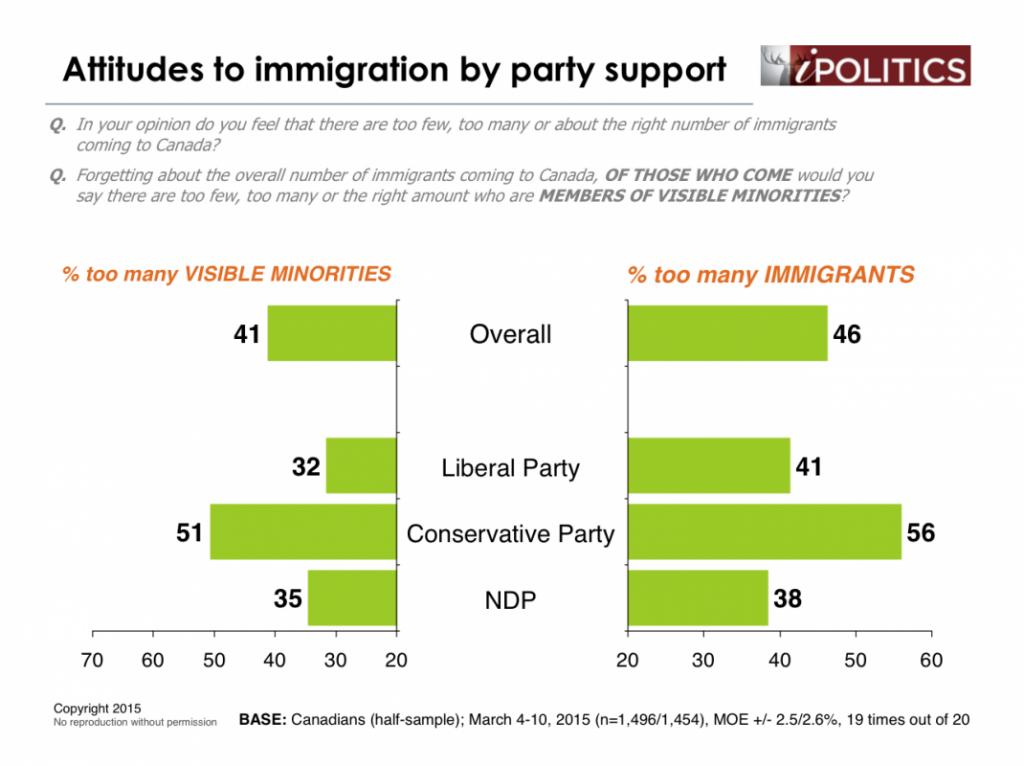
The EKOS poll: Are Canadians getting more racist?

Interesting contrast with annual CIC tracking survey which continues to show stable support for current levels of immigration as per chart below:

CIC_Tracking_Survey

Questions of race and religious dress have rarely been ballot box issues in Canada. Now, however, they appear to be the key factors behind major shifts in the voter landscape.

Visible minorities and Immigration - Ekos

Canada has absorbed a large number of visible minority immigrants over the past twenty years, turning us from a largely white society with ancestry drawn from Britain and France to an extremely heterogeneous one. Initial deep reservations about immigration dropped consistently over that period as we became more diverse. The public embraced the ideal of multiculturalism; dire warnings about ethnic enclaves and a fading national identity never came true. Our research over that period shows national attachment remained very high in Canada, while ethnic identifications actually dropped.

It’s useful to remember how far apart public opinion in Canada and the United States was following the 9/11 terrorist attacks. In both countries there was a sharp, immediate rise in opposition to immigration. In Canada, however, that trend soon dissipated, reaching an all-time low around 2005 — when only 25 per cent of us said there were too many immigrants and less than one in five said that too many immigrants were visible-minority. In the U.S., the level of opposition to immigration was nearly three times higher. Canada remained a nation open to the world: pro trade, pro-immigration and pro-diversity. This seemed to confer both social and economic advantages.

Recent polling shows opposition to immigration has nearly doubled since 2005 and is threatening to crack the 53 per cent level we saw in 1993. Not only is opposition to immigration in general scaling heights not seen in twenty years but the number of Canadians saying we admit too many visible minorities has just cracked the 40-point ceiling for the first time ever.

…When we look at how attitudes on immigration and race spread out among the main federal parties, a pattern emerges. Liberals and New Democrats have no cause to be smug; fully one-third of their supporters think too many of those coming to Canada are visible minorities.

But it’s the Conservative party — which owes much of its current success to wooing votes from new Canadians — that seems to have the problem. Jason Kenney, to his credit, wants new Canadians in his party’s corner. But half of the people who support his party would prefer to see fewer non-white immigrants.

Frank Graves of EKOS polling has some startling new numbers