Why does the left downplay antisemitism? All forms of racism should be abhorred | Dean Sherr

Fair commentary, and some good parallels between antisemitism, Islamophobia and other forms of racism and prejudice:

But Jews should not be required to parade our suffering, historical or contemporary, in a competition for attention with other forms of racism. Nor should we be expected to tolerate the constant appearance of antisemitic language and imagery at prominent anti-Israel rallies, which does seem to show that the use of antisemitic symbols and language in the west is seen as less threatening, or perhaps “understandable”, when connected with Israel.

….Her [Miriam Gargoyles’]  solution was for Australians to see that “not all Jews behave in the way Israelis are doing” – suggesting all the Jew has to do is denounce Israel loudly enough, or perhaps wear a sign, that indicates that we aren’t all “evil” like Israelis are, to avoid being victimised.

Ironically, it sounds remarkably like a demand so often made of Muslims. As Australian prime minister Tony Abbott said a week earlier, “I wish more Muslim leaders would say [they are a religion of peace] more often and mean it.” Abbott’s comments were widely denounced by the left and rightfully so, but Margolyes’ comments were not objected to, they were applauded by many in the audience and online.

It is surely obvious that mitigating bigotry or racism with victim-blaming is wrong regardless of the victim’s ethnic or religious background. Yet it persists in some left-wing circles that Jews are the exception to this rule – our communal connection to Israel makes us somehow more legitimate targets, unless we denounce the Jewish state.

The problem with this notion is twofold – firstly, because Jews do not wear signs declaring our position on Israel. A proud Zionist Jew can just as easily be targeted at a kosher supermarket as an anti-Zionist one. More than that though, why should we have a duty to detach ourselves from a vital aspect of our cultural identity to avoid victimisation?

The reality is that we are human beings with complex identities, defined by a wide range of societal, communal and ethnic influences. Must we carry the burden of answering for all of Israel’s actions because we were born Jewish? And are we so unlike other ethnic cultures that care for the safety and security of our relatives abroad, that we can be painted as immoral for not abstracting ourselves from their threatened existence?

In a political climate where fear is a weapon as much as a state of mind, where innocence isn’t automatically assumed, and where wars and foreign affairs can fuel prejudice at home, it is natural that many take great steps to defend embattled Muslim communities from the risk of dangerous incitement. In doing so, they recognise that Muslims deserve to have their rights – freedom of association, of safety, of speech – protected, if necessary by the state.

They also recognise that self-determination of cultural and national identity is not something we can impose on other people. Those rights and understandings must be equally extended to Jews without the expectation that we must first denounce Israel, fight it, answer for it, or be ashamed by it.

… When progressives downplay or diminish the threat of antisemitism in the diaspora because of Israel – or, worse, fuel it – they do not extend to us those equal rights they purport to stand for. Progressives do more than dishonouring their values in this case, they diminish the unique history of Jews in Australian (and western) society, failing to acknowledge and defend us as equal, regardless of our relationship with or opinions about Israel.

The left must act to repair its straining relationship with Jews and once again take up opposition to antisemitism as its cause. Antisemitism is, like all forms of racism, to be abhorred and condemned unequivocally, not reduced and marginalised by games of comparison and mitigation. It is not a partisan issue and it cannot be up to the right to own the unqualified outrage it deservedly generates. The left, and the values it holds, are far too proud and dear to our hearts for that.
Why does the left downplay antisemitism? All forms of racism should be abhorred | Dean Sherr | Comment is free | The Guardian.

Emmett Macfarlane: Harper’s needless niqab fight

Good piece by Emmett Macfarlane on the niqab debate. Concluding paras below:

Justin Trudeau was not wrong to point out that there is a deeply troubling, corrosive element to this debate. (Full disclosure: I was asked to read a draft of his speech on this topic and provide non-partisan feedback.) The recent incident of a Quebec judge denying access to a woman wearing a hijab (head scarf) was deplorable. The judge denied someone access to justice on the basis of her identity, and should be removed from the bench for such a flagrant violation of her role and of the constitution. In the midst of such troubling anti-Muslim sentiment, policies that target minority groups in this fashion are irresponsible.

The policy also speaks to an ignorance about Canada’s success with social integration. Second-generation immigrants in Canada tend to do extremely well in comparison to their counterparts in many other countries on measures like intergenerational social mobility and language acquisition. There is no reason to think the niqab issue is any different; a tiny minority of Muslim women in Canada choose to wear it, and it is highly unlikely their daughters will. Opponents of the niqab might ask themselves, again, whether government intervention is even necessary on this issue. Of course, they might also stop to ask themselves if there aren’t other reasons why a woman would wear one, as opposed to just “oppression,” and why their allegedly “pro women” position requires telling women what they can’t wear and when.

Finally, the debate also raises a fundamental question about our politics. There has been much commentary about the place of social conservatism in the Conservative party, as people wonder how Stephen Harper has managed his caucus for so long while denying social conservatives opportunities to pursue policies like those related to restricting abortion. Looking at this debate, and government initiatives like Bill C-51, it has become clear that this attention has been focused on the wrong group of conservatives, because I am left asking myself, with some frequency lately, what happened to all of the libertarians?

Emmett Macfarlane: Harper’s needless niqab fight

Foreign students left behind in new Express Entry immigration program | Toronto Star

Oversight or by design? Metropolis Panel on Temporary Foreign Workers March 27 will have opportunity to discuss:

International graduates from Canadian universities and colleges say Ottawa’s new skilled immigration system actually hinders their access to permanent residency instead of promoting it.

The scholars say their once-prized assets — Canadian education credentials and post-graduate work experience — have little to no value under the new Express Entry program, which came into effect Jan. 1.

The problem, which the federal government denies, lies in the significance given to a certificate called the Labour Market Impact Assessment (LMIA). It is issued by Ottawa to ensure a candidate’s skills are sufficiently in demand to warrant hiring an immigrant.

Ottawa says applicants for Express Entry, such as international graduates, do not need an LMIA to qualify. But Express Entry acceptance is based on a point system and it’s not possible to earn enough points without an LMIA, immigration experts say.

“The new system is flawed,” said Toronto immigration lawyer Shoshana Green. “We want people who went to school and have work experience in Canada. These people are already fully integrated. And now we are ignoring them. It is just bizarre.”

Under the Express Entry system, an applicant may earn a maximum of 1,200 points. An LMIA automatically earns applicants 600 points. The other 600 possible points are awarded for personal attributes such as education, language skills and work experience.

How many points does it take to qualify for Express Entry? It changes. So far it has been as high as 886, and has dropped to 735 points. Regardless, the qualifying level is more than 600, so an LMIA is necessary.

Foreign students left behind in new Express Entry immigration program | Toronto Star.

Also covered in the Globe:

International students in limbo under immigration system changes – The Globe and Mail

More immigrants coming to Nova Scotia than at any time in the last 10 years, government says

The numbers are still small compared both the provincial population (900,000) and to overall immigration levels (around 250,000):

But the trend hasn’t been a straight line of steady growth. Since 2004, when 1,771 immigrants arrived in Nova Scotia, the number rose almost every year and peaked at 2,651 in 2008 before dropping off to 2,138 in 2011 and rebounding steadily in the past three years.

Among last year’s immigrants, 717 people came through the Nova Scotia Nominee Program — the highest number yet for the program. This year, a total of 1,050 individuals are expected to gain permanent residency through the program, the government says.

Diab also said more immigrants are choosing to stay in the province. She said the latest figures from Statistics Canada indicate 71 per cent of immigrants who arrived in Nova Scotia between 2007-2011 stayed in the province. These are the most recent numbers available, and the province relies on Ottawa to provide retention figures.

The retention rate for immigrants who arrived in Nova Scotia between 2003 and 2007 was 69 per cent.

Diab said the province has streamlined the application process for skilled and educated immigrants, strengthened ties between government and settlement service providers and changed the nominee program to allow international students to stay in Nova Scotia.

As well, the province appointed a premier’s task force on immigration last August.

“Nova Scotia is a welcoming community and we want to ensure our province is seen by immigrants as an excellent choice,” Diab said in a statement.

More immigrants coming to Nova Scotia than at any time in the last 10 years, government says – The Globe and Mail.

What drove seven young Quebeckers into the arms of the Islamic State?

A good and balanced portrayal of the debates in Quebec, with a good selection of different views. But the money quote on lessons learned comes from Amy Thornton, a researcher in radicalized youth in Europe and North America, University College London:

Ms. Thornton, the U.K. de-radicalization researcher, said there are different models for countering extremism, but the wider atmosphere matters. Canada has sent fewer than a couple hundred fighters to jihad and homegrown terrorists remain mercifully rare compared to Europe. Maintaining a calm and welcoming stance is key to Canada remaining a fringe contributor to the ranks of extremists, she said.

“This is about keeping your national identity, and Canada’s national identity is about openness and integration and toleration,” she said. “Don’t let extremists from either side dominate debate. Don’t lurch toward marginalizing people just because something happens. Stay balanced.”

What drove seven young Quebeckers into the arms of the Islamic State? – The Globe and Mail.

Douglas Todd: If academia is becoming less relevant, blame bad writing

These apply to all writing, not just academic:

What are the signs of bad writing?

• Jargon: Sometimes it’s necessary to use technical words, but words like “apperception” become unhelpful jargon when they’re used mostly to keep out outsiders. Other bits of jargon, like “outsourcing,” hide offensive realities.

• Verbs as nouns: Billig dislikes academic “nouniness,” the tendency to turn virtually every idea into an abstract noun. Billig names scores of over-used nouns, like mediatization, re-ethnicification, deindividuation and, especially, reification. He argues against making verbs into nouns with suffixes such as “ization,” “ication” or “ism.”

Billig is correct when he says such nouns turn vague concepts into concrete things, when they’re not.

An over-reliance on abstract nouns helps academics avoid dealing with real people and actual processes, Billig says.

For what it’s worth, one of my pet-peeve abstract nouns is the increasingly common “essentialism.”

• Passive language: Academics, like everyone else, need to avoid passive sentences when possible, because they include less information than sentences with active verbs, which require (often human) actors as subjects.

• Not much to say: In academic circles, the pressure “to publish or perish” is not an empty threat. Billig maintains somewhat ruthlessly that a cause of bad writing is that many academics don’t have much worthwhile to say. Academics, he says, often use jargon, nouns and passive sentences because they’re hiding that they’re just repeating platitudes.

• Self-censorship: This is another danger in academia. It’s not just politicians and business leaders who cover their butts with euphemisms; academics also default to bureaucratic language. Bureaucratese is designed to say less, not more.

Douglas Todd: If academia is becoming less relevant, blame bad writing.

And always a good idea to re-read Orwell’s Politics and the English Language essay from time to time.

David Mulroney warns Canada should apply Afghanistan’s lessons to Iraq

Sound advice:

A former top official on Canada’s work in Afghanistan is warning against getting too involved in Iraq without clear and realistic objectives.

David Mulroney, who served as the deputy minister in charge of the Afghanistan Task Force, said Canada hasn’t looked closely enough at its experience in Afghanistan.

“When I recently saw Foreign Minister [Rob] Nicholson musing that we’d apply some of the lessons of Afghanistan to our engagement, I kind of sat bolt upright because I think one of the problems is we haven’t spent much time learning the lessons of Afghanistan,” Mulroney said in an interview to air Saturday at 9 a.m. on CBC Radio’s The House.

Mulroney said a newly released audit shows “how hard it was to get that development assistance and humanitarian assistance right in a place where none of the officials were really clear about what Canada’s objectives were.”

Mulroney also served as secretary to the Independent Panel on Canada’s Future Role in Afghanistan, which was led by former foreign affairs minister John Manley, and as foreign and defence policy adviser to the prime minister.

He said the lack of discussion about Afghanistan toward the end of the 10-year mission has kept Canadians from learning key lessons, which include being realistic about how much Canada doesn’t know about a region and setting “often very modest” goals.

Mulroney also said Canada needs an exit strategy.

“When does it happen for us and who’s around to pick up the pieces of what we’ve put in place. Until we’ve really talked honestly about that, I’d be very worried about our ability to pull something off in a place that’s as challenging as that nexus of Iraq and Syria.”

He also warned the government has to think about how the humanitarian, military and diplomatic pieces fit together.

“If it’s being done now, this is the time to tell Canadians that people have thought about that. Because if it hasn’t been done, we’ll get the same ultimately disappointing results that audit points to on Afghanistan.”

David Mulroney warns Canada should apply Afghanistan’s lessons to Iraq – Politics – CBC News.

And a good short interview with him in the Globe:

 How would you characterize the tension between diplomats and political staffers nowadays?

The truth is that public servants now serve a concierge function. They get difficult things done on the basis of careful instruction. So you focus on managing events, like visits, and then you report back to headquarters, but then you feel increasingly bullied. By the end of my career I’d written the same report on Sino-Canadian relations a dozen times. It was time to go.

In what specific way did Ottawa make you feel discouraged?

On the [Chinese social media site] Weibo we hosted a discussion about the case of Lai Changxing, [a fugitive to whom Canada gave refuge].

The other was about the official car I drove, which generated a real discussion about how what kind of accountability officials should be held to.

But there was complete silence from Ottawa, the kind that indicates disapproval. There was nothing they could hold against us because there were too many positives, including two editorials in The Globe. In the end though we turned the way embassies communicate on their head.

David Mulroney on pandas, the PM and Chinese-Canadian relations

Why we can’t run from Starbucks’ #RaceTogether campaign

Although over-taken by Starbucks decision to cancel the campaign, good piece by Tabitha Southey on the Starbucks #RaceTogether campaign:

As for the rather precious outcry that people are just trying to get their coffee, and so this is hardly the place for this kind of thing, you can still just get a coffee – but let’s not ignore the long and raucous tradition of discussing politics, philosophy and current affairs in coffee houses.

Coffee houses were once predominantly about discourse and debate and, yes, they too had owners who made money – yet still managed to be hotbeds of sedition. Cheer up, grumpy radicals, the French and American revolutions were both plotted in the Starbucks of their day.

I know that, when I walk down a street in New York with my wonderful sister-in-law, who is black, we’re walking on different streets. I know, of course, that racism is entrenched and systemic – and that I benefit from it every day.

No one’s suggesting that it is a little personal “issue” that can be solved by coffee talks, but we shouldn’t underestimate the power of small stories, of moments of connection, to provoke change.

Small stories are how we organize our world, and I find I can’t laugh for long at anything that encourages us to glimpse down the other’s road.

Why we can’t run from Starbucks’ #RaceTogether campaign – The Globe and Mail.

Canada faces dramatic drop in citizenship, prompting concerns about disengaged immigrants

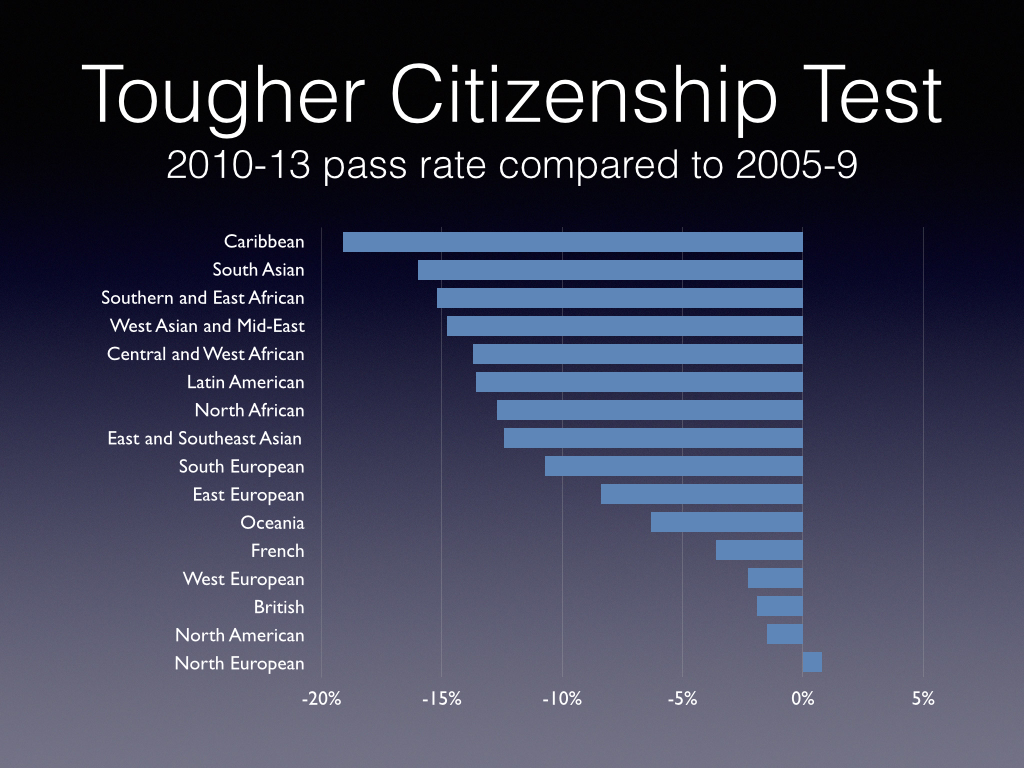
Canadian Multiculturalism: Evidence and Anecdote Deck - Images.039Further to yesterday’s post regarding my forthcoming book (Multiculturalism in Canada: Evidence and Anecdote) and the deck summarizing some of the high level results, the Toronto Star article focussing on my findings regarding citizenship take-up and the impact of the 2010 changes (the chart above shows the impact of the citizenship test changes on different ethnic groups):

“In the past, citizenship was viewed as a stepping stone to immigrant integration, and it should be done earlier on,” said Griffith, who will present Multiculturalism in Canada at a three-day national immigration and settlement conference in Vancouver that starts Thursday.

“These changes have made it harder and prohibitive for some to acquire citizenship, turning Canada into a country where an increasing percentage of immigrants are likely to remain non-citizens, without the ability to engage in the Canadian political process.”

Based on latest government data, Griffith found that the ratio of permanent residents who eventually become citizens has been in decline since 2000, and has dropped most rapidly in recent years.

Only 26 per cent of permanent residents who settled in Canada in 2008 have acquired Canadian citizenship, compared with 44 per cent for the wave of immigrants settling in 2007, and 79 per cent of those who arrived in 2000.

Griffith said the government data used in his analysis was selected to reflect the fact that it takes immigrants an average six years to acquire Canadian citizenship. The 2008 cohort best indicates the early impact of reforms implemented by the Conservative government.

The permanent-resident-to-citizen conversion rate does generally rise the longer immigrants have been in Canada. But an 18 per cent decrease between the 2008 and 2007 cohorts is alarming, Griffith said.

Citizenship and Immigration Canada spokesperson Johanne Nadeau said Canada has one of the highest naturalization rates in the world, “as 86 per cent of eligible permanent residents for Canadian citizenship decide to acquire it.”

She suggested the Griffith is misinterpreting the data because “he is not taking into account those (permanent residents) who are not yet eligible to become citizens because they haven’t met all of the requirements needed to begin the citizenship process.”

Citizens are protected by the Charter of Rights and Freedoms, can vote in elections and are entitled to Canadian passports. Not only do permanent residents not have those privileges, they are also vulnerable to revocation of their status and removals from Canada.

“I understand the rationale behind these government changes,” said Griffith, who worked for the government as the reforms were developed and rolled out, and retired in 2013.

“But I’m on the side of inclusion rather than exclusion. We need to make sure those who apply for citizenship take it seriously, but we don’t want to inadvertently create excessive barriers and shift the relationship of some of the communities with the country.”

… “When you make it more difficult for some communities to become citizens, you are going to create issues with their engagement, attachment and identity of Canada,” said Griffith.

“The question is how we balance between ensuring the rigours of the (citizenship) process and yet making it fair and reasonable.”

Canada faces dramatic drop in citizenship, prompting concerns about disengaged immigrants

Multiculturalism in Canada: Evidence and Anecdote (forthcoming)

Description of my forthcoming book (summer 2015):

With over 20 percent of the population foreign-born, and with more than 250 ethnic origins, Canada is one of the world’s most multicultural societies. Canada’s ethnic and religious diversity continues to grow alongside immigration.

Yet how well is Canada’s model of multiculturalism and citizenship working, and how well are Canadians, whatever their ethnic or religious origin, doing? Will Canada’s relative success compared to other countries continue, or are there emerging fault lines in Canadian society?

Canadian Multiculturalism: Evidence and Anecdote undertakes an extensive review of the available data from Statistics Canada, Citizenship and Immigration Canada operational statistics, employment equity and other sources to answer these questions and provide an integrated view covering economic outcomes, social indicators, and political and public service participation.

Evidence and Anecdote provides a detailed analysis from the national perspective as well provincial overviews, showing both common trends and regional differences. The book outlines the theoretical, historical, and policy context to illustrate the uniqueness of Canada and evolution of multiculturalism and to help readers understand the broader context for the evidence and analysis.

Visuals and charts are extensively used to engage readers and substantiate the changing nature of Canadian diversity.

Intended audience includes the media, academics, policy makers at federal, provincial and municipal levels, organizations active in integration and related issues, as well as ethnic and religious communities themselves.

Canadian Multiculturalism: Evidence and Anecdote will be available summer 2015.

Table of Contents

  • Preface
  • Executive Summary
  • Introduction
  • Theory, Policy and Practice
  • Canada: A National Perspective
  • British Columbia: Or Should it be Asian Columbia?
  • Alberta: The New Face of Diversity
  • Saskatchewan: Steady Growth
  • Manitoba: Quiet Success
  • Ontario: Multiculturalism at Work
  • Québec: Impact of a Complex Identity
  • Atlantic Canada: Immigrants Wanted but Will They Come and Stay?
  • The North: Aboriginal Nations and New Canadians
  • Policy Reflections and Implications
  • Acknowledgements
  • Appendices

Summary deck presentation here.