Think tanks need to show us the money – Yakabuski

Good column by Konrad Yakabuski on think tanks as charities or political actors (see also Miles Corak’s How to think about “think” tanks):

The Fraser Institute raised 15 per cent, or about $6.6-million, of its total revenue from foreign sources in the four fiscal years to 2012. Not to single out Fraser – whose research, like that of its peers, is rigorous but only half the story – but no one could argue that such money has gone toward charity.

“Fundamentally, think tanks on the left and right have been abusing the privilege of being a registered charity,” says Toronto lawyer Mark Blumberg, a leading expert in the field. Since charities are only allowed to devote 10 per cent of their revenue to political activities, “you could argue some of them haven’t been following the rules.”

The line between political advocacy and policy analysis has become increasingly blurred. Three years ago, the Harper government made a big to-do about anti-pipeline environmental groups taking foreign donations. And the CRA has started cracking down on organizations that confuse political advocacy with charity.

Perhaps it’s time we also focused on think tanks. They play a valuable role in democracies, but their research is only as credible as the amount of disclosure they provide. The pro-transparency blog Transparify recommends that journalists add the phrase “does not disclose its funders” when reporting on research produced by such think tanks. It’s advice worth following.

Think tanks need to show us the money – The Globe and Mail.

Is the Professor Bossy or Brilliant? Much Depends on Gender – NYTimes.com

Gender bias universities

Frequency of word “genius” in RatemyProfessor

Interesting study on bias, this time in the university setting:

Studies have also shown that students can be biased against female professors. In one, teachers graded and returned papers to students at the exact same time, but when asked to rate their promptness, students gave female professors lower scores than men. Biases cut both ways — teachers have also been found to believe girls are not as good in math and science, even when they perform similarly to boys.

Mr. Schmidt, who made the chart as part of a project called Bookworm for searching and visualizing large texts, said he was struck by “this spectrum from smart to brilliant to genius, where each one of those is more strongly gendered male than the previous one was.” He was also surprised that relatively few people commented on female professors’ clothing or looks, which he had expected to be the case.

Another surprise, he said, was Shakespeare — apparently many more men than women teach it in English departments.

Men are more likely to be described as a star, knowledgeable, awesome or the best professor. Women are more likely to be described as bossy, disorganized, helpful, annoying or as playing favorites. Nice or rude are also more often used to describe women than men.

Men and women seemed equally likely to be thought of as tough or easy, lazy, distracted or inspiring.

Interestingly, women were more likely to be described in reviews as role models. Mr. Schmidt notes that the reviews are anonymous, so he doesn’t know the gender of reviewers. It could be that more female students describe female professors as role models than men do when describing men or women.

Is the Professor Bossy or Brilliant? Much Depends on Gender – NYTimes.com.

Ottawa seeks job market clarity – Labour market survey

Good course correction:

The $8-million survey, which was announced several months ago and is just now under way, marks a return to more traditional methods after the Conservative government ran into criticism for relying heavily on a much less expensive private software program.

The Globe and Mail revealed that the government’s claims were the result of a problem with the data, which included jobs from the classified site Kijiji where the same job can be reposted many times, producing a false impression of a rising demand for labour.

When jobs from Kijiji were removed from the data set, the rise in job vacancies essentially disappeared.

Yet one year later, government officials and other labour market observers continue to struggle with the best way to measure the job market in an age when traditional job ads have been replaced with online job boards.

Two federal departments – Finance Canada and Employment and Social Development Canada – continue to pay for a database of online job ads from Wanted Analytics. The company runs software that scans online job boards as well as individual company websites to produce a database of jobs. The database it provides to government departments can be altered to include or remove various sources, including Kijiji.

Finance Canada renewed its contract with Wanted in December for another year at a cost of $18,250.

A Finance Canada spokesperson said the department uses the data along with other sources – such as Statistics Canada and the Bank of Canada – as part of its analysis of the labour market.

Employment and Social Development Canada said it does not use the database for labour market projections.

“This data can still be useful to the department to better understand current labour market conditions as they pertain to online job postings,” ESDC spokesperson Simon Rivet wrote in an e-mail.

Dan Kelly, the president of the Canadian Federation of Independent Business, said his organization supports the new survey even though some employers complain that answering questionnaires is a form of red tape.

Mr. Kelly said he expects the new survey will support the view of employers that labour shortages are real and that measures such as the Temporary Foreign Worker Program, while controversial, are needed.

“Ultimately we need better sources that everyone can rely on and accept as a true state of affairs on the labour market,” he said.

Now all we need is to reinstate the Census.

Ottawa seeks job market clarity – The Globe and Mail.

Millions for immigrant services in B.C. went unspent

This has been a long-standing issue:

The draft report, called Lessons Learned Study: British Columbia’s Contribution to Settlement and Immigration 1998-2013, appears to explain why the federal government stripped authority to run the program from the province effective April 1, 2014, said Vancouver-based immigration lawyer Richard Kurland.

“It certainly justifies it,” said Kurland, who obtained the document through the Access to Information Act.

The report noted that B.C. officials were “less than effective” in presenting financial information, and “significant amounts were not accounted for.” It also noted that the federal government did not do an adequate job of ensuring B.C. gave a full account of how the funds were spent.

“(Citizenship and Immigration Canada) officials had ongoing concerns regarding consistent lapsed funds, accountability and access to (program) evaluation findings. C.I.C. also had questions related to B.C. serving non-eligible clients such as Canadian citizens and temporary foreign workers.”

The report said B.C. officials had indicated that the funding for non-immigrants and non-refugees came from B.C.’s contribution to immigrant settlement coffers, which generally totalled eight to 10 per cent of the entire federal-provincial settlement budget.

“While B.C. noted that ineligible clients were served with provincial funds, it was not always clear for C.I.C. officials if this was in fact the case,” the report said.

…The transfer back to federal government control has been a “huge transition” for the sector, Friesen said.

“Under the provincial government … the focus of the relationship was on the services to clients, the output. We had greater flexibility … to be able to move funds around to address gaps in services,” Friesen said.

“The funding regime is very, very different under the federal government with far more focus on the financial management than necessarily on the service side. … You could say it was the opposite under the provincial government.”

Millions for immigrant services in B.C. went unspent.

Study finds high levels of equality for Muslim women in Canada

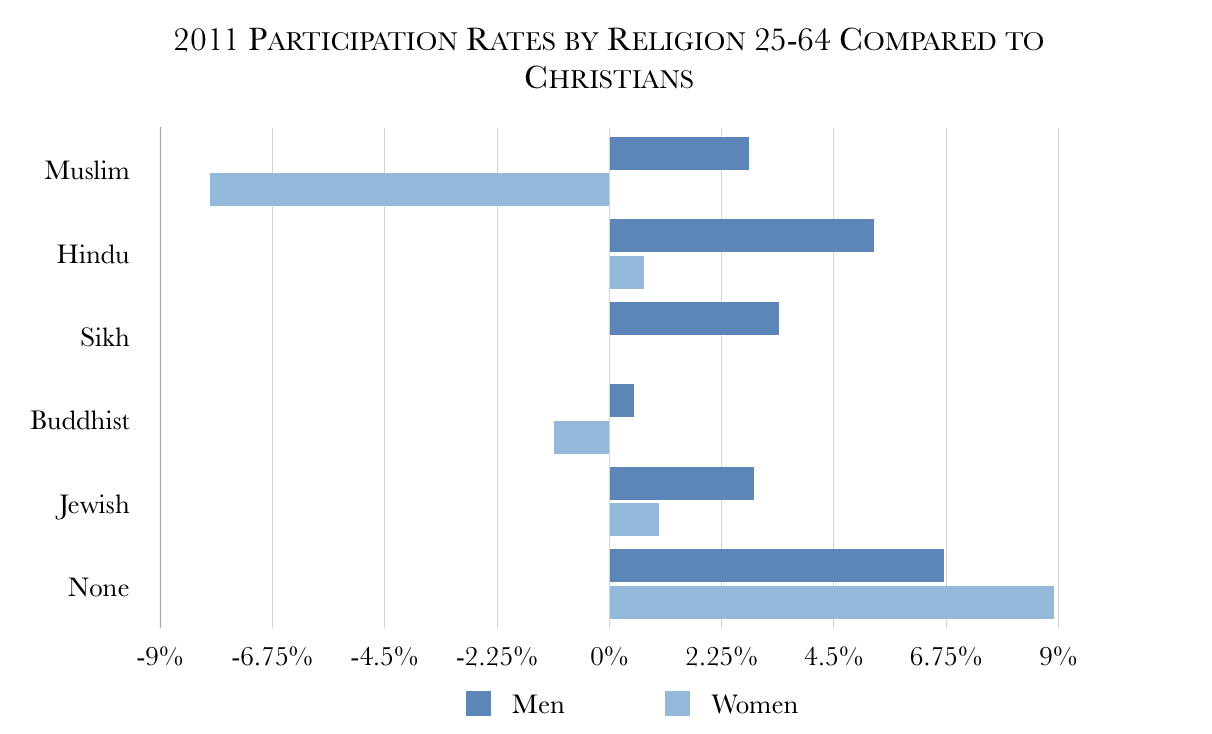
Participation_Rates_Religion_Compared_to_ChristiansI have yet to analyze second generation participation rates by religion but for all generations (the vast majority being first generation) show greater differences as shown in the above chart (compared to Christians) than the Reitz study, which uses more recent NHS 2011 data than  2001 and 2006 Census data.

However, his points on ethnic origin being a more important determinant than religion make sense:

Reitz said the study’s findings should dispel misperceptions about female subservience restricting Muslim women in Canada to roles in the home. While recent Muslim immigrants demonstrate more gender inequality than some groups, the data for others under far less public scrutiny such as Hindus and Sikhs are not much different. National culture in the country of origin makes a bigger difference than religion itself. For example, gender inequality is greater for Muslim immigrants from Pakistan than from the Middle East or Europe, regardless of individual strength of religious commitment. Similar patterns of difference by country of origin are found among Christian immigrants.

“Most tellingly, second-generation Muslim women in Canada are just as active in the workforce as other groups,” said Reitz.

Work force participation rates for women compared to men have long been viewed as a prime indication of the extent of gender equality in the Canadian population.

It made sense to use the same measurement to examine attitudes about gender among immigrant populations, said Reitz.

He had another motive as well. “Exhaustive data in a peer-viewed study is important for satisfying academics and other researchers, but the larger point is to reach the wider public and dispel some harmful myths.

“The idea that Muslims hold values that make it difficult for them to integrate into Canadian society is misguided,” said Reitz. “It also suggests how international politics can affect our attitudes toward immigrants.”

Study finds high levels of equality for Muslim women in Canada.

Why Obama invoked the Crusades — and what it says about how he views terrorism – and Related Commentary

Carefully thought out strategy:

Obama, though, is not budging. And his comments on the Crusades and the Inquisition represent the latest ratcheting up in his quest to change how people talk about terrorism. He views Islamist terrorists as exploiting their religion; his opponents believe there is something about Islam that creates fanatics who are willing to carry out terrorist attacks.

For what it’s worth, Americans used to sympathize more with Obama. But the rise of the Islamic State appears to be pushing things in the opposite direction. A Pew poll in September showed, for the first time, that 50 percent of Americans viewed Islam as more likely to encourage violence than other religions. Another 39 percent said it was not more likely to encourage violence.

This could be part of the reason Obama is upping the rhetoric. Words matter, and the way this issue is framed is going to go a long way toward determining how the “war on terror” will be waged. Moreover, the rise of the Islamic State — along with the lesser-publicized Boko Haram — has ramped up the debate over terrorism and its roots to the highest point since perhaps after Sept. 11, 2001. This is a key moment in defining the terms of the debate. Both Republicans and Obama recognize that.

Obama’s critics believe he’s being Pollyannaish about the nature of the threat and how it is inherently tied to Islam. Without recognizing the seeds of terrorism, they reason, how can you combat it?

Obama disagrees wholeheartedly with that characterization and thinks attributing violence to Islam is unfair and damaging to relations between Christians and the broader Muslim population.

It’s perhaps the defining semantics debate of his presidency.

Why Obama invoked the Crusades — and what it says about how he views terrorism – The Washington Post.

Commentary from Richard LeBaron, a former U.S. ambassador (ret.) and the founding coordinator of the U.S. Center for Strategic Counterterrorism Communications Strategy:

The United States and its allies are in a conflict with certain groups that would like to convince the world that they are the true representatives of Islam.

We will succeed in that war only if we stay focused on the key element of counterterrorism strategy: excellent intelligence gained through maintenance of a first-rate intelligence community and sharing of intelligence with others; the ability to project deadly force when needed against specific groups and targets who wish us harm; and enlistment of Muslim and non-Muslim countries and communities around the world to do their fair share in combating terrorism and addressing its root causes—be those poor governance, weak states, religious incitement, or psychologically marginalized individuals looking for outlets for their rage.

Preventing the attraction to terrorism, as opposed to attacking known terrorists, is a long-term project that requires a serious approach. The contrived debate about labeling terrorism is both counterproductive and at odds with an American value system that separates religious belief from political considerations.

Those actually doing the fighting against terrorists deserve better than bumper sticker slogans to guide their actions. They should not be asked to fight a dimly understood religious war.

Declaring War on Radical Islam Is Not a Counterterrorism Strategy

The Globe Editorial on the Canadian government response is along similar lines:

Canada’s small number of terrorists thus far have been mostly self-radicalized. Think of the St-Jean-sur-Richelieu murderer Martin Couture-Rouleau or parliamentary shooter Michael Zehaf-Bibeau. Both were deeply troubled men who at some point grabbed onto ideas floating about on the Internet, and decided that the purifying appeal of violence was the answer for what ailed them. They weren’t sent here by ISIS; it would be more accurate to say that they caught a virus, albeit one that the intellectual immune system of the overwhelming majority of Canadians of all faiths is thus far resistant to.

They were also self-Islamicized. Their made-up religion of endless war had little to do with the Islam encountered in Canada’s mainstream mosques. Otherwise, this country might be overrun with Couture-Rouleaus and Zehaf-Bibeaus. It is not.

On the day of the Parliament Hill shooting, this newspaper editorialized “against exaggeration, hysteria and despair” and “in favour of calming the hell down.”

Over the past few weeks, the Prime Minister has seemed intent on riling people up and making the most of the terrorist threat. He has exaggerated the danger of ISIS and its connection to possible terrorism in Canada. That’s wrong. At a time like this, the PM should be the chief minister in charge of deflating hyperbole, putting things in perspective – and reminding Canadians that we must continue as we always have, on guard but free.

 A ‘war on terrorism’? No thanks. There are smarter ways to meet the threat 

Lastly, shallow commentary by Rex Murphy:

There have been many sins committed by many faiths, and there are tragedies even now underway. But it is a very displaced analysis that seeks to offer corrections to Christianity during a period of Islamic turmoil, and seeks out forgotten sins to ignore those so very close to mind.

He forgets history provides context and cautions us not to jump on bandwagons and the meme of the day.

Rex Murphy: In Obama’s impulse to absolve Islam, he offers a rebuke to Christianity

Niqab ban at citizenship ceremony struck down by court

While wearing a niqab is inappropriate, given that it signals being less open to integration, at a ceremony designed to welcome new Canadians to the Canadian family, the rationale invoked by Minister Kenney – that citizenship judges could not see that the oath was spoken – was always weak.

Applicants could simply mouth nonsense words and it would be a rare judge who would notice in a typical ceremony of 40-50 people (earlier post Ex-immigration minister Jason Kenney ‘dictated’ niqab ban at citizenship ceremony, court told):

While it is not unusual to have government policies overturned in breach of Charter and constitutional rights, the court ruling is unusual because the decision was based on the finding that the ban mandated by the immigration minister violated the government’s own immigration laws.

“To the extent that the policy interferes with a citizenship judge’s duty to allow candidates for citizenship the greatest possible freedom in the religious solemnization or the solemn affirmation of the oath,” wrote Justice Keith M. Boswell, “it is unlawful.”

Ishaq was sponsored by her husband to Canada from Pakistan in 2008 and successfully passed the citizenship test in November 2013.

She was scheduled to be sworn in at a citizenship ceremony in Scarborough two months later but decided to put it on hold after learning she would need to unveil her niqab under a ban introduced in 2011 by then-Immigration Minister Jason Kenney. Her Charter challenge ensued.

“From the moment the minister announced the policy, many of us felt it’s illegal. The court confirms that it is the case. It is not a requirement in the law for someone to be seen in front of a (citizenship) judge taking the oath. Signing the paper is all (that’s) required,” said Ishaq’s lawyer, Lorne Waldman.

“Clearly, the policy was driven by Kenney himself. All documents found he was the driving force behind it.”

Ishaq, who started wearing niqab since she was 15, had no objection to unveil herself for the purposes of her identification before taking the citizenship test.

However, she objected to the requirement to remove the veil at the citizenship ceremony because it is public and unnecessary for the purposes of identity or security.

Immigration officials subsequently offered to seat her in either the front or back row and next to a woman at the ceremony, but she refused the arrangement since the citizenship judge and officers could still be male, and there could potentially be photographers at the event.

Niqab ban at citizenship ceremony struck down by court | Toronto Star.

Graeme Hamilton: Banning centre run by controversial Montreal Imam problematic in a democratic society

Valid:

Aurélie Campana, a political science professor at Université Laval and holder of the Canada Research Chair on Conflicts and Terrorism, said countries around the world are seeking the proper balance between respecting freedoms and thwarting radicalization.

“We are all walking a tightrope, whether in Quebec in Canada or in other countries confronted by these problems,” she said. “I don’t think anyone has found a miracle solution yet.”

But turning the danger of radicalism into an emotional political issue is a recipe for increased social tensions, she said.

“In Canada, through multiculturalism, there is a relative social peace that is not found in other countries — in France, for example,” she said. “The risk is that this law indirectly calls into question the existing social balance, and that the Muslim community is stigmatized.”

Mr. Bouazzi said he hears regularly of young Montrealers leaving to join ISIS but argues that, in the short-term, the best counterweight is to appeal to Muslim families. “They do co-operate,” he said, citing the recent example of a father who called in police after his son robbed a variety store to finance a trip to join the jihad.

He said a tough law that restricts freedoms is counterproductive. “We are really in front of a dilemma: Because we want to fight terrorism that does not agree with democracy, we’re actually destroying our democracy,” he said. “It’s very important to stay strong in these situations, because we don’t want them to win.”

Graeme Hamilton: Banning centre run by controversial Montreal Imam problematic in a democratic society

The Parliamentary Secretary for Multiculturalism Asks Iranian-Canadians “Why Are You Here?” | Susan Khazaeli

While the commentary goes a bit too far in its arguments that this language creates two classes of citizens, subconsciously it may reflect this belief.

And people come to Canada for both economic objectives and living in a country that respects political and human rights:

A Conservative Toronto MP, Chungsen Leung, recently attended an event organized by the Association of North American Ethnic Journalists and Writers. During the meet-and-greet, Mr. Leung was asked about the increasing difficulties faced by Iranians attempting to obtain a Canadian Visa. Emotions apparently ran high. At one point, in a heated exchange, Mr. Leung asked a member of the audience, “If you like Iran so much then why do you come to Canada?”

He then demanded to know: “Why are you here?” Some audience members were so offended by his comments and his dismissive attitude — which one attendee characterized as “arrogant” — that they decided to leave the event.

Mr. Leung is also the Parliamentary Secretary for Multiculturalism. It kind of sounds like a bad joke, doesn’t it?

According to a CTV report, Mr. Leung’s office claims that the exchange was a “miscommunication.” His email apology expressed regret for the misunderstanding. Perhaps Mr. Leung’s comments were off-the-cuff, but they were, by no means, innocuous.

Even if unintentional, Mr. Leung’s comments were discriminatory and hostile. The subtext of the messaging is: “Why don’t you go back where you came from?” They betray an underlying attitude that many non-white Canadians encounter when expressing views critical of government policy. This attitude becomes even more pronounced when that non-white Canadian comes from a country that, like Iran, is on the outs with Canada.

The Parliamentary Secretary for Multiculturalism Asks Iranian-Canadians “Why Are You Here?” | Susan Khazaeli.

Two stories about inequality

Good storytelling showing both pictures.

MilesCorak's avatarEconomics for public policy

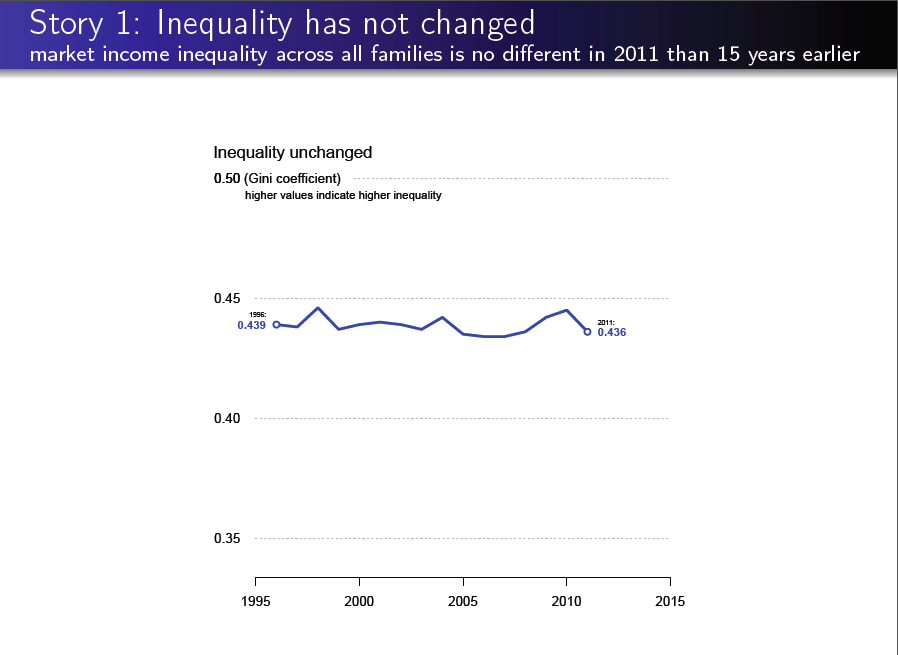
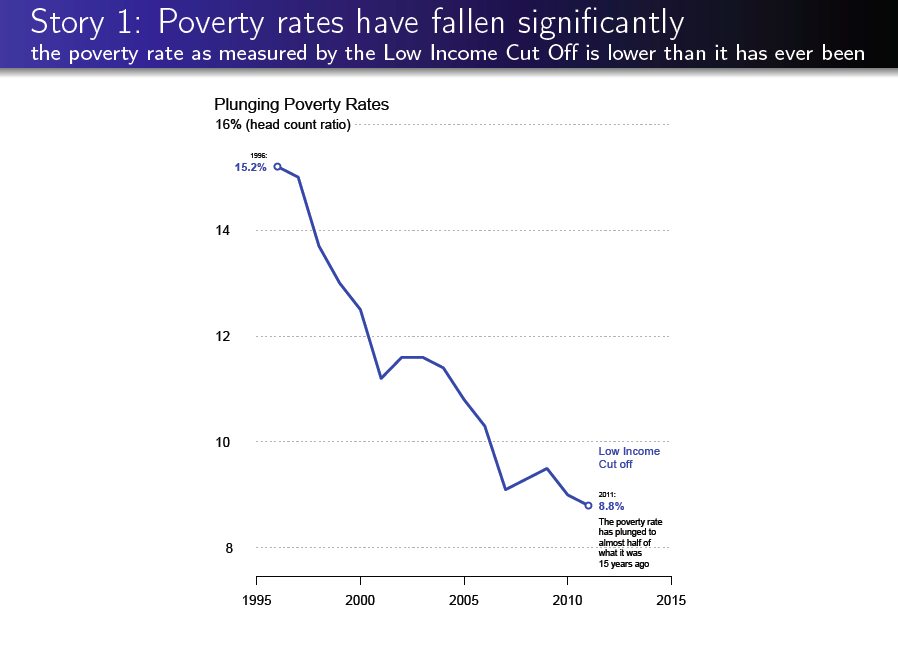
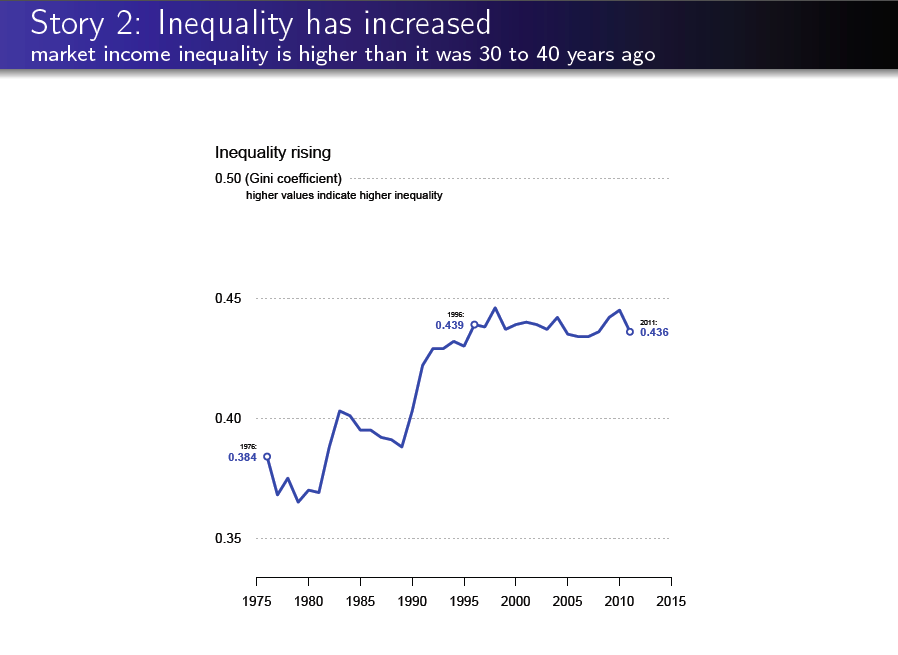
In many rich countries the “hard” facts describing the income distribution are easily available. Yet, discussions about inequality are animated by two different stories with very different public policy implications.

You can listen to a caricature of these points of view in this pair of interviews on CBC radio: http://www.cbc.ca/radiowest/2015/01/21/two-different-takes-on-the-worlds-wealthiest-one-per-cent/

I offer more detail on the way Canadians have framed these stories as a part of a presentation to the School of Policy Studies at Queen’s university.

Here is Story 1 in pictures (click on the images to enlarge).

Story 1 Inequality has not changedStory 1 Middle incomes have been on the riseStory 1 Poverty rates have fallenStory 1 Top income shares have not risen much

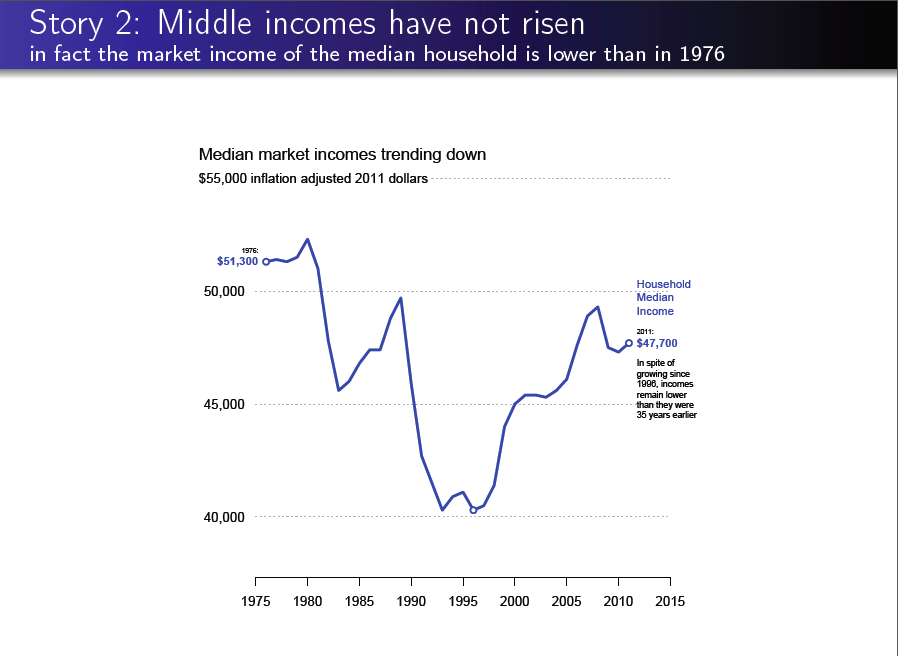
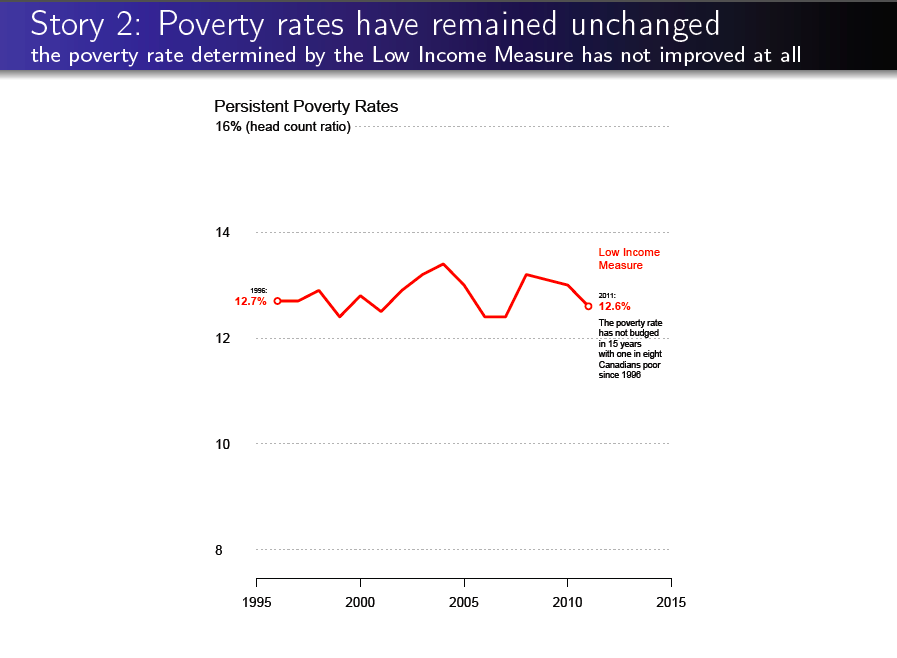
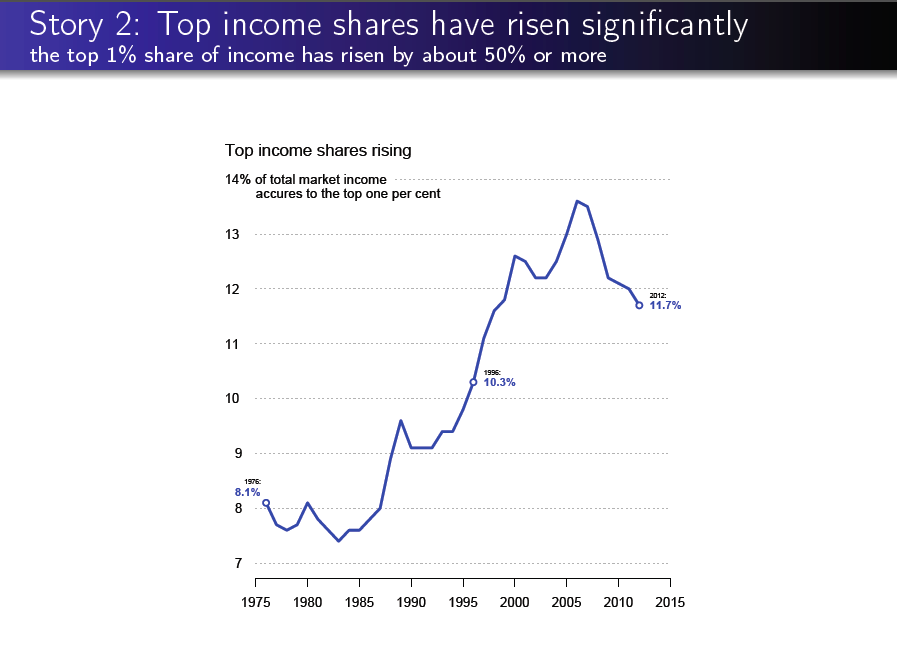
Here is Story 2 in pictures (click on the images to enlarge).

Story 2 Inequality has increasedStory 2 Middle income have not risenStory 2 Poverty rates are unchangedStory 2 Top income shares have risen

My presentation argued that context—rooted in economic theory and the appropriate use of statistics—is needed to understand the truth behind these stories, and to turn them into a conversation useful for public policy.

Here is the full set of slides I used.

Corak_Two_Stories_about_Inequality_and_Public_Policy_presentation_to_Queens_University_February_5_2015

View original post