Research Shows White Privilege Is Real

More examples of unconscious bias at work:

A field experiment about who gets free bus rides in Brisbane, a city on the eastern coast of Australia, shows that even today, whites get special privileges, particularly when other people aren’t around to notice.

The bus study underscores this point. Drivers were more likely to let testers ride free when there were fewer people on the bus to observe the transaction. And the drivers themselves were probably not aware that they were treating minorities differently. When drivers, in a questionnaire conducted after the field test, were shown photographs of the testers and asked how they would respond, hypothetically, to a free-ride request, they indicated no statistically significant bias against minorities in the photos (86 percent said they would let the black individual ride free).

Of course, unconscious bias might play out differently in the United States than in Australia. But research in America, too, suggests that decision makers use discretion to bestow benefits in a discriminatory fashion. For example, a recent study of 22 law firms by Arin N. Reeves, a lawyer and sociologist, found that partners were less critical of a junior lawyer’s draft memo if they were told the lawyer was white than if they were told the lawyer was black.

What does white privilege mean today? In part, it means to live in the world while being given the benefit of the doubt. Have you ever been able to return a sweater without a receipt? Has an employee ever let you into a store after closing time? Did a car dealership take a little extra off the sticker price when you asked? When’s the last time you received service with a smile?

White privilege doesn’t (usually) operate as brazenly and audaciously as in the Eddie Murphy joke, but it continues in the form of discretionary benefits, many of them unconscious ones. These privileges are hard to eradicate, but essential to understand.

Research Shows White Privilege Is Real – NYTimes.com.

Racially diverse emojis miss the point – Macleans.ca

Some interesting articles on the issue of racially diverse emojis, starting with Adrian Lee taking the position that these undermine the universality and ambiguity of the current set:

The problem is, the idea and execution of racially representative emojis completely misses the point.

For starters, emojis never really had a race problem. The invention of Shigetaka Kurita, emoji have an Asian root that has in many ways been whitewashed over, with many of the original ones depicting Japanese-centric images such as a bowing businessman; it is why many of the food items in Unicode’s emojis are Japanese, from ramen to tempura shrimp. According to the Wall Street Journal, “initially supposed to depict characters with inhuman, cartoon-like complexions—for example, a yellow or orange colour.”

So the standard baseline in emojis was never really white—that’s a later interpretation that society has applied. If anything, the race problem is with Unicode, the consortium that codes symbols and images so they can be displayed across the world’s many platforms and devices, which took Kurita’s initial offering, sidelined many of the Japan-centric ones, and produced a selection of 722. (Personal research finds that Apple devices currently feature 845 emojis.)

And the reality of racial representation is that it will, invariably, leave someone out and leave someone unhappy. It has already begun; social media has noted there is no one with freckles and red hair among the six new colour options for each emoji. The backlash has started, too, as some have been furious over the bright yellow of what they are seeing as the “East Asian” skin colour—ironic, since they’re actually referring to the aforementioned “cartoon-like” emoji complexion, as Asians are not technically depicted at all, given the fact the new emojis reportedly hew to the Fitzpatrick scale, a “dermatological standard” for judging race. (The Fitzpatrick scale did not adequately measure non-white skin colour for years after its 1975 creation, dumping all non-white skin into one category.) There’s perhaps nothing more problematic than Chinese people seeing themselves as the cartoonish, bright yellow initially designed to mean literally nothing. But anyway.

… Unlike most languages, less precision serves emoji better. Emojis’ generality is exactly why it’s taken off as a universal language, not necessarily the efforts of some secretive coding consortium. Emoji are our modern-day shibboleths—they’re defined not by colour, but by context.

And while it’s hardly wrong to get our hackles up over race, it seems odd that the hill we are choosing to defend is the one where the baseline was an intentionally preposterous complexion for a fun thing whose use is derived by its ambiguity. So let’s not let racial politics needlessly creep into our woman doing the salsa: May your fist emoji mean fist-bump or solidarity or I’m-punching-you, no matter what shade it is.

Racially diverse emojis miss the point – Macleans.ca.

And the science or classification scheme behind the selection of skin tones that was used in creating these emojis:

So how did Unicode, the consortium that sets the standard for emojis, settle on particular colors for their icons? Vocativ’s Sarah Kaufman explains that the tones are based on a scale created in 1975 by Harvard dermatologist Thomas Fitzpatrick, “the father of academic dermatology,” to assess how different people’s skins reacted to varying degrees of UV rays.

Kaufman helps break down the skin categories:

  • Type I (scores 0 to 6): Pale white; blond or red hair; blue eyes; freckles — Always burns, never tans

  • Type II (scores 7 to 13): White; fair; blond or red hair; blue, green or hazel eyes — Usually burns, tans minimally

  • Type III (scores 14 to 20): Cream white; fair with any hair or eye color; quite common — Sometimes mild burn, tans uniformly

  • Type IV (scores 21 to 27): Moderate brown; typical Mediterranean skin tone — Rarely burns, always tans well

  • Type V (scores 28 to 34): Dark brown; Middle Eastern skin types — Very rarely burns, tans very easily

  • Type VI (scores 35+): Deeply pigmented dark brown to black — Never burns, tans very easily

Here’s Where Emoji Skin-Tone Colors Come From
Afghan immigrant studying in Vancouver wins Loran scholarship

The feel-good story of the week on how Canada provided Somaya Amiri opportunities, and how her determination enabled her seizing them:

When Somaya Amiri was a little girl, she’d watch each morning as her big brother hoisted a backpack over his shoulders and walked to school in Afghanistan’s Behsood District. She remembers desperately wanting to go too.

The day she decided to follow him, her father noticed she was missing from the house and caught up with her at the school. He was furious.

“When I got home my mom and grandmother were crying,” Ms. Amiri said in an interview. “They told me that when you are a girl, you don’t go to school.”

Ms. Amiri now finds herself pondering which of Canada’s top universities she will attend.

This month, the 17-year-old was among 30 Canadian high school students named Loran scholars. Under the program, she will receive up to $100,000 to fund four years of tuition. The scholarship also includes a mentorship program and money for summer internships.

Afghan immigrant studying in Vancouver wins Loran scholarship – The Globe and Mail.

ICYMI: Antisemitism — The Facts and the Hope | John Gerzema

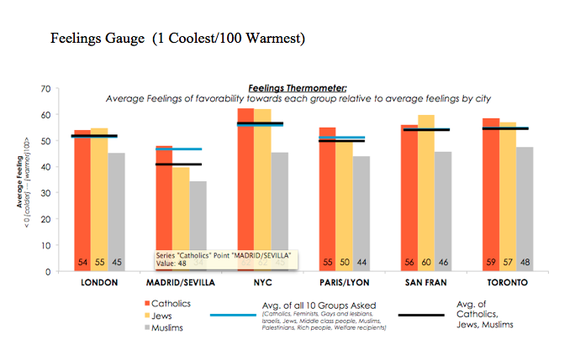
Comparative Religious Attitudes CitiesInteresting comparative study across religions and cities, with strong conclusion of how best to proceed:

The data shows that anti-Semitism, at least in the countries surveyed, is stubborn, deep-seated and chronic. It is worse than anti-Catholic bigotry but not quite as widespread as anti-Muslim feelings. Yet here’s a critical distinction: within nations, people act-out against Jews more often than they do against Catholics and Muslims. Some of this behavior seems linked to events involving Israel. However, it would be wrong to suggest a causal link between expressions of anti-Semitism and Israeli policy. Last Fall’s conflict in Gaza, for instance, may have “unleashed” anti-Semitism, acting as a false catalyst, but the feelings against Jews exist independent of the Middle East. After all, if someone predisposed to hate Jews cites Israeli policy to justify their anti-Semitism, he or she is still an anti-Semite.

Yet not all our findings were bleak. As part of our study we tried to determine whether people were affected by media mentions of Israel. When we asked our survey respondents last August to read an unbiased report on the ongoing events in Israel and Gaza we saw expressions of anti-Jewish feelings decline. People who told us they were “somewhat open” to new information moved from a 14 percent to 25 percent likelihood of sympathizing with Israel. Those that were “very open” moved from 35 percent to 42 percent likelihood of sympathizing with Israel. We saw related reductions in the number of people who said they had negative thoughts about Jews in general.

So the data offers hope that hearts and minds can be affected by honest, reliable, unadulterated information. We can inform instead of inflame. We can teach instead of just talk. We can exercise our freedom of speech and freedom of the press as a means to contest cultural boundaries. The alternative is watching bigotry of all kinds — against Muslim or Jew, Catholic and, sadly, a long list of other groups — dominate the discussions around the world. The evidence is there that we can create change and counteract the hate that occurred last week and continues to be so pervasive and pernicious. It is up to all of us to engage, enlighten and educate.

Anti-Semitism — The Facts and the Hope | John Gerzema.

Prime Minister, this isn’t how we should do things in Canada | Elghawaby

Amira Elghawaby of the NCCM reacting to the Government’s messaging, making three points:

  1. Stoking fear of the “other”;
  2. Pretend to care about Canadians wrongfully imprisoned abroad but do as little as possible to get them released; and,
  3. Act tough on terror.

Similar to other commentary I have already posted.

Hard not to disagree with her conclusion:

The government that says it is committed to protect Canadians is the same one that alienates the very communities it needs to empower and work with. Prime Minister, this shouldn’t be how we do things here.

Prime Minister, this isn’t how we should do things in Canada | Toronto Star.

If IS falls, Canada must be ready for the return of foreign fighters – Momani and Dawson

Sobering assessment of one of the major gaps in the Government’s overall approach in reducing the risk of radicalization and returning fighters by Bessma Momani and Lorne Dawson:

The provisions of Bill C-51 attempt to stem the supply side of terrorism, by censoring online conversations and beefing up CSIS and RCMP capacities. But the bill does not have a strategy to tackle the demand side of the problem, such as de-radicalization programs, building capacities and resilient communities through political empowerment, and supporting alternative narratives in vulnerable demographic groups. Security measures have a troubling tendency to feed back into the radicalization process itself. If IS is decapitated, the threat posed from returning fighters is theoretically higher than if it is simply contained, and it is unlike the consequences of defeating al-Qaeda for the radicalization of Western youth.

What can be done? Investing in prevention tools can help stop the feedback loop that could further radicalize new recruits and returning fighters. Prevention means we need to understand the appeal of IS as a cult, couched in medieval misinterpretations of an otherwise peaceful religion. Stemming the supply and re-offence of returnees requires detoxing wannabe fighters; understanding how vulnerable youth and misfits are searching for identity online; working with religious and community leaders to help would-be radicals discern the difference between scripture and propaganda; and de-glorifying the violence and militancy of travelling to Syria or other fronts. Disillusioned returnees can be used to describe the mundane and hypocritical life under IS rule. Some of the fighters who have returned to civilian life tell tales of how quickly they became disenchanted, as they were assigned to cleaning toilets and working Twitter accounts, and not trusted with combat or decision-making roles. This is not to say that we can expect a flood of ‘innocent’ returnees, but there will be some and we ought to be prepared with a variety of tools to suppress further radicalization other than our prison system.

Investing in de-radicalization/reintegration programs will address the demand side of terrorism that Bill C-51 does not. This will cost money and require considerable ingenuity, but other nations facing a much more severe threat from returnees, such as Germany and Denmark, have initiated such programs. The government should acknowledge that using the law may seem like a quick and cheap fix, but ignoring the need for a more “sociological” approach will cost more in the long run.

If IS falls, Canada must be ready for the return of foreign fighters – The Globe and Mail.

What we’re talking about when we talk about ‘judicial activism’

Emmet Macfarlane commenting on the recent set of articles on judicial activism:

In the wake of landmark decisions on assisted suicide and the right to strike (among others), there appears to be a new renaissance for decrying the “judicial activism” of the Supreme Court of Canada.

Andrew Coyne accuses the Court of ignoring precedent, rewriting the constitution and basically lacking “any rational basis” for its decisions. Conrad Black is equally critical. Stockwell Day accuses the Court of writing law, rather than merely applying existing law. Gordon Gibson arguably goes even farther, calling the Court “the greatest threat to our democracy,” and accusing it of “making” rather than merely “interpreting” the law. And Brian Lee Crowley complains of the “unaccountable” and virtually unlimited control judges have over the meaning of the Charter, allowing them to trump legislation and introduce uncertainty into the law. In the view of all of these critics, it is asserted that judges have abandoned the “appropriate” level of judicial restraint.

…Instead, judicial activism has an empirical definition that can be understood in both a quantitative and qualitative sense. In a quantitative sense, activism can be measured based on the frequency with which the Court invalidates laws or impacts government policy. A deferential court that never overturns government decisions is not activist, a court that always does so is the most activist. As political scientists like Christopher Manfredi argue, judicial activism can be seen as being on a spectrum. Our Supreme Court is “activist” in about 35 percent of Charter cases.

But saying that does not make a claim about whether this level of activism is inappropriate or desirable. Indeed, given the whole purpose of the Charter of Rights, a completely “restrained” Court would arguably be as problematic as one that is constantly making policy. Whether the Court is “too activist” is a normative judgment that people are free to argue about. But under this definition, to say that activism is meaningless or does not exist would be incorrect.

…Judicial activism is a tricky concept, and it is often used in completely subjective ways. The public debate about judicial power is incredibly important precisely because the Court wields so much policy influence. A lot of the time charges of “activism” do not seem particularly helpful in clarifying the terms of that debate. A big problem is that the Court’s critics and critics of judicial activism are both wrong, albeit in opposite directions. The former think that judges should just stick to “the law,” as if that were possible, while the latter think the Court’s decisions are only about the law because the policy consequences are merely the result of what the constitution means.

Dismissing the notion of judicial activism entirely is to deny that judges have the discretion—which they invariably exercise—to act with more or less deference to the decisions of democratically elected governments. In this sense, the concept itself remains useful and important.

What we’re talking about when we talk about ‘judicial activism’

The True History Behind Downton Abbey’s Antisemitism Storyline | TIME

For Downton Abbey founds, the story behind the mini-theme of antisemitism and tolerance:

Lady Rose MacClare and Atticus Aldridge come from similar socioeconomic backgrounds but different religions—though they’ve changed their name and acquired a noble title, the Aldridges are Jewish—and neither family is thrilled about the engagement. In typical Downton fashion, when it comes to love there is, as the Dowager Countess puts it, always something: Despite the fact that Rose’s aunt Lady Grantham’s father was also Jewish, the match is still not fully accepted within the household. The show has a solid track record of incorporating real-life historical moments; the Aldridge family’s struggle to be accepted mirrors the experience that a wealthy Jewish-British family might have faced in the real 1920s, and the real Rothschild family gets a shout-out during the episode.

But, in this case, the true story behind the fiction doesn’t actually go back quite so far in time. Rather, for Julian Fellowes, the creator and sole writer of the Emmy-award winning show, the plot line is a familiar one.

“In my own youth I went out with a girl for some time from a very prominent, grand Jewish family,” Fellowes tells TIME. “And it was one of my only times when I have been considered ineligible and not a sort of desirable party.”

In the latest episode both families protest the wedding, with Atticus’s father Lord Sinderby calling Rose a shiksa—a derogatory Yiddish term meaning gentile woman—and Rose’s mother staging a scene that makes it look as though Atticus is cheating. Fellowes explains that he had wanted the show to have a romantic storyline in which the disapproval went both ways. The timing of this story airing in the U.S. amid a rise of anti-Semitism in Europe is simply coincidental.

… Still, though the story was not planned in response to current events, Fellowes acknowledges that the issues raised by this particular Downton wedding aren’t a matter of history only. “The situation is not as simple as one had hoped and these emotions are still rampant,” he says. “All of this stuff is pretty fundamental and we are still looking for solutions to a lot of it. I think, at least I hope, it’s useful and helpful to be reminded that these divisions have had to be addressed and resolved since the beginning of history.”

Likewise, the characters’ fears of assimilation and anti-Semitism are worthy of empathy in any time period. “When [Lord Sinderby] explains why he doesn’t want to have non-Jewish grandchildren, you do—or I hope you do—slightly understand his point of view and you slightly sympathize,” Fellowes says.

The True History Behind Downton Abbey’s Anti-Semitism Storyline | TIME.

Opinion: Manifesto for a modern Islam

Debate within the Muslim communities on reformation and modernity:

In a clearly formulated manifesto last week, four well-known Muslim intellectuals appealed to all Muslim political and religious leaders to stand up and support a democratic Islam. In their letter, they also laid out some concrete steps, among them a conference in France early next year that would “define the contours of a progressive interpretation of Islam firmly grounded in the 21st century.”

The four men behind this letter are Tariq Ramadan, professor of contemporary Islamic studies at the University of Oxford; Anwar Ibrahim, the head of Malaysia’s national opposition and chairman of the World Forum for Muslim Democrats; Ghaleb Bencheikh, the president of the World Conference for Religions for Peace; and Felix Marquardt, founder of the Abd al-Raḥman al-Kawakibi Foundation. They’re hard on their fellow Muslims and ask tough questions. In their letter, they call for a clear-eyed diagnosis of Islam’s current plight and want to develop a fundamental critique of Islamic culture and religion.

The authors rightly ask, for example: Why have the regular calls for “an Islamic Renaissance” largely gone unanswered? Why did the “uncompromising critical analysis of the Quran and the prophetic traditions,” launched at the beginning of the 20th century, not lead to a lasting Islamic path to modernity? Why are innovative reformers who are looking for a connection between modernity and Islamic norms and values often forced to stand on the edge of society, fighting a losing battle?

Opinion: Manifesto for a modern Islam | Europe | DW.DE | 22.02.2015.

And from the Manifesto:

We must take ISIS’s and Boko Haram’s claims to be practicing a rigorous Islam seriously: suggesting simply that terrorist acts committed in the name of Islam have nothing to do with Islam is not serious. The accusations brought against the ‘silent majority’ of Muslims as a result of the actions of these terrorist groups may be unjust, but they must be addressed. Once and for all, we must let the barbarous murderers who justify their crimes in the name of Islam know: when they attack anyone, they are attacking us Muslims, our faith and values, first and foremost.

Muslim opinion leaders must be aware of their crucial responsibility in this area. If we do not want Islam to be permanently hijacked, it is our duty to constantly advocate moderation and a reformist approach to issues of religious education, governance, the rule of law, freedom of expression and the protection of fundamental liberties while taking a clear stand on the interpretation of scriptural sources (ijtihâd).

Those who want to divide humanity use uneducated shortcuts to associate Islam and barbarism and imply that there is an intrinsic violence in our religion, a natural solidarity between Muslims and terrorists. They imply that Islam is intrinsically incompatible with democracy.

In reality the vast majority of Muslims reject violence. And when freedom and democracy suffer, they suffer too, just as Buddhists, Sikhs, Christians or Jews do. The enemy is not our neighbour who goes to the synagogue, the church, or the temple. The real peril lies elsewhere: it is in the withdrawal, the ignorance, and the stigmatisation of the other; it is in the prejudices that drive us apart when we should be joining together as humans.

The time has come to turn the tables on the hijackers and set a new course for Islam in the 21st century. Our future, as peace-loving Muslim democrats, is at stake.

Muslim Democrats of the World, Unite!

ICYMI: Over €450 million: Malta’s “citizenship sale program” reports success – eTurboNews.com

Malta’s “citizenship for sale” program:

Malta’s Individual Investor Program (IIP) has now received over 400 applications since its launch in early 2014, which will result in over Euro 450 million (US$ 530 million) in Foreign Direct Investment.

This foreign direct investment comprises deposits, bonds, and real estate among other elements, and equates to approximately Euro 10 million (US$ 12 million) per week.

The first letters of citizenship approval-in-principle have been issued, and the first applicants will be issued with their certificates of naturalisation soon after their contribution, investment and residency requirements are fulfilled. There are over 40 nationalities represented among the applicants so far.

The IIP is a modern citizenship-by-investment program aimed at ultra-high net worth individuals and families worldwide. It was designed and is marketed internationally by Henley & Partners for the Government of Malta under a Public Services Concession. Andrew J. Taylor, Vice-Chairman of Henley & Partners, states, “Our firm understands the finest details of the IIP because we designed and created it with the Government of Malta. We are proud to work with the majority of families applying for citizenship through the program, who choose Henley & Partners because we are best positioned to ensure applicants adhere to all government regulations and follow all steps needed for a successful application.”

While it has the advantage of being open and honest, there is something sleazy about such an approach.

Over €450 million: Malta’s “citizenship sale program” reports success – eTurboNews.com.