Citizenship minister’s office declines to clarify “hijab” reference
2015/02/20 Leave a comment
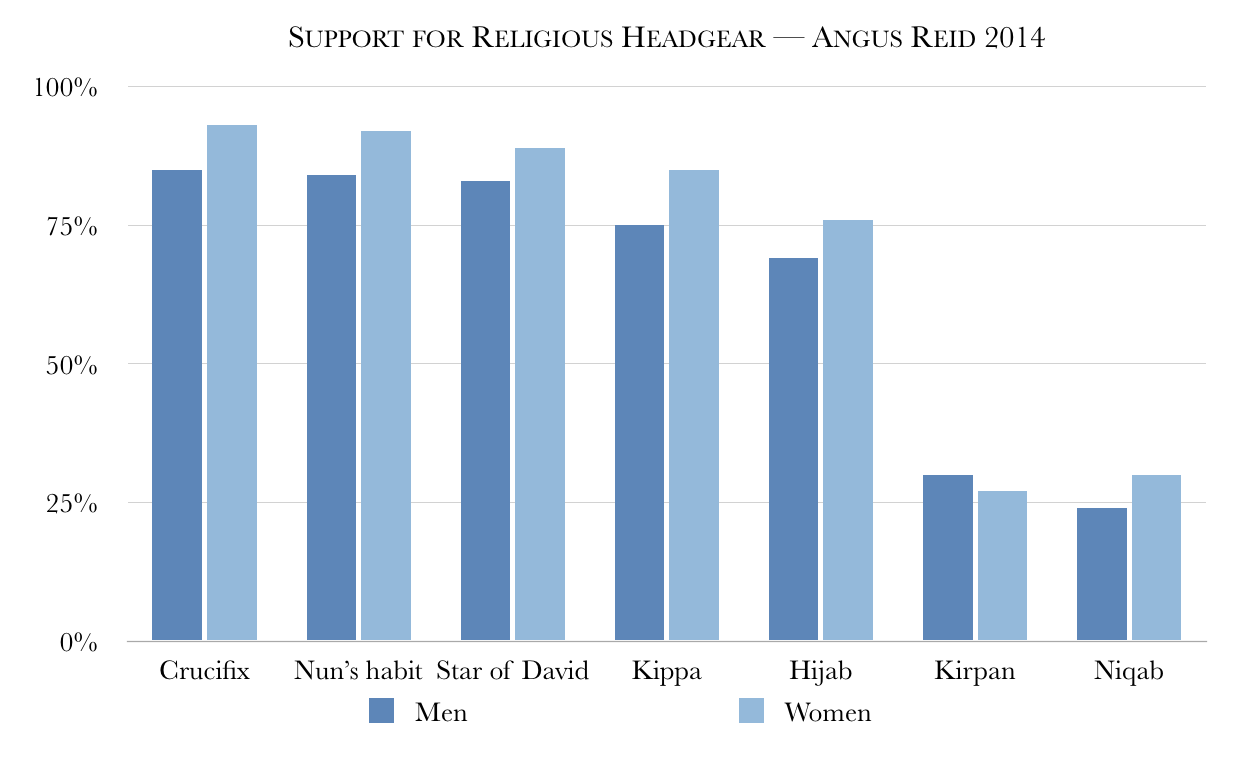 As noted by John Geddes, Minister Alexander surely knows the difference between a hijab and niqab (mainly worn in Gulf Arab countries) and the burqa (worn in Afghanistan where he lived and worked).
As the above chart shows, Canadians clearly make a distinction between the hijab and the niqab, with the former supported by three-quarters of Canadians, the latter only one-quarter.
Is this part of an emerging Quebec strategy to play on xenophobia? Part of the strategy to play the values card? From another Minister, I might assume an inadvertent slip of the tongue.
And sad to see, after Minister Kenney and the Government, were so strong in their opposition to the PQ’s proposed Charter of Quebec Values:
Based on today’s evidence, you would have been wrong. News that the Conservatives sent out a fundraising email on the topic led to a question from Liberal MP Chrystia Freeland in the House. She focused specifically on how the Tory email mentioned that the government was appealing a judge’s ruling “allowing people to wear the hijab while taking the oath.”
The odd thing about that phrase, which Freeland zeroed in on, is that the word “hijab,” at least in Canada, almost always refers to a Muslim woman’s head scarf that covers only the hair, unlike the “niqab,” which also covers much of the face. Directing her question at Citizenship Minister Chris Alexander, a former diplomat who served in Muslim countries, including Afghanistan, Freeland said, “Surely the minister, of all people, ought to know the difference between a niqab and a hijab.”
But Alexander defended his terminology. He alluded to his experiences “living in a majority Muslim country where the hijab has been used to cover the face of women, just as the niqab and just as the burka has been used under the terrible influence of the Taliban, and other obscure entities, in places like Afghanistan and Pakistan.”
I took that to suggest the government might mean to allow the hijab during the citizenship oath, so long as it wasn’t somehow used to cover the face. To be certain I understood properly, I emailed Alexander’s office for a clarification. The first response said Alexander was referring to “the actual covering of the face during the oath.” Just to be certain, I followed up by asking if, in that case, the hijab would be permitted, if it didn’t cover the face.
Instead of answering that question directly, Alexander’s office forwarded me this statement: “As the Prime Minister said, it is offensive that someone would hide their identity at the very moment where they are committing to join the Canadian family. We are opposed to anything that hides someone’s face when reciting the Oath of Citizenship. We believe the oath should be taken freely, openly and proudly for everyone to hear.”
I don’t think that directly answers my question about the hijab. In fact, I remain puzzled about why Alexander injected such a precise term as “hijab” at all into this already fraught debate. Having used it, though, he should now explain in plain language exactly how he means to be understood.
I assume he means it in a different way than Defence Minister Jason Kenney did, back when he was citizenship minister in 2013, and the Quebec Charter of Values debate was roiling, and he tweeted: ”A child is no less Canadian because she or he wears a kippa, turban, cross, or hijab to school.”
Citizenship minister’s office declines to clarify “hijab” reference.
 About Andrew
 Multicultural Meanderings