Drawing the prophet: Islam’s hidden history of Muhammad images

Interesting article on the history of devotional Islamic art that depicts the prophet Muhammad. Again, a sad forgetting of some of the rich traditions within Islam:

To many Muslims, any image of the prophet Muhammad is sacrilegious, but the ban has not always been absolute and there is a small but rich tradition of devotional Islamic art going back more than seven centuries that does depict God’s messenger.

It began with exquisite miniatures from the 13th century, scholars say. Commissioned from Muslim artists by the rich and powerful of their day, they show almost every episode of Muhammad’s life as recounted in the Qur’an and other texts, from birth to death and ascension into heaven.

Intended as private aids to devotion and prayer, these detailed scenes were made for both Sunni and Shia worshippers, and surviving examples can be found in dozens of major museum and library collections.

They also laid the foundations for a popular, if minority, tradition of devotional and inspirational images that still exists today, from icons cherished in homes to a five-storey government-commissioned mural in the heart of Tehran and even to revolutionary street art in Cairo – although the prophet’s face is obscured in both those public drawings.

In the wake of the murder of cartoonists at French magazine Charlie Hebdo, many Muslims and non-Muslims have argued that Islam has always banned any representation of the prophet, in part because of strong warnings in the Qu’ran and other religious texts against idolatry or anything that could be seen as a pathway towards idolatry.

This position is rarely challenged, perhaps because the existence of images of Muhammad is little known and almost never discussed outside communities that create, study or buy them. But their obscurity frustrates experts who see them as a rich part of Islam’s artistic heritage and resent the misconception that the only depictions of the prophet are mocking or racist creations by non-believers. “It’s really important for audiences that have never seen the pietistic images of Muhammad to make a radical distinction between the mystical and beautiful images that have been produced over the last 1,000 years by Muslims and for Muslims, and the offensive and sometimes pornographic images [currently in the news],” said Omid Safi, director of the Islamic Studies Centre at Duke University in North Carolina.

Drawing the prophet: Islam’s hidden history of Muhammad images | World news | The Observer.
France’s political elite never champions virtues of a multicultural nation | Elise Vincent

Good piece by Elise Vincent of Le Monde on the problems with France’s approach to diversity and integration:

The problem with the approach of both Sarkozy and Hollande is that it reveals a defensive attitude, never a proactive one. So when the government begins to accept meatless menus in canteens or creates Muslim areas in cemeteries, the impression given to the French public is still that of an “abdication” faced with the claims of Muslim “lobbies”. It doesn’t, as it could, suggest an approach that’s chosen and is beneficial to the French Muslim minority and so, in turn, to the whole of French society.

Similarly, constantly brandishing the idea of a republic “one and indivisible” – as the saying goes – France judges that it is defending itself against Anglo-Saxon “multiculturalism”.

In truth, on the ground, things are very similar. De facto community organisations exist in France, as in the UK. But there’s one key difference: by acting as it does, France prevents the emergence of moderate “community leaders”. Those who manage to emerge in public debate are those who shout the loudest: the radicals.

While failing to review its “model”, France is ignorant of the extent of its mixed relationships and the children born to them. How, without accurate ethnic statistics, can we address properly this grassroots transformation of France? How to measure properly the failures of integration or the success of many immigrants, whether Muslim or not?

The way of speaking of “living together” in France is often too negative, obsessed by the most extreme behaviour, or, alternatively, it is too celebratory, as if it were absolutely necessary to embellish reality to better fight the rise of the Front National. The analyses are often coarse, unnecessarily judgmental. The always subtle, complicated reality of identity and life on the ground is regularly overlooked. All these small shifts in what and how people feel have much more to do with everyday tensions than blind terrorism.

Physicists know that the smell of a dangerous gas is detectable in the air long before becoming harmful and ends in an explosion. There are still two years before the next presidential elections. Two years to prevent French voters massively supporting the Front National, as predicted by many polls. Stopping this leak will not necessarily protect France from terrorism, but it will at least guard against another cataclysm.

France’s political elite never champions virtues of a multicultural nation | Elise Vincent | Comment is free | The Observer.

Satirical religious cartoons should be illegal, says Ottawa imam and reactions

From one of the preferred interlocutors of the Government in the Canadian Muslim community:

Imtiaz Ahmed, an imam with the Ahmadiyya Muslim Community, said it should be against the law to publish cartoons that depict religious figures in a derogatory way.

“Of course we defend freedom of speech, but it has to be balanced. There has to be a limit. There has to be a code of conduct,” Ahmed said.

“We believe that any kind of vulgar expression about any sacred person of any religion does not constitute the freedom of speech in any way at all.”

Ahmed said there should be limits placed on freedom of speech to prevent the publication of offensive material. He says that seems to be the case for events such as the Holocaust. Members of the public denounce those who say the Holocaust never happened.

“We don’t want the Jewish community to be hurt by these sentiments,” Ahmed says.

And yes, of course there are limits; the debate is more about what those limits should and should not be, and what is considered offensive and to whom. A blanket “ban” on religious satire is what he seems to be what he is suggesting.

Satirical religious cartoons should be illegal, says Ottawa imam | Ottawa Citizen.

And the reply by the Association of Canadian Editorial Cartoonists:

“I think it should be up to the cartoonist and their editor as to whether a cartoon has crossed the line and become too distasteful,” said Wes Tyrell, association president and the feature editorial cartoonist for Yahoo! Canada.

“A cartoonist should absolutely be prepared to criticize what they see as poor behaviour by any human on the planet, whether a politician or religious figure. I find the whole concept of ‘you can’t touch them’ as pretty sad.”

… Ahmed’s views on censorship were met Friday with a storm of protest on the Citizen’s website. “I’m Catholic and I saw the humour in Monty Python’s Life of Brian: I didn’t pick up a gun after that,” wrote public health inspector Bruce Kemball, who noted that Canada already has laws against hate speech.

Other religious leaders contacted by the Citizen also weighed in on the issue.

Rabbi Reuven Bulka said it’s too unwieldy to try to define what’s unacceptable as it relates to satire and religion.

“We abhor hateful speech, we abhor speech that’s demeaning of anyone,” he said. “But in the end, the only way you’re going to have an effective counter to this kind of garbage is by people not buying these papers or not subscribing to them. If there’s no market, it won’t happen.”

Cartoonists insist they should be able to satirize anyone

The monumental politics behind Ottawa’s newest memorials

Good piece on the history of the Holocaust and Communism memorials and the Government over-riding experts, particularly with respect to site location:

The advisory committee on which Bedford serves is chaired by Larry Beasley, Vancouver’s retired director of planning, and arguably the biggest star in Canadian urban planning circles. Beasley is now a University of British Columbia professor, and heads an international consulting firm. (He was not available to comment when the version of this article that appears in the print edition of Maclean’s was being written, but has responded by email to questions for this updated online version.) Not only did Beasley confirm that his advisory committee concluded that “the chosen site was not a good site, and that it was needed for a higher priority government purpose over the next few years,” he added that, beyond the location issue, the committee didn’t like the winning design, by ABSTRAKT Studio Architecture of Toronto.  “We did not vote on the actual design, but the selected one was not the one the majority of our group preferred, as advisers on the urban design aspects only,” Beasley said.

Asked why the government ignored or rejected the advice of Beasley’s committee, particularly on the site for the memorial, a spokesman for the Department of Canadian Heritage said in an email: “The National Capital Commission’s role in this project is not to advise or approve a location but to oversee the design competition.” That description of the NCC’s function seems more limited than is suggested by the commission’s own website, where the role of Beasley’s committee is described as providing advice on “long-range plans and policies for the use of public lands and properties in Canada’s Capital Region; design proposals affecting these federal lands; [and] real property matters.”

The future court building previously slotted for the contested site was to have been named after Pierre Elliott Trudeau—hardly a mark in its favour for the Conservatives. Soon after the election of the Harper government in 2006, the memorial alternative gained powerful political backers, particularly Employment Minister Jason Kenney, who also spearheads Harper’s political outreach to ethnic communities. Tribute to Liberty, the private group formed in 2008 to support the memorial, is led by Canadians who immigrated from former communist countries in Eastern Europe, as well as Asia, communities Kenney has tirelessly courted.

The Holocaust Monument site, a short walk west beyond the built-up Parliament Hill area, has attracted no significant criticism. Both Bedford and Abel said this site—next to the Canadian War Museum in an open area slated for major new development—is far more suitable than the location for the Victims of Communism memorial. Still, its ultimate popularity is not guaranteed. The monument is expected to cost $8.5 million, with Ottawa matching up to $4 million in private donations. The design calls for six slanting triangular concrete segments, suggesting a broken Star of David, enclosing a space big enough for 1,000 people to gather. Its key designer is Daniel Libeskind, the Polish-American architect, perhaps best known to Canadians for his jutting addition to Toronto’s Royal Ontario Museum, called the “Crystal,” which opened to mixed reviews in 2007, and has not proven to be a conspicuous hit with the public.

With Canadian Heritage saying that “major elements” of both monuments are slated to be largely completed by fall, this highly visible aspect of Harper’s legacy seems assured no matter who wins this year’s federal election. The verdict that matters most will be rendered by visitors, when they decide whether or not to add two sombre stops to the must-see circuit of Ottawa landmarks.

The monumental politics behind Ottawa’s newest memorials – Macleans.ca.

Paris policeman’s brother: ‘Islam is a religion of love. My brother was killed by terrorists, by false Muslims’

From the brother of the slain police officer, Ahmed Merabet:

“My brother was Muslim and he was killed by two terrorists, by two false Muslims,” he said. “Islam is a religion of peace and love. As far as my brother’s death is concerned it was a waste. He was very proud of the name Ahmed Merabet, proud to represent the police and of defending the values of the Republic – liberty, equality, fraternity.”

Malek reminded France that the country faced a battle against extremism, not against its Muslim citizens. “I address myself now to all the racists, Islamophobes and antisemites. One must not confuse extremists with Muslims. Mad people have neither colour or religion,” he said.

“I want to make another point: don’t tar everybody with the same brush, don’t burn mosques – or synagogues. You are attacking people. It won’t bring our dead back and it won’t appease the families.”

Paris policeman’s brother: ‘Islam is a religion of love. My brother was killed by terrorists, by false Muslims’ | World news | The Observer.

Charlie Hebdo harsher with Christianity than Islam

Martin Patriquin on Charlie Hebdo:

My point here isn’t only that Charlie Hebdo is an equal opportunity offender of religions, a fact repeatedly borne out in the magazine’s archives. It’s also this: over the years, Charlie Hebdo has been far harsher with Christianity than it has with Islam. Catholic organizations have sued the magazine 13 times, and only once by Muslim groups. That the magazine was both firebombed (in 2011) and its staff attacked and killed (2015) by apparent adherents of Islam only speaks to Charlie Hebdo’s central point: it’s not the religion that’s the problem—though there’s that too—but its  most extreme adherents. “French Muslims are sick of Islamism,” read the first cover sell in one issue.

French society might well be anti-Islam. Muslims, who make up 12 per cent of the country’s population, account for about 60 per cent of its prison population. Many of Paris’s infamous banlieues are petri dishes of relative poverty and exclusion. French politicians, eager to curry to the public’s favour, have been far too quick in appealing to its baser fears; Nicolas Sarkozy’s outright burqua ban is but one example of this.

But Charlie Hebdo is hardly a reflection of this hate. In fact, when it wasn’t pillorying him for being an image-obsessed, pro-American patsy, Charlie Hebdo was at its best when it pointed out in brilliant and profane Technicolor how Sarkozy was guilty of scapegoating Muslims and the Roma for the sake of an election. Here is one example.

There’s a sad irony for you: far from being anti-Islam, Charlie Hebdo was perhaps the loudest defender of those who practice it.

Charlie Hebdo harsher with Christianity than Islam.

And in the same vein, on Arun with a View, commentary on the content of Charlie Hebdo by someone who has read it on and off over the years:

… The fact is, CH is on the left, targets all religions—but not their believers—in equal measure, and aims its main fire at politicians, and particularly the right (and, above all, the Front National). CH comes out once a week, i.e. 52 times a year. A handful of its issues—less than a dozen—over the past decade have had cover cartoons mocking radical Islamism (not Islam or Muslims). A drop in the bucket in terms of what CH has published. And most of these cartoons have been pretty good actually. Witty and on target.

A few in the inside pages—which could only be seen if one purchased the issue, as CH puts almost nothing on its website—were in poor taste (and the cover cartoon from last October on the girls kidnapped by Boko Haram—which was situated in the context of the then French debate on family allowances—was definitely in very poor taste), but, taken as a whole, could in no way be taken as denigrating to Muslims qua Muslims. And then there’s the actual content of CH’s columns and articles, which absolutely no CH detractor mentions (as they have most certainly never read any). I will defy anyone to find any of these—published at any point over the years—that could in any way be considered racist or Islamophobic.

On Charlie Hebdo, bigotry, and racism

Minister Alexander helped bureaucrats avoid giving full details on visa wait times | Toronto Star

While there is some validity to the concerns regarding officials about the workload, one has to question whether or not CIC’s computer systems cannot generate these kinds of reports relatively easily (it’s not as if officers are looking at the 16 million records individually, they are using the CIC databases to extract the information):

The emails have officials describing the “enormity of the request,” estimating it would involve some 16 million records.

The emails also say the team tasked with crunching these numbers had to keep putting it aside to work on “high-priority requests to respond to public discussion and interdepartmental analysis around the (temporary foreign workers) file.”

Relief came when an official wrote on May 2: “You can hold this work — MINO (minister’s office) has come back to advise ADMO (office of the assistant deputy minister for operations) that we will use the same response we provided to Q-359.”

That was an order paper question about processing times submitted by Liberal immigration critic John McCallum, which was almost identical to the part of the question from Blanchette-Lamothe officials were scrambling to answer in time.

The response Alexander provided in the Commons last May 12 — there was no accompanying paperwork — is nearly verbatim to the response Blanchette-Lamothe received in writing two days later, although it also refers to “an excessive number of taxpayer-funded man-hours.”

A spokesman for Alexander said that was appropriate.

“It was at the advice of the department that we took the chosen approach. The questions posed by both Mr. McCallum and Ms. Blanchette-Lamothe were detailed, multi-part questions which could not be answered within the prescribed time frame. The answer to this (order paper question) reflects the advice of (Citizenship and Immigration Canada’s) professional, non-partisan public servants,” Kevin Menard wrote in an emailed statement Friday.

Chris Alexander helped bureaucrats avoid giving full details on visa wait times | Toronto Star.

The ideologies of Canadian economists, according to Twitter – Macleans.ca

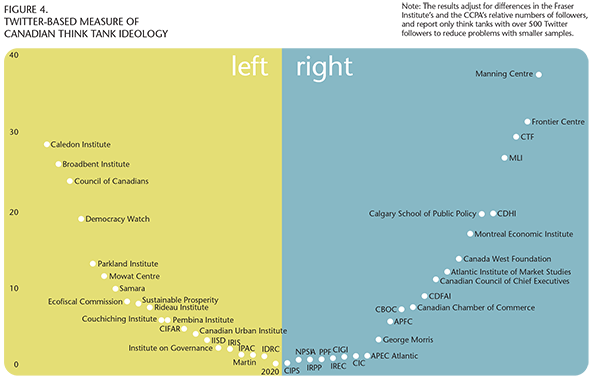
Think tanksInteresting analysis of Twitter use and followers to indicate ideological leanings by Stephen Tapp:

Four additional results are worth highlighting. First, there are indeed many Canadian think tanks: these results include 44. Having such a crowded playing field may explain much of the general public’s confusion about which think tank fits in where ideologically.

Second, according to my ideology measure, Canadian think tanks seem to be about evenly split on the left-right continuum: there are 21 think tanks to the left of centre and 23 to the right.

Third, the smile isn’t exactly symmetric. In this sample, and with this measure, the average “right-wing” think tank appears to be a bit more “ideological” than the average “left-wing” think tank. That said, the difference is not that large and may simply reflect what Halberstam and Knight found in the US: that conservatives are actually more tightly connected on social media than liberals.

Fourth, my preliminary analysis did not suggest any systematic relationship between ideology and Twitter followers. In other words, it does not appear that more extreme ideologies on their own are associated with a larger Twitter following.

… That said, we should always be careful when reducing a complex issue to a single number along a single dimension. The concept of ideology is inevitably problematic. Moreover, think tank ideologies are not uniform within a given organization and they change over time. Finally, of course, readers should not use these results to prejudge, discredit or approve of research by any of these organizations without a thorough reading of that research. I emphasize that these simple results are preliminary and just a first step; much more work is needed to better understand these complex issues.

The ideologies of Canadian economists, according to Twitter – Macleans.ca.

Apprenticeship ad’s claim of skilled trades shortfall open to question – Politics – CBC News

Embarrassing lack of due diligence:

The government pointed CBC News to “a combination of industry estimates,” several of which were written by Rick Miner, the president of Miner & Miner Ltd., a management consulting firm specializing in labour market issues.

Miner concluded that Canada will face a “major problem” with skilled worker shortages if nothing changes over the next 16 years.

But he told CBC News his projections are for overall labour and for skilled labour, not specific to the trades.

“I think you’d have a tough time finding somebody who is going to back that unless they have a real broad definition of both the trades and a broad definition of what they define as shortage,” Miner said.

“If somebody said … right now there’s a shortage of a million workers in the trades in Canada, I’d say that’s an inflated number. That’s not true.”

Asked if he could point to labour data showing Canada would face a shortage of “one million skilled trades” workers over the next decade, Miner said he could not.

The government also pointed to a 2013 estimate by the Canadian Chamber of Commerce. But Sarah Anson-Cartwright, the chamber’s director of skills policy, told CBC News those forecasts originated from Miner’s older reports, which are not specific to the trades and have since been reviewed.

“The Canadian chamber does not cite the forecasts from Miner’s 2010 and 2012 reports since they are out-dated now.”

Apprenticeship ad’s claim of skilled trades shortfall open to question – Politics – CBC News.

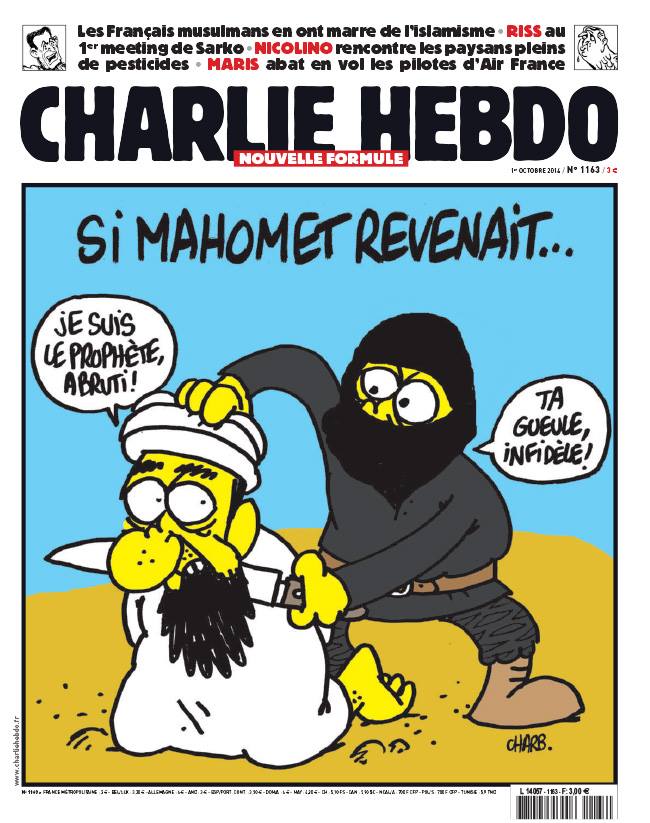
Charlie Hebdo shooting: Debate over publishing the Muhammad cartoons

charlie hebdo no1163 011014While it is a legitimate debate to have over whether or not to publish the cartoons given fear of giving offence or further stirring things up, my sense is that editors have made a blanket decision rather than looking at the cartoons and selecting some that are not gratuitous but make valid points.

My example would be the one above:

Studer said the CBC decided against running the cartoons, arguing that to show those depictions of Muhammad would needlessly offend Muslims, who consider such depictions sacrilege.

And he wasn’t alone in putting forward that argument. The New York Times executive editor Dean Baquet told the paper’s public editor he spent about half of the day deciding whether or not to publish the cartoons, changing his mind twice before ultimately deciding not to run the images.

“We have a standard that is long held and that serves us well: that there is a line between gratuitous insult and satire. Most of these are gratuitous insult,” Baquet said.

The Washington Post ran one image on its editorial pages while the main U.S. networks, including ABC News, CNN and Fox backed off from publishing the cartoons. The Associated Press also declined to make them available.

In Canada, of the Toronto-based newspapers, only the National Post ran the controversial cartoons. Almost none of the U.K. papers ran the cartoons, nor did the BBC and the Paris-based papers Le Monde or Le Figaro.

Charlie Hebdo shooting: Debate over publishing the Muhammad cartoons – World – CBC News.

And in Quebec media, which apart from the Montreal Gazette, widely published some of the cartoons:

Publier les caricatures ou pas?