What drives anti-immigrant sentiment? – Ian Buruma

Ian Buruma on the drivers on anti-immigrant sentiment and the increased divide between educated metropolitan elites and the “less sophisticated, less flexible and, in every sense, less connected provincials.”

Canada does not figure in his commentary, perhaps because we have managed these tensions – which we have – better than most:

Populist rabble-rousers like to stir up such resentments by ranting about foreigners who work for a pittance or not at all. But it is the relative success of ethnic minorities and immigrants that is more upsetting to indigenous populations.

This explains the popular hostility toward Mr. Obama. Americans know that, before too long, whites will be just another minority, and people of colour will increasingly be in positions of power. At this point, all that Tea Partiers and others like them can do is declare, “We want our country back!”

Of course, this is an impossible demand. Short of unleashing massive and bloody ethnic cleansing – Bosnia, on a continental scale – Americans and others have no choice but to get used to living in increasingly diverse societies.

Likewise, economic globalization cannot be undone. But regulation can and should be improved. After all, some things are still worth protecting. There are good reasons not to leave culture, education, lifestyles or jobs completely exposed to the creative destruction of market forces.

What drives anti-immigrant sentiment? – The Globe and Mail.

Debate over police powers missing key voices: women and minorities

Lack of representation is a problem, both in terms of optics as well as substance:

Here in Canada, to say that police unions are boys’ clubs – and white boys’ clubs at that – understates just how glaring the absence of women and visible minorities is.

Let’s start with Toronto, “the world’s most diverse city.” Of the eight board members of the Toronto Police Association headed by Mr. McCormack, all eight are male and seven are white. This in a force of 7,650 members, in which 30 per cent are women and 23 per cent are visible minorities, who police a city where 51 per cent of the residents are women and almost the same percentage are members of a visible minority.

Canada’s second-largest city fares no better. The Montreal police union has six executive members. All are men and all are white.

Calgary? Of seven board members, all are men, one is non-white.

Ottawa: of eight members, all men, one non-white.Halifax: five members, all men, all white.

Vancouver only lists its president (male, white) on its website, and Winnipeg doesn’t list any of its 13 board members.

RCMP officers are forbidden from forming a union. But Canada’s two largest provincial police unions mirror their city cousins: the Ontario Provincial Police Association has seven board members. Six are men and all are white. The Sûreté du Québec has six executive members and 12 board members. All are men, all are white.

While I would not go as far as his generalizations about men and women (and visible minorities) as he does below, representation is also about how decisions and actions are perceived by the broader, and more diverse, public.

But why does this matter? What’s the connection between lower levels of testosterone and less incendiary rhetoric? And not just rhetoric. When police line up outside the courtroom to defend one of their own accused of a crime, I don’t think I’ve ever seen a policewoman pushing the media away. And when the New York cops turned their backs on Mayor de Blasio outside the church last week where he was to speak at the funeral of Raphael Ramos, not a policewoman’s back was to be seen.

The connection, of course, is that women are less violent than men, certainly in deed and often in word as well. (in ‘thought’ we’ll never know). Women are more empathic than men. Women make more rational decisions than men, in everything from investing to … shooting. While women make up 20 per cent to 35 per cent of many police forces, the number of female police officers caught using excessive force ranges from tiny to non-existent.

Debate over police powers missing key voices: women and minorities – The Globe and Mail.

ICYMI: Experts view radicalized individuals who incite violent attacks as misfits with ‘overvalued ideas’

More on radicalization:

But [Matthew] Logan said it would be a disservice to categorize him simply as a “jihadist.” Many radicalized individuals are misfits of society who cling obsessively to “overvalued ideas” as a way to elevate their sense of self, Logan said. They can just as easily be drawn to the cause of animal activism as the Islamic State narrative, he said.

“They’re not terrorists. They’re people with overvalued ideas jumping on a cause,” he said.

In a column published in the journal Violence and Gender, Logan wrote that while they may see themselves as rebels for a particular cause, “it should be understood that it is really not ‘the cause’ that moves them to violence,” but an underlying psychopathology, perhaps mixed with a bit of narcissism.

“These persons have idealized values, which have developed into such an overriding importance that they totally define the ‘self’ or identity of the individual,” he wrote.

Academics have used the concept of “overvalued ideas” to try to explain the actions of everyone from Ted Kaczynski (the “Unabomber”), the American mathematician who sent mail bombs as part of a campaign against technology, to people with anorexia nervosa, the eating disorder in which people starve themselves to achieve a desired body image.

Logan is quick to add, however, that having “overvalued ideas” should not diminish one’s culpability for a violent act.

Experts view radicalized individuals who incite violent attacks as misfits with ‘overvalued ideas’.

Australian multiculturalism now – New Head of Australian Multiculturalism Council

The new head of Australia’s Multiculturalism Council, Sev Ozdowski. With some exceptions (i.e., English and French) could be applied to Canada:

But what is multiculturalism? It is not ideology or myth of some utopian society. Multiculturalism is a set of practical measures to manage our diversity and to foster the successful integration of migrants, grounded in values of equality and liberty. Multiculturalism assumes that culture is enriched by diversity rather than polluted by it, and that different cultural elements can co-exist within a broader cultural envelope that creates its own common ground. It contains a range of policies and programs about our governance, equality and human dignity, and aims at social cohesion.

To start with effective multiculturalism locally requires an overriding and unifying commitment to Australia, an acceptance of the rule of law, freedom of speech and religion, English as the national language and the equality of the sexes. The right to express your own cultural background carries the responsibly to afford others the same right to express theirs. In addition, multiculturalism aims to harness new economic opportunities afforded by new arrivals.

Australian multiculturalism also aims to remove racial and religious divisions and provide a check on the strong cultural nationalist impulse. In other words, contemporary Australian multiculturalism is a social compact, a two-way street between established and new communities. Cultural and religious leaders are expected to play their role by helping governments handle the occasional social conflicts, in particular by helping manage the impact of foreign loyalties and religious hatreds.

…There is always more to be done to ensure Australia’s social cohesion remains sustainable. We must continue to work hard to ensure there is a wide and equal participation in Australian society, regardless of our cultural, linguistic and religious backgrounds. We must empower migrants to chase their dreams in Australia to maximize their economic contribution and remove the need for ethnic ghettos and separation from the community at large. These are the conditions that help create cohesive societies able to take on the task of nation building projects.

Our multicultural success is one of our key strengths as we deal with the changing nature of the modern world, and the response to the Sydney siege is a good demonstration of a mature, inclusive society. We must now take the opportunity to continue to demonstrate this tolerance to further share our Australian values and culture.

Australian multiculturalism now – On Line Opinion – 29/12/2014.

ICYMI: White? Black? A Murky Distinction Grows Still Murkier – NYTimes.com

While not based on a random sample, nevertheless interesting results, showing just how much mixing has occurred, and continues to occur, in the US:

In the United States, there is a long tradition of trying to draw sharp lines between ethnic groups, but our ancestry is a fluid and complex matter. In recent years geneticists have been uncovering new evidence about our shared heritage, and last week a team of scientists published the biggest genetic profile of the United States to date, based on a study of 160,000 people

The researchers were able to trace variations in our genetic makeup from state to state, creating for the first time a sort of ancestry map.

“We use these terms — white, black, Indian, Latino — and they don’t really mean what we think they mean,” said Claudio Saunt, a historian at the University of Georgia who was not involved in the study.

The data for the new study were collected by 23andMe, the consumer DNA-testing company. When customers have their genes analyzed, the company asks them if they’d like to make their results available for study by staff scientists.

Over time the company has built a database that not only includes DNA, but also such details as a participant’s birthplace and the ethnic group with which he or she identifies. (23andMe strips the data of any information that might breach the privacy of participants.)

The scientists also have been developing software that learns to recognize the origins of the short segments of DNA that make up our genomes. Recently they used their program to calculate what percentage of each subject’s genomes was inherited from European, African or Native American forebears.

“This year we saw that we were in a great position to do the analysis,” said Joanna L. Mountain, senior director of research at 23andMe.

On average, the scientists found, people who identified as African-American had genes that were only 73.2 percent African. European genes accounted for 24 percent of their DNA, while .8 percent came from Native Americans.

White? Black? A Murky Distinction Grows Still Murkier – NYTimes.com.

Ottawa hiking citizenship fees for second time in a year | various

Naturalization rateWhenever governments have bad news to convey, they either cloak it up with good news, or try to bury it before a long weekend or holiday.

In this case, raising citizenship fees, the Government has done both: burying the announcement in a press release announce success in addressing the backlog (some 260,000) new Canadian citizens, and issuing the press release just before Christmas.

One has to ask whether this further increase was already planned but, for a political management perspective, the Government decided better to increase fees in a two-step process.

Or was it simply incompetence in that the earlier calculations of citizenship processing costs underestimated the true costs, and over-estimated the savings from the revisions to the Citizenship Act?

My normal preference is to assume incompetence (having seen it in myself) rather than more Machiavellian interpretations.

But in any case, the increase makes Canada significantly more expensive than Australia ($AU 300 or CAD $282). Moreover, comparison to the USA ignores the fact that the US Citizenship and Immigration Service retains any fees for operations (hence the Republican frustration with President Obama’s immigration initiative as they have no funding levers available to counter them), whereas in Canada the $60 million the increase generates would normally go to the consolidated revenue fund and not to CIC to cover additional costs).

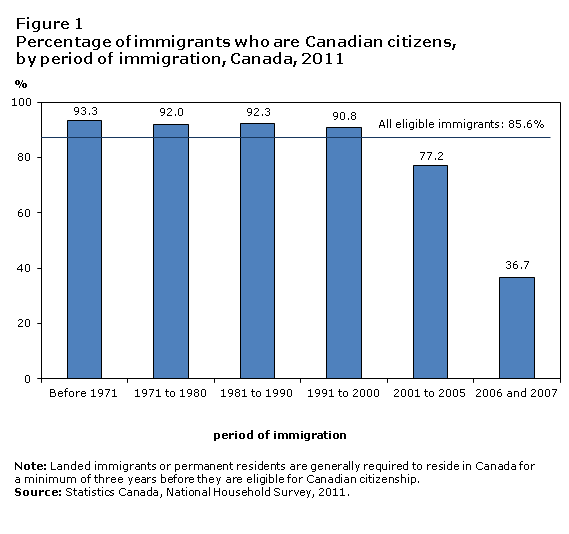
More substantively, this and other changes will continue to erode the Canadian model of immigration as a pathway to citizenship. As indicated in the StatsCan chart above, the 85.6 percent naturalization rate trumpeted by many a CIC Minister only applies to previous waves of immigration, with more recent waves having much lower rates (37 percent).

An area of concern and one to monitor, given that it moves us towards more disenfranchised residents who cannot participate in the political and democratic processes:

In February, Citizenship and Immigration Canada already increased the fee from $100 to $300 in order to recover its administrative costs. The upcoming raise means it will now cost applicants five times the money for their citizenship applications within a year. Successful candidates must also pay another $100 rights of citizenship fee to become citizens.

Officials said the fee changes are necessary to pay for the more stringent citizenship process introduced by the government to clear a backlog it created with the “residence questionnaire,” which is used to scrutinize if applicants have physically spent enough time in Canada to qualify for citizenship.

In August, Immigration Minister Chris Alexander also announced a new streamlined decision-making process to cut the backlog, which has since been reduced by 17 per cent. In total, Canada welcomed more than 260,000 new citizens this year.

“With a record number of new Canadians this year, it is clear that our government’s changes to the Citizenship Act are having a real impact,” Alexander said in a statement.

“We are fulfilling our commitment to reducing backlogs and improving processing times.”

Based on citizenship projections from 2014, the fee raise could bring in an additional $60 million to the federal coffers in 2015.

Hard not to think of this as more of a “cash grab,” given that the changes were partially sold on efficiency grounds and that CIC received an influx of $44 million in Budget 2013 to address the backlog.

Ottawa hiking citizenship fees for second time in a year | Toronto Star.

Record number of new citizens welcomed in 2014

Graphic – Changes to Canada’s Citizenship Fees: A Comparative View – Relieving the Burden on Canadian Taxpayers (6 February 2014 press backgrounder).

And the latest article complaining about citizenship processing times:

Want-to-be Canadians frustrated by citizenship processing delays

And the public statement regarding the results of CIC’s analysis of the further increase:

In its analysis, the department said the fee jump may impose additional financial pressures on some people or families.

“While the analysis assumes that there will not be a reduction in overall demand for citizenship as a result of the fee increase, it is acknowledged that some may be required to delay their application as they will need more time to save for the new fee,” the analysis says.

“Overall, in the long-term, this will likely not have a significant impact on the uptake for citizenship.”

No acknowledgement that naturalization rates have dropped from the public – and obsolete – 85.6 percent rate often quoted.

And it would be interesting to see the assumptions behind the analysis that this will not reduce overall demand for citizenship.

Conservatives Hike Citizenship Fees.. Again
The Science of Why Cops Shoot Young Black Men

Good in-depth article on the psychology and neurology of subconscious bias and how it is part of our automatic thinking and sorting:

Science offers an explanation for this paradox—albeit a very uncomfortable one. An impressive body of psychological research suggests that the men who killed Brown and Martin need not have been conscious, overt racists to do what they did (though they may have been). The same goes for the crowds that flock to support the shooter each time these tragedies become public, or the birthers whose racially tinged conspiracy theories paint President Obama as a usurper. These people who voice mind-boggling opinions while swearing they’re not racist at all—they make sense to science, because the paradigm for understanding prejudice has evolved. There “doesn’t need to be intent, doesn’t need to be desire; there could even be desire in the opposite direction,” explains University of Virginia psychologist Brian Nosek, a prominent IAT researcher.”But biased results can still occur.”

The IAT is the most famous demonstration of this reality, but it’s just one of many similar tools. Through them, psychologists have chased prejudice back to its lair—the human brain.

Were not born with racial prejudices. We may never even have been “taught” them. Rather, explains Nosek, prejudice draws on “many of the same tools that help our minds figure out whats good and whats bad.” In evolutionary terms, its efficient to quickly classify a grizzly bear as “dangerous.” The trouble comes when the brain uses similar processes to form negative views about groups of people.

But here’s the good news: Research suggests that once we understand the psychological pathways that lead to prejudice, we just might be able to train our brains to go in the opposite direction.

The Science of Why Cops Shoot Young Black Men | Mother Jones.

And yes, I did take the Implicit Association Test (also available at UnderstandingPrejudice.org) and scored just as miserably as the Chris Mooney, the author of this article. Very sobering, and I encourage all to take it.

Overall interest in military careers low for Black, Latin-American and Filipino Canadians | National Post

Not particularly surprising, nor is the usual bureaucratic response – change the targets (RCMP had managed to do so a number of years ago):

The findings come as National Defence has been looking to cut legally mandated recruitment targets for women, visible minorities and aboriginals in uniform, a move that has prompted sharp debate in military circles.

While the military is expected to aim to have 11.7% of those in uniform be visible minorities, the actual number is 4.2%.

While that represents an increase from previous years, documents obtained by the Citizen show defence officials have been pushing to cut the target to 8.2%.

Those lobbying for a change will point to the survey of black, Filipino and Latin American Canadians as proof the current employment equity goals are unrealistic. Others, however, will say the report proves recruiting efforts need to change.

The survey saw less than 1% of respondents from the three ethnic groups cite the military from a list of careers they would be interested in pursuing, or which they would recommend to a young person.

Similarly, about 20% of respondents from each of the three groups said the military was the career they would be least interested in pursuing or recommending to someone else.

Overall interest in military careers low for Black, Latin-American and Filipino Canadians | National Post.

Radical Islam, Nihilist Rage – Kenan Malik

Kenan Malik on radicalization and rejection of modernity (apart from using social media and weaponry of course!):

Anti-imperialists of the past saw themselves as part of a wider political project that sought to modernize the non-Western world, politically and economically. Today, however, that wider political project is itself seen as the problem. There is considerable disenchantment with many aspects of modernity, from individualism to globalization, from the breakdown of traditional cultures to the fragmentation of societies, from the blurring of moral boundaries to the seeming soullessness of the contemporary world.

In the past, racists often viewed modernity as the property of the West and regarded the non-Western world as incapable of modernizing. Today, it is radicals who often regard modernity as a Western product, and reject both it and the West as tainted goods.

The consequence has been the transformation of anti-Western sentiment from a political challenge to imperialist policy to an inchoate rage against modernity. Many strands of contemporary thought, including those embraced by “deep greens” and the far left, express aspects of such discontent. But it is radical Islam that has become the lightning rod for this fury.

There are many forms of Islamism, from the Taliban to Hamas, from the Muslim Brotherhood to Boko Haram. What they have in common is a capacity to fuse hostility toward the West with hatred for modernity and, seemingly, to provide an alternative to both. Islamists marry political militancy with a conservative social sensibility, a hostility to globalization with the embrace of a global ummah (the worldwide community of Muslim believers). In so doing, they turn the contradictory aspects of their rage against modernity into a strength.

Jihadism provides Islamist ideology with a military form and seemingly creates a global social movement, at a time when radical alternatives have collapsed. What jihadism does not possess is the moral and philosophical framework that guided anti-imperialist movements. Shorn of that framework, and reduced to raging at the world, jihadists have turned terror into an end in itself.

Radical Islam, Nihilist Rage – NYTimes.com.

ICYMI: Mistrust between bureaucrats and politicians bad for Canada: survey

doing their best 1224-survey2-ps04-grInteresting survey. Above chart I found particularly striking and worrisome.

While it is unlikely that a new incoming government will be much more trusting and reliant on public servants for broader policy advice given some of the macro-trends at play, some of the more fundamental distrust and ideology regarding the role of government may improve the relationship:

About 66 per cent of Canadians think public servants should “actively” provide expert advice and recommend policies, compared to the 18 per cent who say their job is simply to implement the desires of politicians. This view is evident across the country but is strongest among older, more educated people and higher-income earners.

And nearly three-quarters of those asked believe the best policies would come from a “collaborative” working relationship between public servants and politicians. Only 10 per cent believe “tension” would generate better policy.

The survey provides Canadians’ perspective on an issue that has been hotly debated in Ottawa for several decades, as power shifted to the Prime Minister’s Office and public servants lost their onetime monopoly on providing advice to ministers.

The findings are also at odds with the view of the current Conservative government, which, after nearly a decade in power, doesn’t particularly trust the public service and sometimes finds its advice obstructionist.

Public servants complain their advice isn’t actively sought or is ignored if offered on big issues and direction. They say ministers come to the table with ready-made policies that public servants are told to implement. The rising stars among public servants are issue-managers and fixers, not big-idea thinkers.

This view of policy advice was recently illustrated when Finance Minister Joe Oliver gave a $550-million tax cut to the small-business lobby without his department — once the bureaucracy’s crème de la crème of policy analysts — conducting any analysis of its own.

…Maryantonett Flumian, president of the Institute on Governance, said she commissioned the survey to determine how Canadians feel their governments serve them.

She said the findings suggest Canadians still support a parliamentary democracy even though Canada has drifted towards a “Washminister” system — the name used for a hybrid of Washington’s presidential and Britain’s Westminster systems of responsible government.

“We see a mismatch in expectations and outcome from all the players: politicians, public servants, citizens, and we wanted to see how Canadians viewed this,” she said, “and they think the spirit of co-operation would have better outcomes and they understand who is accountable: the people who form the government and make the decisions,”

Although Canadians expect public servants to have a policy advisory role, they don’t necessarily think public servants of the future should have more influence on managing departments and agencies than they do now. About 28 per cent say they should have more influence; 17 per cent said less and 34 per cent were in the middle, happy with the status quo.

Mistrust between bureaucrats and politicians bad for Canada: survey | Ottawa Citizen.