The Unbearable Whiteness of Congress – The Daily Beast
2015/01/10 Leave a comment
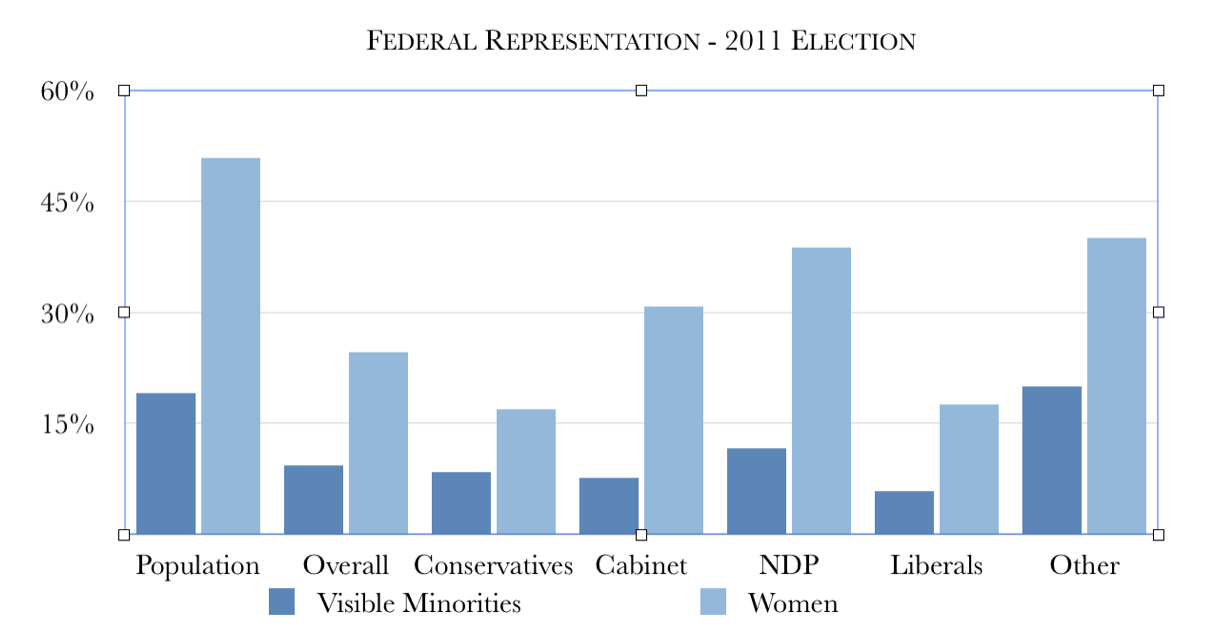 A reminder in the US of gaps in political representation for women, blacks and hispanics (chart above shows Canadian representation from the 2011 federal election):
Cue the confetti: The new Congress sworn in on Tuesday is the most diverse in our nation’s history!
That would truly be a milestone to celebrate—until you see what that record “diversity” actually means. Ready? The breakdown of the 114th Congress is 80 percent white, 80 percent male, and 92 percent Christian.
… Look, I don’t care if you are a liberal or a conservative. It’s impossible to make the claim that our Congress accurately reflects the demographics of our nation. And it’s not missing by a little but a lot. If Congress accurately reflected our nation on the basis of race, about 63 percent would be white, not 80 percent. Blacks would hold about 13 percent of the seats and Latinos 17 percent.
But what do we really see? The new Senate has only two black senators. That statistic is even more striking given that earlier this week the first black person ever elected to the Senate, Edward Brooke, was laid to rest. Brooke won his seat in 1966 and served two terms. How far has Congress really evolved on race when in 50 years it has gone from one black senator to two? (Even the arguably more democratic House is only at 10 percent black members.)
Congress moves slowly, and I don’t mean just on passing legislation.
Latinos, the fastest growing minority group in America, are even more underrepresented in Congress. They hold 3 percent of the Senate and a little over 7 percent of the House.
And let’s look at religion. Congress is now 92 percent Christian, resembling more to a papal enclave than our religiously diverse nation. The latest Pew Poll found that nearly 20 percent of Americans identify as atheist, agnostic, or not being affiliated with any religion. Yet there’s only one member of Congress, Rep. Kyrsten Sinema (D-AZ), who openly acknowledges she’s not a member of any religious group.
OK, let’s put race, ethnicity, and religion aside and address the most glaring under representation in Congress of any group: women. This Congress will welcome more women than ever before at 19 percent of the House and 20 percent of the Senate.
 About Andrew
 Multicultural Meanderings