Why are so many Ontario black children in foster and group homes?
2014/12/13 1 Comment
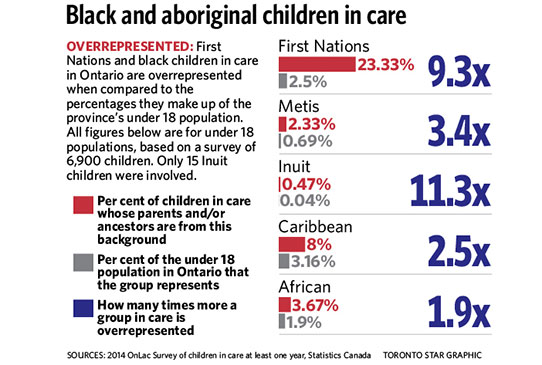 Interesting but not surprising. Having the data allows questions and discussion:
Researchers concluded the results were influenced by the 2008 recession, which affected blacks more than whites and caused more strain on families. Poverty, it noted, is the strongest predictor of maltreatment rates.
Most children’s aid societies in Ontario don’t keep income statistics on the families they serve. The new provincial database won’t capture that information either. But local CAS officials know poverty is often a factor.
“Sometimes people don’t want to make the connection between poverty and child protection,” says David Rivard, chief executive officer for the Toronto CAS. “But there is a correlation. That’s the reality.”
A recent report on child poverty in Toronto co-authored by the agency noted that 41 per cent of children of southern and eastern African heritage are growing up poor — more than three times the rate of children with roots in the British Isles. Meantime, 26 per cent of children whose families are from the Caribbean and 25 per cent from North Africa live in poverty.
Groups serving the black community are trying to bridge the cultural divide that can land children in care. The common use of spanking to discipline children in Africa and the Caribbean, for example, can lead to astonished parents being charged with assault.
… After the Star began asking about the over representation of black youth in care, the Ministry of Children and Youth Services met with CAS officials, the provincial child advocate and Parsons’ African Canadian Legal Clinic.
Children’s aid officials and the legal clinic late last month submitted a funding proposal for a project to look into why the numbers are so high and how to reduce them.
“This cannot be just another study or training program,” Parsons insists. “What I want to see is concrete, substantive change — a reduction in those numbers.”
Parsons and other advocates say the numbers won’t go down until family counsellors from their community team up with CAS workers on every protection investigation involving a black child. That’s how Texas, for example, reduced the number of black children and youth in care.
“I’m not saying there aren’t kids in our community who should be in care,” Parsons says. “But the first approach for an African-Canadian child should not be apprehension and care. And that’s what the numbers are saying to me right now.”
Why are so many black children in foster and group homes? | Toronto Star.
 About Andrew
 Multicultural Meanderings
The work of the Children’s Aid Societies has always reflected changing trends in governments and society in general. Every few years, it has seemed, the trend swung from prevention to protection and back again. When programs are funded and in place to promote prevention of basic problems such as poverty, we see smaller numbers of children in care. As soon as the emphasis goes to protection, in an effort to reduce risk, but with less assistance and education, apprehension becomes more likely.
With the ever-increasing gap between rich and poor in our society, the goal of reducing poverty seems more remote. And poverty is a condition more likely to be found in the above mentioned communities. Add to that cultural practices such as discipline and a patriarchal approach from some communities and the residual effects of residential schools and other features of colonialism in our first nations, it is no wonder these children are over-represented in the stats on children in care.
Drastic funding cuts to Children’s Aid Societies has made it necessary to stick more closely to the basic mandate of protection, as prevention always seems to be regarded as a “frill” and the first to go. Until we, as a society, change our views on the importance of prevention rather than saving money by cutting funding for services, we will not see a reduction in the numbers.