Toronto election is missing a racial equity perspective | Toronto Star

The activist perspective on the upcoming Toronto municipal elections:

What’s more, we need leaders who are willing and able to put racial equity at the core of their campaign. This would mean, among other things, supporting employment equity at the city level and having a concrete plan for implementation; committing to inclusionary zoning and the expansion of affordable housing development; embracing the collection, analysis and use of disaggregated data by the city for all of its programs and services, including Toronto Police Services; and pushing for the extension of the municipal franchise to all city residents regardless of their immigration status.

It would indeed be a sorry state of affairs if Torontonians were to cast their ballots on Oct. 27 based solely on which candidate has the fewest skeletons in her or his closet.

As the most diverse city in North America, Toronto desperately needs a leader who can demonstrate true understanding and commitment to the city’s motto, “Diversity Our Strength,” with a plan to promote respect for equality, including an economic platform that is equitable, inclusive and sustainable.

Toronto election is missing a racial equity perspective | Toronto Star.

Anti-Semitism Rises in Europe Amid Israel-Gaza Conflict – NYTimes.com

Good overview of some of nastier aspects of antisemitism emerging in Europe from the NY Times:

Carola Melchert-Arlt, an elementary school principal in Berlin and mother of three, said she felt afraid for the first time in her decades of living in Germany. She said her mother had asked her to stop wearing a Star of David, a family heirloom from her grandmother’s bat mitzvah, around her neck.

Friends have taken down their mezuzas, Ms. Melchert-Arlt said, and she no longer stifles a smile when a fellow Jew wonders if they are really welcome in Germany.

“We have all always felt the latent anti-Semitism here,” Ms. Melchert-Arlt said. “But what we have experienced in recent weeks and days, not only in Germany but across Europe, is a prevailing mood of outward anti-Jewish sentiment in the streets.”

Anti-Semitism Rises in Europe Amid Israel-Gaza Conflict – NYTimes.com.

And the Globe’s similar take by Eric Reguly:

The intense media coverage of the war, much of it sympathetic to the Palestinians, has added fuel to the anti-Semitic fire, Jewish and Muslim group say. And what the mainstream European media shows is positively sanitized compared to what can be found on social media such as Twitter, where pictures of dead, dying and mutilated Palestinian children are common.

“The thing about social media is that it cannot be reined in,” says Salman Farsi, communications officer for the East London Mosque and London Muslim Centre. “Everyone pushes out their propaganda and it’s quite scary. Left unchecked, it will generate more hatred and possibly violence.”

Mark Gardner, director of communications for Britain’s Community Service Trust, has a similar view. “I think of a lot of the anti-Semitic reaction comes from the media,” he said. “It causes enraged people to become more enraged. It can come from the mainstream media or, increasingly, from self-selected media like the social media sites.

”For years, CST has carefully monitored anti-Semitic “incidents” in Britain and claims it is ultra careful to distinguish between ant-Semitic and anti-Israel behaviour. Mr. Gardner says the number of anti-Semitic incidents always spike up when the Israel-Gaza conflict, ongoing since 2006 erupts into extreme violence Hamas has ruled the Gaza Strip since 2007.

The peak monthly number of anti-Semitic incidents recorded in Britain by the CST was 289, in January, 2009, during Operation Cast Lead. That’s when the Israelis, determined to stop the rocket launches from Gaza and the delivery of arms into Gaza through what Israel described as “terror tunnels”, launched a bombardment and ground invasion of the strip. Between 1,200 and 1,400 Palestinians were killed, and 13 Israelis.

The second highest figure came this month as the Israel-Gaza war grew bloodier by the day. Between July 1 and July 29, 130 anti-Semitic incidents were recorded.

Is the Gaza conflict stoking anti-Semitism in Europe? – The Globe and Mail.
Conservative support grows among Chinese-Canadians, despite Liberal push to regain ethnic voters

Good read and analysis on the political efforts of the major parties with Chinese Canadians:

The data appear to indicate the Tories’ continuing ethnic outreach, spearheaded by cabinet minister Jason Kenney, is connecting with the fast-growing numbers of Canadians who trace their roots to China and Taiwan.

The party’s more conservative approach to social issues and softened stance toward China may also be helping it reach Chinese-Canadians who were once seen as more likely to support the Liberal party.

For both parties, the money raised from Chinese-Canadians accounts for only a small share of total fundraising, but could be a leading indicator of ballot-box support in the coming election.

Although the parties do not report the ethnicity of donors to Elections Canada, contributions from Chinese-Canadians can be roughly tracked because of the limited number of Chinese surnames.

Most Chinese have one of about 100 common family names or their Romanized variants, such as Wong or Wang. So common are the Chinese names, the expression “Old One Hundred Names” is used in China to refer to the average person.

In 2007, seven of every 1,000 contributors to the Conservatives had one of these common Chinese surnames, according to the analysis of donors who gave more than $200 annually. But the 2013 numbers, reported this month, show that share has nearly doubled, with 13 of every 1,000 with a Chinese name.

Over the same period, the number of contributors who gave to the Tories rose by 34%, but the share with Chinese names outpaced that, rising by 173%.

The share of Liberal support from the Chinese community has remained largely static since 2007, when 10 in 1,000 donors to the party had Chinese names. That figure was unchanged in the 2013 filings, despite a surge in support for the party and its new leader, who was elected in April 2013.

The New Democrats appear to have the weakest level of support from Chinese-Canadians, the data show, with only three contributors in 1,000 with Chinese names.

Conservative support grows among Chinese-Canadians, despite Liberal push to regain ethnic voters

Strengthening Citizenship, Speeding Up Processing – Canada News Centre

Bit of a puff piece as no hard numbers (not that the improvements are not happening, but the Government appears to have an aversion to releasing numbers on a timely basis):

It is expected that in 2015/16 the processing time for citizenship applications will be less than a year. It is also projected that the current backlog of applications will be reduced by more than 80 percent.

Changes to Citizenship Act now in effect:

In addition to the new streamlined decision making model, the government has today implemented a range of legislative amendments to further strengthen Canada’s citizenship program. These amendments relate to authorities to refuse incomplete applications and a uniform system for judicial review of citizenship decisions are also now in effect.

These changes were part of Bill C-24, the Strengthening Canadian Citizenship Act, which received Royal Assent on June 19, 2014. These improvements are in addition to funding in Economic Action Plan 2013 of an additional $44 million over two years to the citizenship program to ensure the timely processing of applications.

Quick facts

  • Canada has the highest rate of naturalization in the world—85 per cent of eligible permanent residents become citizens.

  • Since 2006, Canada has welcomed over 1,300,000 proud new Canadians.

  • Citizenship and Immigration Canada received 333,860 citizenship applications in 2013, the highest volume ever and a strong reminder of the value of being a Canadian citizen.

Strengthening Citizenship, Speeding Up Processing – Canada News Centre.

Islam in Egypt: Manipulating the minarets | The Economist

The Economist on the clampdown in the mosques in Egypt:

The Muslim Brotherhood has called the government’s expanding control a “war on Islam”. But in the current climate of repression, and at a time when the Muslim Brotherhood is loathed by the army, the civil service and many ordinary Egyptians, there has been little protest. Secular opponents who have been outspoken against restrictions on activists in the past have been silent. Some Salafists, who tend not to speak out against the government, have grumbled, but most abide by the curbs.

Human-rights groups see good reason for all to be worried by the new restrictions. “This in effect kills the idea of religious freedom, since Egyptians can’t opt for any religious practice not approved of by the authorities,” says Mr Ezzat. It may be counter-productive, too. In the past, clamping down on the mosques has bred anger and forced hardliners underground. That is not what Egypt needs.

Islam in Egypt: Manipulating the minarets | The Economist.

Ontario now the worst place for educated immigrants looking for work

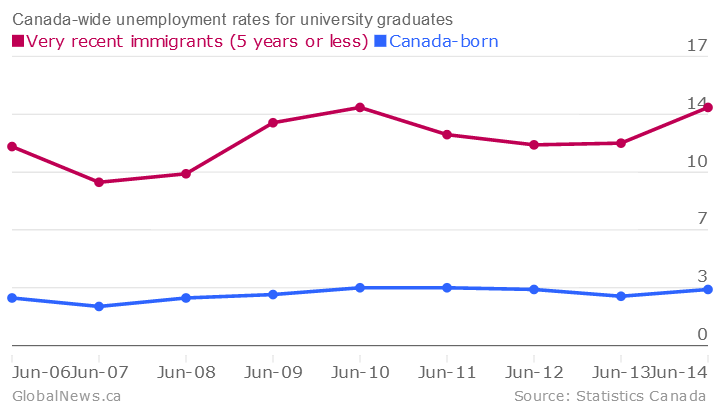
canada-wide-unemployment-rates-for-university-graduates-very-recent-immigrants-5-years-or-less-canada-born_chartbuilderNot exactly good news, but expect that there is variance based on country of origin and ethnicity. Will be doing some number crunching over the coming months  in this area, as well as looking at second-generation economic and social outcomes:

According to data Statistics Canada crunched for Global News, 14 per cent of university-educated immigrants who’ve come to Canada in the last five years are without a job – more than their counterparts with a post-secondary certificate or high-school diploma.

Only 3.3 per cent of Canadian-born university grads, on the other hand, are unemployed, as are 5.6 per cent of university-educated immigrants who’ve been in Canada a decade or more.

And 2013 numbers indicate Ontario’s swapped places with Quebec as the worst place to be a highly educated new immigrant in search of work: Last year 14.7 per cent of recent immigrants in Ontario with university degrees were out of work, compared to 12.4 per cent in Quebec.

Ontario now the worst place for educated immigrants looking for work | Globalnews.ca.

‘Home Children:’ Don Cherry had personal connection to honoured children’s group

One of the relatively less known stories in Canadian history (the Government did do a relatively minor commemoration when I was at CIC and the speech by Senator Gerry St. Germain, a former home child, was particularly moving):

About 118,000 British children — one was Cherry’s maternal grandfather and war vet, Richard Palamountain — were shipped to Canada between 1869 and 1948 to work as indentured farm hands and domestic servants.

The abuses many suffered in Canada were horrific. One of them, Arthur Clarkson, who arrived as a nine year old, was horsewhipped and made to live in an unheated barn, almost costing him his frostbitten lower limbs.

“It’s really heartbreaking to hear some of the stories. These kids were actually slaves,” Cherry told The Canadian Press.

“They had to sign something for so many years and most of them didn’t know what they were signing.”

Almost every one of the home children in Canada at the time — about 10,000 — signed up to serve during the Great War that began 100 years ago, including Cherry’s grandpa. More than one-thousand died in action, most at the bloody battle at Vimy Ridge. Many had no one to mourn them. Others died without notification to their relatives.

Don Cherry had personal connection to honoured children’s group.

No English? In the kitchen, it’s no problem

Great reminder that language is not necessarily everything to success by Meeru Dhalwala of Vij’s (great Vancouver Indian restaurant):

The way it works at Vij’s, Oguz and Vikram approve any changes in overall labour costs and can forbid raises if the costs are not in line with what they should be. We have had hours-long discussions and negotiations. One of my favourite meetings was years ago when a group of my kitchen staff met with Oguz and Vikram about raises and vacation allowances. Oguz went on about the financial logic as it pertains to the overall success of the company, and Vikram eventually lost his temper when my staff kept on persisting on the benefit. Amarjeet, my manager, turned to Oguz calmly and said, “Oguz, sorry but you will have to.” And then she turned to Vikram, “There is no reason to yell. We are all in this together.”

The confidence of my kitchen staff is also rooted in a shared responsibility for the long-term. When I first opened our Seattle restaurant, I was training an Ethiopian woman on the grill. This was her first job in the United States. Her English was not strong, but she asked me questions. “How much restaurant cost to build?” “Where you get money from?” “How long lease is?”

She did not like grilling, but I bribed her, suggesting that once she got the hang of it, I would give her a raise. A few weeks later, I offered her the raise. She took my hand, “No, Meeru. First you pay bills. I need job for long time and don’t want you close restaurant. Once you can pay bills, then you give me raise. “ She is now one of my managers in Seattle.

No English? In the kitchen, it’s no problem – The Globe and Mail.

Maytree Lessons for and from Toronto » Maytree

open-uri20140701-27920-t13my

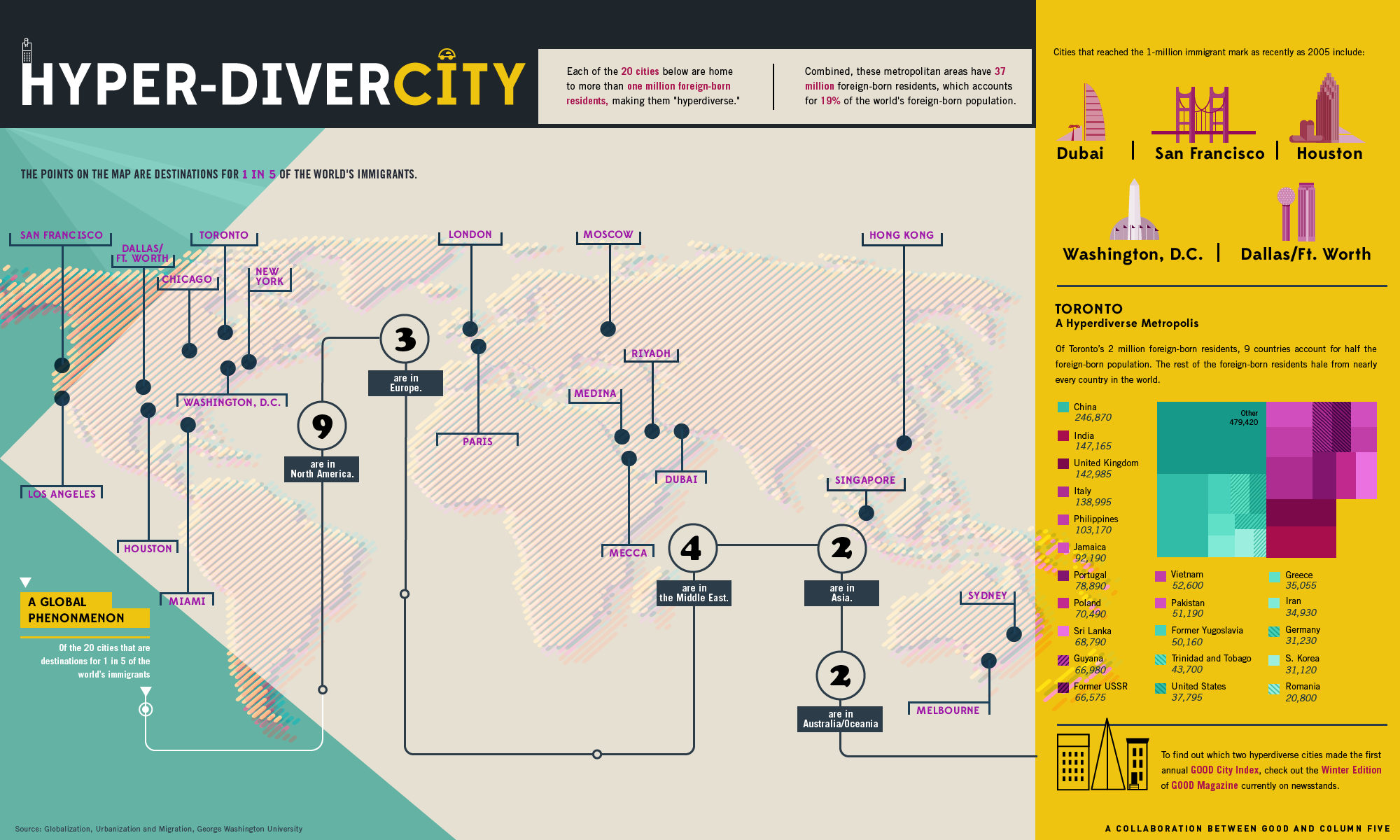
Graphic from Good Magazine

Ratna Omidvar’s report of the recent Cities of Migration Berlin conference. Worth reading:

For all the self-criticism that we Torontonians like to inflict on ourselves, we secretly know that our city is admired all over the world as a place that works well with its diversity. But lest we feel too smug, let’s remember that world leaders don’t keep their titles without continuous learning and innovation. They should, in the words of Hamburg Mayor Olaf Scholz, “Oppose the idea that there’s nothing to change any more.”

At the international Cities of Migration conference in Berlin convened by Maytree in June, practitioners, policy makers and private sector leaders shared lessons on good practice in immigrant inclusion from their own cities: Helsinki, Nashville, Tokyo, Lisbon, Auckland, Sao Paulo, Athens, and many more. From this global hub in Berlin come many ideas for and a few from Toronto.

One of the founding principles of Maytree’s Cities of Migration project is that good ideas can travel. That a smart policy working in Seattle can be tweaked to also work in Halifax. That a successful initiative from San Francisco can be replicated in London. This is because cities are often better placed to address immediate needs that are local in nature, such as employment, home ownership, success in school, and neighbourhood inclusion. As Khalid Koser of the Geneva Centre for Security Policy said in his keynote, “While states are building walls, cities are building bridges.”

Maytree Lessons for and from Toronto » Maytree.

‘Koreans not ready for multiculturalism’

Interesting story on increased diversity within South Korea, particularly through the offspring from mixed unions, and how that comes across in a country with a strong cultural and historical identity:

South Korea is quickly turning into a multicultural society with a growing number of biracial children, but the majority of Koreans are “not ready” for ethnic diversity, according to scholars and experts.

The number of biracial babies in the country increased dramatically, making up 4.7 percent of all newborns in 2012. In 2008, they accounted for 2.9 percent, and 4.3 percent in 2010. A total of 97,701 biracial children were born from 2008 to 2012, according to Statistics Korea.

However, Koreans tend to have racial and ethnic prejudice against immigrants based on their countries of origin, according to research by the Asan Institute for Policy Studies.

Canada’s figure for mixed unions nationally is 4.6 percent, no data that I have seen about the percentage of mixed union offspring.

‘Koreans not ready for multiculturalism’.