Mirror Images: Antisemitism and Islamophobia – New Canadian Media – NCM

My take on the similarities and differences between antisemitism and islamophobia:

And for those protesting or supporting Israel, a do’s and don’t guide see How to Support Israel without Being Racist and How to Criticize Israel without Being Antisemitic for additional thoughts:

1.       Protest against the political entity Israel, Hamas, not the religion or ethnicity Jews, Muslims, Arabs.

2.       Never protest outside a mosque or synagogue. Find a neutral place e.g., federal or provincial parliaments, City halls.

3.       Avoid any use of Nazi imagery and language no ‘death to the Israelis, no death to the Jews,’no death to the Arabs, no death to the Muslims’ language.

4.       No violence or threats of violence.

5.       Hard as it may, try to understand where the other side is coming from. Not necessarily to accept, but to understand.

Mirror Images: Antisemitism and Islamophobia – New Canadian Media – NCM.

CBSA allowed religious travellers to avoid female guards – Toronto – CBC News

I’m with the staff on this. Bad call by the managers:

Canada Border Services Agency managers at Toronto’s Pearson airport allowed a small group of Hindu priests to avoid screening by female border guards to comply with their religious beliefs, CBC News has learned.

A CBSA officer, outraged that such a request would be considered, spoke exclusively to CBC News about what happened at Pearson’s Terminal 3 on the evening of Monday, July 28. Fearing she could be disciplined for speaking out, the officer spoke on the condition that her name and identity be withheld.

The officer said she and her colleagues — whose job involves screening passengers for entry into Canada after they arrive on international flights — were told before their shift not to switch work stations with other officers without first asking a supervisor.

“The reason given was that there were five individuals coming in who had requested only to be served by male officers,” said the CBSA officer in an exclusive interview with CBCs Nil Koksal.

The five male travellers who made the request to CBSA are Hindu priests, called sadhus. Sadhus follow a strict lifestyle that requires them to avoid any contact with women.

And a reminder that these kinds of issues are not unique to any one religion.

CBSA allowed religious travellers to avoid female guards – Toronto – CBC News.

Jonathan Kay: Sun News’ cynical attacks on Justin Trudeau have crossed the line into anti-Muslim hysteria

Kay nails it:

Moreover: If indeed it is true that al-Sunnah al-Nabawiah mosque remains a religious home for unassimilated Muslim immigrants with radical, un-Canadian views, shouldn’t that be all the more reason for Canadian politicians to let those congregants know that if they want to live and flourish in this country, they need to adapt to our values?

Justin Trudeau’s riding of Papineau is one of the poorest and most diverse in Canada. It is full of immigrants who are wrestling with the process of integrating into Canadian life. What sort of MP would we want for such a riding — one who brags to Sun News viewers about how he wouldn’t set foot within 50 feet of this or that house of prayer, lest he be tainted by association with the teeming Muslim hordes who pray therein … or someone who actually seeks to engage with these people and draw them into the political mainstream?

Jonathan Kay: Sun News’ cynical attacks on Justin Trudeau have crossed the line into anti-Muslim hysteria

Andrew Lawton, also in the National Post, piles on this critique:


When the PMO arranged my interview with James, I was looking forward to hearing what the government had done or was doing to address the radicalization alleged at the Al Sunnah Al Nabawiah mosque. Shockingly, what I presumed was the most relevant question to the discussion, appeared to dumbfound James, who skirted it no fewer than three times, offering up only scripted condemnations of Justin Trudeau.

“I think it was completely outrageous. I think it’s completely unacceptable that the leader of the Liberal Party, Justin Trudeau, would associate with a group that allegedly radicalizes Canadians to join al-Qaeda and has even been listed by the Pentagon as a location known to them,” James told me during the live interview.

I asked, “Why is this a politics question and not a question of Canadian public safety and intelligence?”

I was expecting anything but the answer she gave.

“I thank you for that question, but as you know, I probably —I cannot comment on operational matters of national security, Andrew,” she said. “But I think the real question is here — Justin Trudeau knew about this. He knew about this and instead he went into this mosque, did a whole lot of handshaking and trying to win votes. He will stoop at nothing to try to win over terrorist organizations. I can’t believe this.”

Embarrassing. But even intelligent MPs sound stupid when they have to stick to stupid talking points (e.g., Chris Alexander defending the government’s handling of the F-35, among others).

Not sure this helps them.

Andrew Lawton: If Trudeau is schmoozing with terrorists, why aren’t we arresting any?
Maytree Flight and Freedom: Stories of Escape to Canada

Maytree’s newest project, writing a collection of refugee stories:

What does escape look like up close? Why do people choose Canada? And once they land in a safe country, what happens next?

In Flight and Freedom, Maytree’s Ratna Omidvar and Dana Wagner draw on 30 astonishing interviews with refugees to Canada to document their extraordinary journeys of flight, and to transform a misunderstood group into familiar, human stories.

Each of the 30 stories documents an escape that is sometimes harrowing and always remarkable. The narrative then turns to contemporary lives and careers, and the impact of refugees-turned-Canadians in the communities they call home, from Halifax to Vancouver.

Stories focus on Canadians who arrived as refugees from notable conflicts around the world, from the War of 1812 to the ongoing War in Afghanistan. Beyond conflict zones, other stories profile people from persecuted groups like gay men and women. At the time of escape, some refugees were children, others were parents, and others got out alone. Notwithstanding the diverse events of a story, the single overriding imperative for all characters can be summed up in one sentence: “We have to run.”

Closing the book is a question: Would they get in to Canada today? Peter Showler, lawyer and former chairperson of the federal Immigration and Refugee Board, answers the hypothetical question by analyzing how the cases would be handled under Canada’s new refugee system.

You can sign up for updates (book out in 2015) at the link below:

Maytree Flight and Freedom: Stories of Escape to Canada » Maytree.

Rachel Brothers wins human rights case for wrongful firing – Nova Scotia

A reminder that discrimination can occur in a variety of contexts:

Donald Murray, chair of the Nova Scotia Human Rights Commission, said Brothers was “undermined by association staff whose colourist thinking and behaviour created a toxic work environment at the head office in Halifax and the Annapolis Valley regional office in Kentville, where Ms. Brothers was employed as a regional educator.”

Jeff Overmars, a spokesman with the Nova Scotia Human Rights Commission, said he can’t say too much about Tuesdays decision.

“We understand this is a very sensitive issue in the African Nova Scotian and other communities,” he said.

“It’s an issue we have to look into, to meet with the communities, to gain some insight and to better understand the history and complexity of the issue.”

Lawrence Hill, in his Massey Lectures Blood, covers some of the same ground as he discusses the history of colour and percentages of black blood, and argues for a universal, rather than “blood” approach.

Rachel Brothers wins human rights case for wrongful firing – Nova Scotia – CBC News.

Don’t politicize women’s bodies

One take on the risks of banning the niqab. See also her previous piece (It’s Muslims themselves who give voice to verse) as well as a previous post on the CCMW study of Canadian women wearing the niqab and the individual stories and backgrounds of the women interviewed (Study dispels stereotypes about Ontario women who wear niqabs).

I still find that wearing the niqab (as distinct from the hijab) sends an anti-integration message:

In this context, it is especially important to put women first, to give women space to chart their own journeys, and to allow the veil and lack thereof to have meanings beyond their patriarchal origins.

Importantly, Muslim women ought to be free to make their own choices – which necessarily includes the right to make their own mistakes – as they navigate their way through multiple identities. As a woman who wore the niqab for 10 years in Canada through public high school at Streetsville Secondary School in Mississauga, and undergraduate and masters degrees at the University of Toronto, I am grateful to have belonged to a liberal democracy that allowed me the space and time to have my own journey and find my own way. I am proud of Canadians for rejecting a copycat proposal to ban the face veil in Quebec earlier this year. In this instance, the EU has much to learn from the Canadian model.

Don’t politicize women’s bodies – The Globe and Mail.

Australia: Queensland gets it right on multiculturalism

One regional, favourable view of multiculturalism:

Most migrants and refugees to Queensland still settle in the capital city, Brisbane.

Brisbane has the highest proportion of overseas-born residents 28.3 percent, ABS census 2011, followed by the Gold Coast 27.9 per cent and Logan 26.1 per cent.

Brisbane attracts more Indians and Chinese, the Gold Coast more Japanese, while Logan attracts more Samoans. Many are international students.

Brisbane’s Lord Mayor Cr Graham Quirk said Brisbane now holds a “Refugee Welcome Day”, acknowledging that more than 2000 refugees settled in Brisbane last year and would build a new Multicultural Performing Arts Centre in Sunnybank in 2015.

“The Multicultural Performing Arts Centre will include a theatre with a capacity for 300 people, rehearsal and studio spaces for community groups, a stand-alone kitchen and canteen as well as dining and entertainment facilities,” Cr Quirk said.“

Council has invested $3.9 million in 2014-15 for this combined facility which we will build with the Sunnybank Community Sports Club,” he said.“

And it will benefit the entire southside community once it is complete.”

Queensland gets it right on multiculturalism.

Israel, Gaza, War & Data — i ❤ data — Medium

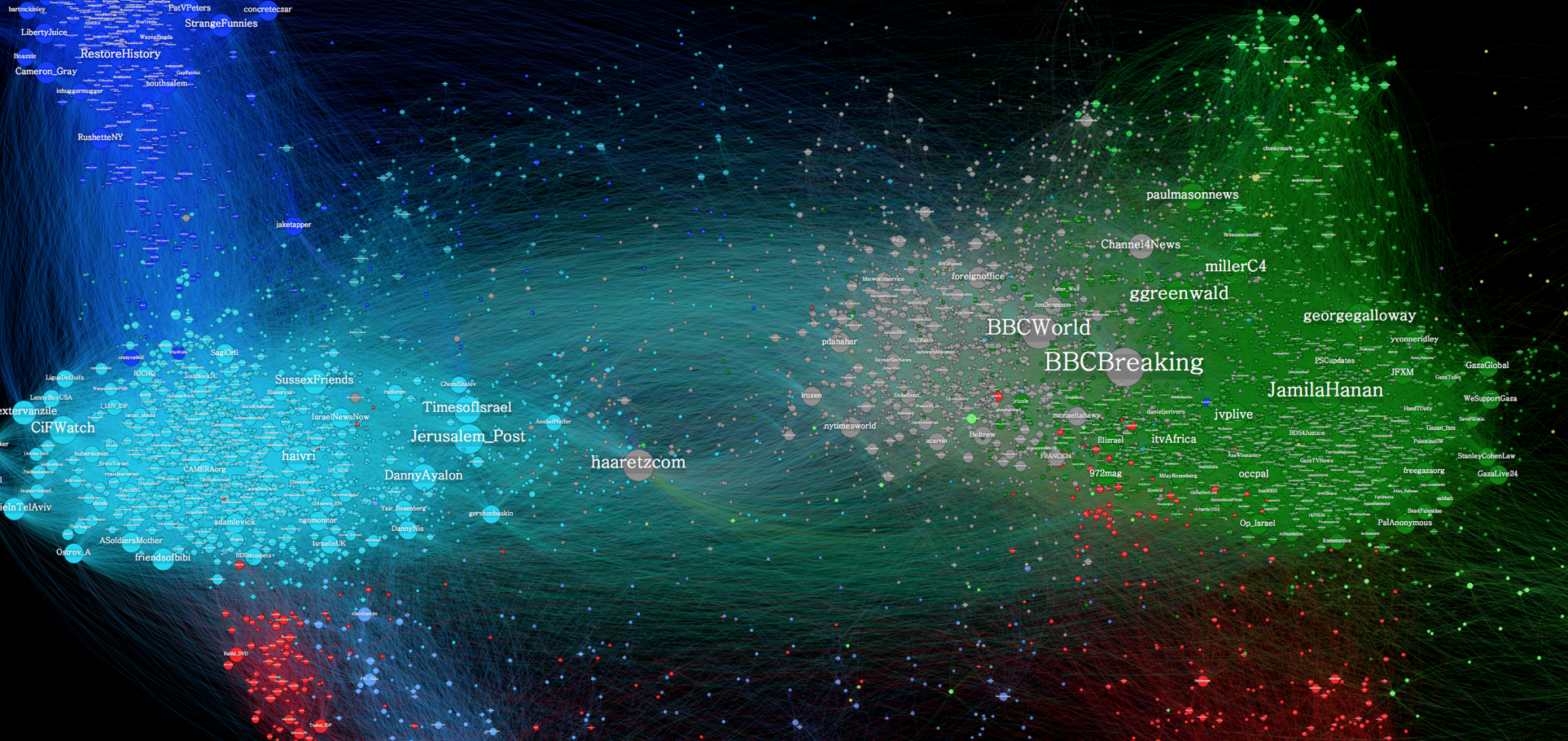
Twitter Mid-East solitudesFor data visualization geeks, as well as those more broadly interested in social networks and how they reinforce our existing views, this article by Gilad Lotan is a must read (Haaretz, the left-wing Israeli newspaper, draws the most from both sides):

Facebook’s trending pages aggregate content that are heavily shared “trending” across the platform. If you’re already logged into Facebook, you’ll see a personalized view of the trend, highlighting your friends and their views on the trend. Give it a try.

Now open a separate browser window in incognito mode Chrome: File->New Incognito Window and navigate to the same page. Since the browser has no idea who you are on Facebook, you’ll get the raw, unpersonalized feed.

How are the two different?

Personalizing Propaganda

If you’re rooting for Israel, you might have seen videos of rocket launches by Hamas adjacent to Shifa Hospital. Alternatively, if you’re pro-Palestinian, you might have seen the following report on an alleged IDF sniper who admitted on Instagram to murdering 13 Gazan children. Israelis and their proponents are likely to see IDF videos such as this one detailing arms and tunnels found within mosques passed around in their social media feeds, while Palestinian groups are likely to pass around images displaying the sheer destruction caused by IDF forces to Gazan mosques. One side sees videos of rockets intercepted in the Tel-Aviv skies, and other sees the lethal aftermath of a missile attack on a Gazan neighborhood.

The better we get at modeling user preferences, the more accurately we construct recommendation engines that fully capture user attention. In a way, we are building personalized propaganda engines that feed users content which makes them feel good and throws away the uncomfortable bits.

Worth reflecting upon. I try to have a range of news and twitter feeds to reduce the risk.

Israel, Gaza, War & Data — i ❤ data — Medium.

Behind British Minister of Faith Sayeeda Warsi’s Resignation Over Gaza | TIME

Good article in Time about the dramatic resignation of Sayeeda Warsi, the former UK Minister of Faith, over the UK government’s approach to the crisis in Gaza.

Warsi, as the article and her frequent speeches and interventions, played a significant and positive role in the ongoing UK debates about Muslims, integration and radicalization:

At first glance, one might assume that this story is simply “Muslim minister resigns over U.K. support for Israel.” Warsi is, after all, the first Muslim to serve in so high a position, and soon after her resignation, she called for an immediate arms embargo against Israel in an interview with the Huffington Post UK.

But that’s almost certainly too simplistic an understanding of what happened. Warsi has built her professional career on a foundational principle that religious and historic divides do not necessitate irreconcilable divisions or violence. She made it her mission to help create a government that, as she often said, would “do God” and advocate for faith’s place in society. That meant working for people of all faiths. She spoke out against Islamophobia and worked to make sure British government was inclusive for Muslims. In 2012 she let the U.K.’s largest ministerial delegation to the Vatican. Last year she came to Washington, DC, to speak out against the global persecution of Christians. One of her main goals was to encourage the international community to develop a cross-faith, cross-continent commitment to protect Christian minorities. Religious persecution, she told me at the time, is the biggest challenge of the 21st century. “It is about working up the political will,” she said. “It is about getting some consensus, it is about politicians being prepared to take on these difficult challenges.”

Her personal faith story is also one that bridges divides often thought to be unbridgeable. She is the daughter of Pakistani immigrants and grew up in a Muslim family with a blended theological background that included both Shias and Sunnis. “We were taught to respect and love other faiths as much as we loved our own, and I suppose, you know, quite strong teachings that you can only truly be a Muslim if you also are Christian and Jewish before that, that actually Islam is just an extension of the other faiths and it has been a process where various books have been revealed at various times,” she told me. “I don’t see there is a collision course between people of faith, I actually do think it is instinctively based up on the same values.”

Her whole story is rooted in commitment to a higher calling. It makes her decision to resign is all the more dramatic, and it sends a strong statement that political will requires moral courage. “I always said that long after life in politics I must be able to live with myself for the decision I took or the decisions I supported,” she said in her resignation letter. “By staying in Government at this time I do not feel I can be sure of that.”

Behind British Minister of Faith Sayeeda Warsi’s Resignation Over Gaza | TIME.

Multiculturalism: The unstoppable global trend – Campaign India

More on multicultural marketing from Mike Fromowitz of Ethnicity Multicultural Marketing + Advertising Inc:

In a recent Huffington Post article titled ‘Multicultural marketing: a must for multicultural countries.’ author Kimron Corion put it this way:  “I realised that many businesses were using the same marketing message to target everyone, regardless of race and culture. Even though social media and the Internet have made it easier to do marketing, using the same generic message for everyone was not the best approach. I believe that people should be marketed to in their culture and their beliefs. And thats when I came in contact with a term that I believe has been revolutionising marketing. Maybe not more than the Internet has done, but I believe its a concept thats very important and many marketers should embrace it. Its called multicultural marketing or ethnic marketing.

“Multicultural marketing refers to marketing to one or more person of a particular ethnic background. This tends to take into consideration a persons age, gender, culture, norms, language, religion, traditions etc. to persuade that person to buy. Additionally people tend to stay within their cultural boundaries, their norms, traditions, culture, all tend to influence their buying habits. Multicultural marketing or ethnic marketing is very important and it is one of the factors that will help determine the success of many marketing campaigns.”

Immigrants the world over would rather be advertised to in their first language, within their cultural mores. Many of them wish to be communicated to in their language of choice—it’s more comfortable and appealing to them, and for many, it’s much easier than reading English. Culture takes time to learn and it’s not easy. So it’s better not to expect that everybody reading your ad will understand any subtle, implicit culturally related message. Irony and culture is similar – either you get it or you don’t.

Multiculturalism: The unstoppable global trend – News – Advertising – Campaign India.