Israel and the world: Us and them | The Economist
2014/08/06 Leave a comment
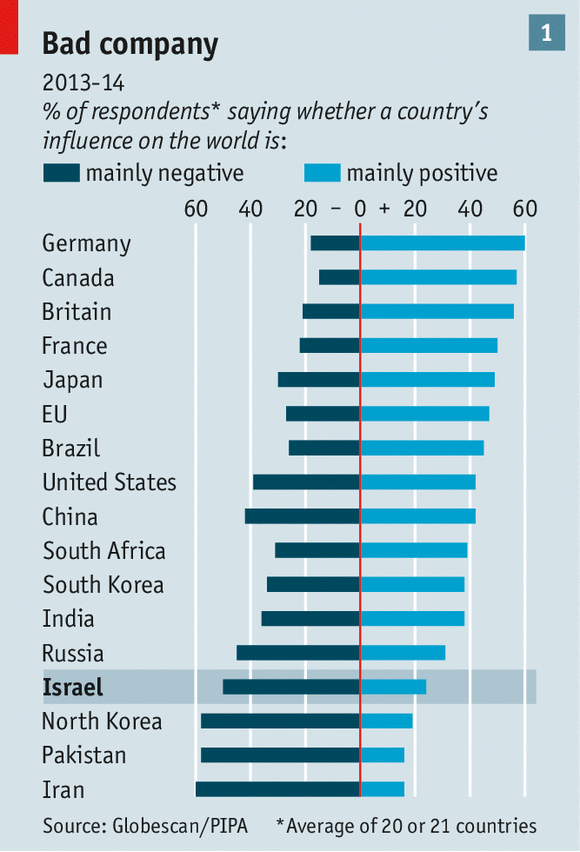
Not encouraging:
Daphna Kaufman of Reut wonders whether Israel is also moving away from Europe. The secular and social-democratic leanings of Israel’s early decades dovetailed with western Europe’s. But the 1m migrants from the former Soviet Union, who arrived in the 1990s, have scant democratic tradition; many seek salvation in a strongman, a Jewish Putin, to rescue Israel from its enemies.
A similar number of national-religious Jews, heavily represented in government, see Israel as part of the divine plan for the Messiah’s coming, and worry that democracy might get in the way. More often now, Israel finds it easier to deal with non-democratic regimes, in the region or in the Asia-Pacific, where politics intrudes less on business. All of that bodes ill for co-operation with the country’s European critics and perhaps its American ones too.
Some hope that the common threat of a jihadist menace will yet induce Europe to treat Israel as its frontline bulwark and to overlook the plight of the Palestinians. “Ours is the fight of the free world,” says Mr Steinitz. But others see only greater divergence ahead. “Within 50 years, Europe’s lingua franca will be Arabic, and Britain will have a Muslim majority,” Moshe Feiglin, a hardline member of Mr Netanyahu’s party, Likud, tells a nodding audience in Bet Shemesh, a commuter town between Jerusalem and Tel Aviv. His listeners see a future in which Israel is increasingly forced to rely on its own devices—and its own might.
Haven’t seen any recent Canadian polling on attitudes with respect to Israel and Palestine.
 About Andrew
 Multicultural Meanderings